
What Is Jev AI? The 193.6× Faster Claim, Pricing, API & Jev vs ChatGPT
Jev AI is TypeSafe’s new System One model built for fast, structured decisions rather than long-form chat. We break down its 193.6× faster claim, pricing, API, benchmarks, business use cases and how Jev compares with ChatGPT and Claude.
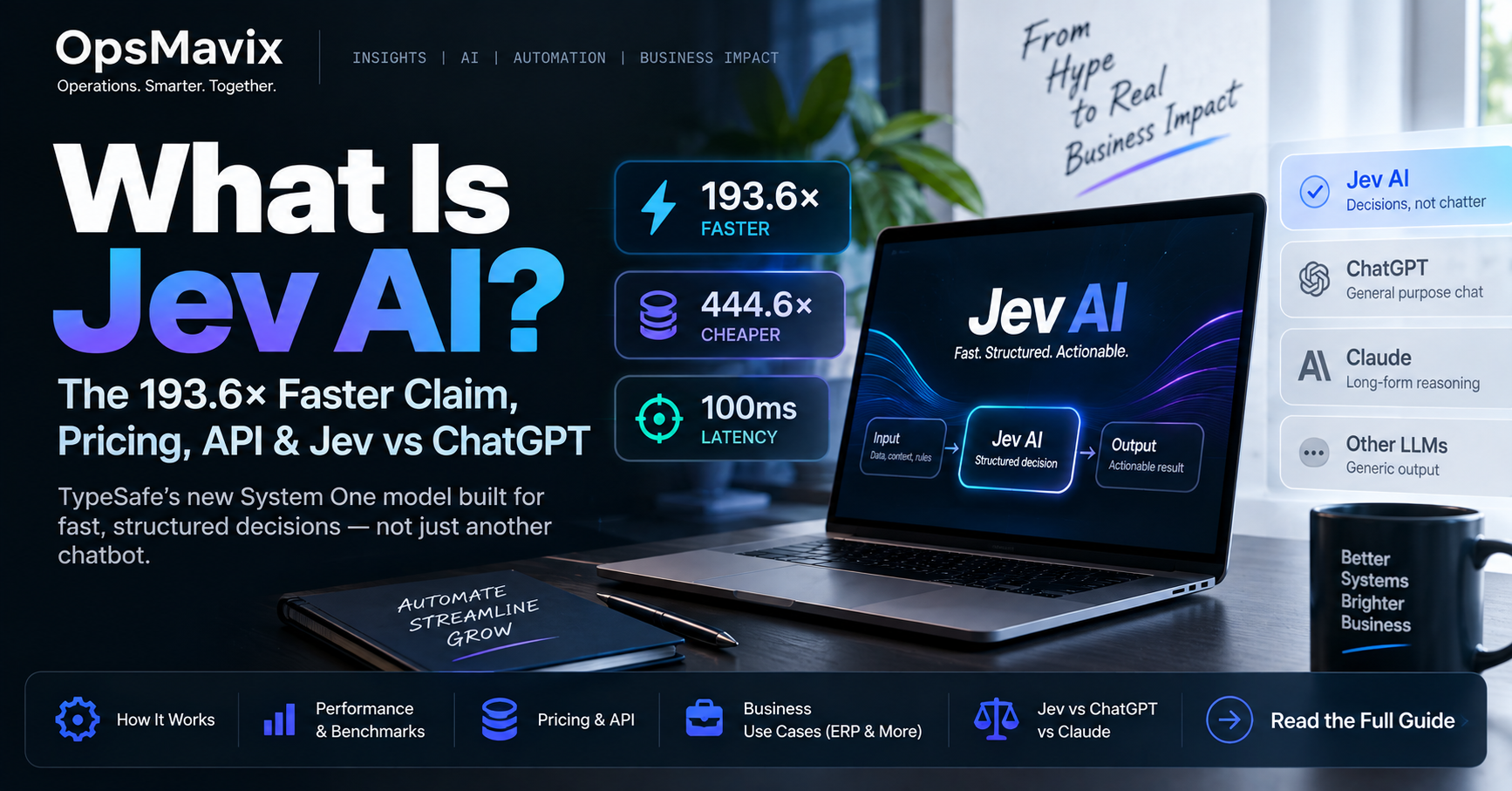
TypeSafe AI has launched Jev, an AI model that deliberately refuses to do the thing most AI models are built around: generate text. Instead, Jev takes a piece of state, evaluates questions you define, and returns typed decisions with probabilities that software can act on.
That sounds less exciting than a chatbot until you see the numbers TypeSafe is putting behind it.
On its own System One workflow evaluations, TypeSafe reports Jev was 193.6× faster and 444.6× cheaper than the LLM comparison setup used in those tests. The company currently lists Jev at $0.042 per million input tokens — $42 per billion — with output tokens priced at $0. It also reports end-to-end response times in the 70–500 ms range for System One-style queries.
Those figures are eye-catching, but they need context. They are TypeSafe’s own evaluations, not a universal proof that Jev is 193.6× faster than ChatGPT or Claude on every task. TypeSafe itself says the headline gains are likely at the high end of what users will see in real workloads.
So the more useful question is not simply “is Jev AI really 200x faster?”
It is:
That is the idea behind Jev.

Image source: TypeSafe AI — Introducing System One Models & Jev.
Jev AI in 30 seconds
Jev AI is the first public System One Model from TypeSafe AI. It is designed for fast decisions inside software rather than open-ended conversation.
A normal LLM is usually asked to produce a string:
Input -> model -> generated text -> parse it -> validate it -> decide what to do
The Jev model works differently:
State + predefined question
        ↓
      Jev
        ↓
Typed decision + probabilities + confidence
        ↓
Your software decides what happens next
For example, instead of asking a chatbot:
You can define the allowed answers in advance:
Billing
Technical
Sales
Returns
Jev evaluates the ticket and returns a bounded result plus probabilities. Your application can then route the ticket automatically or send uncertain cases to a human.
That is the core of the Jev decision model.
What is Jev AI?
If you searched what is Jev AI, the simplest answer is:
Jev is a fast, structured AI decision model from TypeSafe AI that returns bounded choices, scores and probabilities instead of generated prose.
TypeSafe calls this category a System One Model.
The name is inspired by the “System 1” idea popularised by Daniel Kahneman: fast, immediate judgments rather than slower deliberate reasoning. TypeSafe says it built Jev specifically for the small semantic decisions that happen inside software.
That makes Jev TypeSafe, TypeSafe Jev, TypeSafe AI Jev, Jev System One Model, and Jev model all different searches for essentially the same product.
The model launched in September 2026 as TypeSafe emerged from stealth. TypeSafe says its stack includes a new model architecture, a parallel sampler and a training method it calls Reinforcement Learning for Calibrated Decisions (RLCD).
The company’s thesis is straightforward: chat models are optimised to produce useful strings for humans, while many software systems do not actually need another paragraph. They need a decision.
Who created Jev AI?
The Jev AI founder story is part of why the launch has attracted attention.
TypeSafe AI was founded by Diogo Almeida, alongside Erik Gafni and Sasha Sheng. Almeida previously worked at OpenAI and was involved in the RLHF and instruction-following research that contributed to the development of ChatGPT.
TypeSafe announced a $40 million seed round led by DCVC as it emerged from stealth.
So if you are searching who created Jev AI, the answer is TypeSafe AI, led by Diogo Almeida and its founding team.
The Jev AI launch is also notable because TypeSafe is not positioning the product as another general-purpose assistant. It is trying to define a different category: machine-native intelligence that sits inside software.
How does Jev AI work?
The most important thing to understand about how does Jev AI work is that you define the possible shape of the answer before the model runs.
TypeSafe currently exposes three core question types:
| Question type | What it does | Example |
|---|---|---|
| Noul | Estimates whether a statement is true | “Does this order require manual review?” |
| Choice | Picks from predefined options | “Which department owns this ticket?” |
| Score | Places something on an ordered scale | “How risky is this transaction?” |
A single request can ask multiple questions against the same state.
For example, a support workflow could ask Jev to decide:
- which department should receive the ticket;
- whether the issue is urgent;
- how frustrated the customer appears;
- whether a human review is required.
The result is a Jev structured output rather than a paragraph.
A Choice response can include the selected option, the probability distribution across the available options and a confidence value. This is why searches such as Jev probabilities, Jev classification model, Jev routing model, and Jev structured decisions are central to understanding what the product actually does.
The software surrounding Jev still controls the action.
That distinction matters.
Jev does not magically “run the business.” It provides judgments that ordinary application code can use.
Why is Jev AI faster?
The answer to why is Jev AI faster is largely architectural.
Traditional LLMs generate text sequentially, token after token. Even when all you need is one classification, the model may reason, generate a response, serialize it into JSON or prose, and then your software must parse and validate it.
Jev gives up general text generation.
TypeSafe says Jev evaluates its declared outputs in parallel and directly returns bounded values. There is far less text to generate and no need for a long conversational answer.
That is where the Jev AI speed and Jev latency claims come from.
TypeSafe reports:
- 70–500 ms end-to-end response times for its System One-style calls;
- a homepage workflow example completing in around 0.114 seconds;
- up to 193.6× faster on its published workflow evaluation setup.
This is why people are searching phrases such as Jev 100ms, Jev AI performance, Jev benchmark, and Jev AI 200x faster.
But the benchmark needs to be read correctly.
Is Jev AI really 200x faster?
Sometimes in TypeSafe’s tests, yes. As a universal claim, no.
The company’s own launch article gives unusually useful caveats.
TypeSafe says the headline 193.6× faster and 444.6× cheaper figures come from its workflow evaluations and that it expects these figures to be “on the higher end of real world gains.”
It also notes that:
- the workflows were created by members of TypeSafe’s own model-capabilities team;
- the reference probabilities are based on the average of large external models;
- the LLM comparison uses TypeSafe’s wrapper for producing System One-style decisions;
- latency can depend on where the caller is located relative to TypeSafe’s infrastructure.
So is Jev AI really 200x faster?
The fair answer is:
TypeSafe has demonstrated gains approaching 200× on selected System One workflows, but you should benchmark Jev against your own workload before treating 200× as an expected production result.
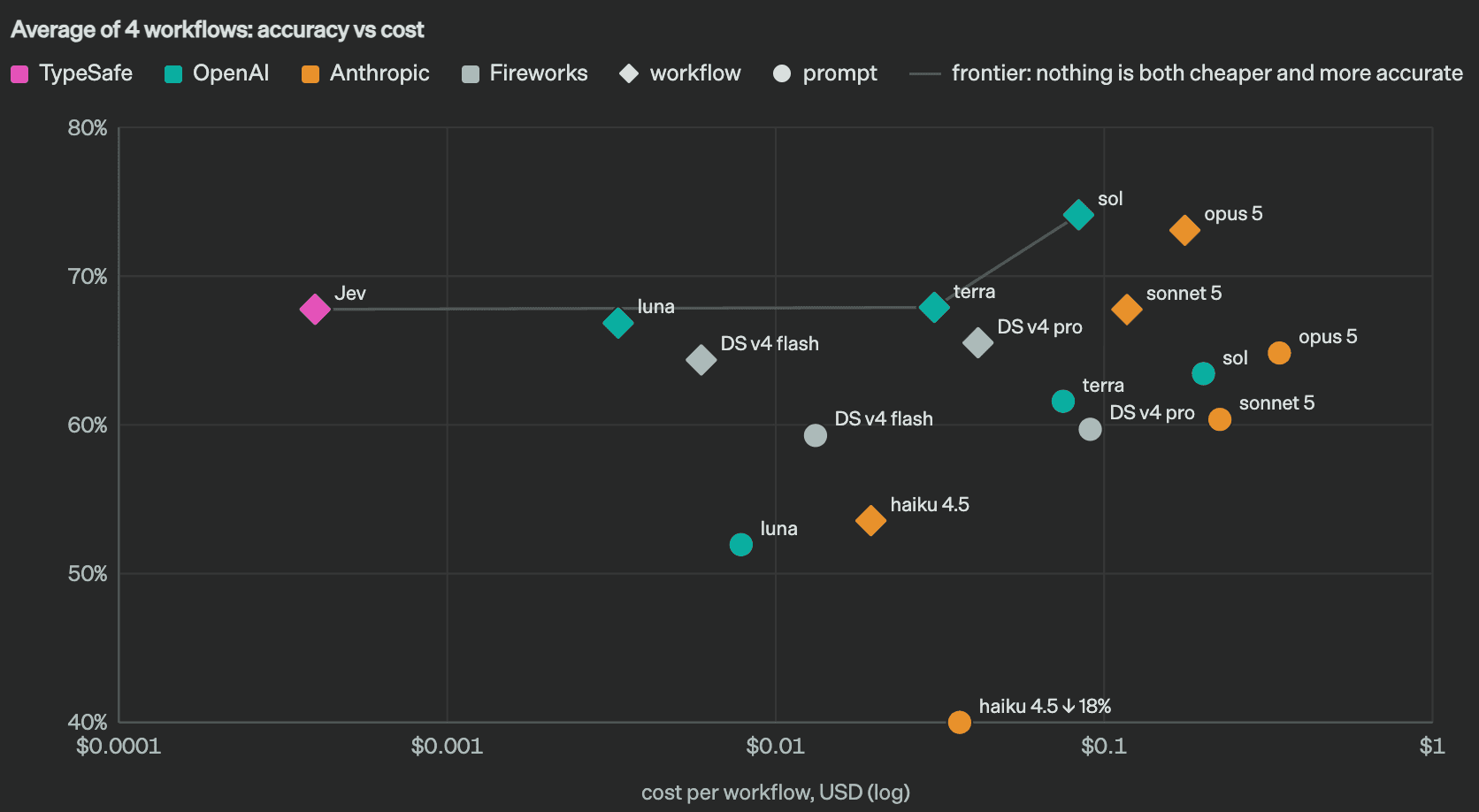
TypeSafe’s workflow evaluation graphic. The company explicitly notes that its headline gains are likely at the high end of real-world results. Source: TypeSafe AI.
This nuance is important because Jev benchmark results are not the same thing as a neutral industry benchmark showing Jev beating every LLM at every task.
Jev is optimised for a narrower job.
Jev AI pricing: how much does Jev cost?
Current published Jev AI pricing is unusually aggressive.
TypeSafe lists:
| Item | Published price |
|---|---|
| Input tokens | $0.042 per 1 million tokens |
| 1 billion input tokens | $42 |
| Output tokens | $0 |
That means Jev pricing is based on the amount of input you send rather than paying for a long generated answer.
A simple example:
100,000 calls
× 1,500 input tokens per call
= 150,000,000 input tokens

150M / 1M × $0.042
= $6.30
At the published rate, one billion input tokens would cost $42 before any other infrastructure or third-party costs.
So if you are comparing Jev AI cost, Jev API pricing, or asking is Jev AI free, the answer today is:
Jev is not simply a free model. TypeSafe publishes usage pricing of $0.042 per million input tokens and currently charges $0 for output tokens. Access terms and pricing can change, so check the official pricing before building a production budget.
The company also says it cannot yet prove that its current prices are not subsidised, which is another reason not to project launch pricing indefinitely.
Jev vs ChatGPT: which one is better?
The wrong way to frame Jev vs ChatGPT is as a single winner.
They are built for different jobs.
| Need | Jev | ChatGPT / general LLM |
|---|---|---|
| Write an email | No | Yes |
| Produce an explanation | No | Yes |
| Generate code | No | Yes |
| Summarise a document | No | Yes |
| Classify a ticket | Strong fit | Can do it |
| Route a request | Strong fit | Can do it |
| Score risk against a rubric | Strong fit | Can do it |
| Choose an agent/tool | Strong fit | Can do it |
| Return bounded probabilities | Core design | Possible, but not its primary interface |
| Low-latency repeated decisions | Core design goal | Depends heavily on model/setup |
So Jev AI vs ChatGPT is less like choosing between two chatbots and more like choosing between two different layers in the same system.
A practical architecture could look like this:
Incoming request
      ↓
Jev decides intent / risk / route
      ↓
High confidence? ── No ──> Human review
      │
     Yes
      ↓
ChatGPT / Claude performs the generative task
      ↓
Jev verifies or routes the result
That combination may be more interesting than replacing one with the other.
The same logic applies to Jev vs GPT and Jev vs LLM searches more broadly.
Jev vs Claude
Jev vs Claude has the same fundamental distinction.
Claude is a general generative model built for language, reasoning, code and agentic tasks. Jev is designed for bounded software decisions.
If the job is:
Claude is the obvious category of tool.
If the job is:
That is much closer to Jev’s intended design.
So Jev vs traditional LLM is not really about which model is smarter in general. It is about whether the task needs generation or judgment.
Jev AI automation: where this gets interesting
The real potential of Jev AI automation is not consumer chat. It is software making thousands or millions of small fuzzy decisions.
That could make Jev AI workflow automation relevant in areas where rigid rules are too brittle but a full frontier LLM call feels unnecessarily slow or expensive.
Potential patterns include:
1. Jev ticket routing
For Jev ticket routing, a helpdesk could classify each incoming message into a known support team, detect urgency, estimate dissatisfaction and decide whether the ticket needs escalation.
The workflow remains controlled by your software. Jev supplies the semantic judgment.
2. Jev lead classification
A Jev lead classification workflow could evaluate an enquiry against predefined categories such as:
Qualified
Needs nurturing
Existing customer
Supplier
Spam
Requires human review
A CRM could then route the lead based on confidence.
3. Jev AI decision making for approvals
For Jev AI decision making, a purchasing system could evaluate whether a request fits known conditions before sending it into a formal approval path.
For higher-risk decisions — finance, hiring, compliance or anything with material consequences — confidence should be a signal for escalation, not permission to remove oversight blindly.
4. Jev business automation
For Jev business automation, the interesting use is the “fuzzy middle” between simple if/else rules and expensive generative agents.
Examples:
- classify incoming orders;
- detect unusual order notes;
- route exceptions;
- score supplier issues;
- decide whether a record needs review;
- choose which workflow should run next;
- classify customer messages;
- prioritise operational exceptions.
This is why Jev AI for business is a more interesting search than simply asking whether Jev can replace a chatbot.
Jev for ERP: what could it actually do?
For OpsMavix, Jev for ERP is where the model becomes genuinely relevant.
An ERP or operations system contains hundreds of decision points that are not really writing tasks.
Examples could include:
Purchasing
Does this purchase request look routine?
Which approval route should it use?
Does the supplier note contain a delivery risk?
Inventory
Is this stock discrepancy likely to be a data issue, receiving issue or picking issue?
Should this exception be escalated?
Customer service
Which team owns this message?
Is this likely to cause churn?
Does it require immediate intervention?
Order management
Is this order safe to auto-process?
Which exception route applies?
Does the customer's note conflict with the normal workflow?
Manufacturing
Which exception category best describes this production delay?
Is this issue severe enough to stop the next operation?
None of these necessarily need a long paragraph from an LLM.
They need a narrow decision that can be fed into a larger operational workflow.
That is exactly the argument behind Jev workflow automation.
For more on the underlying systems layer, see our guide to operational systems and how a single source of truth changes day-to-day operations.
Jev AI agents: decision model rather than full agent
Another growing search cluster is Jev AI agents and Jev for AI agents.
The distinction matters:
Jev is not, by itself, a full autonomous agent.
It can act as the decision layer inside an agent.
For example:
Agent observes state
      ↓
Jev chooses:
- click
- type
- go back
- stop
      ↓
Agent executes action
      ↓
New state
      ↓
Repeat
This can reduce the need for a large generative model to reason in prose at every step.
The open-source Jev Ultrafast project from Browser Use is an early example of this pattern. Its Jev browser agent uses Jev to select an operation and browser element, while a separate small language model generates text only when text input is actually required.
The project reports a Google Flights demonstration completing in about 7.1 seconds, but its own README is careful to describe the evidence as a small experiment rather than a universal browser-agent benchmark.
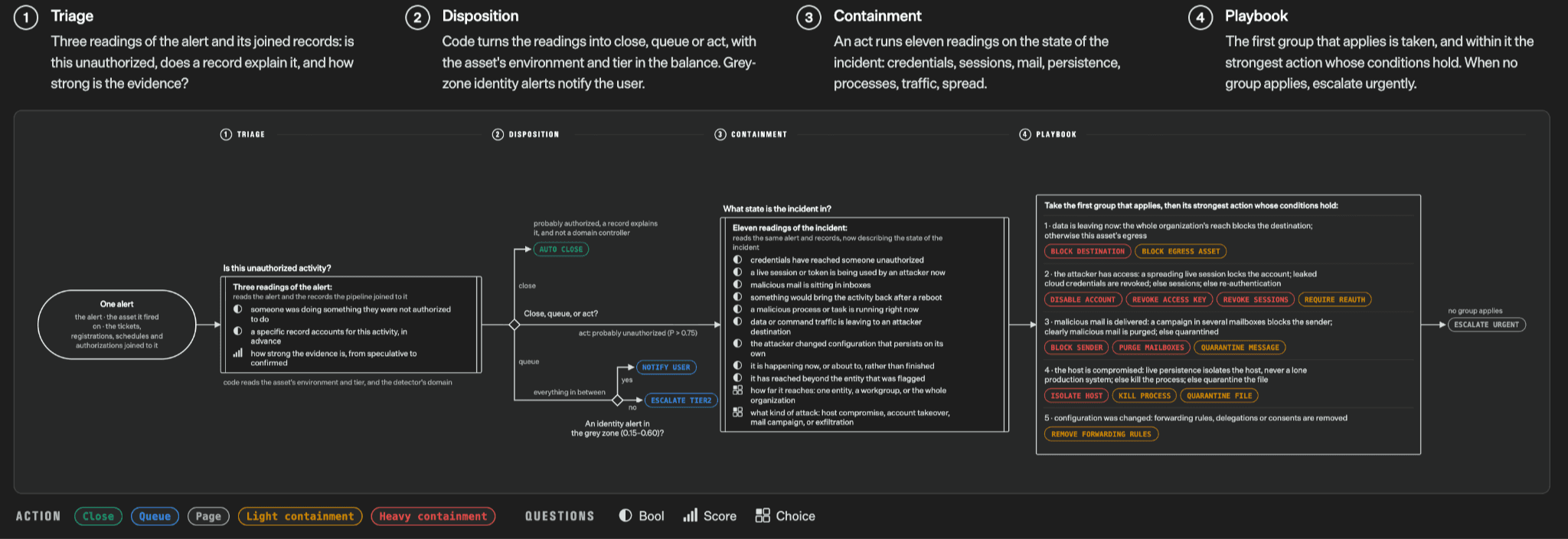
Example workflow graphic from TypeSafe’s launch post. Source: TypeSafe AI.
Jev API: how developers access it
The Jev API is where Jev becomes useful as a software primitive.
At a high level, developers send:
- a
state; - one or more typed questions;
- the model identifier.
The response returns structured answers your program can use.
A simplified conceptual request looks like this:
{
  "model": "jev-latest",
  "state": {
    "message": "I was charged twice. Please refund the duplicate payment."
  },
  "questions": {
    "department": {
      "type": "choice",
      "instructions": "Which team should handle this?",
      "criteria": {
        "billing": "Payments, charges and refunds",
        "technical": "Bugs and technical problems",
        "sales": "New purchases and upgrades"
      }
    }
  }
}
For current syntax and limits, use the official Jev API documentation at docs.typesafe.ai rather than copying an old example from a blog.
Jev has also started appearing through third-party AI infrastructure. Cloudflare’s AI documentation lists typesafe/jev, and Vercel announced Jev on AI Gateway.
That distribution is worth watching because it may make Jev easier to add to existing application stacks.
Jev GitHub: is Jev open source?
If you search Jev GitHub, be careful about the distinction between the model and projects built around it.
The Jev model itself is provided as a hosted model/API rather than an open-weight GitHub release.
However, community projects are already appearing.
One example is:
- browser-use/jev-ultrafast — an experimental browser agent using Jev as the action-selection layer.
There are also community “awesome Jev” repositories collecting examples, integrations and patterns.
That does not mean those repositories are official TypeSafe model source code.
How to use Jev AI
If you are searching how to use Jev AI, start by identifying a decision, not a writing task.
A good first Jev use case has:
- a clear piece of input state;
- a finite set of valid outcomes;
- a repeated decision;
- a way to test whether the output is useful;
- a safe fallback when confidence is low.
A poor first use case is:
A better first use case is:
Then:
- define the allowed outcomes;
- gather representative examples;
- call Jev against those examples;
- measure accuracy and confidence;
- choose thresholds;
- keep a human-review path;
- test it against your existing rules or LLM setup;
- only then automate the action.
That is a much better way to evaluate Jev AI performance than relying on a headline benchmark.
Jev signup and access
For Jev signup, TypeSafe’s official site currently directs developers to its access flow and product resources.
Start at:
Because the product is new and access conditions are moving quickly, check the official site for the latest availability rather than relying on a cached guide.
Jev structured output is not the same as guaranteed correctness
One of the most important points in the entire Jev discussion is the difference between type safety and truth.
TypeSafe says Jev cannot produce an out-of-schema answer because the possible output space is defined in advance.
That is meaningful.
If the valid choices are:
billing
technical
sales
Jev is not supposed to suddenly return:
Maybe ask Steve.
But a perfectly valid billing answer can still be the wrong decision.
So when TypeSafe talks about eliminating hallucinated output, the safest interpretation is:
Jev structurally prevents invalid output types; it does not make every decision correct.
The Jev probabilities and confidence values matter precisely because uncertainty still exists.
Any production Jev AI automation should therefore decide what happens when confidence falls below a threshold.
Jev vs LLM: the bigger idea
The bigger Jev vs LLM argument is not really about one model.
It is about how AI gets embedded into software.
The first AI wave made the chatbot the interface:
Human -> prompt -> AI -> text
The Jev approach suggests a different architecture:
Software -> narrow judgment -> probability -> code
That can create systems where AI is not something the user talks to.
It is simply a tiny decision layer running hundreds of times in the background.
If this model category works, the biggest impact may be invisible.
Your ERP, CRM, warehouse software, helpdesk, e-commerce platform or internal operations system may make better semantic decisions without anyone opening a chat window.
That is why the new Jev AI model is worth watching even if you never want another chatbot.
Should businesses replace ChatGPT or Claude with Jev?
No.
At least, that is not the useful conclusion from the current evidence.
Use a general LLM when you need:
- generation;
- reasoning;
- explanations;
- summarisation;
- code;
- flexible conversation;
- open-ended transformation.
Consider a model like Jev when you repeatedly need:
- routing;
- classification;
- scoring;
- bounded choices;
- risk gates;
- agent action selection;
- confidence-aware automation.
The more likely future architecture is not Jev vs Claude or Jev vs ChatGPT.
It is Jev + Claude, Jev + GPT, or Jev alongside other models — each doing the part of the workflow it is best suited to.
What to watch next
Jev is still extremely new.
Before treating the launch claims as settled, watch for:
- independent latency testing from different regions;
- independent accuracy and calibration evaluations;
- production case studies;
- failure-mode reporting;
- pricing changes after launch;
- broader Jev API availability;
- how quickly the Jev AI agents ecosystem develops;
- whether other labs adopt similar machine-native decision models.
The most important proof will not be another benchmark chart.
It will be companies using this approach in production and showing that the combination of speed, cost, confidence and bounded outputs is more useful than simply calling a general LLM.
FAQ
What is Jev AI?
Jev AI is TypeSafe AI’s first System One Model. It is designed to make fast, structured decisions inside software, returning typed values and probabilities instead of conversational text.
What is the Jev System One Model?
The Jev System One Model is TypeSafe’s name for a model optimised for quick, bounded judgments. It receives application state and predefined questions, then returns structured decisions.
Is Jev AI 200x faster?
The phrase Jev AI 200x faster comes from TypeSafe’s published performance claims. Its workflow evaluations produced gains of up to 193.6× on the setup it tested, while the company says 40–200× can occur for System One-shaped queries. TypeSafe also says the headline result is likely at the high end of real-world gains.
What is Jev latency?
TypeSafe reports Jev latency of roughly 70–500 ms for System One-style calls. The exact number will depend on the request, infrastructure and network location.
Is Jev a 100ms AI model?
Jev 100ms is a useful shorthand for its low-latency ambition, and TypeSafe has shown calls around that range, including a 0.114-second homepage example. It should not be treated as a guarantee that every call will finish in exactly 100 ms.
What is Jev AI pricing?
Current Jev AI pricing is $0.042 per million input tokens, with output tokens listed at $0. Check TypeSafe for current prices before deploying.
Is Jev AI free?
If you are asking is Jev AI free, the current public pricing is usage-based rather than simply free: $0.042 per million input tokens, with output tokens currently priced at zero.
What is Jev API pricing?
Jev API pricing currently follows TypeSafe’s published model rate of $0.042 per million input tokens and $0 for output tokens.
What is Jev AI cost at scale?
At the published Jev AI cost, one billion input tokens would be $42. Actual application cost also includes any surrounding infrastructure, models, storage and engineering.
What is Jev vs ChatGPT?
In Jev vs ChatGPT, Jev is designed for structured decisions while ChatGPT is a general-purpose conversational and generative system. They can complement each other rather than directly replace one another.
What is Jev vs GPT?
Jev vs GPT is fundamentally a decision-model-versus-generative-model comparison. GPT models can perform many tasks Jev cannot, while Jev is optimised for bounded, low-latency decisions.
What is Jev vs Claude?
For Jev vs Claude, Claude is suited to open-ended reasoning and generation. Jev is aimed at classifications, routing, scores and other predefined decisions inside code.
What is Jev vs traditional LLM?
Jev vs traditional LLM comes down to output design. Traditional LLMs generate strings; Jev returns predefined typed decisions and probabilities.
Can Jev be used for business automation?
Yes, Jev business automation could include ticket routing, lead classification, workflow gates, exception scoring and operational decision points — provided the workflow is properly tested and uncertain cases have a fallback.
Can Jev be used in ERP systems?
Potentially. Jev for ERP could support classification, routing, exception handling and confidence-based escalation inside purchasing, inventory, sales, service and manufacturing workflows.
What is Jev Ultrafast?
Jev Ultrafast is a community browser-agent project from Browser Use that uses Jev to select browser actions and targets while calling a separate text model only when text generation is needed.
Is there a Jev browser agent?
The Jev browser agent pattern is already being explored by projects such as browser-use/jev-ultrafast, but these are early community experiments rather than proof that Jev is universally better for browser automation.
Where is the Jev API documentation?
The official Jev API documentation is available through TypeSafe’s docs at docs.typesafe.ai.
Is there a Jev GitHub repository?
There are Jev GitHub community repositories and integrations, but the Jev model itself is not published as an open-weight model repository. One notable project is browser-use/jev-ultrafast.
What is Jev AI explained simply?
For Jev AI explained in one line: it is an AI model for software that makes a bounded decision with probabilities instead of writing a paragraph.
The bottom line
Jev is interesting because TypeSafe is questioning an assumption that has dominated the AI market: that increasingly powerful text generation is the right primitive for every intelligent software task.
For many tasks, it is.
For others, the application may only need:
If Jev can reliably make those decisions at a fraction of the latency and cost of larger generative models, it could become useful precisely because users never see it.
The 193.6× faster headline deserves attention, but it should not be the conclusion.
The real test is whether Jev’s structured, probability-aware approach makes production automation simpler, cheaper and easier to control.
That is what businesses should benchmark.
Building AI into a real operations system?
AI is useful when it sits inside a clear process — not when it becomes another disconnected tool.
OpsMavix builds operations systems around the way a business actually runs: orders, stock, production, reporting and the automation between them.
If you are looking at AI for routing, exceptions, approvals or workflow decisions, start with the process and then choose the model.
Tell us what’s broken — we’ll show you the system we’d build.
Sources & further reading
- TypeSafe AI — Introducing System One Models & Jev
- TypeSafe AI — homepage and current pricing
- TypeSafe AI — workflow evaluations
- TypeSafe AI documentation
- Cloudflare AI docs — TypeSafe Jev
- Vercel — TypeSafe AI’s Jev on AI Gateway
- Browser Use — Jev Ultrafast on GitHub
- TypeSafe AI funding announcement / Business Wire syndication
<!– SEO keyword coverage: jev ai; what is jev ai; jev typesafe; typesafe jev; typesafe ai jev; jev system one model; jev model; jev ai 200x faster; jev ai speed; jev latency; jev 100ms; jev ai performance; jev benchmark; jev vs chatgpt; jev vs gpt; jev vs claude; jev vs llm; jev ai vs chatgpt; jev vs traditional llm; jev ai automation; jev ai agents; jev browser agent; jev ultrafast; jev ai workflow automation; jev for ai agents; jev decision model; jev ai for business; jev for ERP; jev workflow automation; jev ticket routing; jev lead classification; jev ai decision making; jev structured decisions; jev business automation; how does jev ai work; jev structured output; jev probabilities; jev classification model; jev routing model; jev api; jev api documentation; jev github; jev ai pricing; jev pricing; jev api pricing; is jev ai free; jev ai cost; how to use jev ai; jev signup; who created jev ai; jev ai founder; jev ai launch; new jev ai model; why is jev ai faster; is jev ai really 200x faster; jev ai explained –>