
What Is a Goods Received Note (GRN)? A Practical Guide
A goods received note is the buyer's own record of what physically turned up against a purchase order — not what was ordered, not what the supplier says was sent. This guide covers what goes on a GRN, how it feeds three-way matching, and why the document quietly fails on spreadsheets and email.
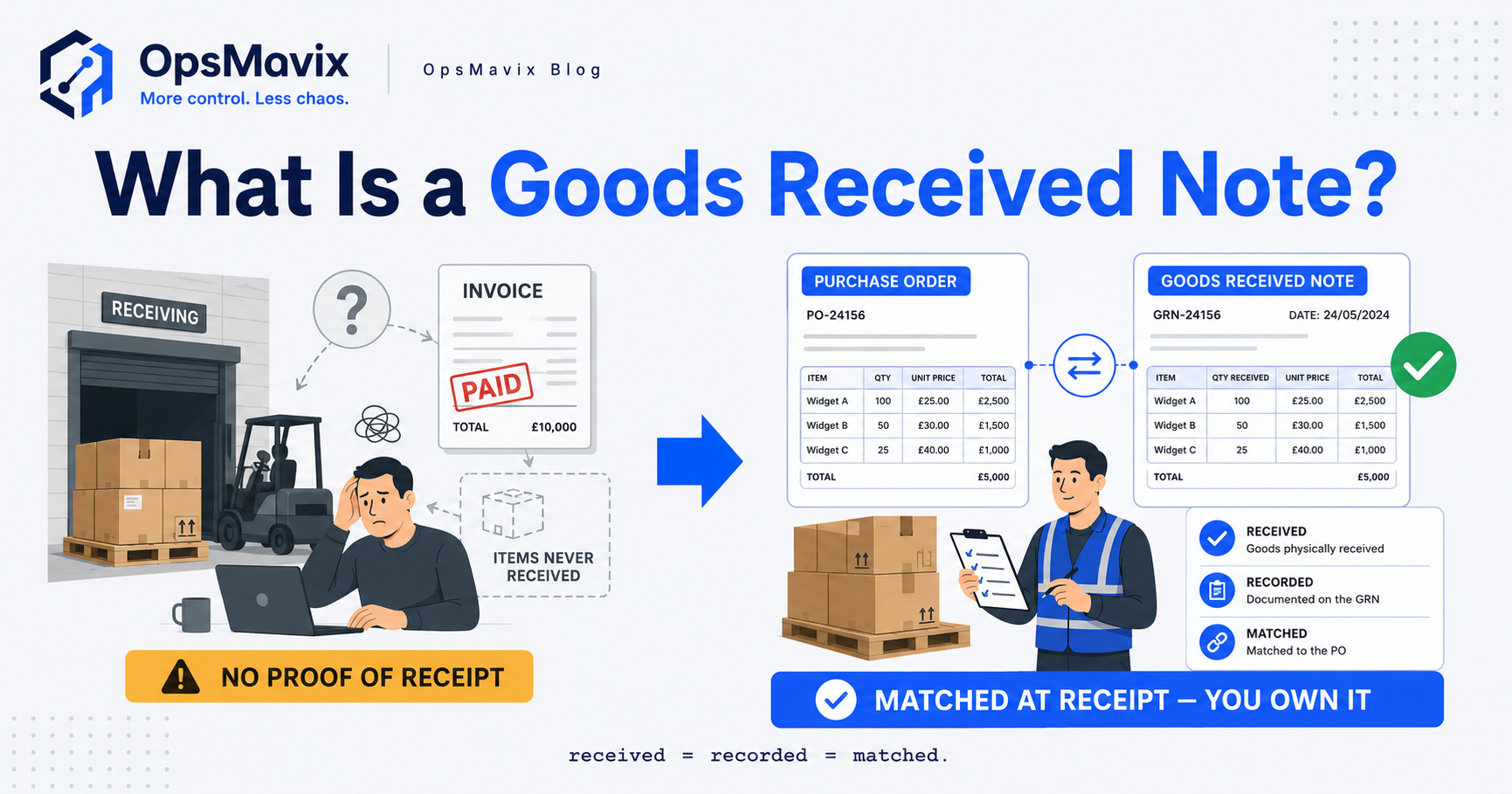
A goods received note (GRN) is the buyer’s own record of what physically arrived against a purchase order — the items, the quantities, the date, and the condition they turned up in. It exists to answer one question no other document can answer honestly: not what you ordered, and not what the supplier claims they sent, but what you actually got and accepted.
What a goods received note actually is
A goods received note is created by the person receiving a delivery, at the point the delivery arrives, and it records what was physically taken in. That is the whole point of it: it is the buyer’s independent statement of fact, made at the loading bay, not a copy of anyone else’s paperwork. The Chartered Institute of Procurement & Supply treats the GRN as a standard control document in the procure-to-pay cycle — the checkpoint that sits between ordering goods and approving payment for them.
The reason it has to be independent is that the two documents either side of it have a bias. The purchase order says what you wanted. The supplier’s invoice says what they want to be paid for. Neither is a record of reality — reality is what came off the lorry, and unless someone writes that down at the moment it happens, it is gone. The GRN is that record. Booked in properly, it becomes the single trustworthy answer to “did we get this, and how much of it,” which is a question that gets asked far more often than most businesses expect: by accounts before they pay, by the shop floor when a line runs short, and by an auditor when the numbers are queried.
What goes on a GRN: the fields that matter
A GRN does not need to be elaborate, but it does need to carry enough to be matched and audited later. Strip it to essentials and it holds a small set of fields, each doing a specific job:
- GRN number — a unique reference so the note can be found and matched, and so nobody books the same delivery in twice.
- Purchase order number — the link back to what was ordered. Without it, the GRN floats free and three-way matching is impossible.
- Supplier name and delivery date — who delivered, and when it landed. The date matters for stock timing, supplier performance, and the accounting period.
- Item description and code — what was received, in your own terms, not just the supplier’s part number.
- Quantity ordered vs quantity received — the two numbers side by side. This single comparison is where short and over-deliveries surface.
- Condition and quality notes — damaged, wrong spec, rejected, quarantined. A quantity that arrived but failed inspection is not a quantity you can use or should pay for.
- Received by — who checked and signed it in, so there is accountability if a discrepancy is disputed weeks later.
The two fields people leave off are the ones that cost the most: quantity received recorded separately from quantity ordered, and condition. Skip those and the GRN stops being a record of reality and becomes a rubber stamp of the order — which is exactly the failure it exists to prevent.
GRN vs purchase order vs delivery note
These three get confused constantly, usually because a stretched receiving team treats the supplier’s delivery note as the GRN. They are three different documents, written by two different parties, for three different reasons:
| Document | Written by | Says |
|---|---|---|
| Purchase order | You (the buyer) | What you asked the supplier to send |
| Delivery note | The supplier | What the supplier says they put on the lorry |
| Goods received note | You (the buyer) | What you actually received and accepted |
The delivery note is the trap. It arrives with the goods, it lists quantities, and it is tempting to sign it and file it as proof of receipt. But it is the supplier’s claim, not yours — if it says 100 and 98 turned up, signing it uncritically means you have just endorsed the supplier’s version of events. The GRN is separate precisely so that your count, not theirs, is the record that governs payment. When a business skips the GRN and relies on the delivery note, it has quietly handed the supplier the last word on what was received. That is the goods-receiving process failing at its most important step.
How the GRN feeds three-way matching
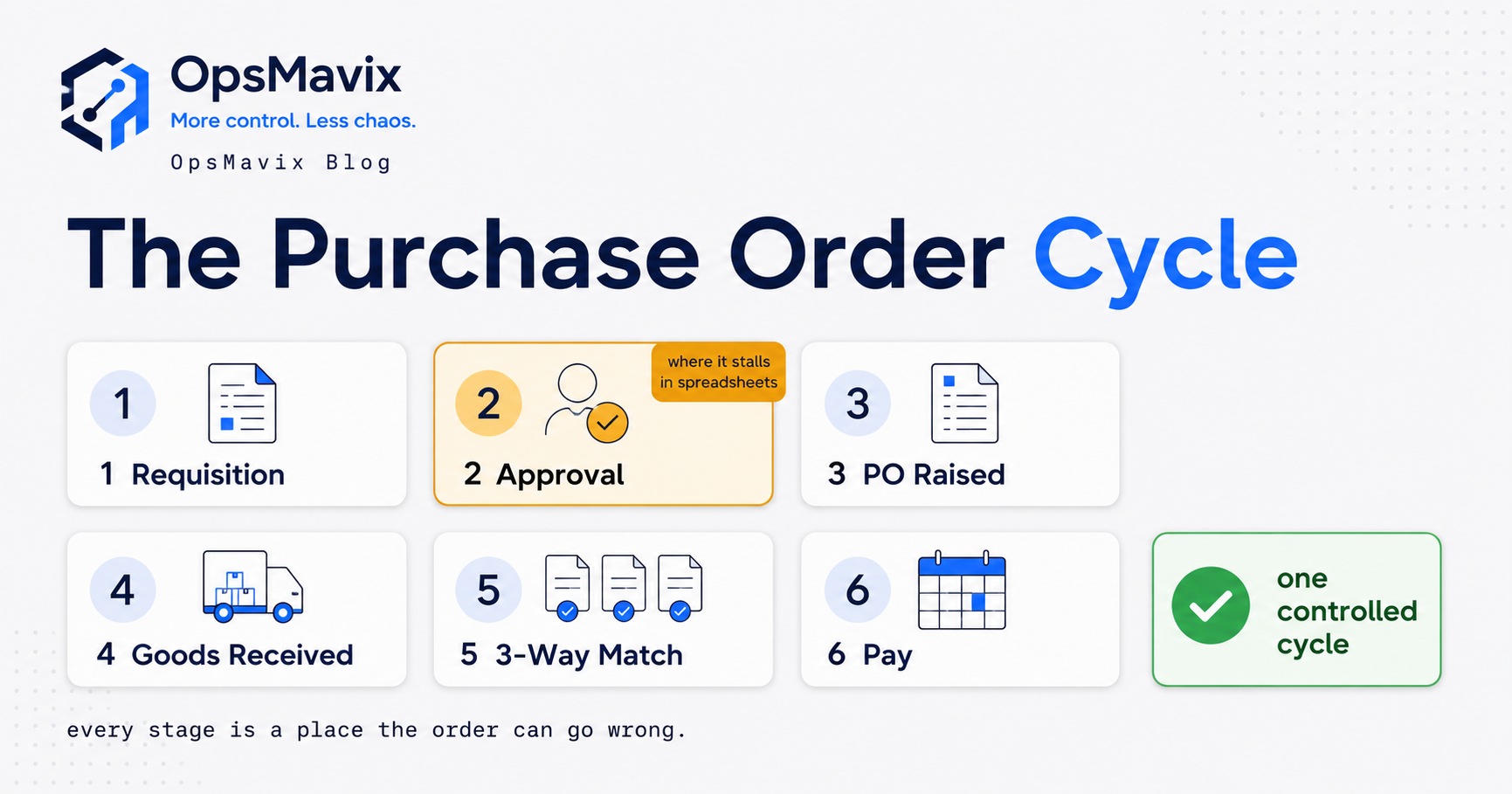
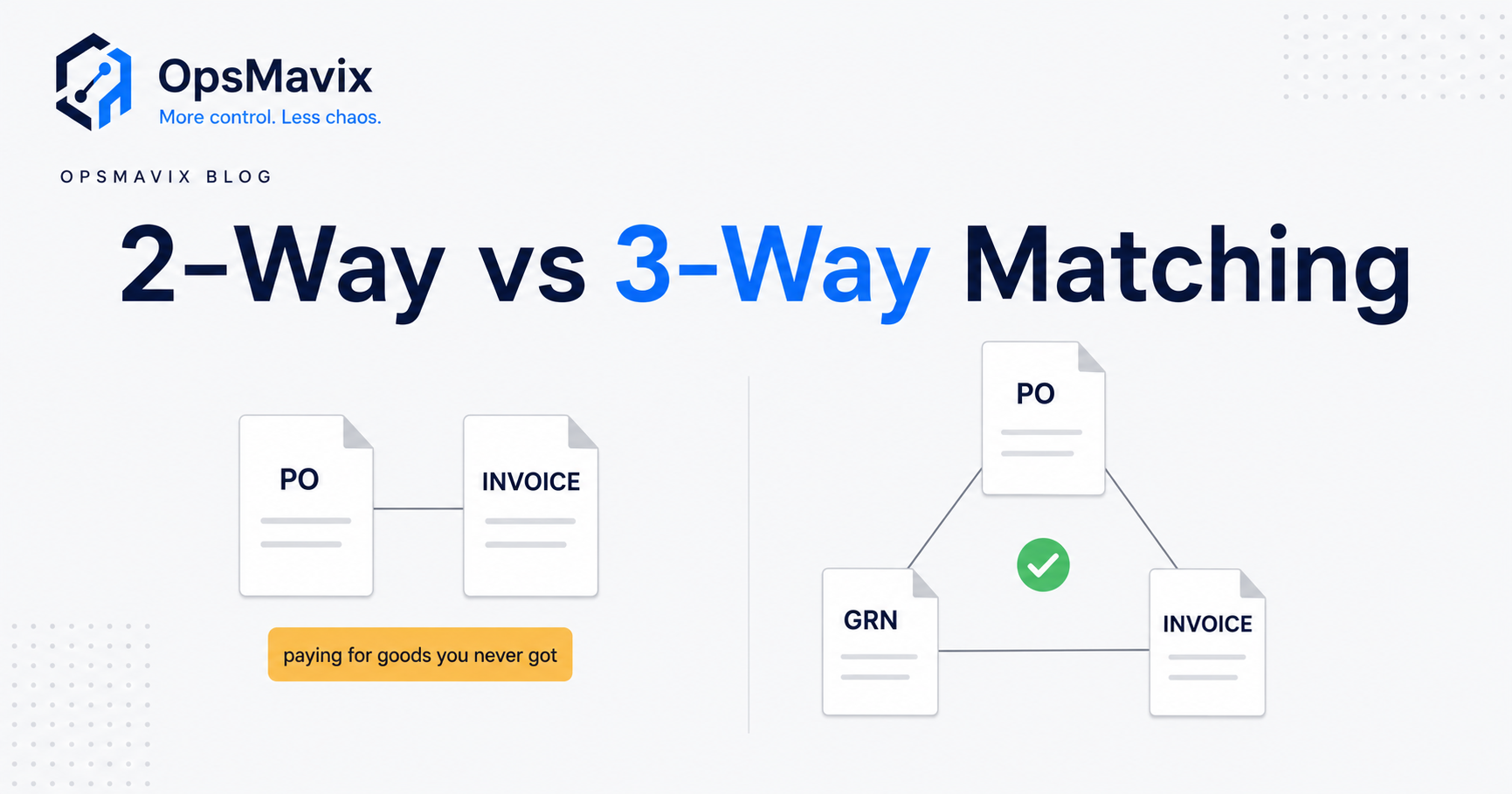
Three-way matching is the accounts-payable control that checks three documents agree before an invoice is paid: the purchase order, the goods received note, and the supplier invoice. AccountingTools describes it as the payment-verification technique for confirming that an invoice is valid and can be paid — you ordered it (PO), you received it (GRN), and you are being billed the agreed price (invoice). When all three line up, the invoice is cleared. When they do not, the mismatch is flagged before any money moves.
The GRN is the load-bearing document in that trio, because it is the only one that describes physical reality. Without it, “matching” collapses into a two-way check — PO against invoice — which only confirms that the supplier billed you for what you ordered, not for what arrived. That is a check that passes happily while you overpay. The GRN is what turns the match from a paperwork tidy-up into an actual control: it inserts a fact between the wish and the demand, and refuses to let them settle until the fact agrees with both.
This is also why GRN quality directly determines matching quality. A GRN that just copies the PO quantity — because someone ticked “received” without counting — will always match, and will therefore never catch anything. The control is only as honest as the count behind the note.
How a GRN stops you paying for goods you never got
The clearest way to see the point of a GRN is a worked example. Say you run a wholesale business and order 100 units of a line at £40 each — a £4,000 purchase order.
- PO: 100 units × £40 = £4,000.
- Delivery arrives. Your receiver counts 96 good units, plus 2 damaged and rejected. The GRN records 94 accepted (96 received, 2 rejected — depending on your policy the damaged pair are quarantined or returned).
- Invoice arrives: 100 units × £40 = £4,000. The supplier has billed for the full order.
Two-way matching (PO vs invoice) passes cleanly: 100 ordered, 100 billed, £4,000 both sides. You pay £4,000. You have just paid £240 for six units you never received into usable stock — and you will only discover it if and when the shelf comes up short, by which point the invoice is settled and clawing it back is a phone call nobody wants to make.
With a GRN in the match, the three documents disagree: ordered 100, received-and-accepted 94, billed 100. The invoice is held. Accounts raises a query or a debit note for the six-unit gap, and £240 stays in your account until the supplier corrects the bill or ships the balance. Scale that across every delivery in a year and the GRN is not admin — it is the difference between paying for what you got and paying for what you were told you got. Short deliveries billed in full, damaged goods invoiced as sound, and the occasional duplicate invoice are exactly the leaks this document is built to catch.
The GRN as your VAT and audit trail
There is a UK-specific reason the GRN matters that the procurement blogs tend to skip: it is part of the evidence trail behind your VAT. To reclaim input VAT, HMRC expects you to hold valid evidence that you received a taxable supply, and to keep your VAT records for at least six years — the record-keeping rules are set out in VAT Notice 700, and HMRC’s input tax manual covers what counts as acceptable evidence when a standard invoice is in question.
A clean GRN is a meaningful part of that story. It ties a specific delivery to a specific PO and invoice, dated and signed, and it demonstrates that goods you reclaimed VAT on actually arrived. In an inspection, “we ordered it and we paid the invoice” is weaker than “here is the order, here is the note showing 94 units received on this date signed by this person, and here is the corrected invoice for 94.” The GRN is what makes the trail continuous instead of jumping from order straight to payment with reality missing from the middle. For a business that wants its books to survive scrutiny, the note is not overhead — it is the evidence.
Where the GRN breaks down on spreadsheets and email
The GRN concept is sound. What fails is the way most growing businesses run it. The typical setup is a delivery note signed at the bay, a receiving tab in a spreadsheet updated later (sometimes), and an email trail where the office asks the warehouse “did the Acme order come in yet?” Each of those has the same fault: the receiving fact and the ordering record live in different places, maintained by different people, and they drift.
The failure modes are predictable:
- The count never gets entered. Goods land, get put away, and the spreadsheet update waits until “later” — which arrives after the invoice does. The match now runs against a blank.
- The delivery note becomes the GRN by default. Nobody does an independent count, so the supplier’s number is the only number, and short deliveries pass straight through.
- The GRN and the PO log don’t talk. Receiving is recorded in the warehouse; the open-PO list lives in the office. A purchase order tracking system built from two disconnected spreadsheets can’t tell you what’s still outstanding, because the two halves never reconcile.
- Part-deliveries get lost. A PO half-received looks handled but isn’t closed, and the outstanding balance is precisely the bit that gets forgotten until it becomes a stockout.
- There is no alert. A spreadsheet cannot tell you an invoice arrived for a PO with no matching receipt. Someone has to notice. Under pressure, nobody does.
None of these are people failing. They are a document being asked to do a real-time, cross-department job in a tool that has no memory, no links, and no way to raise its hand. The GRN doesn’t break because the team is careless — it breaks because the paper-and-email version has no mechanism to keep the count, the order, and the invoice pointed at each other.
The owned-system fix: enter once, match automatically
The fix is not a bigger spreadsheet or a stricter rule about filling it in. It is to make the receiving count the moment the data is captured once and then reused everywhere it is needed — instead of being re-keyed, re-emailed, and re-lost across three tools.
In a right-sized operations system that you own, the flow is a single continuous chain. The PO is raised and sits as an open order. When the delivery arrives, the receiver books it in against that PO — scanning or counting the actual quantities — and that one action does several jobs at once:
- It creates the GRN as a permanent, dated, signed record, linked to the PO automatically.
- It updates stock, because the goods are now available to use — no separate inventory entry, no re-keying.
- It updates the open-PO position, closing the order if complete or holding the outstanding balance as a backorder if it came short.
- It arms the three-way match, so when the supplier’s invoice lands it is checked against the PO and the recorded receipt without anyone lining up three documents by hand — and held if they disagree.
Enter the data once, at the point reality happens, and the same fact drives the stock record, the PO status, and the payment control. Nothing is re-typed, so nothing drifts. The match runs on the real received quantity because there is no other quantity in the system to run on. This is the practical meaning of an inventory system that captures data at receipt rather than reconstructing it afterwards from memory and email: the goods received note stops being a form someone might fill in, and becomes a by-product of the act of receiving that you cannot skip.
Do you even need a formal GRN?
Honest answer: not always, and it is worth saying so. If you take a handful of deliveries a month from reliable suppliers, and the same person orders, receives, and approves the invoice, a formal GRN process can be more ceremony than control. A checked delivery note and a careful eye may genuinely be enough at that volume.
The point where you do need one is fairly sharp. It arrives when receiving and paying are done by different people; when delivery volume is high enough that nobody can hold the open orders in their head; when suppliers occasionally ship short, late, or damaged; or when short deliveries billed in full have already cost you real money. Any one of those, and the GRN stops being paperwork and starts being the thing that keeps you from paying for goods you never got. Two or three of them together, and the spreadsheet-and-email version will already be leaking — you just may not have measured it yet.
If that is where you are — too busy for the paper version, not looking for a full ERP — the question is not whether to keep a goods received note, but whether receiving, stock, and matching should still live in three places that don’t talk.
Sources
Keep reading
Getting value from OpsMavix? Add us as a preferred source on Google — you'll see more of our operations content in your AI Overviews, AI Mode and Search.