
Supply Chain Management Software Modules and Types: A Buyer's Map
Supply chain management software is not one product; it is a stack of specialist tools. This buyer's map breaks down the main types by function and by how they are delivered, so you can work out which kind you actually need.
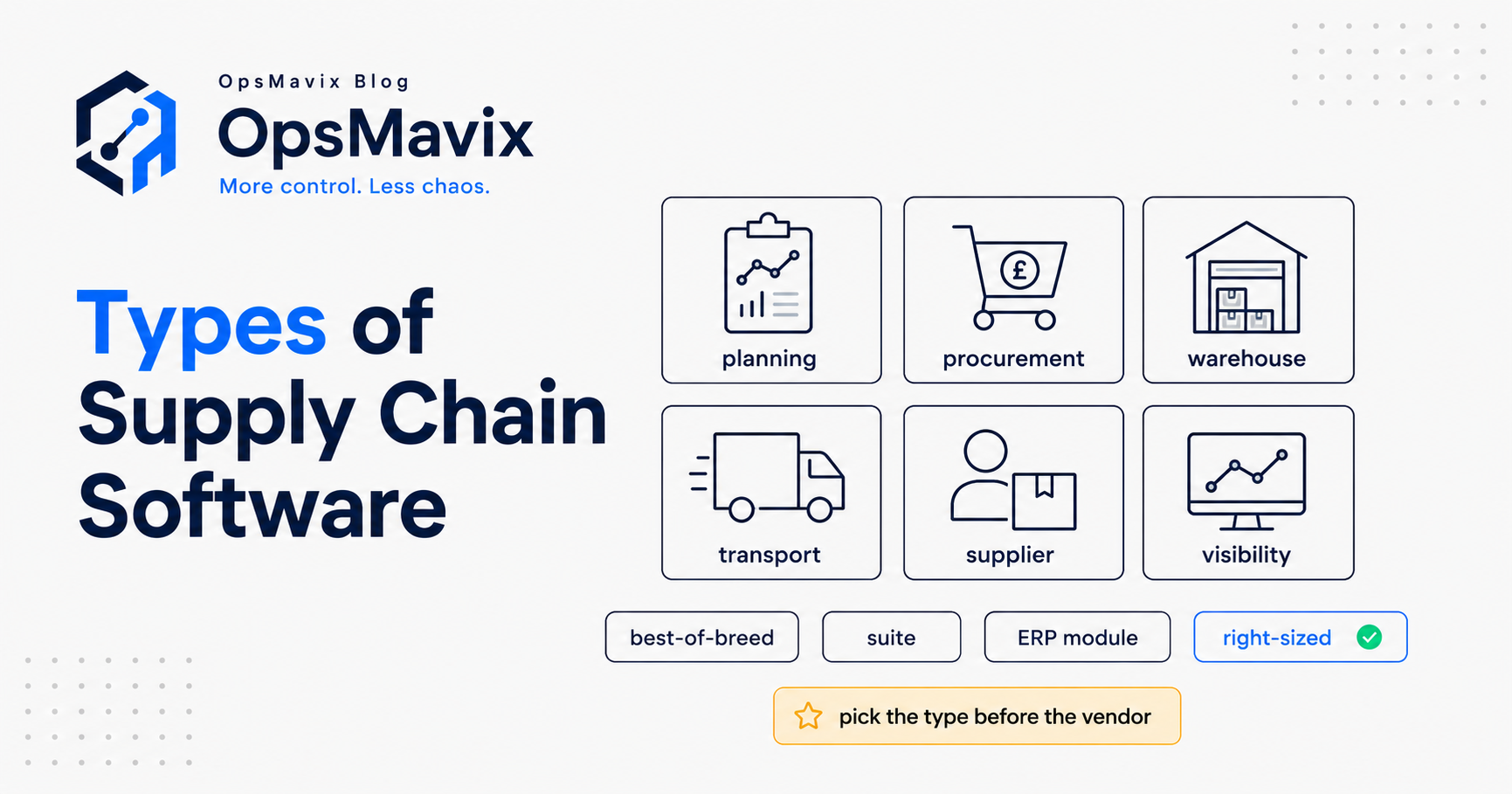
There is no single “supply chain management software”. The label covers at least six functional categories and four ways of delivering them, and most buyers get burned because they compare a warehouse tool against a planning suite as if they were the same thing. This post is the map, not the vendor list. For the wider overview of what SCM software is and whether you need a full platform, see our guide to supply chain management software.
Quick summary: The main functional types trace the classic supply chain process phases: planning, sourcing, making, delivering and returning, as codified in the ASCM SCOR Digital Standard (source). On top of that sit four delivery models: best-of-breed point tools, all-in-one SCM suites, ERP modules, and right-sized owned systems.
Contents
- How to read the map (function vs delivery)
- Supply chain planning software
- Procurement and sourcing software
- Supplier relationship management (SRM)
- Inventory and warehouse execution (WMS)
- Transport and logistics (TMS)
- Order management and fulfilment
- Supply-chain visibility and analytics
- Delivery type 1: best-of-breed point tools
- Delivery type 2: all-in-one SCM suite
- Delivery type 3: ERP module
- Delivery type 4: right-sized owned system
- Comparison table
- Worked example: a £6m wholesaler
- FAQ
How to read the map (function vs delivery)
Two questions decide everything. First, what job does the software do: plan, source, store, move, or watch? Second, how is it delivered: as a standalone specialist, part of a big suite, a bolt-on to your accounting/ERP system, or something built around your own process?
The functional layer follows a well-established backbone. The SCOR framework maintained by ASCM (the body that absorbed APICS) organises supply chains into a small set of core processes, updated in the SCOR Digital Standard to plan, source, transform, fulfil, return and orchestrate (source). Every category below maps onto one of those. Keep the two axes separate and vendor pitches stop being confusing.
If you want the functional layer broken down one piece at a time, with who needs each piece and who can skip it, read our guide to supply chain management software modules.
Supply chain planning software
Planning tools answer “how much, of what, and when”. This is the demand-planning, supply-planning and sales-and-operations-planning (S&OP) layer: forecasting demand, netting it against stock and capacity, and turning that into purchase and production signals. Gartner tracks this as its own distinct market, separate from execution software (source).
For manufacturers, the production-facing slice of planning is material requirements planning. If you make things to order or to stock, that mechanic deserves its own read: see our breakdown of what an MRP system does. Most SMBs do not need a standalone planning suite; they need a forecast that is trusted and connected to reordering. The failure mode here is buying sophisticated statistical forecasting on top of dirty stock data, so the model produces confident numbers nobody trusts. Fix the underlying inventory record first, then decide whether planning software adds anything a good reorder-point rule does not.
Procurement and sourcing software
Procurement software runs the buy side: requisitions, purchase orders, approvals, supplier catalogues, e-sourcing and (at the fuller end) source-to-pay. CIPS, the UK’s chartered procurement body, frames procurement as the whole process of acquiring goods and services, not just cutting a PO (source).
For a smaller operation the practical version is disciplined purchase-order management with supplier lead times baked in, which sits close to our guide to supplier order management software. You rarely need a heavyweight sourcing platform until spend and supplier count are large.
Supplier relationship management (SRM)
SRM is often confused with procurement, but it is a different job. CIPS defines it as the process of identifying and managing all interactions with key suppliers to grow value for both parties, moving beyond day-to-day PO handling into scorecards, risk and long-term partnership (source). Software here holds supplier records, performance metrics, contracts, certifications and risk flags. Manufacturing buyers who care about traceability (EN 1090, material certs) live in this category whether they call it SRM or not.
Inventory and warehouse execution (WMS)
This is the “store” layer. A warehouse management system controls what happens inside the four walls: receiving, put-away, bin locations, picking, packing and stock counts. The clean industry distinction is that a WMS manages inventory inside a facility while a transport system manages freight between locations (source).
Inventory software and WMS overlap but are not identical. Inventory tools track quantities and valuation across locations; a full WMS adds directed movement and labour. Many SMBs conflate the two and overbuy a WMS when a solid multi-location inventory system would do.
Transport and logistics (TMS)
A transportation management system plans and executes the physical movement of goods: multimodal routing, carrier selection, freight rating, load building and freight-bill audit. Gartner defines a TMS as software supporting multimodal sourcing, planning and execution of the physical transport of goods across the supply chain (source). If you ship a lot, across carriers, this earns its keep. If a courier portal and a spreadsheet cover it, a TMS is premature.
Order management and fulfilment
Order management software (OMS) sits between selling and shipping: it captures orders from every channel, allocates stock, prevents overselling, and orchestrates fulfilment. For wholesalers and distributors this is often the true operational heart of the business, which is why we treat it as its own thing in our wholesale order management system. It is where “we sold stock we didn’t have” gets solved.
Supply-chain visibility and analytics
The newest functional category is visibility: control towers, analytics and reporting that sit above the execution tools and show one picture across them. Gartner groups analytics, supplier collaboration and visibility inside the broader SCM market alongside procurement, transport and warehousing (source). The catch: a control tower is only as honest as the systems feeding it. Buy visibility last, once the underlying data is clean, or you will just be looking at rubbish faster.
Delivery type 1: best-of-breed point tools
Now the second axis: how the function is delivered. Best-of-breed means picking the strongest specialist for each job, a dedicated WMS, a dedicated TMS, a dedicated planning tool. You get depth. You pay in integration: every seam between tools is a place data goes stale, and you own the glue. Right for businesses with one dominant, complex need and the appetite to wire the rest together.
Delivery type 2: all-in-one SCM suite
A suite ships planning, procurement, inventory, transport and visibility under one vendor. Fewer seams, one contract, consistent data model. The trade-off is that no single module is usually as deep as the best point tool, licensing is broad, and you adopt the vendor’s way of working. Suites suit larger, more standard operations that value integration over specialist depth.
Delivery type 3: ERP module
Many businesses get SCM as bolt-on modules to an ERP (the inventory, purchasing and light planning inside a general business system). Convenient if you already run the ERP and your needs are mainstream. But ERP supply-chain modules are generalists, and forcing an unusual process into them creates the workaround sprawl that pushes SMBs back to spreadsheets. If you are weighing this, read operational systems vs ERP before you commit.
Delivery type 4: right-sized owned system
The fourth delivery type is the one most category maps omit: a system built around your process, owned by you, sized to the job. Not generic custom code, and not an SCM vendor product, an operations system that does the two or three things your supply chain actually lives or dies on, and connects them, without the licence weight of a suite or the compromise of an ERP module. This is OpsMavix’s lane, and it belongs on the map as a legitimate option for businesses “outgrowing spreadsheets and disconnected tools”.
The reason it belongs on the map is that the other three delivery types all optimise for the vendor’s economics, not yours. A suite wants you on as many modules as possible; a point tool wants depth you may never use; an ERP module wants you to fit its mould. An owned system inverts that: you pay to solve named problems and you keep the asset. The trade-off is real, it needs a partner who scopes tightly and resists scope creep, which is why we lead with an audit rather than a licence quote. It is not the right answer for a large, standard operation that genuinely spans all six functions; it is the right answer when two or three functions carry the whole business.
Comparison table
| Delivery type | Depth per function | Integration effort | Fit for | Watch out for |
|---|---|---|---|---|
| Best-of-breed point tools | High | High (you own the glue) | One dominant complex need | Data drift between seams |
| All-in-one SCM suite | Medium | Low (single vendor) | Larger, standard operations | Licence weight; vendor’s way |
| ERP module | Low–medium | Medium | Mainstream needs on existing ERP | Workaround sprawl for odd processes |
| Right-sized owned system | Targeted to your top jobs | Designed in from the start | “outgrowing spreadsheets, not looking for ERP” | Needs a partner who scopes tightly |
Worked example: a £6m wholesaler
A distributor turning over £6m sells across a trade counter, phone and a webstore. Their pain is overselling and slow order turnaround, not freight optimisation or demand modelling.
Reading the map: their live functional need is order management first, inventory/WMS second. Planning, TMS and a control tower are noise for now. On the delivery axis, a full suite is overkill and expensive, an ERP module would force their multi-channel ordering into a generalist mould, and a best-of-breed OMS plus a separate WMS means owning integration they have no appetite for.
The right-sized answer is one owned order-and-stock system covering channel capture, real-time allocation and warehouse picking, with clean data ready to feed a visibility layer later. They buy the two jobs that are bleeding money and skip the eight that are not. That is the whole point of reading the map before shopping.
FAQ
What are the main types of supply chain management software?
By function: supply chain planning, procurement and sourcing, supplier relationship management, inventory and warehouse (WMS), transport and logistics (TMS), order management, and visibility/analytics. These map onto the plan-source-make-deliver-return processes in the ASCM SCOR standard.
Is an ERP the same as supply chain management software?
No. An ERP is a broad business system that usually includes some supply-chain modules (inventory, purchasing). Dedicated SCM software goes deeper in a specific function. An ERP module is one delivery type for SCM, not a synonym for it.
What is the difference between a WMS and a TMS?
A warehouse management system manages inventory and movement inside a facility; a transportation management system manages freight between locations. They solve different problems and are often bought separately.
Do small businesses need all these types?
Almost never. Most SMBs have two or three functions that genuinely bleed money and the rest are fine on existing tools. Buying the whole landscape is the classic overspend. Map your real jobs first.
What is a “right-sized owned system”?
A system built around your specific process and owned by you, covering only the functions you actually need, rather than a broad vendor suite or an ERP module. It is a legitimate fourth delivery option, not generic custom code.
How OpsMavix Can Help
OpsMavix is not an SCM vendor and does not sell generic code. We build right-sized, owned operations systems for businesses that have outgrown spreadsheets but do not need, or want to pay for, a full supply-chain suite. We start by mapping your real functional needs against the landscape above, then build only the parts that fix the leak, with a delivery guarantee on the work. If you want to know which types of supply chain management software you genuinely need before anyone tries to sell you all of them, Book a Free Operations Leak Audit.
Sources
- ASCM, SCOR Digital Standard — https://www.ascm.org/corporate-solutions/standards-tools/scor-ds/
- Gartner, Supply Chain Management market reviews — https://www.gartner.com/reviews/markets/supply-chain-management
- Gartner, Supply Chain Planning Solutions market — https://www.gartner.com/reviews/market/supply-chain-planning-solutions
- Gartner, Transportation Management Systems market — https://www.gartner.com/reviews/market/transportation-management-systems
- CIPS, What is Procurement? — https://www.cips.org/intelligence-hub/procurement/what-is-procurement
- CIPS, Supplier Relationship Management — https://www.cips.org/intelligence-hub/supplier-relationship-management