
Purchase Order Software: Getting Buying, Approvals and Suppliers Under Control
Purchase order software is meant to do one thing well — raise a PO, get it approved, send it to the supplier, and track it until the goods land and the invoice matches. Most growing businesses don't need the enterprise procurement suite to do that. Here's where the line sits between a full platform and a right-sized system built around how you already buy.
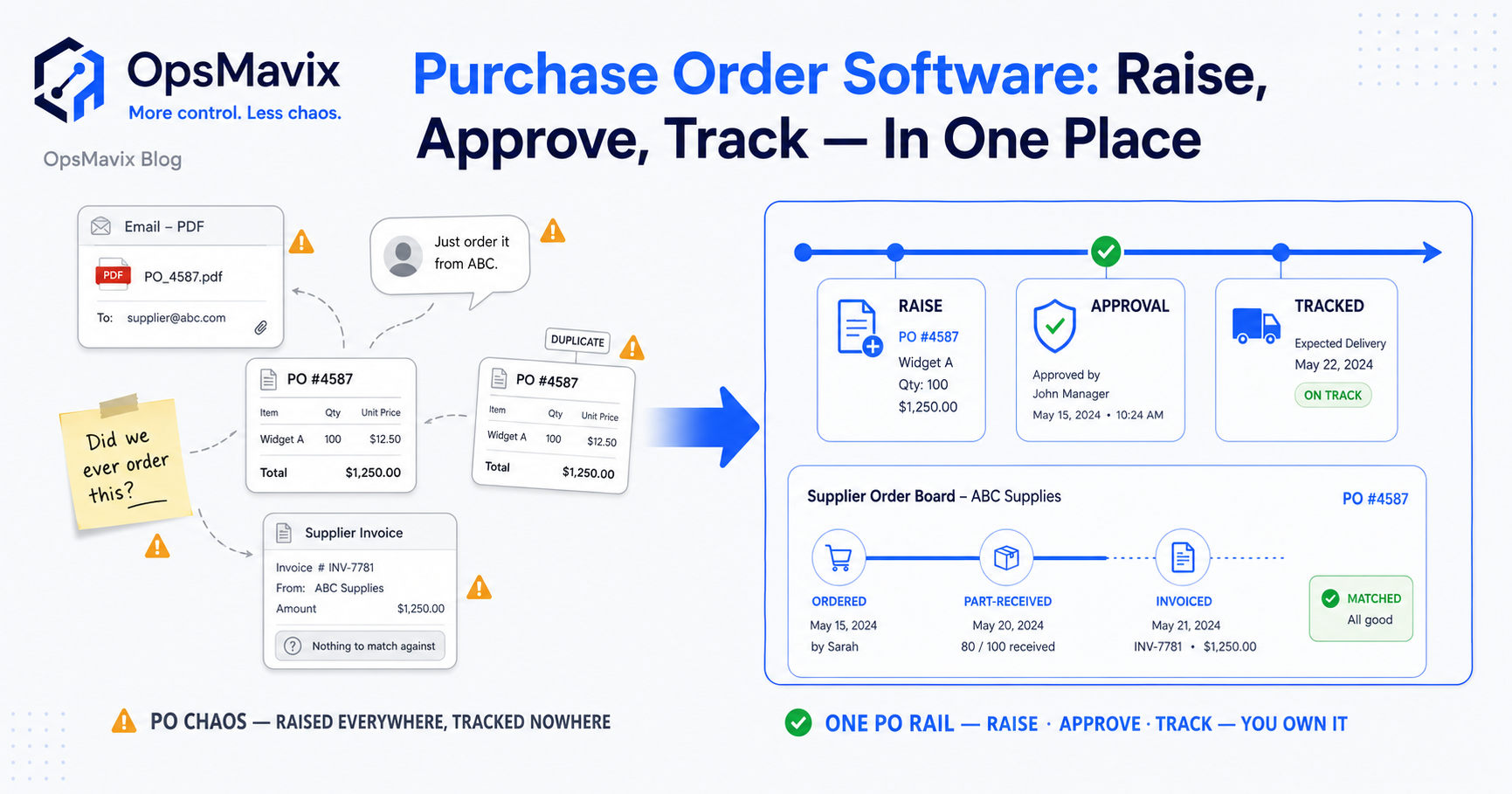
Good purchase order software does something unglamorous but valuable: it lets you raise a purchase order, route it for approval, send it to the supplier, and track it from “on order” to “received and matched” without any of it living in someone’s inbox. Whether you need a full procurement platform to do that or a right-sized system depends on how much you buy, how many people approve it, and how tangled your supplier list has become. A heavy procurement suite earns its cost across hundreds of suppliers, multi-tier approvals and thousands of POs a month. Below that, most growing businesses need the same core — raise, approve, send, receive, match — built around how they already buy, and owned outright.
This post is about that decision, not a feature tour. Where the line sits between “you genuinely need enterprise procurement” and “a right-sized PO system covers what’s leaking,” what each side actually buys you, and when the big platform is the wrong call. It’s squarely about the buying side — raising and tracking POs to suppliers — not the sales-order side, which is a different problem covered further down.
Key Takeaways
- Purchase order software covers the buying side: raise a PO, approve it, send it to the supplier, receive against it, match the invoice. Most businesses need that core, not an enterprise procurement suite.
- The leak is rarely “we lack software” — it’s POs raised by email, verbal approvals, and no live view of what’s on order versus what’s landed.
- Three-way matching (PO, goods received, invoice) is where the money hides — it stops overpaying, double-paying, and paying for what never arrived.
- Approvals belong in the system, not in someone’s head — who can commit what spend, routed automatically, with a record of who said yes.
- A right-sized custom system models your suppliers, your approval rules and your receiving, ties POs to live stock, and you own it — no per-seat creep, no enterprise modules to configure.
What Purchase Order Software Actually Does (and Who the Full Version Is For)
A full procurement platform, in enterprise form, is a heavy machine: supplier onboarding and scorecards, multi-tier approval workflows, budget and cost-centre controls, catalogue and punch-out purchasing, contract management, and deep ERP integration. When you run hundreds of suppliers and thousands of purchase orders a month across multiple sites and budgets, every one of those modules earns its keep. The complexity is the point.
The trouble starts when a growing business with forty suppliers buys the same machine. They’re not rejecting capability — they’re rejecting capability they’ll never touch, sold at a price that assumes they will. What most actually want is modest: raise a clean PO instead of a forwarded email, get it approved before the money’s committed, and know at a glance what’s on order, what’s overdue, and whether the invoice matches what turned up. That’s not enterprise procurement. That’s the core of it, built around how they already buy.
1. The Real Job Is Killing Ad-Hoc Buying, Not Adding Software
Ask a business owner what actually hurts about purchasing and it’s rarely “we lack purchase order software.” It’s the mess around the buying. Someone emails a supplier to order stock, someone else rings another supplier for the same thing, a manager approves a spend verbally, and nobody has one place that says what’s actually on order. Two people buy the same parts. A commitment gets made that nobody signed off. An order gets forgotten until the line runs short.
That’s the core leak — every purchase raised by inbox and memory is a duplicate order, a missed approval, or an untracked commitment waiting to happen. Software fixes it only if it captures the way you actually buy, from the informal phone order to the recurring supplier you use every week. A right-sized system gives every purchase one home: raised once, in a consistent shape, visible to everyone who needs to see it, before the money leaves.
2. Approvals Belong in the System, Not in Someone’s Head
The moment more than one person can commit company money, you need a rule for who can approve what — and most growing businesses run that rule in their heads. Small orders go through on trust, big ones get a verbal yes, and the boundary between them is wherever the buyer guessed it was that day. It works until it doesn’t: a spend gets committed nobody signed off, or an urgent order stalls because the one person who approves is on holiday and there’s no fallback.
Purchase order software earns its place here by making approval a step, not a favour. A threshold that routes anything over a set value to the right person automatically. A record of who approved what, and when. A clear queue so nothing sits waiting because it got lost. A right-sized system models your thresholds and your approvers rather than forcing a generic hierarchy on a team of twelve.
3. Three-Way Matching Is Where the Money Actually Hides
The quiet money leak in buying is paying for things that don’t line up. The invoice says one price, the PO said another. The supplier billed for ten, eight arrived. An invoice comes in twice and both get paid because nobody’s cross-checking against the order. Three-way matching — lining up the purchase order, the goods actually received, and the supplier invoice — is the discipline that catches all of it, and it’s exactly the thing that never happens when POs live in email.
Get this into the system and the match becomes automatic: the invoice can’t clear until it agrees with what was ordered and what was received. Short deliveries surface before you pay for the full order. Price creep between quote and invoice gets flagged instead of waved through. Duplicate invoices get caught on the second attempt. This is the same one-shared-number discipline behind live inventory — the moment the order, the receipt and the bill are tracked in separate places, they drift, and the drift costs you real cash.
4. Purchase Orders and Stock Have to Share One Number
A PO system that can’t see stock is half a tool. You reorder because the shelf looks low, not knowing there’s already a PO in flight for the same line — so you double-order. Or the goods land and nobody updates stock, so the number you reorder from is wrong again. Purchasing and inventory are the same loop: what you’ve committed to buy, what’s on the way, and what’s actually on the shelf all have to sit on one figure.
Tie the PO to live stock and the loop closes. Raising an order updates “on order” so the next person sees it before they reorder. Receiving against the PO updates stock the moment goods land, not a day later when someone gets to the paperwork. Reorder points can trigger a draft PO automatically when a line drops low, so buying gets ahead of the shortage instead of chasing it. That’s the join a standalone PO tool can’t give you, because it can’t see the rest of the operation.
5. Suppliers Under Control, Not Scattered Across Inboxes
When purchasing lives in email, so do your suppliers. Prices sit in old quotes, lead times live in the buyer’s memory, and which supplier is reliable for what is knowledge that walks out the door if they leave. There’s no easy answer to “who did we order this from last time, at what price, and did it turn up on time” — the kind of question that decides whether you’re buying well or just buying.
A right-sized system puts the supplier at the centre of the buying record: their catalogue and agreed prices, their lead times, the full history of what you’ve ordered and how it landed. Reorder from a supplier and last agreed pricing is already there. Late deliveries build a record instead of a grudge. The buying knowledge stops living in one person’s head and becomes something the business owns.
6. The Real Cost Is Implementation and Lock-In, Not the Licence
The sticker price on an enterprise procurement suite is the least of it. The expensive part is the implementation, the per-seat creep as your team grows, and the dependency on a vendor you can’t leave. Businesses that buy the big platform routinely describe running a fraction of it — a handful of modules switched on, the rest configured, paid for, and never used — plus an implementation partner on retainer to keep the thing alive.
A right-sized custom system flips that. No per-seat fees as your buyers grow. No procurement modules to configure and ignore. Nothing a vendor can sunset or price up next renewal, because you hold it. You’re not renting your purchasing desk from a platform that assumes you’re ten times your size — you own a system scoped to the buying you actually do, and maintained as you grow into it.
7. When a Full Procurement Platform Is the Right Call (the Honest Bit)
Sometimes the big platform is correct, and we’ll say so. If you run hundreds of suppliers, need multi-tier approval chains tied to budgets and cost centres, buy through catalogues and punch-out, manage formal contracts and supplier scorecards, or process thousands of POs a month across multiple entities, a full procurement suite earns its cost — the modules a smaller business would call overkill become the things that pay for it.
The decision isn’t “custom good, platform bad.” It’s matching the tool to the buying you actually run. The mistake cuts both ways: don’t run a genuinely complex, high-volume procurement operation on a lightweight system, and don’t buy an enterprise suite for a team that raises a few hundred POs a month. If staying manual is honestly still cheaper than either, stay manual a while longer — switch when the leak outgrows the fix, not before.
Full Procurement Suite vs a Right-Sized PO System
| Enterprise Procurement Suite | Right-Sized Custom PO System | |
|---|---|---|
| Built for | Hundreds of suppliers, multi-entity, high PO volume | Growing business, real approvals, tens of suppliers |
| Feature use | You run ~20%, maintain 100% | You run what’s built; nothing spare |
| Approvals | Deep multi-tier workflows | Modelled to your thresholds and approvers |
| Matching | Full three-way matching engine | Three-way match on the orders you actually place |
| Stock link | Broad ERP integration you may not need | One shared figure — PO, receipt and stock joined |
| Upfront cost | High licence + implementation partner | Fixed build (£3k–£25k range) |
| Ongoing cost | Per-seat fees, annual modules, partner hours | You own it — no per-seat, no retainer |
| Right when | True procurement scale and complexity | “Too big for spreadsheets, too small for enterprise” |
A Quick Word on the Sales Side (So There’s No Confusion)
Purchase order software is about buying — the POs you raise to your suppliers. It’s a different problem from managing the orders your customers place with you, even though both involve the word “order.” If what’s actually breaking is customer orders arriving by fax, phone and email and getting re-typed into your accounts tool, that’s the sales-order side — start with whether you need a full order management system or a right-sized one and how to stop re-keying orders by hand. This post stays on the buying side: raising, approving and tracking POs out to suppliers.
FAQ
What is purchase order software?
Purchase order software is a system for the buying side of a business: it lets you raise a purchase order, route it for approval, send it to the supplier, receive goods against it, and match the supplier invoice to what was ordered and delivered. The enterprise versions add supplier scorecards, catalogue purchasing, budget controls and multi-tier approvals; a right-sized version covers the core raise-approve-send-receive-match flow built around how you already buy.
Do I need a full procurement suite or a right-sized PO system?
It depends on scale and complexity. If you run hundreds of suppliers, multi-entity budgets, catalogue buying and multi-tier approval chains, a full suite is justified. If your real problem is POs raised by email, verbal approvals, invoices nobody matches and no live view of what’s on order, a right-sized system fixes that without the enterprise overhead — and you own it. Most growing businesses are in the second group.
What is three-way matching and why does it matter?
Three-way matching lines up three documents before an invoice is paid: the purchase order (what you agreed to buy), the goods received note (what actually arrived), and the supplier invoice (what you’re being billed). When they don’t agree — short delivery, price creep, a duplicate invoice — it gets flagged instead of paid. It’s the single biggest place purchasing leaks cash, and it’s exactly what falls apart when POs live in email.
Can a custom PO system handle our approval rules?
Yes — that’s a core reason to build rather than buy off-the-shelf. A right-sized system models your approval thresholds and your approvers the way you actually work: anything over a set value routes to the right person automatically, with a fallback so nothing stalls when someone’s away, and a record of who approved what and when. Generic platforms force a standard hierarchy that rarely fits a smaller team.
Should purchase orders connect to stock?
They should. Purchasing and inventory are one loop — what you’ve committed to buy, what’s on the way, and what’s on the shelf all sit on one figure. Tie the PO to live stock and raising an order shows as “on order” so nobody double-orders, receiving updates stock the moment goods land, and low lines can trigger a draft PO automatically. A standalone PO tool that can’t see stock leaves you reordering blind.
How OpsMavix Can Help
OpsMavix builds right-sized purchase order and buying systems for businesses stuck in the gap — too big for spreadsheets, too small to justify an enterprise procurement suite. We build the part you actually run: every PO raised once in a consistent shape, routed through your approval thresholds before the money’s committed, sent to the supplier, received against, and three-way matched so you never overpay or double-pay. It ties to one live stock figure so buying and inventory share a number, and it’s shaped to how you already order — owned outright, no per-seat fees, nothing a vendor can switch off.
If you’re weighing purchase order software against building the right thing once, start by seeing where the buying actually leaks. Book a Free Operations Leak Audit and we’ll map where ad-hoc ordering, missed approvals and unmatched invoices cost you today, what it’s worth to close, and whether a full platform or a right-sized system is the genuine fit for how you buy now.
Keep reading

Getting value from OpsMavix? Add us as a preferred source on Google — you'll see more of our operations content in your AI Overviews, AI Mode and Search.