
Manufacturing ERP Systems UK: Fit Before Features
A practical UK buyer's guide to manufacturing ERP systems: MRP, BOM, scheduling and the overbuy trap. Written for the shop that is outgrowing spreadsheets but not sure it needs a full ERP to fix a few floor-level problems.
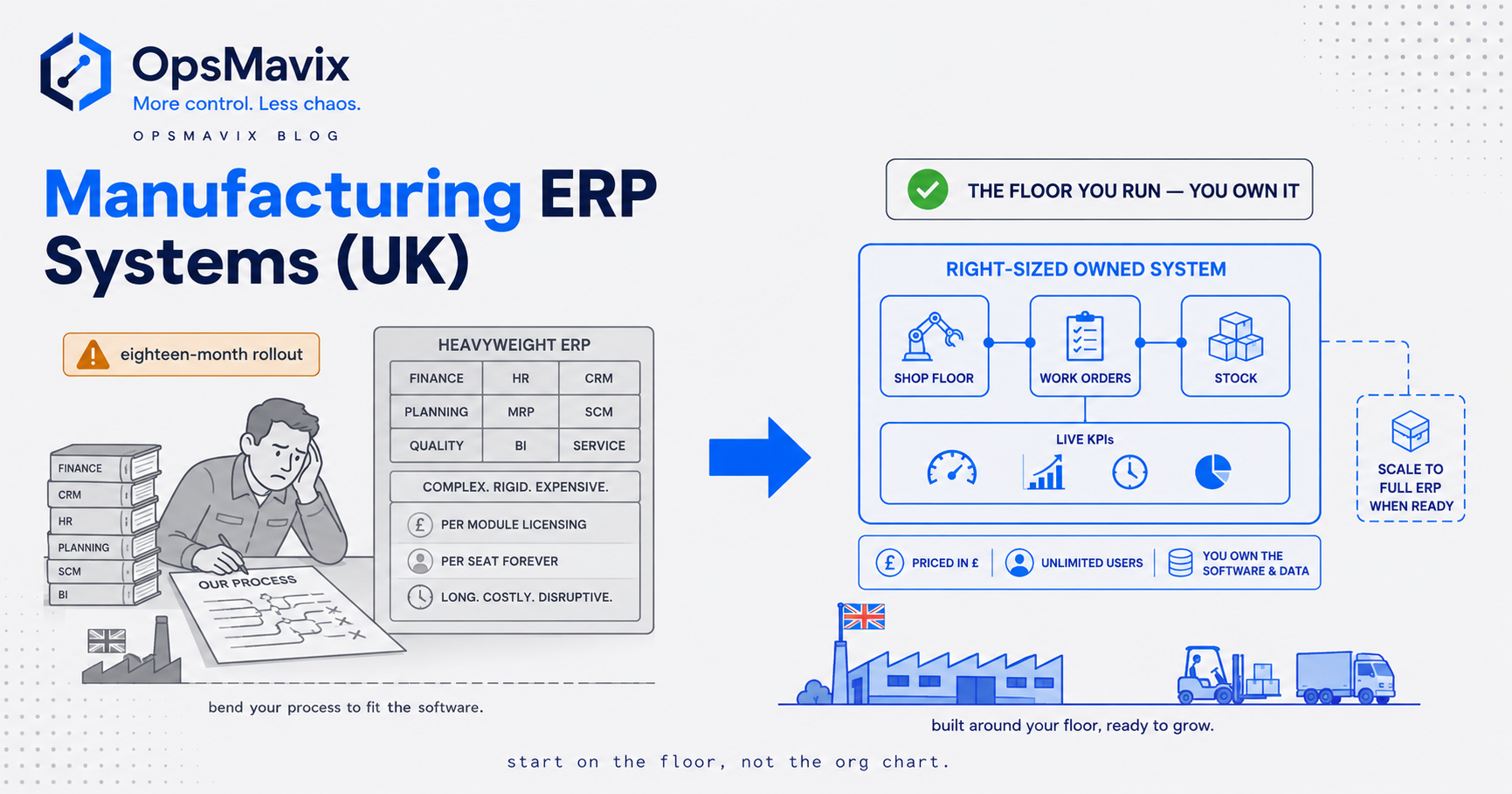
Manufacturing ERP systems in the UK are enterprise software suites that tie together stock, purchasing, production, costing and reporting so a factory runs from one set of numbers instead of a dozen disconnected files. The label covers everything from SAP and Epicor down to Sage 200 and a long list of UK resellers who configure them. If you make things for a living and you have outgrown spreadsheets, this is the category most people point you at, and it is usually the first search you run.
The trouble is that “manufacturing ERP” is sold as one decision when it is really two. The first is whether your operation genuinely has the complexity a full ERP is built for. The second, quieter one is whether the few problems actually costing you money need all of it, or three or four parts of it. A lot of UK shops answer the first question with a reflex “yes”, sign up for a platform priced and scoped for a factory twice their size, and spend two years and a five-figure budget solving a handful of floor-level leaks that never needed the machinery.
What Manufacturing ERP Systems Actually Do
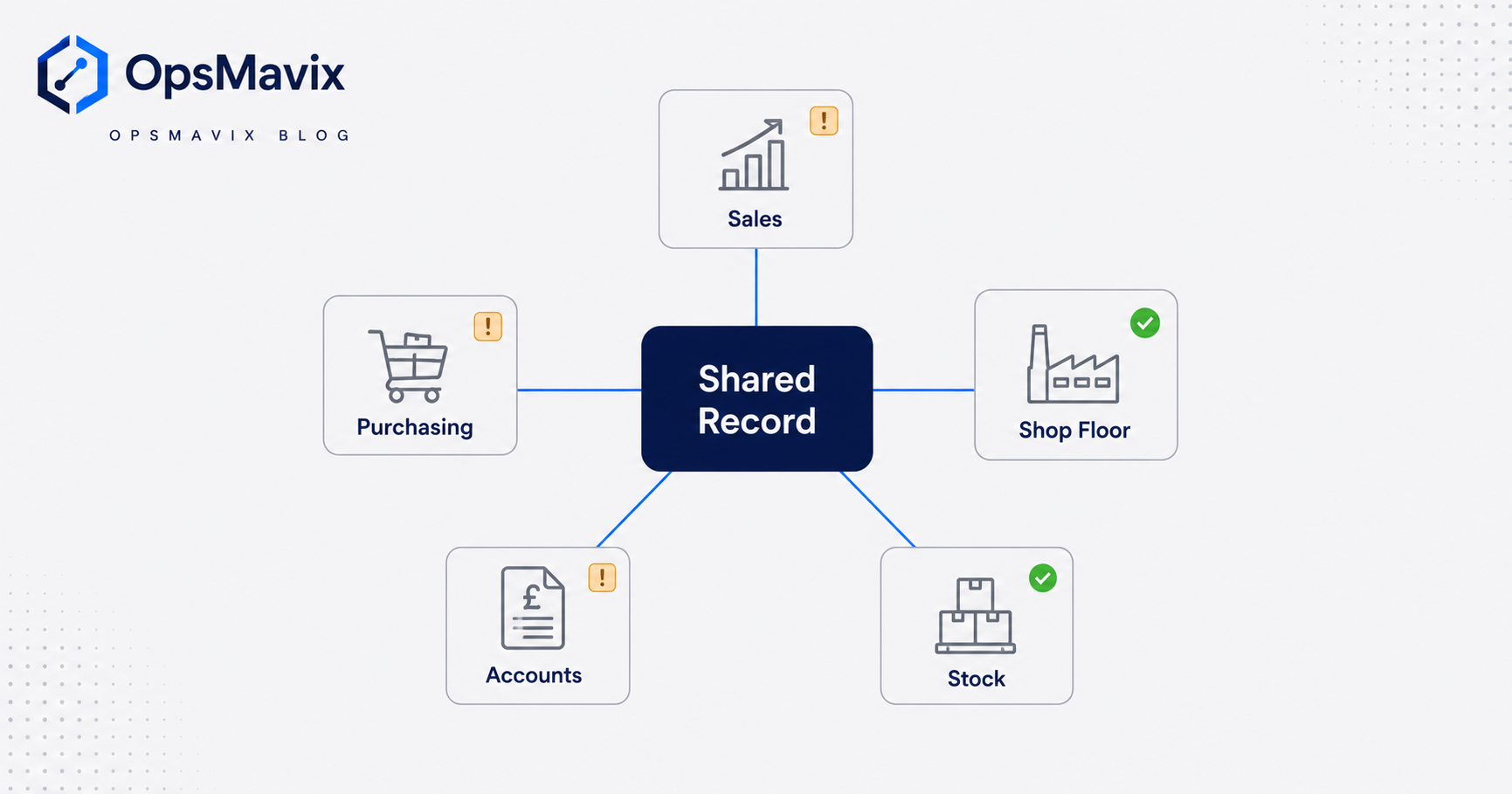
Strip away the branding and a manufacturing ERP does one core job: it holds a single, shared version of the truth about your business, and lets every function read and write to it. Sales enters an order, and the same record drives a works order on the floor, a material requirement in purchasing, a stock movement in the warehouse and a cost line in the accounts. Nothing gets re-keyed. When it works, the value is that everyone is looking at the same numbers at the same time.
On top of that spine sit the manufacturing-specific modules. As the UK guide from ERP Research puts it, these systems are built to “handle complex bills of materials, production scheduling, quality management, and shop-floor execution”. In practice that means material requirements planning, bills of materials, routings that sequence work across machines or benches, capacity and scheduling, shop-floor confirmations and quality checkpoints. The bigger platforms add finance, CRM, warehouse management and analytics in the same suite.
For a factory with dozens of people on the floor, multi-level assemblies and real scheduling constraints, that breadth is the point. The whole operation on one system, costed and planned end to end, is a serious advantage. The question is never whether the software is good. It is whether the complexity you would be adopting matches the complexity you actually run.
The Overbuy Risk: The Leak UK Shops Rarely Price In
Here is the part the sales process is not built to tell you. Most manufacturing ERP is priced and scoped for the top of its range, and a smaller shop pays for a lot of capacity it will never use.
The UK numbers are blunt. The HBP Group puts a small-business ERP project at £15,000 to £50,000 for year one, mid-sized at £50,000 to £250,000, and enterprise past £1 million, with per-user monthly licences running £30 to £300 and up. Those licences do not stop. You pay them per seat, every month, for as long as you use the system. A UK implementation guide from Leadership Services puts a small UK manufacturer (£1m to £10m turnover) at £3,000 to £25,000 all in for year one, and warns the real cost typically lands 25 to 50 percent above the vendor quote once customisation and internal time are counted.
Then there is the failure rate. Research compiled by Godlan from Panorama Consulting and Gartner data found that 73 percent of discrete manufacturing ERP projects fail to meet their objectives, with average budget overruns of 215 percent and timelines running roughly 30 percent long. Discrete manufacturing fails harder than almost any other sector, because the modelling is fiddly and the shop keeps changing under the software.
The leak is not that ERP is bad. It is paying enterprise prices, carrying per-seat licences forever, and absorbing a project with a two-in-three chance of missing its goals, all to fix a few floor-level problems a much smaller intervention would have closed. Overbuying feels safe because it is thorough. It is one of the more expensive mistakes a UK manufacturer can make.
MRP, BOM and Scheduling: What You Are Really Buying
The three engines under most manufacturing ERP are worth understanding on their own terms, because they are where the depth lives and where the overbuy usually hides.
MRP (material requirements planning) looks at demand, current stock, lead times and bills of materials, then tells you what to buy and make and when. It earns its keep when you have many components, variable lead times and enough SKUs that working it by hand is genuinely error-prone. If you buy a short list of materials from a handful of suppliers, MRP is solving arithmetic you could do on a whiteboard.
Bills of materials (BOM) define exactly what goes into each product, at every level. A single-level BOM is a straightforward list. The reason full ERP BOM tools get heavy is multi-level explosion, where sub-assemblies feed sub-assemblies that feed a finished product three or four layers deep, plus revision control and effective dating. That machinery is real value if your products are built that way, and dead weight if your BOM is one level of material in, one product out.
Scheduling and capacity sequence work across machines, benches or cells against finite capacity. This is where the biggest platforms justify themselves, and also where buyers should read the small print. Plenty of ERP scheduling assumes infinite capacity by default and simply sets dates from lead times, and true finite, constraint-based sequencing is often a paid add-on or a separate module. If your scheduling decision is “what runs on the two machines next week”, you are buying an aircraft cockpit to drive to the shops.
The pattern across all three is the same. Each answers a real manufacturing problem. The honest question is how many of those problems you have, and how deep they go. A shop that has one of the three at any depth is a different buyer from a shop that has all three.
The Honest Three-Way Comparison
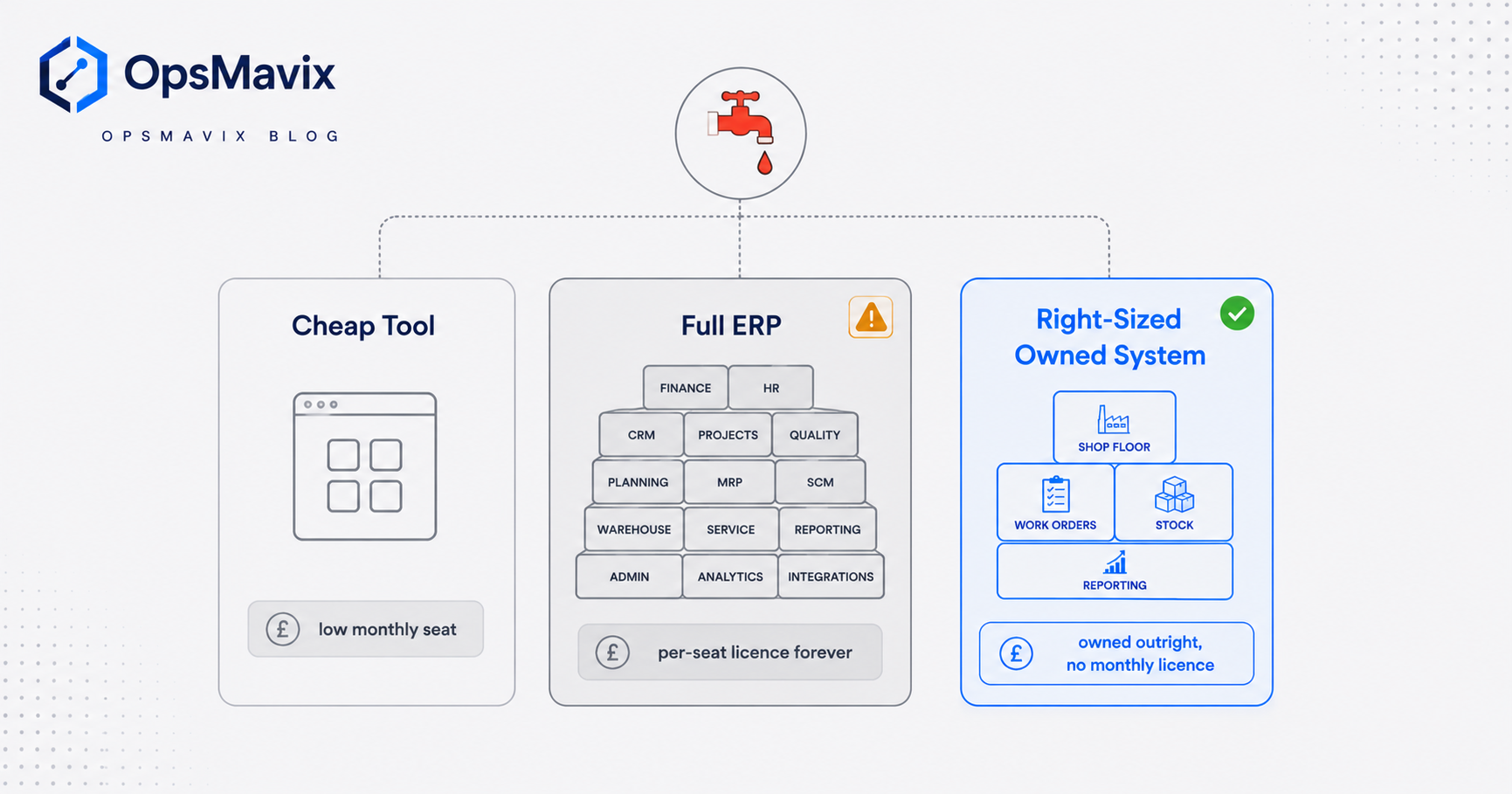
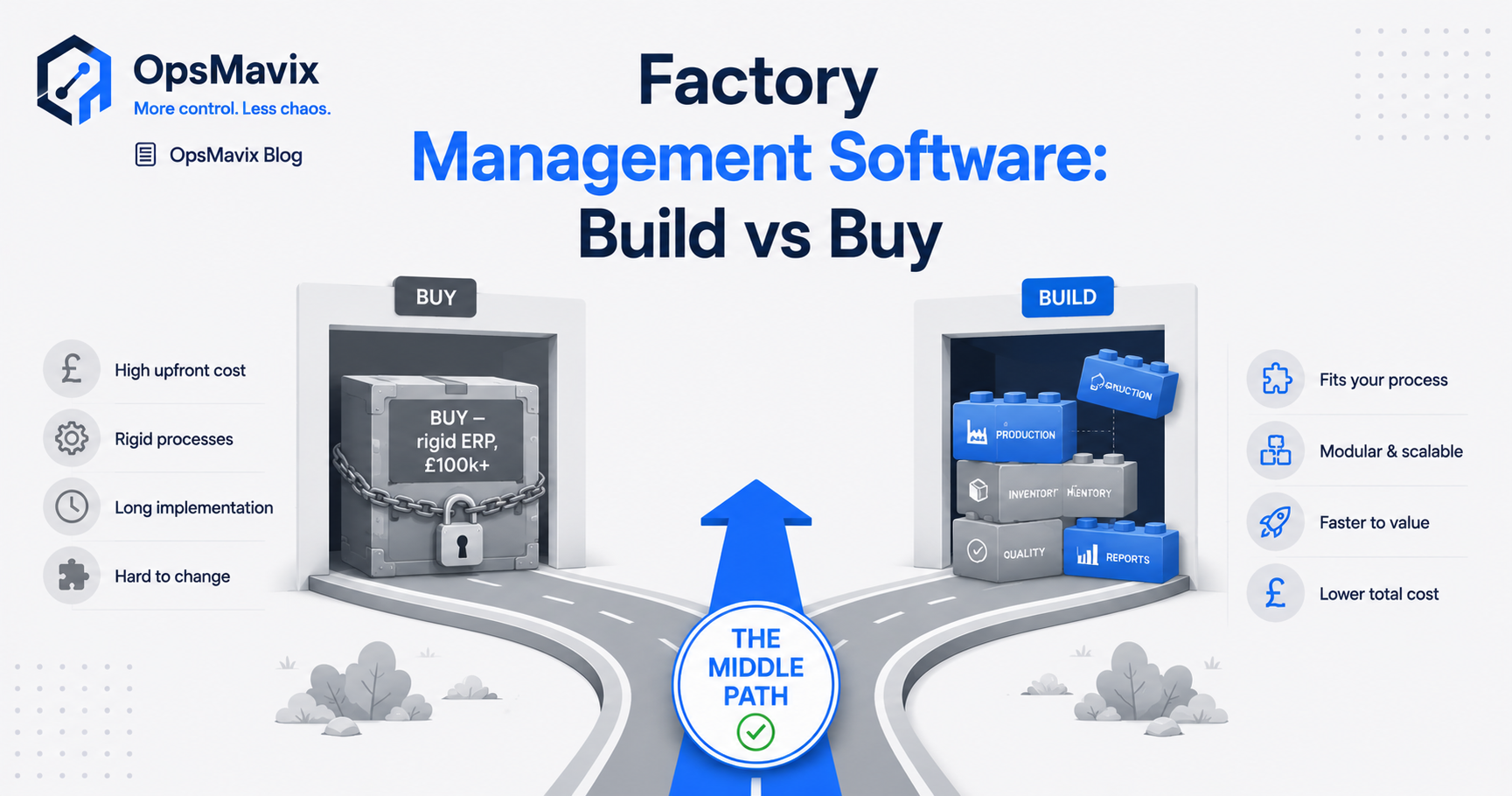
There are really three ways to fix operational pain in a UK manufacturing business, and the right answer is the cheapest option that actually closes your specific leak, not the most complete one.
| Generic / cheap tool | Full manufacturing ERP | Right-sized owned system | |
|---|---|---|---|
| What it is | Off-the-shelf inventory, stock or MRP app (often £30 to £150 per user per month) | Enterprise suite: SAP, Epicor, Sage 200, Dynamics and UK resellers | An operations system built around how your shop already runs, expandable later |
| Fit | Fine until you outgrow it; you bend your process to the template | Does everything; you bend your process to the software’s model | Shaped to your actual process; holds the parts you use, not the parts you do not |
| Price shape | Low monthly per-seat, cheap to start | £15k to £250k+ year one, then per-seat licences forever | One build cost, owned outright, no per-seat licence to pay every month |
| Implementation | Days to weeks | 3 to 12+ months for manufacturing; 73% of discrete projects miss their goals | Weeks, scoped to the specific leaks first |
| Ownership / lock-in | Vendor controls features, pricing and data; can be repriced or retired | Vendor lock-in; you maintain it against updates and app dependencies | You own it; nothing a vendor can reprice or switch off |
| When it is right | Simple stock and orders, one location, no real production complexity | Genuine multi-level BOMs, finite scheduling, many sites or seats | outgrowing spreadsheets, a few clear leaks, not every part of an ERP needed yet |
None of these is the villain. A cheap off-the-shelf tool is the correct answer for a genuinely simple operation, right up to the day you outgrow it. A full ERP is the correct answer when your complexity actually matches its depth, and reaching for anything lighter would just push the mess back onto spreadsheets beside it. The mistake is buying tier three’s complexity to solve tier one’s problem. For a fuller treatment of the enterprise options, the guide to ERP software for the manufacturing industry walks the category, and the best ERP for manufacturing compares the named platforms head to head.
A Worked Example: A 12-Person UK Fabricator
The following is illustrative, not a claim about a specific client. The numbers are realistic UK figures used to show the shape of the decision.
Picture a 12-person metal fabrication shop turning over about £1.4m. They cut, weld and finish to order. Their pain is concrete and countable: jobs get quoted from memory, so margins wobble; nobody can say where a job is without walking the floor; stock of steel and consumables drifts from what the shelf actually holds; and material gets ordered late, so jobs stall waiting on delivery. Four leaks, all real, all costing money.
The full-ERP route quotes them a mid-tier manufacturing platform. Using the UK bands above, year one lands somewhere between £30,000 and £70,000 once configuration, data migration and internal time are counted, with per-seat licences of maybe £75 to £150 per user per month continuing forever after. For eight named users that is roughly £7,000 to £14,000 a year in licences alone, before support. Implementation runs six months at least, and the sector failure statistics say there is a meaningful chance it never fully lands. Most of the modules they are paying for, the finite scheduler, the multi-level BOM explosion, the quality gates, the CRM, address problems this shop does not have. Their BOM is one level. Their capacity plan is two welding bays.
The right-sized route starts from the four leaks. It builds a quoting tool that pulls real material and labour figures so margins stop wobbling, a live job-status board so the question “where is that order” is a glance not a walk, stock that decrements as material is consumed against one true figure, and a reorder prompt tied to lead times so steel is ordered on time. That is a scoped build measured in weeks, owned outright, with no monthly per-seat licence. When the shop later wins bigger contracts and genuinely needs routing and finite scheduling, those parts get added to the system they already own, rather than triggering a fresh migration.
The point is not that the ERP is bad. It is that this shop would be paying for a factory’s worth of software to fix four things, when four things is exactly what a right-sized manufacturing production tracking approach fixes without the tail of per-seat cost. Buy the cheapest thing that closes the real leak.
Integrations and Why Ownership Matters
Two practical points get skipped in most ERP pitches, and both favour thinking harder before you buy the whole platform.
The first is integrations. A manufacturing ERP is only useful if it talks to the tools you already run: your accounting package, your supplier portals, your shipping, your CRM. The big suites solve this by asking you to adopt their whole ecosystem, so the accounting and the CRM and the warehouse all live inside the ERP too. That is tidy if you want all of it. If you only wanted the production piece, you have just signed up to configure and maintain a stack of modules you never came for, and to keep them in sync every time something changes on the floor.
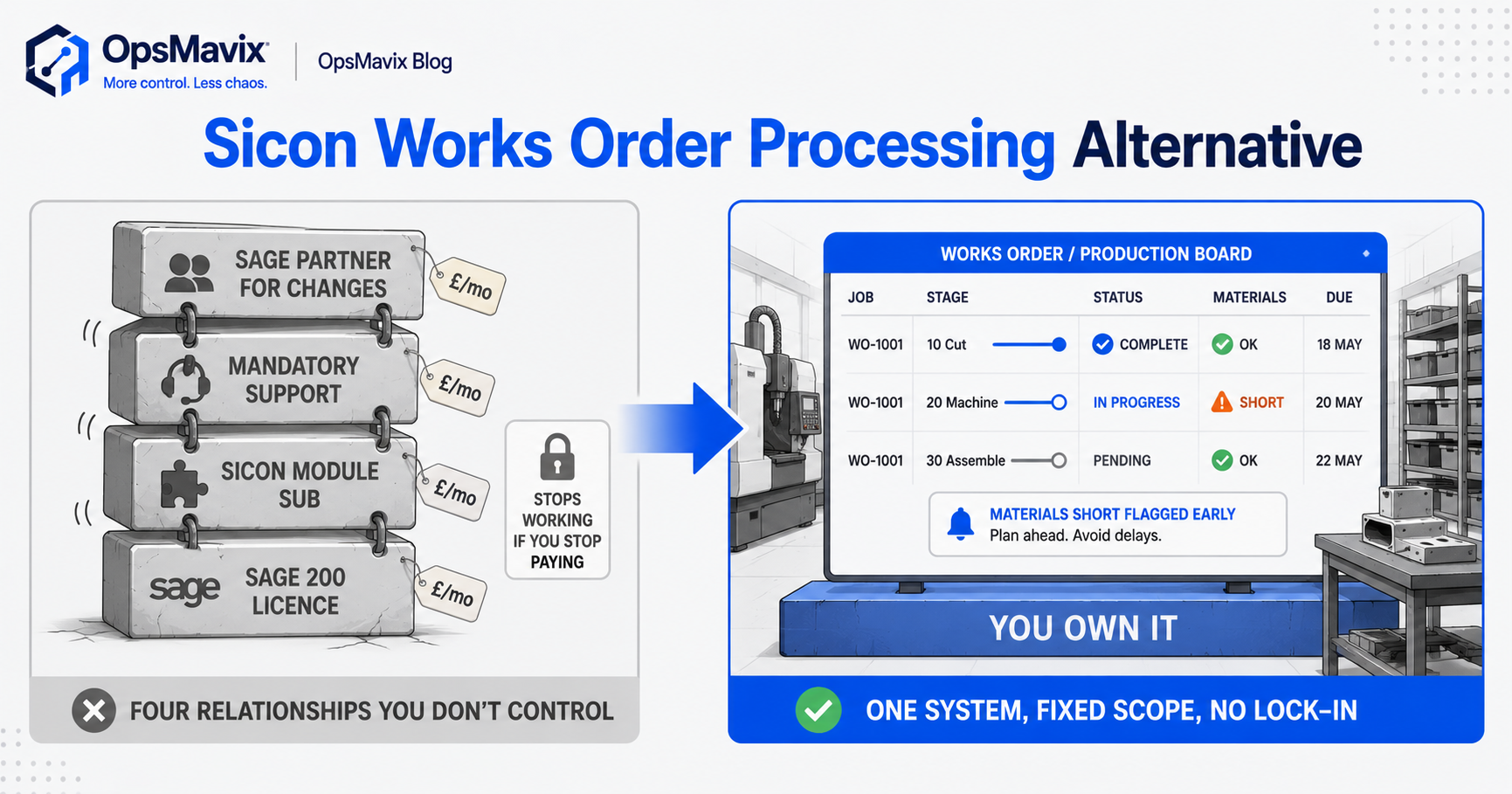
The second is ownership, and it is the one that compounds. With a full ERP you are renting. The vendor sets the roadmap, controls the pricing, owns the data model, and can reprice or retire features on their schedule, not yours, and every per-seat licence is a cost that grows as you hire. A right-sized owned system inverts that. The software is bent to fit your shop rather than your shop bent to fit the software, you own it outright, and there is no per-user licence draining every month. When your manufacturing genuinely outgrows the build, you expand what you own, and if you truly reach the tier that needs a manufacturing execution system, you will know because you will be hitting limits you can name.
FAQ
What is the difference between MRP and manufacturing ERP?
MRP is one engine, the part that plans materials and production timing from demand, stock and bills of materials. Manufacturing ERP is the whole platform that MRP sits inside, adding stock, purchasing, costing, scheduling, quality and often finance and CRM on one shared database. You can have MRP without a full ERP, and for a smaller shop that is frequently the more sensible starting point.
How much do manufacturing ERP systems cost in the UK?
For a small UK manufacturer, expect roughly £3,000 to £25,000 in year one at the lower end, and £15,000 to £50,000 for a fuller small-business project, with per-user licences of £30 to £150 a month continuing afterwards, according to Leadership Services and The HBP Group. Mid-sized projects run £50,000 to £250,000. Budget for the real figure landing 25 to 50 percent above the quote.
Do I actually need a full ERP, or just part of one?
Count your genuine complexity honestly. If you have real multi-level BOMs, finite scheduling constraints, several sites and many users, a full ERP fits. If you have a short list of specific leaks, one location and a single-level BOM, you probably need three or four capabilities, not all of them, and buying the whole platform means paying for and maintaining machinery you will never use.
Why do so many manufacturing ERP projects fail?
Research compiled by Godlan found 73 percent of discrete manufacturing ERP projects miss their objectives, with the biggest causes being weak change management, poor data migration and inexperienced teams. Discrete manufacturing fails harder than most sectors because the modelling is intricate and the shop floor keeps changing faster than the configuration can keep up.
Can a right-sized system grow into a full ERP later?
Yes. A right-sized owned system is built to be expanded. You start by closing the leaks that cost you money now, and add routing, finite scheduling, quality or multi-site capability when the business genuinely reaches for them, on top of the system you already own rather than through a fresh migration to a new platform.
How OpsMavix Can Help
Most UK manufacturers who search for an ERP do not need every part of one. They need a few specific leaks closed, and they have been quoted a whole platform to do it. OpsMavix builds a right-sized operations system shaped to how your shop already runs, covering the production, stock, quoting and reporting pieces that are actually costing you time and money, owned outright with no per-seat licence, and expandable into a fuller system if and when your complexity genuinely demands it. We recommend the cheapest thing that closes your real leak, even when that is not us. If you want to see exactly where your operation is bleeding time and money before you commit to any platform, Book a Free Operations Leak Audit.
Sources
- The HBP Group: What Is the Price of ERP?. UK ERP pricing bands in £ by business size, licences and total year-one cost.
- ERP Research: Manufacturing ERP Software UK. What manufacturing ERP covers (MRP, BOM, scheduling, quality) plus Sage 200 UK pricing.
- Leadership Services: ERP Implementation UK SME Guide. UK SME cost bands, timelines and the quote-versus-real-cost gap.
- Godlan: ERP Implementation Failure Statistics. Discrete manufacturing failure rate (73%) and budget overrun (215%) from Panorama and Gartner data.
Keep reading
Getting value from OpsMavix? Add us as a preferred source on Google — you'll see more of our operations content in your AI Overviews, AI Mode and Search.