Factory Management Software: Build vs Buy
The real build-vs-buy decision for running a factory — cost, fit, lock-in and timeline — and why the middle path beats both a £100k ERP and another spreadsheet tab.
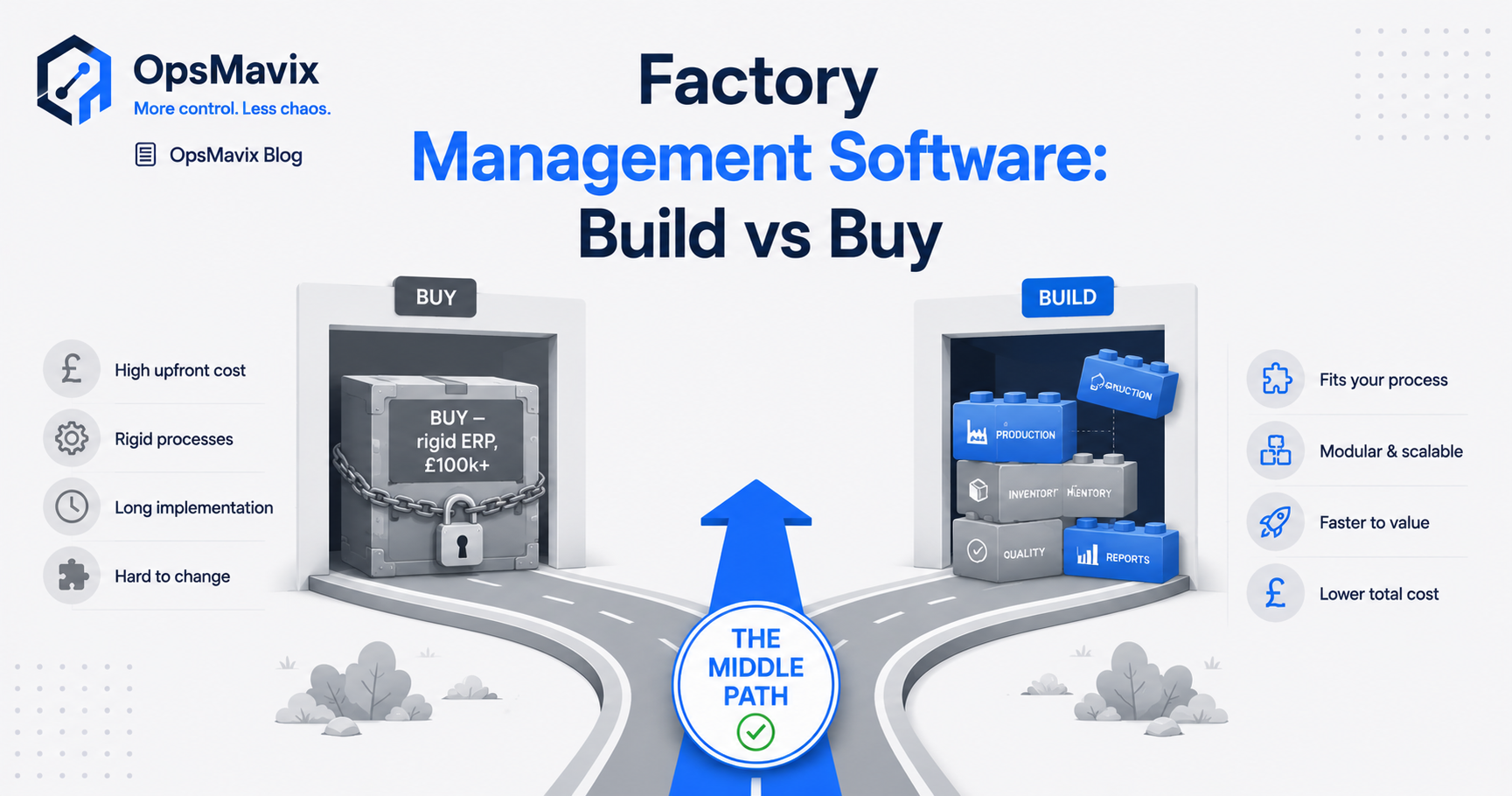
Factory management software runs your floor — production status, stock, orders and reporting — in one place instead of across whiteboards, spreadsheets and people’s heads. The build-vs-buy question actually has three answers: buy an off-the-shelf suite, build something custom, or do nothing and keep paying the spreadsheet tax. For most factories too big for spreadsheets but not yet ready for an ERP, the right answer is the one nobody quotes them: a custom system sized to how the floor already runs.
Owners usually get shown a false choice. Either an enterprise platform that costs six figures and reshapes the business, or carry on as you are. There’s a practical middle, and on a factory floor it’s usually where the control lives. Here’s how to make the call properly.
Key Takeaways
- “Buy” usually means an ERP or MRP: powerful, expensive, slow, and you bend the factory to fit it.
- “Build” means a system shaped to your floor: scoped, owned, and live in weeks.
- The real comparison is cost, fit, ownership and timeline — not the feature grid on a brochure.
- Off-the-shelf often leaves you paying for modules you half-use and renting the platform forever.
- For a factory caught between spreadsheets and a £100k suite, build the middle path: start with one area, prove it, expand.
1What “Buy” Actually Means for a Factory
Buying factory management software almost always means an ERP or a heavyweight MRP — one big integrated suite covering production, stock, finance and procurement from a single vendor. The breadth is the pitch. It’s also the trap: you pay for, learn and maintain far more than your floor needs, then adapt proven workflows to the software’s one way of doing things.
One factory owner we spoke to had already walked this road and recoiled. His verdict on the suite he was quoted: “We spent $100,000 to get the software and now have to pay $38,000 a year for a system where we don’t even use half the functions.” That’s the buy decision in a sentence. Enterprise money — well north of £80k up front, then tens of thousands a year — to half-use a system that doesn’t fit how he runs.
2What “Build” Actually Means
Building doesn’t mean hiring a developer to vanish for a year. It means a focused system shaped around how your factory already works — the production status, stock levels and order flow you actually run on, connected into one source of truth, minus the modules you’ll never open. You get the capability the floor needs, in the language the floor uses, owned by you.
This is the option most owners never see, because the people quoting them sell suites, not fit. The same owner put the gap plainly: “QBO is too small, NetSuite is too expensive. What’s a middle ground?” A proper build is that middle ground.
3Cost: The Quote Is Not the Price
The headline licence is the smallest part of an enterprise rollout. Implementation, consultants, customisation, per-seat fees and annual increases stack on top, and the number you’re shown rarely survives contact with go-live. As he said after a Dynamics quote: “the original quoted price is vastly different from the price once… implemented.” That uncertainty is the real cost.
A scoped build inverts it. Map the problem first, then price it to a fixed scope — typically thousands to low tens of thousands for the specific leaks you’re closing, not six figures on an open meter with a renewal escalator. The number is the number.
4Fit: High-Mix Floors Break Rigid Software
This is where most factory rollouts quietly fail. Off-the-shelf suites assume one model of how a factory “should” run, and a high-mix, low-volume shop doesn’t run that way. So either you re-engineer proven processes to suit the software, or the floor ignores it and reverts to the whiteboard — and the spend is dead.
It happens even with the lighter MRP tools. One manufacturer who trialled a niche system found it “as flexible as a wooden door” and was still doing “manual input… despite paying high dollars” — so the lads went back to the wall. A built system starts the other way round: from your routings, your work centres, your exceptions. The point of live production tracking is to mirror the floor as it is, not as a template imagines it. When the software matches reality, operators trust it. When it fights reality, they route around it.
5Ownership: Who Holds the Keys
Buy, and you’re usually renting access — locked to the vendor, the per-seat pricing, and your data on their terms. Worse on the floor is the dependency: every change means a partner or a VAR on an hourly rate. One owner’s view of that model was blunt: “this whole partner driven industry is a robbery really!!” He’d decided he would never again be hostage to consultant rates for a system he supposedly owned.
A custom build is handed over. You own the system and the data outright. No lock-in, no per-seat fees, no hostage data, no VAR standing between you and a small change. For an owner who’s been burned by the partner model, that independence often decides it, not the price.
6Timeline: Weeks of Value vs a Year of Waiting
Enterprise factory rollouts routinely run a year or more, and plenty stall before they’re fully live — while you keep paying and keep running the old way. A focused build lands useful capability in weeks because it’s scoped to the leaks that hurt, not the entire supply chain.
The way to keep that timeline honest is to refuse to boil the ocean. Don’t instrument the whole factory on day one. Pick the cell or line where the dropped balls cost most — usually the one where a job “falls off the plan and only gets noticed when a customer calls” — get reliable production status and stock there, and prove it. The same stale-data problem that wrecks schedules also wrecks stock; see why stock never matches the system.
7So: Build or Buy?
Decide by the problem in front of you, not the biggest tool on the shelf. If you’re a genuinely large, multi-entity manufacturer with deep integrated needs across many departments, an enterprise suite can earn its weight. If you’re a growing factory with a handful of connected pains — production you can’t see, stock that’s wrong, orders chased by hand — a right-sized build solves that faster, cheaper, and in a way you own.
Most factories asking “build vs buy” sit firmly in the second camp. They’ve only ever been shown the first. If scheduling is your sharpest pain, start there — manufacturing scheduling software for small shops or factory scheduling software vs the whiteboard.
FAQ
Should I build or buy factory management software?
Buy an enterprise suite only if you’re a large, multi-entity manufacturer with deep needs across many departments. For most growing factories, building a custom system scoped to your specific pains — production tracking, stock, orders — is cheaper, faster, fits your floor, and is owned by you outright.
Isn’t custom factory software more expensive and risky than an ERP?
Usually the opposite. ERPs run into six figures with consultants, per-seat fees and annual hikes, and the quote often understates the real cost. A custom build is scoped to a fixed price for one defined problem and delivered in weeks, so the risk is smaller, not larger.
What should factory management software actually do?
Show live production status, keep stock accurate, manage orders, and report on all of it in one place, kept current as work moves on the floor. A focused system covers exactly that without the procurement and finance breadth of a full suite you’ll half-use.
Will the people on the floor actually use a built system?
That’s the design goal. Off-the-shelf software fails most often because it’s rigid, the floor won’t touch it, and the data rots. A system built around how the floor already works, updated in seconds, is one operators trust and keep using.
How long does it take to get factory management software working?
Starting with one cell or line, a useful, trusted system lands in weeks, not the year or more an enterprise rollout typically takes before you see any return. Stock, despatch and reporting connect once the first area is solid.
How OpsMavix Can Help
OpsMavix builds the middle path: custom factory management systems for manufacturers too big for spreadsheets and not ready for an ERP. We map how your floor runs, then build connected production tracking, stock and reporting — fixed scope, live in weeks, yours to own, no lock-in and no VAR.
If you’re stuck between spreadsheets and a six-figure suite you’d half-use, that gap is costing you in rush jobs, wrong stock and lost trust. Book an Operations Leak Audit and we’ll map what your factory actually needs — and what you don’t.