
Manufacturing and Inventory Management Software: One Set of Numbers
Manufacturing and inventory management software only works when stock and the shop floor share one set of numbers, tracking raw materials, WIP and finished goods against a BOM. This is an honest look at the combined system for firms outgrowing spreadsheets and disconnected tools.
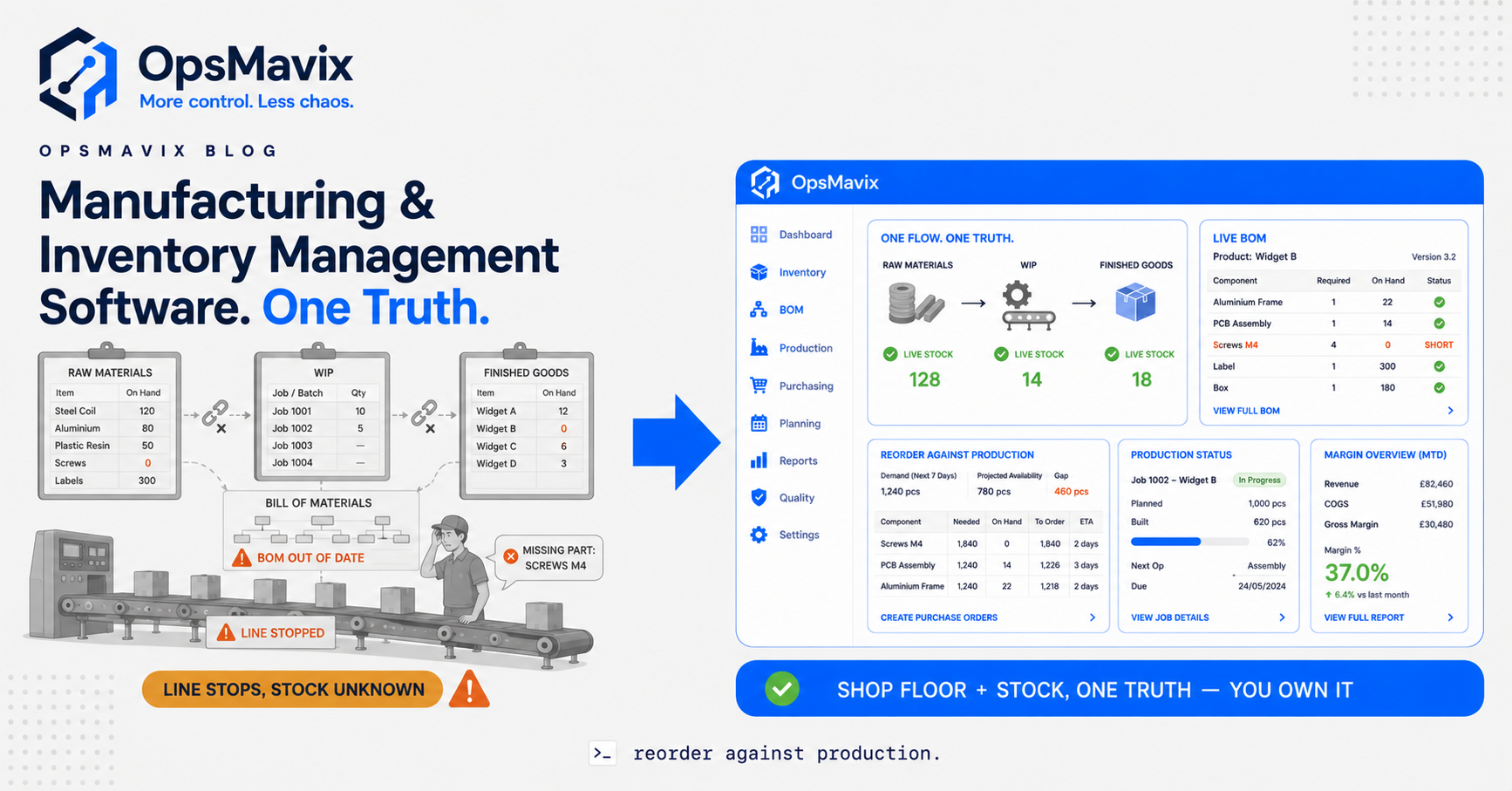
Manufacturing and inventory management software is meant to do one deceptively hard thing: keep the shop floor and the stockroom telling the same story. Most tools sold under that name do only half of it. They are either an inventory tool that counts boxes but has no idea what production is doing to those boxes, or a production tool that schedules jobs but treats stock as somebody else’s problem. Run both, and you now have two systems that disagree about how much steel, how many components, and how much finished product you actually have.
The pain is not that either system is wrong on its own. It is the gap between them. Raw materials get consumed on the floor, but the inventory count does not move until someone remembers to adjust it. A job finishes, but finished goods do not appear in stock until a manual entry catches up. You reorder against yesterday’s numbers while today’s production has already eaten the shelf. The result is the thing every growing manufacturer knows too well: confident numbers on two screens that quietly contradict each other, and nobody sure which one to trust when a customer is on the phone.
Quick summary: When production and stock live in separate systems, shortages hide until they stop the line. An ERIKS survey of UK manufacturers found that more than 50% admitted to downtime driven by parts availability, and that 30% now say stock checks are never undertaken while 55% admit to “rogue spending or secret stashes, off book.” That is what a disconnected view of materials costs you: production stops because the number you trusted was never real.
Contents
- What a combined manufacturing and inventory system actually does
- The two-system split that breaks your numbers
- Tracking raw materials, WIP and finished goods against a BOM
- Generic tool vs full ERP vs owned system
- Integrations and why ownership matters
- A Worked Example: a UK contract manufacturer ends the line-stops
- FAQ
- How OpsMavix Can Help
- Sources
What a combined manufacturing and inventory system actually does
The whole point of a combined system is that a single event updates both worlds at once. When a job pulls 40 metres of steel and six castings, three things should happen in the same moment: raw-material stock drops by exactly that amount, those quantities attach to the job as work-in-progress, and your reorder logic re-checks whether you are now below the point where you need to buy more. No re-keying, no overnight lag, no spreadsheet reconciliation on a Friday afternoon.
Concretely, a real manufacturing and inventory management system tracks stock across the three states it actually exists in:
- Raw materials — what you buy in, valued at what you paid, decremented the instant it is issued to a job.
- Work-in-progress (WIP) — everything half-made on the floor right now, carrying the materials and labour already invested in it. This is the state generic inventory tools ignore entirely, because to them stock is either “in” or “sold.”
- Finished goods — completed product, added to sellable stock the moment a job is signed off, not whenever someone gets round to a manual entry.
Tie those three together against a bill of materials (BOM) and the system can answer the questions that matter: can I actually build this order with what I have, what do I need to buy and by when, and what is genuinely available to promise a customer today. That is the difference between an inventory tool that happens to sit near a factory and software built for the fact that your stock is constantly being transformed. For the stock-visibility half of the picture on its own, our guide to inventory management software for manufacturing goes deeper.
The two-system split that breaks your numbers
Most manufacturers do not choose two disconnected systems. They arrive at them. You start with an accounting or inventory tool because you needed to count stock. Later you add a production planner, or a job sheet, or a scheduling spreadsheet, because you needed to run the floor. Each was sensible on the day. Together they create a seam, and the seam is where your numbers go to die.
Here is how it plays out. Inventory says you hold 200 units of a component. Production has three jobs in progress that will consume 180 of them over the next two days, but that consumption is not reflected in stock until the jobs close. A new order lands, someone checks inventory, sees 200, and promises delivery. Two days later you are 160 short and buying on emergency lead times at a premium, or worse, the line stops. The inventory number was not lying. It just had no idea what the floor had already committed.
This is exactly why the ERIKS finding above bites: when more than half of manufacturers report downtime driven by parts availability, the root cause is rarely that the part was unbuyable. It is that nobody saw the shortage coming, because the system that knew what production would consume and the system that knew what was on the shelf were never the same system. Add the survey’s other numbers — a third of firms never physically checking stock, over half admitting to off-book “secret stashes” — and you have a picture of manufacturers hoarding buffers precisely because they do not trust their own figures. Safety stock becomes a coping mechanism for a data problem.
The cost shows up in three places at once: cash tied up in stock you over-ordered to feel safe, emergency purchasing when the buffer turns out to be fiction, and missed or late deliveries when it does not. None of it appears as a single line on a report. It leaks.
Tracking raw materials, WIP and finished goods against a BOM
The mechanism that fixes the seam is the bill of materials, used live. A BOM is simply the recipe: to make one of product X you need these quantities of these materials. Most manufacturers have BOMs somewhere — in a drawing, a spreadsheet, someone’s head. The upgrade is making the BOM the thing production runs against, so that issuing a job automatically reserves and consumes the right materials, and completing a job automatically produces finished goods.
Run that way, reordering stops being a guess. Instead of reordering against what is physically on the shelf, you reorder against what is on the shelf minus what committed jobs will consume — your true available-to-build position. When that position crosses a reorder point, the system flags the purchase before the shortage becomes a stoppage. That single shift, from reorder-against-stock to reorder-against-production, is the heart of what separates real manufacturing and inventory management software from an inventory app with a factory nearby.
It also makes WIP visible for the first time. Because materials attach to the job when they are issued, you can see the value and contents of everything half-made on the floor. That matters for month-end valuation, but it matters more operationally: you can tell a customer chasing an order exactly where their job is and what is still needed to finish it, without walking the floor to find out. This is the same principle behind good production tracking — capture what physically happened once, at source, and let stock, costing, and delivery promises all inherit it rather than each maintaining its own version. For the wider operational backbone this sits on, our production management system guide covers how scheduling, jobs, and stock fit together.
Generic tool vs full ERP vs owned system
There are three honest routes to putting stock and the shop floor on one set of numbers. Each suits a different firm, and the cheapest one that closes your real leak is the right one.
| Factor | Generic / cheap tool | Full manufacturing ERP | Right-sized owned system |
|---|---|---|---|
| What it is | An off-the-shelf inventory or job app | One integrated platform running the whole business | A focused system built around how you actually make and stock things |
| Raw materials, WIP, finished goods | Usually stock in/out only; WIP ignored | All three, deeply modelled | All three, scoped to your operation |
| BOM-driven reordering | Rarely; reorders against shelf, not production | Yes, full MRP | Yes, reorder-against-production where you need it |
| Stock and floor on one number | No — that is the gap | Yes | Yes, that is its whole purpose |
| Typical year-one cost | Low subscription | £15k–£200k+ for a UK SMB | Scoped to the workflow you fix first |
| Implementation | Days | Many months, disruptive | Weeks, staged |
| Fit to your process | Generic, fits loosely | You bend to fit the system | Built around your process |
| You own it | You rent it | You rent it, per seat/module, forever | You own it outright |
| Best for | Simple, low-mix production | Multi-site, deep-MRP, regulated | Growing firms between the two |
The fair read: if your production is simple, low-mix, and a cheap tool with a bit of manual reconciliation genuinely keeps up, stay there — do not spend money to solve a problem you do not have. If you are large, multi-site, and deeply regulated, a full ERP may earn its cost and its implementation pain. Most growing manufacturers are in the middle: too complex for the cheap tool’s blind spots, nowhere near needing to bend the whole business around an ERP. That is exactly where a right-sized owned system closes the leak without the six-figure project.
Integrations and why ownership matters
A right-sized system should slot into your stack, not demand you replace it. You probably run accounting in Xero, Sage, or QuickBooks, and it works — VAT, payroll, reconciliation, all fine. You are not looking to rip that out. So the sensible architecture is to keep the tools that already do their job and connect them: production and stock live in a system built for the floor, and costed, reconciled figures flow into the accounts through their API. Nobody re-keys the same number twice, and finance keeps the ledger it trusts. Where billing extras and supplier costs need tightening, an inventory automation system keeps the stock side moving without manual counts.
Two things matter more than any feature list. First, ownership. A full ERP is a platform you rent and bend your operation around; when the vendor raises prices, changes terms, or sunsets a module you depend on, that is your problem to absorb. A right-sized owned system is yours — built around your process, changed when you need it changed, with no per-seat meter running as you grow. Second, staging. You do not have to boil the ocean. Start with the single gap bleeding you most — usually the reorder-against-production blind spot that keeps stopping the line — prove the number, then connect the next piece. That is how you build toward a fully integrated manufacturing and inventory system without a big-bang go-live, and you can still grow all the way to a full ERP later if the business genuinely demands it.
A Worked Example: a UK contract manufacturer ends the line-stops
Marsden Components (illustrative — not a claim about a specific client) is a 30-person contract manufacturer in the Midlands making machined parts for industrial customers. They ran a cloud inventory app for stock and a separate scheduling spreadsheet for jobs. Both were fine in isolation. The seam between them was quietly expensive.
An audit of a single quarter found the pattern:
- Line stops from phantom stock. Inventory showed components as available that in-progress jobs had already committed. Twice that quarter the line stopped waiting on parts that “should” have been there, each stoppage costing roughly £1,800 in idle labour and expedited freight. Call it £14,000 a year on shortages that better visibility would have caught in advance.
- Cash trapped in safety stock. Because nobody trusted the numbers, the buyer over-ordered as insurance. Around £40,000 of slow-moving raw material sat on shelves as a buffer against a data problem, not a demand one.
- Late finished-goods updates. Completed jobs did not hit sellable stock until a manual entry caught up, sometimes days later, so the sales side under-promised on product that was physically sitting on the pallet.
Marsden did not buy a full ERP and did not replace their accounting. They put in a right-sized owned system that runs jobs against live BOMs, so issuing materials decrements raw stock and attaches it to WIP in the same action, completing a job adds finished goods immediately, and reordering fires against true available-to-build rather than shelf count. Within the first month, the two line-stops-per-quarter pattern went to zero because shortages were flagged days ahead. The safety-stock buffer could be trimmed by roughly a third as trust in the numbers returned, freeing cash. Sales started promising against real finished-goods stock. The fix was not a platform. It was making one event update both worlds at once. (Figures are illustrative, not a client result.)
FAQ
What’s the difference between inventory software and manufacturing and inventory management software?
Plain inventory software counts stock as either in or sold — it has no concept of materials being transformed. Manufacturing and inventory management software tracks stock across raw materials, work-in-progress, and finished goods, and ties consumption to production via a BOM. The practical test: can the system tell you what is available to build, not just what is on the shelf? If it can only do the latter, it is an inventory tool, and the gap between it and your production reality is where shortages hide.
Do I need a full ERP to get this?
Usually not. Full ERP delivers deep MRP and integrated stock, but it is a large, disruptive project — year-one cost typically runs from £15,000 to well over £200,000 for a UK SMB, and you bend your business to fit the platform. If your real problem is a handful of workflows where stock and the floor disagree, a right-sized owned system closes that far faster and cheaper, and you can still grow toward ERP later if you genuinely need it.
How does BOM-driven reordering actually prevent stockouts?
Instead of reordering against what is physically on the shelf, the system reorders against your shelf quantity minus what committed jobs will consume — your true available-to-build position. When that crosses a reorder point, it flags the purchase before the shortage becomes a stoppage. That is the shift from reorder-against-stock to reorder-against-production, and it is what turns “we ran out mid-job” into “we bought it three days early.”
Will it work with Xero or Sage?
Yes — the point of a right-sized system is that it complements your accounts rather than replacing them. Production and stock live in the system built for the floor, and costed figures flow into the accounting tool through its API. Your accountant keeps the ledger they know; you gain stock and WIP numbers they never had. Nothing gets ripped out.
Can I start small instead of replacing everything at once?
That is the recommended approach. Start with the single gap costing you most — usually the reorder blind spot that keeps stopping the line — prove it works, then connect the next piece. Staging avoids a big-bang go-live and lets the system pay for itself before you extend it toward a fully integrated manufacturing and inventory setup.
How OpsMavix Can Help
OpsMavix builds owned, right-sized operations systems for UK manufacturers who are outgrowing spreadsheets but not looking to bend the business around a packaged ERP. We do not replace the accounting software that already works for you. We close the seam between stock and the shop floor: raw materials, WIP, and finished goods tracked against live BOMs through real production tracking, reordering that fires against what production will actually consume rather than yesterday’s shelf count, and finished goods that appear in sellable stock the moment a job is signed off — so everyone finally works from one set of numbers. We start with a free Operations Leak Audit to find where materials and production leak time and money, build a system around the single gap bleeding you most, and grow from there. If you genuinely need a full ERP, we will tell you honestly before you spend a penny. Book a Free Operations Leak Audit
Sources
- The Manufacturer (reporting the ERIKS “Lost in Production” survey of UK manufacturers): more than 50% admitted to downtime driven by parts availability; 30% say stock checks are never undertaken; 55% admit to rogue spending or off-book “secret stashes.” https://www.themanufacturer.com/articles/industry-driven-by-spare-parts/