
Fit-Out Job Costing Software: UK Contractor Guide
See forecast margin on every fit-out job before final account. A UK guide to package costing, CIS, reverse charge VAT and a worked GBP example.
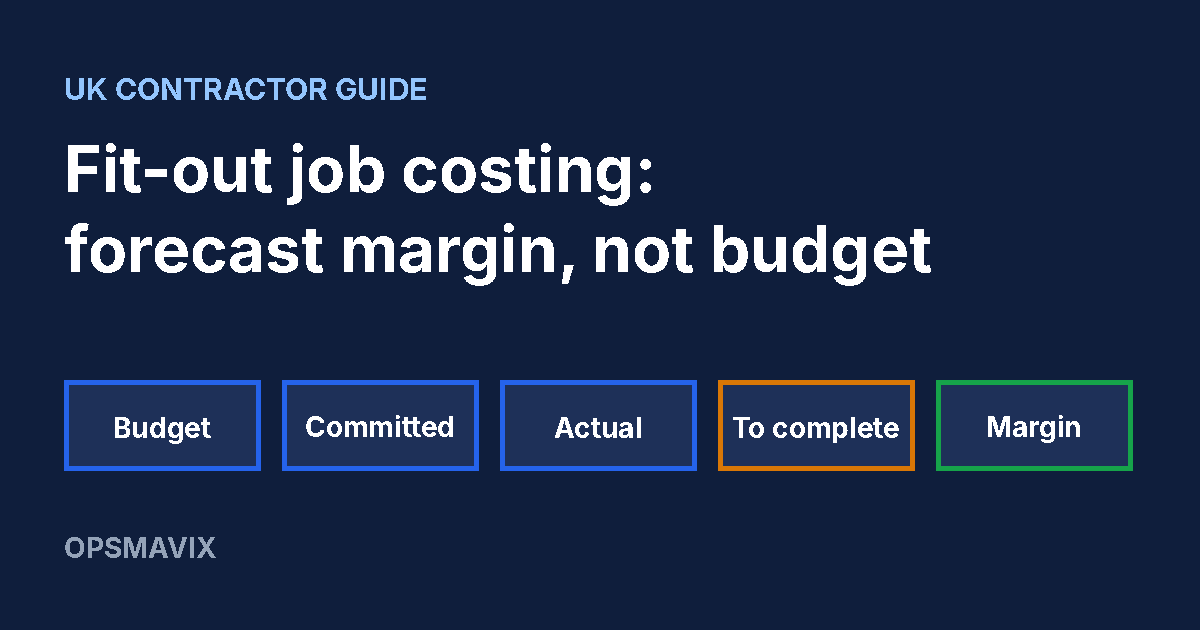
Fit-out job costing software tracks each fit-out contract’s cost and value by package, so you can see forecast margin while the job is still running, not after final account. It brings together the budget, orders already placed, labour and supplier costs, variations and the forecast cost to complete in one view.
Most fit-out firms already know their margin at tender. The problem is what happens next. Partitions overrun, an M&E package picks up extras, the client instructs changes on site, and supplier invoices arrive weeks late. The spreadsheet still shows the tender margin because it compares actual cost with the original budget rather than with a forecast.
This guide covers what to track on a fit-out job, a worked GBP cost-value example, the UK-specific points the software must handle, how to compare options and what implementation involves.
Why fit-out margins disappear mid-job
Fit-out work has a particular cost shape. A typical office or retail fit-out runs several trade packages in parallel over a short programme, with heavy subcontractor use and frequent client changes. That creates five common leaks:
- Package overruns are spotted late. A partitions package can be 15% over before anyone compares it with budget, because labour and materials are booked to the job, not the package.
- Committed cost is invisible. Orders and subcontracts already placed do not appear in the accounts until the invoice arrives.
- Variations are carried out before they are agreed. Work instructed on site is costed, but the value is uncertain until the variation is approved.
- Forecasts are not updated. The “cost to complete” is the original budget minus spend to date, which assumes the remaining work will go exactly to plan.
- Time is not tied to the job. Site hours are recorded for payroll, not against packages, so labour overruns are hidden. Our timesheet software guide covers that capture problem in detail.
What fit-out job costing software should track
The four cost columns per package
Every package (and preliminaries) needs the same four columns:
| Column | What it means | Where it comes from |
|---|---|---|
| Budget | The cost allowed at tender, plus budgets for approved variations | Estimate, variation log |
| Committed | Orders and subcontracts placed but not yet invoiced | Purchase orders, subcontract orders |
| Actual | Costs incurred and recorded | Timesheets, supplier invoices, subcontractor applications |
| Forecast to complete | The cost still expected to finish the package | The package manager’s updated estimate |
Forecast final cost = actual + committed (not yet invoiced) + forecast to complete. Compare that with budget and with agreed value, not just actual against budget.
Value and variations
On the value side, track:
- the contract sum;
- approved variations (instructed and agreed);
- unapproved variations and claims (instructed or submitted, not yet agreed), kept separate;
- the value applied for and the value certified or notified in each payment cycle.
Mixing unapproved variations into value is the fastest way to overstate margin. Show them as an upside, not as part of the base forecast.
A typical fit-out package structure
| Package | Illustrative budget cost (£) |
|---|---|
| Strip-out and enabling | 18,000 |
| Partitions and ceilings | 96,000 |
| Mechanical and electrical | 118,000 |
| Joinery | 42,000 |
| Floor finishes | 31,000 |
| Decorations | 14,200 |
| Preliminaries | 42,000 |
| Total budget cost | 361,200 |
These are hypothetical figures for the example below, not benchmarks. Your package list should match how you estimate and how you buy.
Worked example: monthly cost-value reconciliation (GBP, illustrative)
This is a hypothetical Cat A to Cat B office fit-out used to show the arithmetic. It is not a client case.
At tender
- Contract sum: £420,000
- Budget cost: £361,200 (from the package table above)
- Tender margin: £420,000 − £361,200 = £58,800 (14.0%)
Approved variations by month 3
- Approved variation value: £18,000, with a budget cost of £13,500
- Revised value: £420,000 + £18,000 = £438,000
- Revised budget cost: £361,200 + £13,500 = £374,700
- Budgeted margin: £438,000 − £374,700 = £63,300 (14.5%)
That is the figure a budget-only spreadsheet would still be showing.
Month 3 forecast
| Item | £ |
|---|---|
| Actual cost posted to date | 198,400 |
| Committed, not yet invoiced | 36,800 |
| Forecast cost to complete | 152,600 |
| Forecast final cost | 387,800 |
- Forecast overrun against revised budget: £387,800 − £374,700 = £13,100
- Forecast margin on agreed value: £438,000 − £387,800 = £50,200 (11.5%)
Unapproved extras
The site team has carried out extra work instructed by the client, submitted at £12,000 but not yet agreed.
- If agreed in full: value £450,000, margin £450,000 − £387,800 = £62,200 (13.8%)
- If rejected: margin stays at £50,200 (11.5%)
The useful conversation is now specific: which packages are causing the £13,100 overrun, and what evidence is needed to get the £12,000 of extras agreed. Without the forecast, the job would have looked like a 14.5% job until final account.
UK-specific points your job costing must handle
Your accounting software and accountant handle the tax returns. Your job costing still needs to show the right numbers for each subcontract and each application, or the margin view will drift from what the accounts eventually say.
CIS deductions on subcontractor payments
Under the Construction Industry Scheme, contractors deduct from payments to subcontractors at 20% for registered subcontractors, 30% for unregistered subcontractors, and 0% for those with gross payment status, according to GOV.UK. The deduction is applied after taking off VAT and certain costs the subcontractor paid for directly, such as materials, consumable stores, fuel (other than for travel) and plant hire. Contractors must give the subcontractor a payment and deduction statement within 14 days of the end of each tax month.
Illustrative example (hypothetical): a partitions subcontractor invoices £24,000 excluding VAT, of which £9,000 is materials they bought directly.
| Subcontractor status | Amount the deduction applies to | Deduction | Paid to subcontractor |
|---|---|---|---|
| Registered (20%) | £15,000 | £3,000 | £21,000 |
| Unregistered (30%) | £15,000 | £4,500 | £19,500 |
| Gross payment (0%) | £15,000 | £0 | £24,000 |
For job costing, the cost to the job is still £24,000 in each case. The deduction is money withheld and paid to HMRC on the subcontractor’s behalf, not a saving. A system that books the net payment as the cost will understate the package cost.
VAT domestic reverse charge
Since 1 March 2021, the VAT domestic reverse charge applies to many building and construction services between VAT-registered businesses where the payment is reported under CIS. GOV.UK guidance says it applies to standard and reduced-rated services, and it does not apply where the customer has confirmed in writing that they are an end user or an intermediary supplier.
For fit-out contractors this often means VAT is handled differently on subcontractor invoices you receive and on your own invoices to the client, depending on who the client is. Your job costing should store costs and values net of VAT and flag which invoices are reverse charge, so that the margin view is not distorted by VAT that is accounted for differently.
Payment notices and applications
The Housing Grants, Construction and Regeneration Act 1996, section 110A, requires construction contracts to provide for a payment notice for every payment, given no later than five days after the payment due date, stating the sum considered due and the basis of calculation. If the contract does not comply, the Scheme for Construction Contracts fills the gap.
Practically, that means your system should keep, for each payment cycle, the value you applied for, the value notified or certified, the dates, and the difference. Those gaps are often where approved variations and disputed extras show up first.
Retentions
If your contracts hold retention, track the amounts retained on each application and the release dates or conditions set by the contract. Retention is cash you have earned but not received; showing it per job stops it being forgotten at practical completion and at the end of the defects period.
None of the above is tax or legal advice. Confirm treatment with your accountant and check the contract for each job.
How to compare fit-out job costing options
| Option | Works well when | Watch out for |
|---|---|---|
| Spreadsheet per job | A few jobs at a time, one person maintaining it | No committed cost unless someone keys every order; versions multiply; forecasts rarely updated |
| Accounting software project tracking | You mainly need actual cost against budget per job | Usually no committed cost, package forecasts or variation status; data arrives when invoices are posted |
| Construction ERP or suite | You want accounts, CIS, payroll and job costing in one platform | Implementation effort, per-user costs and the need to change how the business works; see our guide to ERP for the construction industry |
| Job costing dashboard over your existing tools | You want to keep Xero or QuickBooks and add live job margin | Needs a clear package structure and agreed data sources |
Questions to ask in any demo
- Can I see budget, committed, actual and forecast to complete per package on one screen?
- Can site managers update forecast to complete without editing the budget?
- Are approved and unapproved variations shown separately in value and margin?
- Does a CIS deduction leave the gross subcontract cost on the job?
- Can reverse charge invoices be flagged so VAT does not distort margin?
- Can I record applied, notified and paid values with dates for each payment cycle?
- Does site time arrive against the job and package, not just for payroll?
- Can I see month-on-month movement in forecast margin for each job?
Implementation considerations and costs
Getting the structure right
- Agree the package list used at estimate, buying and reporting. If they differ, the comparison breaks.
- Decide who owns forecast to complete for each package and when it is updated, usually monthly before the valuation.
- Link orders to packages at the point of ordering, so committed cost is automatic.
- Capture time on site against job and package, ideally on a phone.
Data you will need
The tender estimate by package, open purchase and subcontract orders, the variation log, payment applications and notices, and access to your accounting software for posted costs.
Costs and timescales
Costs vary widely by approach. A spreadsheet costs staff time; suites carry licence and implementation fees; a focused build costs a fixed amount upfront. OpsMavix publishes a starting price of £4,950 for one area on its project operations dashboard page, with fixed pricing confirmed in writing before the build. Check the page for current terms.
Limitations
- A forecast is only as honest as the person updating it. Software makes the gap visible; it does not close it.
- Job costing does not replace your CIS returns, VAT returns or management accounts.
- Data quality at the start, especially the package budget, determines how useful the margin view will be.
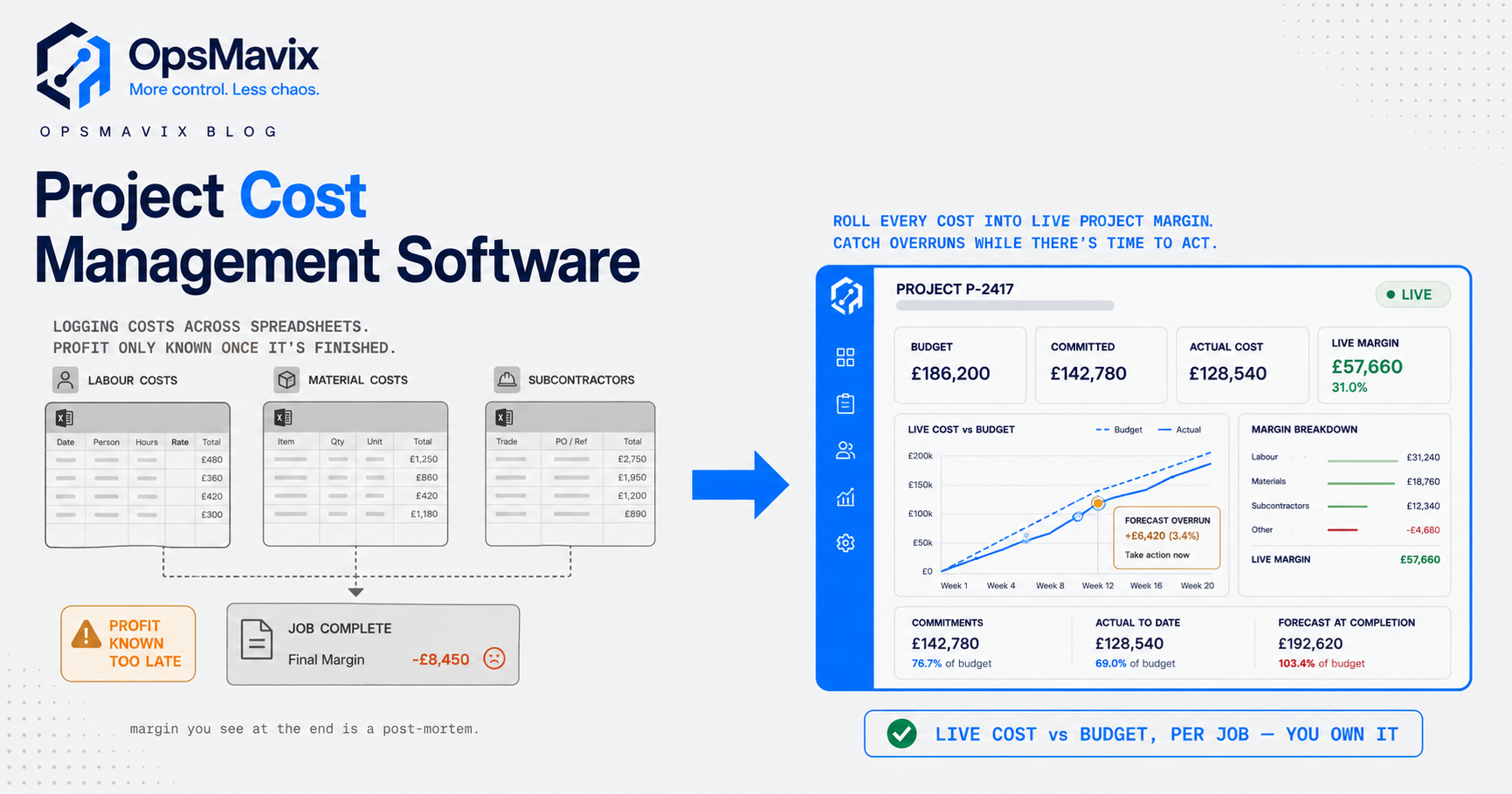
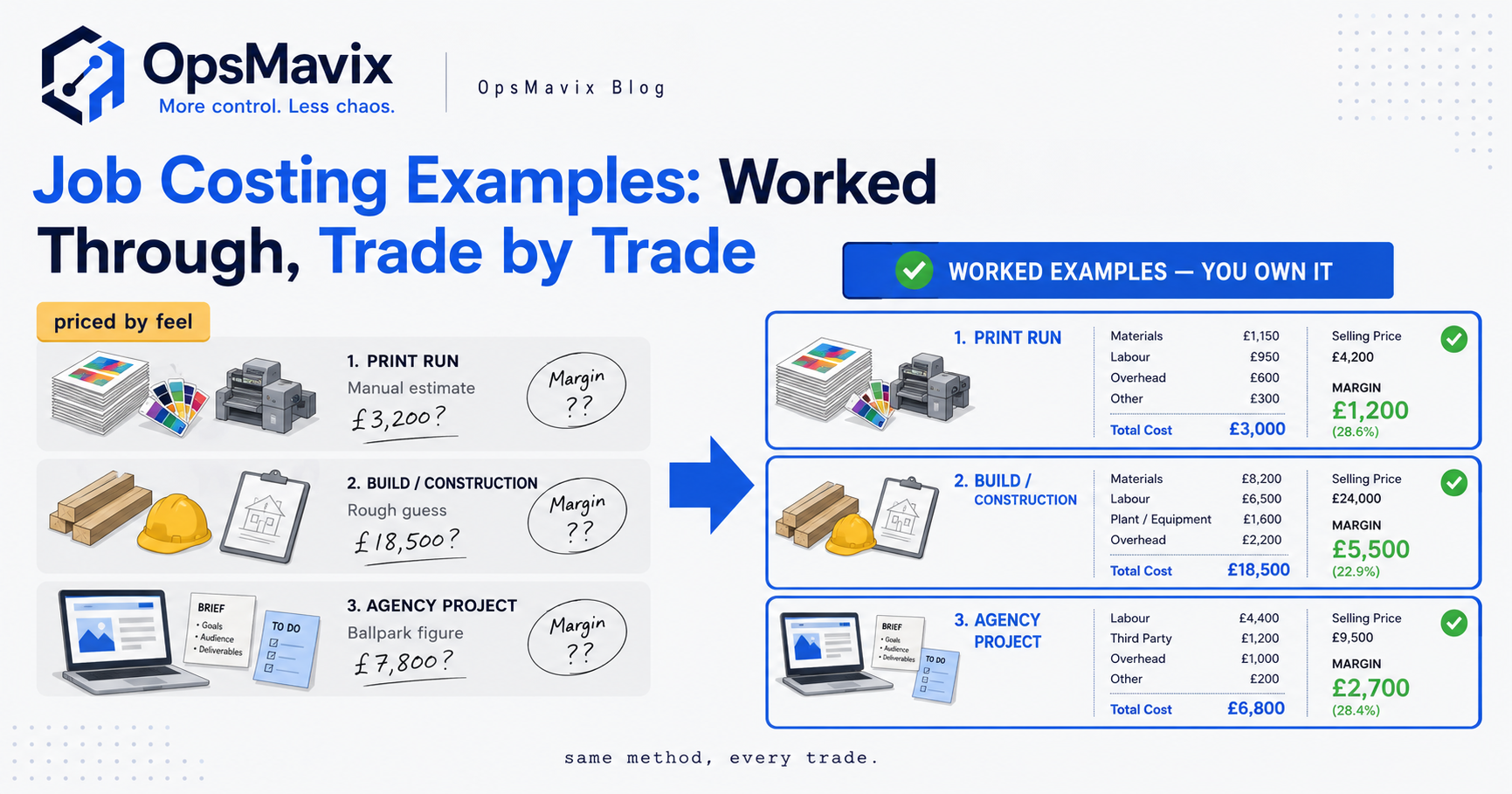
For a broader look at the category, see our guide to project cost management software, and for the arithmetic of costing individual jobs, our job costing examples.
Frequently asked questions
What is fit-out job costing software?
It is software that tracks the cost and value of each fit-out contract by trade package, combining budget, committed orders, actual costs, variations and forecast cost to complete so you can see forecast margin during the job.
What is cost-value reconciliation in fit-out?
Cost-value reconciliation (CVR) compares the value earned on a job with the cost incurred and forecast, usually monthly. It shows whether the job is on track for its margin and where the variance sits.
How should CIS deductions appear in job costing?
The job should carry the gross subcontract cost. The CIS deduction is withheld from the payment and paid to HMRC on the subcontractor’s behalf, so it does not reduce the cost of the work.
Does the VAT reverse charge affect job margin?
It should not, if costs and values are recorded net of VAT. Flagging reverse charge invoices helps avoid VAT being mistaken for cost or income in the margin view.
Can I keep using Xero or QuickBooks?
Yes. Many fit-out firms keep their accounting software for ledgers, VAT and CIS, and add a job costing layer that reads posted costs and adds committed cost, forecasts and variations.
How often should forecasts be updated?
At least monthly, ahead of each valuation or application. Fast jobs with short programmes may need fortnightly updates on the largest packages.
Is this only for large contractors?
No. The method matters most for smaller fit-out firms, where one overrunning job can take a large share of the year’s profit.
Conclusion
Fit-out job costing is not about recording more costs. It is about forecasting the final cost of each package honestly, keeping approved and unapproved value apart, and checking the result every month. Handle the UK specifics correctly, especially gross subcontract cost under CIS and VAT kept out of margin, and the forecast margin becomes a number you can act on while there is still time.
Start with one live job. Split the budget by package, add open orders as committed cost and ask each package lead for a forecast to complete. The gap between that forecast and the tender margin is your first answer.
See live job margin across every fit-out
OpsMavix builds a project operations dashboard for UK fit-out and field-service firms: live estimate-versus-actual per job, time, materials and extras captured from site, and one margin view across every job, sitting over Xero or QuickBooks rather than replacing them.
Bring one recent job where the final margin surprised you. We will show you where the forecast would have flagged it, and what a fixed-scope build would include.
Tell us what’s broken — we’ll show you the system we’d build.
Sources and further reading
- GOV.UK — What you must do as a CIS contractor: make deductions and pay subcontractors
- GOV.UK — How to use the VAT reverse charge if you supply building and construction services
- GOV.UK — VAT domestic reverse charge for building and construction services
- legislation.gov.uk — Housing Grants, Construction and Regeneration Act 1996, section 110A
- OpsMavix — Construction Financial Management Software
Keep reading
Getting value from OpsMavix? Add us as a preferred source on Google — you'll see more of our operations content in your AI Overviews, AI Mode and Search.