
Do You Need ERP Software for the Construction Industry? The Right-Sized Alternative
Most growing construction firms don't have a spreadsheet problem or an ERP problem. They have a control problem, and full ERP is often the wrong-sized fix. Here's an honest way to decide what you actually need.
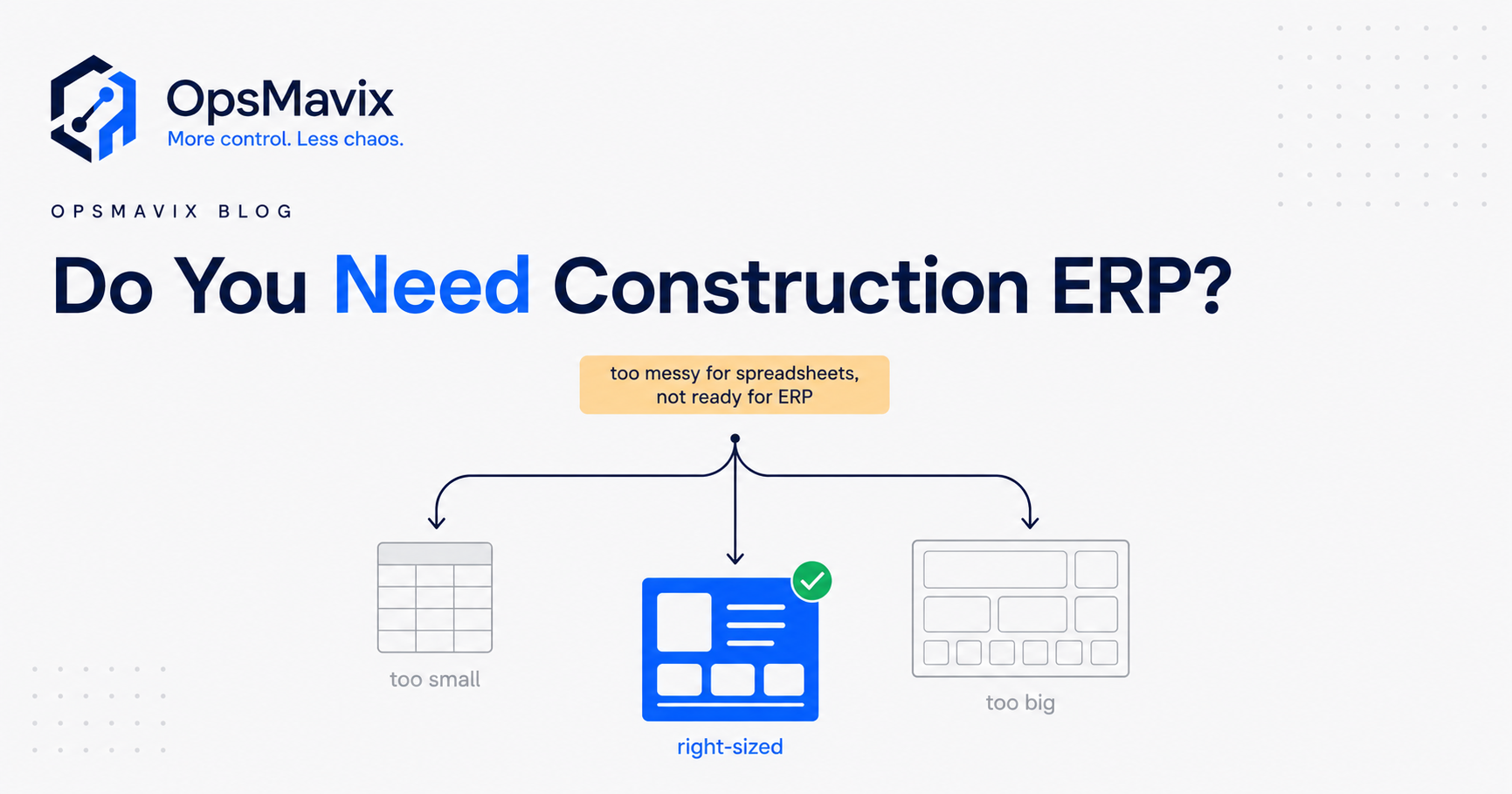
Probably not, and that is the honest answer most vendors will not give you. Before you spend six figures on ERP software for the construction industry, it is worth asking whether a full ERP is genuinely the right size for your firm, or whether a right-sized owned system would end the same pain for a fraction of the cost and disruption. This post gives you a framework to decide, not a sales pitch dressed as advice.
Quick summary: Construction is the largest sector by number of businesses in the UK, and the vast majority are small firms for whom a full ERP is expensive overkill (gov.uk Business Population Estimates). The real question is not “spreadsheets vs ERP” but whether you need enterprise software at all, or a right-sized system built around how your firm actually runs.
Contents
- Why “do I need construction ERP?” is the wrong first question
- What ERP software for the construction industry actually is
- Signs you have genuinely outgrown spreadsheets
- Signs a full ERP is overkill for your firm
- The middle ground: a right-sized owned system
- Decision table: your situation vs the three options
- A self-assessment checklist
- A worked example: a £4m groundworks firm
- What the right-sized alternative looks like in practice
- What it does not do (and when you really do need ERP)
- FAQ
- How OpsMavix can help
- Sources
Why “do I need construction ERP?” is the wrong first question
The pain is real. Job costs land weeks after the job is done. Someone re-keys the same figures into three spreadsheets. You cannot say which contracts are actually making money until the accountant closes the year. Retentions get forgotten. Two people quote off different price lists.
That pain pushes firms straight to “we need ERP.” But ERP is a category of software, not a solution to your specific mess. The better first question is: what decisions are we making late, blind, or twice? Answer that, and the size of the tool you need becomes obvious. Sometimes it is ERP. Far more often, for a UK contractor turning over £1m–£15m, it is not.
What ERP software for the construction industry actually is
ERP (Enterprise Resource Planning) is a single integrated platform that runs finance, payroll, procurement, project costing, plant, HR and more off one database. Construction-flavoured ERP adds industry features: CIS handling, retentions, applications for payment, subcontractor management, and job-level profitability.
On paper that is exactly what you want. The catch is the delivery reality. Enterprise ERP is built for enterprises: heavy configuration, long implementations, per-seat licensing, mandatory process change, and a consultant on the clock. You are buying a factory to make one part. For a large main contractor with hundreds of staff, that scale is justified. For a 30-person firm, it is usually a mismatch between the size of the tool and the size of the problem.
Signs you have genuinely outgrown spreadsheets
Be honest here. Spreadsheets are not the enemy, and many good firms run on them longer than the software industry wants to admit. But there is a point where they stop being a tool and start being a liability. You have outgrown them when:
- The same number lives in five places and you are never sure which is current.
- Job profitability is a guess until the accountant closes the books.
- Version chaos: “final_v3_ACTUAL_use-this.xlsx” is a real filename in your business.
- One person is the system. If they are off, the numbers stop.
- Data entry is doubled or tripled: quote to order to invoice to CIS return, all re-keyed by hand.
- You cannot answer a simple question fast: “which live jobs are over budget right now?” takes half a day.
If three or more of these are true, the spreadsheet era is over. That does not automatically mean ERP. It means you need a system — which is a different, cheaper thing. (More on the difference in operational systems vs ERP and signs you need operational systems.)
Signs a full ERP is overkill for your firm
Here is where most vendors go quiet. A full ERP is likely overkill if:
- You are under ~50 staff and turnover is in the low single-digit millions.
- You only need 20% of the modules. You want job costing and CIS, not plant depreciation schedules and multi-currency consolidation.
- Your processes are not broken, just untracked. You know how to run a job; you just cannot see it in real time.
- You cannot spare anyone for a 9–14 month implementation. ERP projects routinely run long and over budget, and the disruption is borne by the same people already running your live jobs.
- You will end up bending your firm to fit the software rather than the other way round. That is the classic trap covered in why Odoo is often too complex for small businesses.
If you nodded at most of those, you are the exact firm that pays enterprise money for a fraction of the value, then quietly keeps using spreadsheets on the side.
The middle ground: a right-sized owned system
There is a third option that the “spreadsheets vs ERP” framing hides completely: a right-sized, owned operations system built around the way your firm already works.
Instead of buying a giant platform and reshaping your business to fit it, you build (or have built) a lean system that does the handful of things you actually need — job costing, one source of truth for every live contract, CIS-aware invoicing, applications and retentions tracking — and nothing you do not. You own it. There is no per-seat licence meter running, no module you paid for and never opened, and no vendor deciding your roadmap.
This is the space OpsMavix works in: firms outgrowing spreadsheets and disconnected tools. The outcome you are buying is control — one place where the true state of every job lives, updated as work happens, so you stop finding out you lost money on a contract three months after it finished.
Decision table: your situation vs the three options
| Your situation | Spreadsheets | Full ERP | Right-sized owned system |
|---|---|---|---|
| Under ~50 staff, £1m–£15m turnover | Cracking under the load | Overkill and expensive | Ideal fit |
| Need job costing + CIS, not 40 modules | Manual and error-prone | Paying for 80% you won’t use | Built for exactly this |
| Live job profitability, in real time | Weeks late, if ever | Yes, after long setup | Yes, from day one |
| Time available for implementation | None needed, but no gain | 9–14 months, high disruption | Weeks, section by section |
| Budget | “Free” but costs you in errors | Six figures, licences forever | One-off build, you own it |
| Who controls the roadmap | You (but it doesn’t scale) | The vendor | You |
| Double data entry ends | No | Yes | Yes |
The table makes the pattern clear: for most UK construction SMEs, the right-sized column wins on every row that matters.
A self-assessment checklist
Score yourself. One point per “yes.”
Have you outgrown spreadsheets?
- [ ] The same figure exists in three or more files
- [ ] You cannot see live job profitability without manual work
- [ ] One person is effectively the system
- [ ] You re-key the same data across quote, order, invoice and CIS
- [ ] A basic “which jobs are over budget?” question takes hours
Is a full ERP overkill?
- [ ] Under ~50 staff
- [ ] You would use fewer than half the modules
- [ ] Your processes work; they are just invisible
- [ ] You have nobody to spare for a 12-month rollout
- [ ] You do not want a permanent per-seat licence bill
How to read your score:
- 0–2 in the first group: stay on spreadsheets, tighten them up. You are fine for now.
- 3+ in the first group AND 3+ in the second: you are the textbook right-sized-system firm. Do not buy ERP yet.
- 3+ in the first group but 0–2 in the second (large, complex, multi-entity, hundreds of staff): a full ERP may genuinely be justified.
A worked example: a £4m groundworks firm
Take a fictional but typical firm: 28 staff, £4m turnover, 15–20 live contracts at any time, a mix of directly employed and CIS subcontractors.
The pain: The owner cannot see contract profitability until the quantity surveyor updates a master spreadsheet, usually a fortnight behind. Two contracts went underwater last year and nobody flagged it until final account. CIS deductions are calculated by hand each month, and one late return already cost a penalty. Applications for payment and retentions are tracked in a separate sheet that only the QS understands.
The ERP quote: A construction ERP vendor proposes a platform with modules for finance, plant, HR and project costing, a multi-month implementation, and an annual per-seat licence. The all-in first-year cost runs well into six figures, and the owner would need to pull the QS off live jobs to configure it. Most of the modules address problems the firm does not have.
The right-sized build: Instead, the firm gets one owned system: a live view of every contract’s budget vs actual cost, CIS-aware subcontractor payments and monthly figures, and applications and retentions tracked in the same place — updated as costs land, not a fortnight later. Delivered section by section over a few weeks with sign-off at each step, in the sort of band OpsMavix calls a Starter Fix (£3k–£10k) or, for a fuller build, a Growth System (£10k–£25k). No licence meter. The firm owns it.
The outcome: The owner can answer “which live jobs are losing money?” in seconds, catches the next underwater contract in week two instead of at final account, and stops the manual CIS scramble each month. That is the end of the leak — sold as control and profitability, not as software.
What the right-sized alternative looks like in practice
Concretely, a right-sized construction operations system usually delivers:
- One source of truth per job: budget, committed costs, actual costs and margin, live.
- The end of double entry: figures flow from quote to order to invoice without re-keying.
- CIS-aware invoicing and subcontractor payments, because it is built for UK construction, not adapted from a US template. The Construction Industry Scheme rules are non-negotiable and your system should handle them (gov.uk CIS).
- Applications, payments and retentions tracked in one place — important given your statutory right to stage and interim payments on longer contracts (Housing Grants, Construction and Regeneration Act 1996).
- A dashboard the owner actually opens, showing the health of every live contract at a glance. (See tracking project profitability without spreadsheets.)
You own all of it. It fits your process, not a vendor’s idea of one.
What it does not do (and when you really do need ERP)
Honesty cuts both ways. A right-sized owned system is not the answer for everyone. You probably do need full ERP if you are a large main contractor with hundreds of staff, multiple trading entities requiring group consolidation, complex plant and asset management, or regulatory reporting that demands an enterprise-grade audit trail. At that scale, the machinery is justified and a lean system would buckle.
The point is not “ERP is bad.” It is that ERP is one size, and most construction firms are not that size. Cash-flow pressure in the sector is real — construction consistently records the highest number of company insolvencies of any UK industry (gov.uk Insolvency Statistics) — which makes overspending on the wrong-sized tool a genuine risk, not a rounding error.
FAQ
How much does ERP software for the construction industry cost?
It varies widely, but full construction ERP for a serious firm typically runs into six figures once you add licences, implementation, configuration and training, with ongoing per-seat costs every year after. A right-sized owned system is a one-off build you own outright, which is why it suits smaller firms far better.
What is the difference between an operational system and an ERP?
An ERP is a large, standardised platform that you configure and adapt your business to. An operational system is lean and built around how your firm already works, doing only what you need. We cover this in depth in operational systems vs ERP.
Can a right-sized system handle CIS and retentions?
Yes. A UK-focused build handles CIS deductions, subcontractor payments, applications for payment and retentions as first-class features, because it is built for British construction rather than adapted from generic software.
When should a construction firm still choose full ERP?
When you are large and genuinely complex: hundreds of staff, multiple entities needing consolidation, heavy plant and asset management, or enterprise-grade compliance reporting. At that scale a full ERP earns its cost. Below it, it usually does not.
Will I be locked into a vendor?
With ERP, generally yes — licences, roadmaps and upgrades are the vendor’s. With an owned right-sized system, you own the system and control what it does next. That independence is a core reason firms choose it.
How OpsMavix Can Help
OpsMavix builds right-sized, owned operations systems for construction firms that are outgrowing spreadsheets and disconnected tools. We do not sell you code or a platform — we sell the outcome: one source of truth for every job, real-time job profitability, the end of double entry, and control over your numbers. We work section by section with sign-off at every step, we carry a delivery guarantee, and we tell you honestly if you would be better served by tidier spreadsheets or, occasionally, by a full ERP. Curious where the money and time are leaking out of your current setup? Book a Free Operations Leak Audit.
Sources
- Construction Industry Scheme (CIS) — GOV.UK
- Commentary: Company Insolvency Statistics, GOV.UK (construction = highest-insolvency industry sector)
- Housing Grants, Construction and Regeneration Act 1996 — payment provisions, legislation.gov.uk
- Business Population Estimates for the UK and regions 2024 — GOV.UK