
7 Signs Your Business Needs Operational Systems
Most owners don't decide to get operational systems — they hit a wall first. Here are the seven signs you've hit it, and what each one is really costing you.
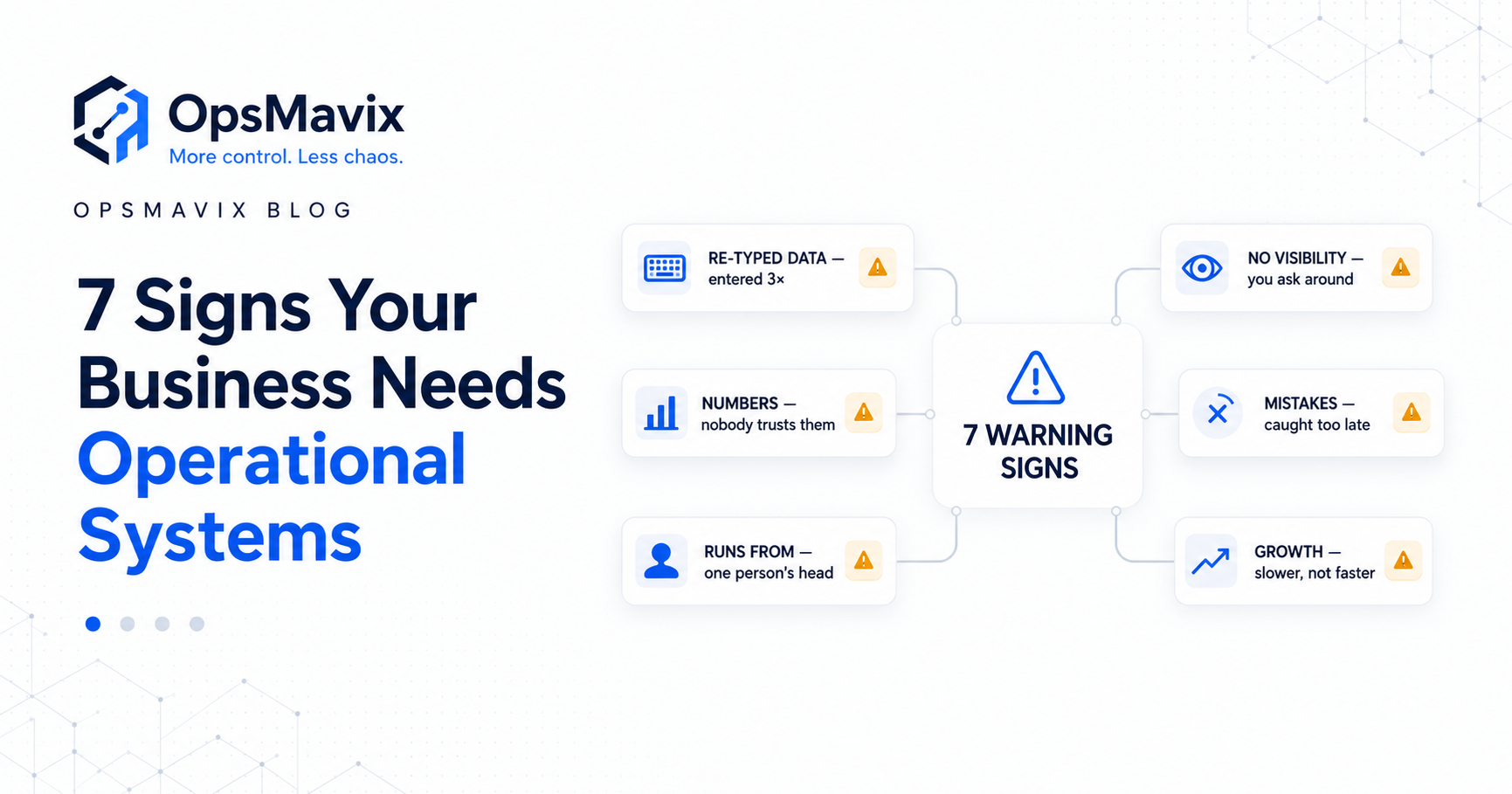
Most business owners don’t wake up and decide to invest in operational systems. They hit a wall first — a bad stockout, a month-end that eats a week, a mistake that costs real money — and only then realise the spreadsheets that got them here can’t take them further.
The tricky part is that the wall arrives quietly. Nothing breaks all at once; the business just gets slower, more fragile, and more dependent on a few people holding it together in their heads. By the time it’s obvious, you’ve already lost months of time and margin to it.
Here are the seven signs you’ve outgrown manual work and need proper operational systems — and what each one is quietly costing you. (If you’re not sure what that even means, start with what an operations system actually is.)
Key Takeaways
- Operational systems replace spreadsheets, manual admin, and disconnected tools with one connected way of working.
- The clearest signs are re-typing the same data, numbers nobody trusts, and a business that runs from one person’s head.
- Each sign maps to a measurable cost — lost sales, wasted hours, or mistakes caught too late.
- You don’t need a giant ERP — you need systems sized to how you work now.
- The right time to fix it is before the wall, not after the expensive mistake.
1Spreadsheets Are Doing Jobs They Were Never Built For
A spreadsheet is brilliant for a quick calculation and terrible as the backbone of a business. When your stock, orders, or production all live in tabs held together by fragile formulas, one wrong cell quietly breaks everything downstream. If a single workbook going wrong could disrupt your week, it’s already too important to be a spreadsheet.
2The Same Data Gets Entered More Than Once
If an order gets typed into an email, then a spreadsheet, then your accounting tool, your team has become the integration layer between systems that don’t talk. That re-keying is pure waste — and every hop is a chance for a wrong number to slip through. Data should be entered once and flow everywhere it’s needed.
3Nobody Fully Trusts the Numbers
When people “just check” before they rely on a figure — walking the floor to confirm stock, re-counting before promising a customer — your numbers have stopped being trustworthy. A business that can’t trust its own data makes slower, more cautious, more expensive decisions. Operational systems exist to make one number true and current.
4The Business Runs Out of One Person’s Head
If one person knows how reordering works, or how a job moves through the floor, and the place wobbles when they’re off — that knowledge is a single point of failure. Systems turn “what’s in someone’s head” into a process anyone can follow, so the business doesn’t depend on heroics or perfect memory.
5You Can’t See What’s Happening Without Asking Around
If answering “where’s that order?” or “how’s production tracking this week?” means messaging three people and waiting, you’re flying blind between updates. A growing operation needs a live picture — one place that shows the real state of stock, orders, jobs and cash without a single phone call.
6Mistakes Only Surface After They’ve Cost You
Oversold stock you find out about when the customer complains. A job that slipped, noticed only when it’s late. A duplicate payment caught at month-end. When problems surface downstream, the damage is already done. Systems catch issues at the point they happen — or stop them entirely — instead of leaving you to clean up after.
7Growth Makes Everything Slower, Not Faster
This is the big one. If every new order, product, or hire adds friction instead of momentum — more chasing, more admin, more things falling through cracks — your operation doesn’t scale. That’s the clearest sign the manual approach has run out of road: growth should make you stronger, not busier.
What To Do About It
You don’t need to rip everything out, and you definitely don’t need a 12-month enterprise project. You need operational systems sized to how your business actually works — connecting stock, orders, production, approvals and reporting into one place you can trust and see. Built around your process, not the other way round. (More on the operational systems every growing business needs.)
The practical first step is simply finding where the manual work is costing you most — which of these seven signs is bleeding the most time and money right now.
FAQ
What are operational systems?
Operational systems are the connected tools and processes that run the day-to-day of a business — inventory, orders, production, approvals and reporting — replacing spreadsheets, manual admin and disconnected apps with one source of truth.
How do I know if my business needs one?
Look for the signs above: re-typing the same data, numbers nobody trusts, the business running from one person’s head, no live visibility, and growth making everything slower. If several ring true, manual work has become your bottleneck.
Do I need a big ERP to fix this?
Usually not. ERPs are heavyweight, expensive and slow to roll out. Most growing businesses need systems sized to how they work now — live in weeks, not a multi-year project. See operational systems vs ERP.
What’s the cost of waiting?
It compounds: lost sales from stockouts, hours lost to re-keying, mistakes caught too late, and decisions made on numbers you don’t trust. The cost is rarely one big event — it’s a daily leak that widens as you grow.
Where should I start?
Start with the single process costing you the most time or money today — stock, orders, invoicing, or visibility — and fix that first, then connect outward from there.
How OpsMavix Can Help
OpsMavix builds custom operational systems that replace the spreadsheets and manual admin holding a growing business back — trustworthy stock, connected orders, visible production, and one live dashboard of the whole operation. Sized to how you work now, live in weeks, yours to own.
If several of these signs hit home, that’s a measurable operational leak. Book an Operations Leak Audit and we’ll map exactly where manual work is costing you — and what to fix first.