
Distribution ERP Software: When You Need It and When You Are Being Oversold
Distribution ERP software is pitched as the system that runs your entire wholesale operation, from stock to despatch to purchasing. This guide explains what it actually covers, why most growing distributors get oversold a heavy platform, and how a right-sized owned system can fix the few workflows that are really costing you money.
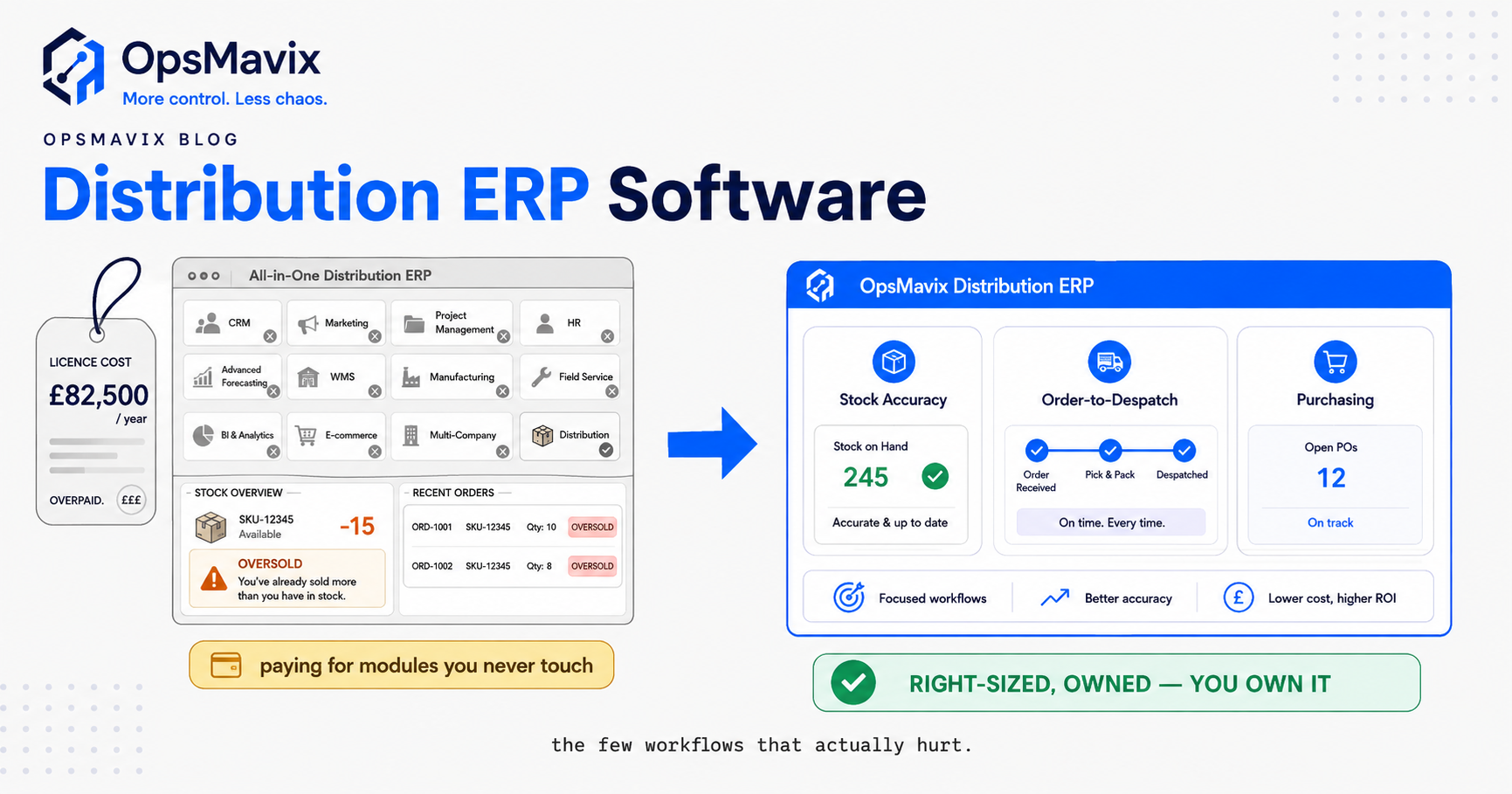
Distribution ERP software is a broad, integrated platform that tries to run every part of a wholesale or distribution business, stock, orders, purchasing, warehousing, finance and reporting, from one shared database so that a single change updates the whole operation instead of a stack of disconnected spreadsheets and inboxes. That is the promise, and for large, genuinely complex distributors it can be the right call. But the honest truth most vendors will not tell you is that the majority of growing distributors are sold a heavy, seven-module platform when only two or three workflows are actually bleeding time and money.
Quick summary: A three-year European study of roughly 233,000 SKUs across seven retailers, co-authored by a professor at Cardiff Business School, found that 59.54% of audited SKUs had inventory record inaccuracies, physical stock that did not match the system at stocktake, and that correcting those records lifted sales by around 4% to 8% (ECR Retail Loss). The number that matters here is not the software feature list. It is stock accuracy, and you can fix that without buying a platform that covers ninety functions you will never switch on.
Contents
- What distribution ERP software actually is
- The core modules and which ones you really use
- Why distributors get oversold
- Full distribution ERP vs a right-sized owned system
- The three workflows that actually hurt
- Signs you genuinely need a full platform
- Signs you are being oversold
- Worked example: a £7m distributor
- How to decide without over-committing
- FAQ
What distribution ERP software actually is
Enterprise resource planning (ERP) is the wide system of record for a whole business, one database that ties finance, operations, stock, purchasing and reporting together. Distribution ERP software is that idea aimed specifically at wholesalers and distributors, so alongside the usual finance and reporting it leans hard into the things a distributor lives on: inventory across locations, sales-order processing, picking and despatch, and purchasing from suppliers.
The pitch is coherent and, on paper, hard to argue with. One source of truth, no double entry, a sales order and a stock movement and a purchase order all referencing the same numbers, and real-time visibility of what you have, what is committed and what is on the way. If you have ever lost an afternoon reconciling three spreadsheets and an email thread, that pitch lands.
The catch is in the word “enterprise”. These platforms were built for scale, and they are priced and structured accordingly: per-user, per-module licences that run forever, plus an implementation measured in quarters, plus the quiet requirement that you reshape your process to fit the tool. For a large distributor with multiple depots, thousands of suppliers and a dedicated operations team, that trade is worth it. For a £3m to £15m wholesaler feeling pain in two specific places, it is often a very expensive way to fix a small number of problems. Our guide to supply chain management software walks through where ERP sits among the other three-letter systems.
The core modules and which ones you really use
A full distribution ERP typically claims to cover seven areas. It is worth knowing them by name, because the gap between the ones you use daily and the ones that sit dark is where the overspend lives.
- Inventory management. Stock levels, locations, reorder points, valuation and movements. For a distributor this is the beating heart of the system, and it is almost always one of the two or three modules that genuinely earns its keep.
- Sales-order management. Taking orders, checking availability, allocating stock, pricing and moving an order through to despatch. The order-to-despatch flow is where customer trust is won or lost.
- Purchasing and supplier management. Raising purchase orders, tracking deliveries, managing lead times and supplier performance. Get this wrong and you either run out or drown in overstock.
- Warehouse management (WMS). Receiving, put-away, picking, packing and despatch, often with barcode or scanner support. Real for larger operations, overkill for a single small warehouse.
- Finance and accounting. The general ledger, invoicing, payments and reconciliation. Many distributors already run this perfectly well in dedicated accounting software they have no wish to replace.
- Transport and logistics (TMS). Route planning, carrier selection and freight costs. Frequently irrelevant if you use couriers and a pallet network rather than your own fleet.
- Reporting and analytics. The dashboards and KPIs that tie the rest together. Useful, but only as good as the data feeding it.
Most growing distributors live and die by the first three: inventory, orders and purchasing. The rest are either handled outside the business, already covered by tools that work, or simply not complex enough to justify dedicated software. That single observation is the whole argument of this article.
Why distributors get oversold
Nobody sets out to buy too much software. Over-buying happens because of how these platforms are sold and how the decision feels from the inside.
First, the sales motion rewards breadth. A vendor selling a seven-module platform is incentivised to show you all seven, because the licence value grows with every module switched on. The demo dazzles precisely because it covers everything, including the things you will never use.
Second, fear does the rest. When you are drowning in reconciliation and month-end oversells, “one system that does everything” sounds like safety, and it is easier to say yes to that than to name exactly which two or three workflows are actually costing you money.
Third, the failure rate is quietly high, and it points at over-scoping. Roughly 55% to 75% of ERP projects fail to meet their objectives, according to figures widely attributed to Gartner (Rand Group). “Failure” rarely means abandoned. More often it means late, over budget, a fraction of the promised functionality delivered, and the team quietly keeping their old spreadsheets alongside the new system, so now you pay for both.
The through-line: you are sold the platform, but you have a process problem. Double entry and no single source of truth is an integration-and-process issue concentrated in a few workflows, not a reason to rent an enterprise suite forever.
Full distribution ERP vs a right-sized owned system
Most distributors sit awkwardly between spreadsheets that have run out of road and a full platform that is too much. There is a third option that rarely makes it onto the shortlist: a right-sized system that covers only the workflows that hurt, built to fit your process, and owned outright. Here is the honest comparison.
| Factor | Full distribution ERP | Right-sized owned operations system |
|---|---|---|
| Best for | Large, multi-depot, high-complexity distributors | Distributors “outgrowing spreadsheets and disconnected tools” |
| Scope | All seven modules, whether you use them or not | Only the two or three workflows that are leaking |
| Fit to your process | Partial, you adapt to the tool’s template | High, built around how you actually work |
| Setup time | Months to over a year | Weeks, focused on the real bottleneck |
| Cost model | Per-user, per-module licences, forever | One-off build, you own it, no per-seat rent |
| Time to value | Long, value arrives after full adoption | Fast, value arrives at the first fixed workflow |
| Adoption risk | High, teams often keep old spreadsheets too | Lower, it mirrors the process people already run |
| Ownership | You rent it and depend on the vendor | You own the system outright |
| Main risk | Over-scoping, low adoption, lock-in | Scoped too narrow if your complexity is genuinely broad |
The pattern owners recognise: a full platform solves the reconciliation problem but charges you for ninety functions to fix three, while a right-sized system fixes the three and leaves the ninety on the shelf where they belong. The skill is telling honestly which situation you are in, and that is a question about your operation, not about the software.
The three workflows that actually hurt
Strip away the module list and, for the overwhelming majority of growing distributors, the pain concentrates in three places. Fix these and most of the daily friction disappears.
Stock accuracy
This is the foundation, and as the ECR Retail Loss research above shows, inaccurate stock records are the norm rather than the exception. When your system says you have twelve and the shelf has nine, everything downstream breaks: you oversell, you buy stock you already have, you disappoint customers, and you stop trusting your own numbers, which pushes people back to manual counts and spreadsheets. Getting to one live, trusted stock figure that everyone reads from is the single highest-leverage fix in a distribution business, and it does not require a seven-module platform. If you run stock across more than one site, multi-location inventory management is where this problem gets sharper and the payoff bigger.
Order-to-despatch
The second leak is the flow from an order arriving to goods leaving the door. When orders come in through one system and stock lives in another, availability gets checked against stale numbers, the same stock gets committed twice, and oversells cluster at month-end when volume peaks. This is not a forecasting problem, it is a shared-data problem. When the order screen and the stock figure are the same source of truth, overselling largely stops on its own. We go deep on this specific failure in how to prevent overselling.
Purchasing
The third leak is buying. Most distributors run reorder points off a shared spreadsheet that is always slightly out of date, so they either run out of fast movers or tie up cash in slow ones, and nobody can answer “what is on order and when does it land” without opening three files. Calculating reorder points from actual sales velocity and real supplier lead times, and showing on-order stock in one place, removes a huge amount of guesswork. Dedicated purchase order software shows the shape of this workflow without dragging in the rest of an ERP.
Notice what is not on this list: transport optimisation, multi-tier supplier risk scoring, demand-planning engines and a warehouse management layer. For a large distributor those matter enormously. For most growing ones, they are the modules that sit dark while you pay for them anyway.
Signs you genuinely need a full platform
To be fair to the category, a full distribution ERP earns its keep when the complexity is real and permanent, not aspirational. Strong signals you are in this camp:
- Multiple depots or countries with stock genuinely moving between locations and real transport-planning decisions to make.
- A large, multi-tier supplier base where supplier risk, lead-time variability and contract management are board-level concerns, not a monthly annoyance.
- Serious demand-planning complexity, thousands of SKUs, heavy seasonality, and forecasting that materially changes what you buy each week.
- A dedicated operations or supply chain team, people whose full-time job is planning and procurement and who will actually adopt and run the system.
- Traceability or regulatory requirements that demand end-to-end lot tracking across the whole chain.
If several of these are firmly true, a mature platform is very likely the right answer, and you should evaluate the serious distribution ERPs properly. Do not let a right-sized-system argument talk you out of infrastructure you genuinely need. The point of this article is not that platforms are bad. It is that they are aimed at a level of complexity most growing distributors have not reached.
Signs you are being oversold
Flip it around. You are probably being oversold if:
- Your pain is concentrated in one or two workflows, almost always stock and purchasing, but you are being shown a suite covering seven.
- Most modules would sit unused. You do not run your own fleet, you have one small warehouse, or you have fifty suppliers not five thousand.
- You are being quoted per-user, per-month licences forever for software you would realistically use at maybe a third of its capability.
- Implementation is measured in quarters, and the plan quietly requires you to reshape your process to fit the tool rather than the other way round.
- Your finance and accounting already work fine, but the platform insists on replacing them too, just to get the bits you actually wanted.
- The real problem, when you say it plainly, is double entry and no single source of truth, which is a process-and-integration fix, not a reason to rent an enterprise platform.
Being oversold is not just wasted money, though the money is real. It is the adoption risk, the multi-quarter disruption, and the lock-in that comes with renting the core of your operation from a vendor whose incentives point at breadth. An operations control system built to your process avoids all three by design.
Worked example: a £7m distributor
Consider a distributor turning over £7m a year, around 1,400 active SKUs, three people in the office, one small warehouse, all deliveries handled by couriers and a pallet network, and accounts kept in software the finance person likes and trusts.
The pain. Purchasing runs off a shared reorder-point spreadsheet that is always a step behind. Sales orders arrive through a separate system, so stock is committed twice and oversells spike at month-end. Nobody can answer “what is on order and when does it land” without opening several files and chasing an email thread. Two afternoons a week disappear into reconciling numbers that should agree and do not.
The oversold option. A full distribution ERP is quoted. It bundles a warehouse management layer, a transport module, multi-tier supplier risk and a demand-planning engine, none of which this business needs, and it wants to replace the accounting software that already works. The price is a per-user monthly licence plus a five-to-six-figure implementation running across three quarters. The transport and WMS modules would never be switched on. The finance team would spend months migrating off a system they were happy with, to end up roughly where they started.
The right-sized option. A system that does three things and nothing else: it holds one live stock figure that both purchasing and sales read from, it calculates reorder points automatically from actual sales velocity and real supplier lead times, and it shows one screen of “on order, in stock, committed, available”. It leaves the accounting software alone and simply talks to it. No transport module, no WMS, no demand-planning engine, no per-seat rent. Built in weeks, scoped to the two real leaks, and owned outright.
The outcome that matters. Oversells stop, because there is one stock figure instead of two. The two lost afternoons come back. The owner can answer “what is on order” in a single click. Finance keeps the tool they trust. That is the difference between buying a platform and fixing the actual problem, and it is why the right question is never “which distribution ERP” but “which workflows are bleeding”.
How to decide without over-committing
A simple, honest decision path:
- Name the leak. Write down the two or three workflows where errors, delays or admin time actually cost you. “Stock is wrong and we oversell” beats “we need better systems”.
- Count the modules you would truly use. If a platform’s value for you is concentrated in inventory, orders and purchasing, that is a loud signal about scope.
- Check the adoption risk. Will the team genuinely move off their spreadsheets, or run both in parallel? If it is both, you have added a cost, not solved a problem.
- Protect what already works. If your accounting tool is doing its job, replacing it just to reach the bits you wanted is a red flag, not a requirement.
- Compare total cost over three years, licences plus implementation plus internal time and disruption, not the demo sticker price.
- Decide breadth versus depth. Broad, permanent complexity points to a platform; concentrated pain and a desire to own the result points to a right-sized system.
Distribution and manufacturing sometimes blur here. If part of your operation involves building or assembling rather than only buying and reselling, what an MRP system is explains where production planning enters the picture. For a pure distributor, though, the honest answer is usually depth over breadth.
FAQ
What is distribution ERP software?
Distribution ERP software is an integrated platform aimed at wholesalers and distributors that ties inventory, sales orders, purchasing, warehousing, finance and reporting into one shared database. The goal is a single source of truth so that a change in one place, a stock movement, an order, a purchase, updates everything else automatically. It is powerful for large, complex operations, but it typically bundles far more than a growing distributor needs.
Do small and mid-sized distributors need a full ERP?
Usually not the full enterprise kind. Most growing distributors feel real pain in just two or three workflows, almost always stock accuracy, order-to-despatch and purchasing, and can fix those with a right-sized owned system rather than a seven-module platform. The trigger to act is not company size, it is when errors, double entry and reconciliation time become one of your biggest hidden costs.
Why do so many distribution ERP projects fail?
Figures widely attributed to Gartner put ERP project shortfalls at roughly 55% to 75%, where “failure” usually means late, over budget, under-delivered, or quietly worked around rather than fully abandoned. A common cause is over-scoping: buying a broad platform to fix a narrow set of problems, then struggling with adoption because the team keeps using their old spreadsheets alongside the new system. Scoping to the workflows that actually hurt is one of the most reliable ways to avoid that outcome.
Is a right-sized owned system cheaper than distribution ERP software?
Over a three-year horizon it usually is, because you pay a one-off build cost and then own it, instead of per-user, per-module licences that continue forever. It is not always cheaper on day one, and if your complexity is genuinely broad, a platform can be better value. The real saving is scope: you pay to fix the workflows that are leaking, not to rent ninety functions you will never switch on.
Can a right-sized system work alongside my existing accounting software?
Yes, and that is often the point. A right-sized owned system can be built to cover only inventory, orders and purchasing while talking to the accounting software you already trust, rather than forcing you to rip it out. A full distribution ERP frequently wants to replace finance too, just to deliver the operational pieces you were actually after, which is exactly the kind of over-reach worth avoiding. For the ledger side of that decision, read our guide to accounting software for distributors.
How OpsMavix Can Help
OpsMavix builds right-sized, owned operations systems for growing UK distributors and product businesses that are outgrowing spreadsheets but not looking for a full distribution ERP. We are not an ERP vendor and we do not sell generic custom code, we sell the outcome: one live source of truth for stock, an order-to-despatch flow that stops overselling, and purchasing that runs on real numbers rather than a stale spreadsheet, all built around your actual process, owned by you, with no per-seat rent and backed by a delivery guarantee. We start by finding out exactly where your operation leaks, then build only what fixes it. When you are ready to see the leaks in yours: Book a Free Operations Leak Audit.
Sources
- ECR Retail Loss — “Grow sales by improving inventory records”, three-year study of ~233,000 SKUs across seven European retailers (co-authored by Cardiff Business School), finding 59.54% of audited SKUs had inventory record inaccuracies and that correcting them lifted sales 4% to 8%: https://www.ecrloss.com/research/grow-sales-by-improving-inventory-records/
- Rand Group — “What percentage of ERP implementations fail?”, reporting figures widely attributed to Gartner that approximately 55% to 75% of ERP projects fail to meet their objectives: https://www.randgroup.com/insights/services/solution-implementation/what-percentage-of-erp-implementations-fail/
- CYBRA — “How accurate is the average retailer’s inventory?”, citing the Auburn University RFID Lab finding that the average retail store’s inventory accuracy sits around 65%: https://cybra.com/average-retailer-inventory-accuracy/