
Direct Purchase Order: Meaning, Examples and When to Use One
A direct purchase order usually means a PO raised without a requisition. Here are its three meanings, when to use one and the controls to keep.

A direct purchase order is usually a purchase order a buyer raises straight away, without a purchase requisition coming first. The phrase is used in two other ways as well: a purchase order for direct materials (the things you make or sell), and, in some manufacturing systems, a purchase order raised for a specific production job so the goods skip the stockroom. Which one someone means depends on their system and their trade.
This guide explains all three, shows where each fits in the normal purchase order process, and sets out the controls that stop direct POs turning into uncontrolled spending. If you need the basics first, start with what a purchase order is.
The three meanings of “direct purchase order”
| Meaning | What “direct” refers to | Where you will see it | Example |
|---|---|---|---|
| PO without a requisition | The buyer raises the PO directly, with no requisition first | ERP and purchasing systems, public sector and university purchasing rules | A buyer orders £180 of workshop consumables from the usual supplier |
| PO for direct materials | What is bought: goods that go into the product or are resold | Procurement and supply chain teams, spend reports | A fabricator orders steel sheet for customer jobs |
| PO tied to a production or work order | Goods go straight to a job instead of into stock | Manufacturing and maintenance modules in some ERPs | A special motor ordered for one machine build |
The first meaning is the one most people searching the term are after, so it gets the most space below.
1. A purchase order raised without a requisition
In a full purchasing process, someone who needs something raises a purchase requisition, a manager or budget holder approves it, and only then does a buyer turn it into a purchase order. Our guide to the purchase order cycle walks through every step.
A direct PO skips the requisition. The buyer creates the purchase order directly in the system. Oracle’s documentation for its purchasing module puts it plainly: “You can create a purchase order manually, without first creating a requisition.” It adds: “In both cases, the purchase order needs approval” (Oracle). That second sentence is the important one. Skipping the requisition should not mean skipping approval.
When a direct PO makes sense
- Low-value, routine items from suppliers you already use, where a separate requisition adds cost but no control. Our breakdown of the cost of processing a purchase order shows how quickly the admin adds up.
- Repeat stock replenishment, where a reorder point or forecast is the “request” and the buyer raises the order.
- Buyer-led purchasing, where the buyer is the person with the need and the budget, so a requisition would be them asking themselves.
- Call-offs against an agreed contract or price list, where price and supplier were approved when the contract was signed.
When it does not
- High-value or one-off purchases, where someone other than the buyer should agree the spend first.
- New suppliers who have not been checked.
- Capital items, or anything that needs a budget holder’s sign-off under your finance policy.
- Orders raised after the goods or invoice have already arrived. These are sometimes called retrospective or “after the fact” orders. The PO then records a decision that was never controlled, and the three-way match proves nothing.
The controls to keep
| Risk | Control |
|---|---|
| Spending nobody else agreed | Approval on the PO itself above a set value, even with no requisition |
| Orders split to stay under the limit | Report on several POs to the same supplier on the same day or week |
| Buying from unapproved suppliers | Direct POs only to suppliers already on your approved list |
| Wrong prices | Prices pulled from the supplier’s agreed price list, not typed in |
| Retrospective orders | Block, or flag for review, any PO dated after the supplier’s invoice or the delivery |
| No audit trail | A reason or reference on every direct PO, kept with the PO |
Public bodies and universities that publish purchasing rules often set value thresholds for buying without a requisition, and many treat splitting an order to stay under a threshold as a serious breach. A small business does not need their paperwork, but the same two ideas work: a value limit, and a check for split orders.
2. A purchase order for direct materials
In procurement, “direct” and “indirect” describe what is being bought. The Chartered Institute of Procurement & Supply (CIPS) defines direct procurement as “the procurement of raw materials required for the manufacture of goods”, and lists products bought for resale under direct spend too. Indirect procurement covers “supplies or services that contribute to the day to day running of the organisations”, such as office furniture, IT, utilities, cleaning, training and software (CIPS).
So in this sense a direct purchase order is any PO for direct materials or goods for resale. It is usually raised from a stock or production plan rather than from a requisition. The distinction matters because the two kinds of order are controlled differently:
| Direct material POs | Indirect POs | |
|---|---|---|
| What triggers them | Reorder points, forecasts, production plans, customer orders | A person’s request (a requisition) |
| What matters most | Lead time, quantity, quality, landed cost, supplier reliability | Budget, approval, value for money |
| Where the cost goes | Stock, then cost of sales | Overheads |
| Typical control | Planning rules, price lists, goods-in checks, quality inspection | Requisition approval, budget checks |
This is why many businesses allow buyers to raise direct-material POs without a requisition while still requiring one for indirect spend. The stock plan already justifies the direct order.
3. A purchase order tied to a production or work order
Some ERP systems use “direct” for goods bought for a specific job that never go into general stock. SAP describes direct procurement as a procedure where “you can order BOM components for a planned order directly instead of via the warehouse” (SAP Help). Iptor’s documentation describes purchase orders created in the background for a manufacturing order’s non-stock components, and notes that “even though you are not receiving the item into stock, you must perform a purchase reception” (Iptor).
The practical point: the goods skip the shelf, but they must still be received and checked against the PO, and their cost should land on the job. A goods-in record still matters. See our guide to the goods received note.
“Direct” is also sometimes used loosely for orders the supplier delivers straight to your customer. Most systems call that a drop-ship purchase order, so check which meaning a colleague or supplier has in mind.
A worked example
Hypothetical example. A UK engineering workshop with 20 staff sets one simple rule: buyers may raise a direct PO, with no requisition, for up to £500 net per order, only to approved suppliers and only at price-list prices. Anything above £500, any new supplier and any capital item needs a requisition approved by the budget holder first.
| Purchase | Value (net) | Route | Why |
|---|---|---|---|
| Cutting discs and gloves from the usual supplier | £180 | Direct PO | Under £500, approved supplier, price list |
| Steel sheet for three customer jobs | £2,400 | Direct PO (direct materials) | Raised from the production plan; prices from the agreed steel price list. The rule treats planned direct materials separately from the £500 limit |
| New pillar drill | £1,350 | Requisition, then PO | Capital item over £500 |
| Two orders of £450 each to a new fixings supplier on the same morning | £900 | Requisition, then PO | New supplier, and £900 in total once the split is spotted |
VAT at 20% is added to each invoice. Whether you can reclaim it depends on your own VAT position. In every case the PO is still approved, sent, received against a goods received note and matched to the invoice before payment. Only the requisition step changes.
Direct PO vs standard PO at a glance
| Standard PO (from a requisition) | Direct PO | |
|---|---|---|
| Who starts it | The person with the need | The buyer |
| Approval | On the requisition, sometimes again on the PO | On the PO itself, by value |
| Speed | Slower: two documents | Faster: one document |
| Best for | High-value, one-off, capital and indirect purchases | Low-value repeat buys, direct materials, contract call-offs |
| Main risk | Delay | Uncontrolled spend and split orders |
FAQ
What is a direct purchase order?
Most often, a purchase order a buyer creates without a purchase requisition coming first. The term can also mean a PO for direct materials or goods for resale, or, in some manufacturing systems, a PO raised for a production order with the goods issued straight to the job.
Does a direct purchase order still need approval?
It should. Skipping the requisition removes one approval point, so most systems and policies put approval on the PO itself, at least above a set value. Oracle’s purchasing documentation notes that a PO created without a requisition still needs approval.
What is the difference between a direct and an indirect purchase order?
In procurement terms, a direct PO buys materials that go into your product or goods you resell. An indirect PO buys things that keep the business running, such as IT, office supplies, cleaning or services. They are triggered and controlled differently.
Is a direct purchase order the same as a drop-ship order?
Not usually. A drop-ship purchase order asks the supplier to deliver to your customer. “Direct” in direct purchase order normally refers to how the PO was raised, or to what is being bought, not where it is delivered.
When should a small business use direct POs?
For low-value, repeat purchases from approved suppliers at agreed prices, and for stock replenishment driven by reorder points. Keep requisitions for high-value, one-off, capital and new-supplier purchases.
Can a direct PO be raised after the invoice arrives?
Systems usually allow it, but it defeats the purpose of a purchase order. Treat any PO dated after the invoice or delivery as an exception that needs review.
How OpsMavix can help
Most small businesses do not need a procurement suite to control direct POs. They need a purchasing system that knows their suppliers, price lists and limits. OpsMavix builds owned, fixed-price systems where direct POs are allowed only within the rules you set: value limits, approved suppliers, price-list prices and flags for split or retrospective orders. Every PO is then received and matched before the invoice is paid.
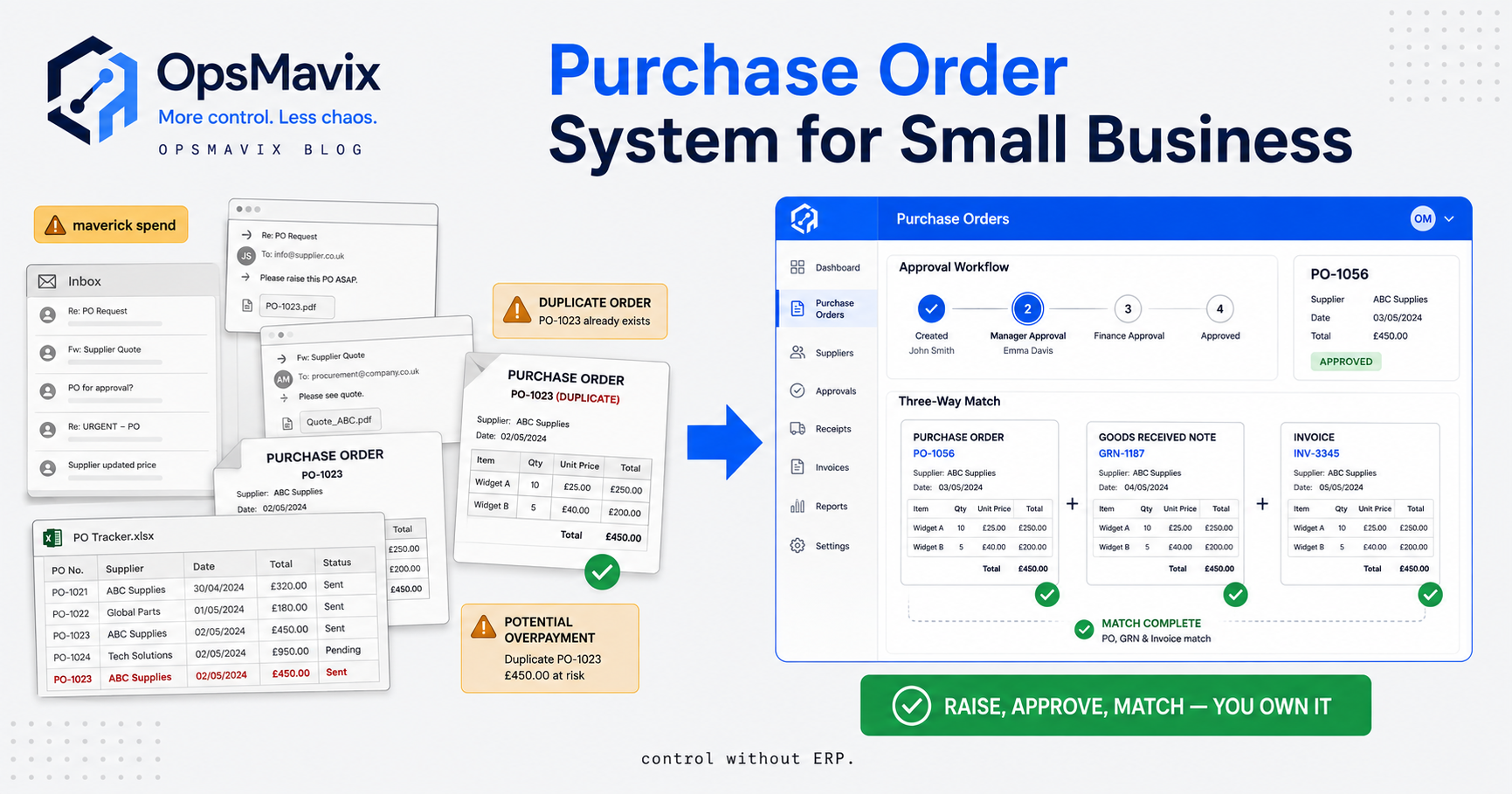
Read more about a purchase order system for small business and our invoice approval workflow, or tell us how your buying works today.
Sources
All checked 19 November 2026.
- Oracle: Direct item procurement for eAM work orders
- CIPS: Direct and indirect procurement
- SAP Help: Direct procurement
- Iptor: Direct purchase orders process
The worked example is hypothetical. Cover photo from Unsplash.
Keep reading
Getting value from OpsMavix? Add us as a preferred source on Google — you'll see more of our operations content in your AI Overviews, AI Mode and Search.