
Stockpile by Canvus Alternative: When Free + Simple Stops Being Enough
Stockpile by Canvus is free, simple and genuinely good for getting off paper. You go looking for a Stockpile by Canvus alternative when you outgrow it — multiple locations, stock that has to stay right across channels, links to your accounting and orders, roles for a growing team. The honest answer isn't another free app. It's a right-sized system shaped to how you actually run, that you own.
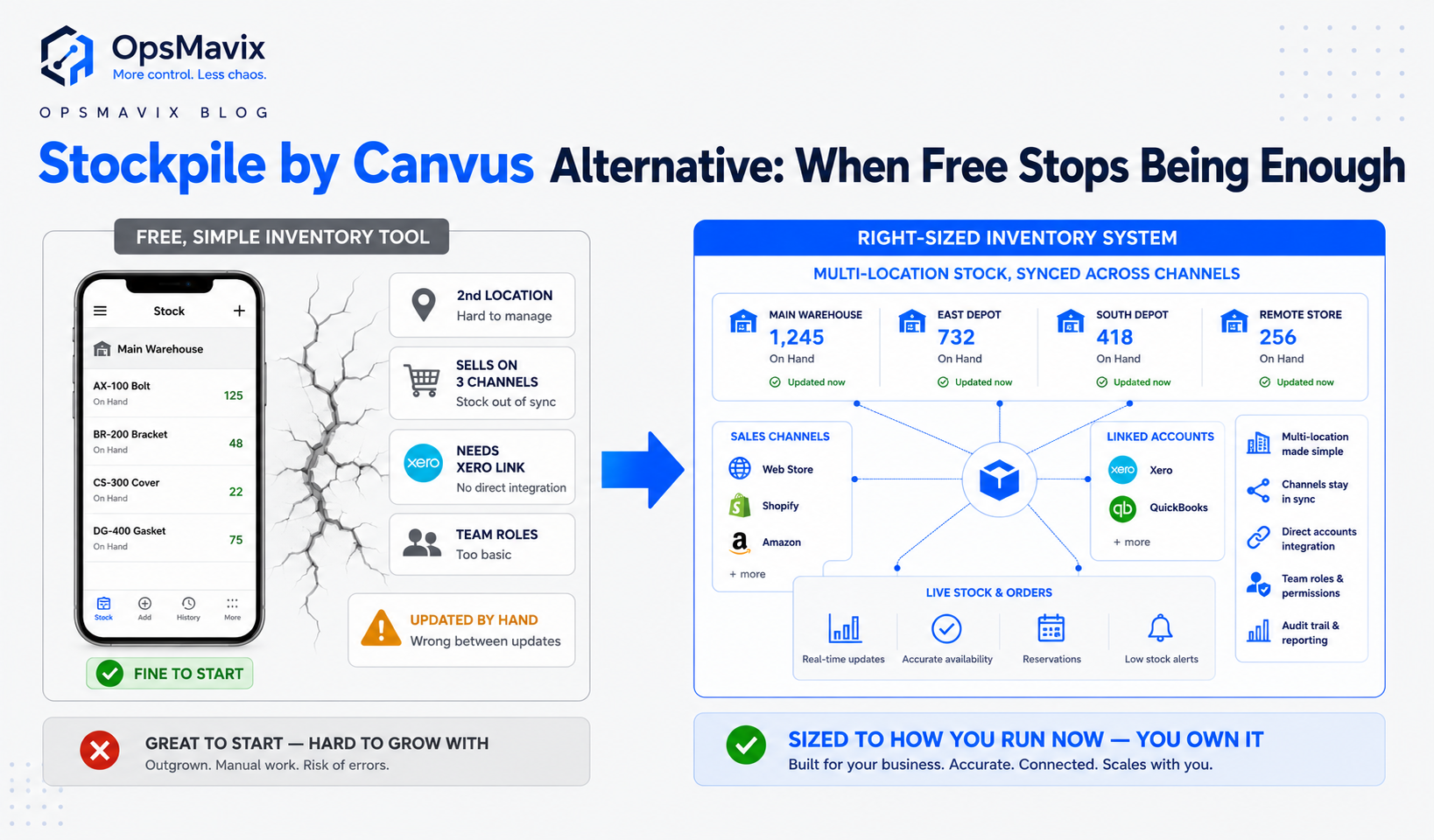
The best Stockpile by Canvus alternative depends on one honest question: have you actually outgrown free and simple, or do you just think you should be paying for something? Stockpile by Canvus is a free, web-based inventory app that does basic stock tracking well, and for a business getting off paper or a single spreadsheet it’s a perfectly good place to start. There’s no shame in a free tool that does the job. You only need an alternative when the job changes — multiple locations to keep straight, stock that has to stay accurate across more than one sales channel, a link into the accounting and orders you already run, roles for a team that’s no longer just you. A basic free app isn’t built for that, and that’s fine; it was never trying to be. The alternative isn’t another free download. It’s a right-sized system shaped to how you actually run, that you own outright.
This post covers when Stockpile by Canvus is genuinely enough, the specific signs you’ve outgrown it, and what a built-for-you system changes. The wider “do I need a custom inventory system at all” question lives in custom inventory systems; this is the free-basic-app versus built-for-you layer of it.
Key Takeaways
- A free, simple inventory app like Stockpile by Canvus is genuinely fine to start. Getting off paper or one spreadsheet is the win — don’t fix what isn’t broken yet.
- You’ve outgrown it when the work moves past basic counting: multiple locations, accuracy across channels, links to accounting and orders, roles for a team.
- The trigger isn’t “we should pay for software.” It’s a specific pain you can name and put a £ figure on — overselling, manual reconciliation, numbers nobody trusts.
- The alternative to a free basic app isn’t a different free app. It’s a right-sized system built around your actual flow, that you own.
- Switch on the maths, not on the price tag. Free that does the job beats paid that doesn’t fit.
When Stockpile by Canvus Is Enough
Be fair to the free option, because most advice isn’t. If you’re a small operation with one location, a manageable SKU count, one main way of selling, and one or two people who touch the stock, a simple free app like Stockpile by Canvus can be exactly right. It gets you off paper and out of a single fragile spreadsheet, gives you a shared list everyone can see, and costs nothing. That’s a real upgrade, and for plenty of early-stage businesses it’s all the inventory system they need for a good while.
You go looking for an alternative when that picture stops matching reality. The pattern we see is a business that’s grown past the tool without noticing — more locations, more channels, more people, more orders — and the free app that was a relief at the start is now the thing everyone works around. One inventory manager described the endpoint bluntly: “our spreadsheet counts wind up being off, sometimes wildly so.” A basic tool with no real-time link to where stock actually moves drifts toward the same place. The question below isn’t “is free bad.” It’s “has the job outgrown what a free basic app is built to do.”
1You Now Have More Than One Place Stock Lives
A simple free app is built around one stock list in one place. The moment stock lives in more than one spot — a second unit, a shop and a stockroom, a 3PL, a van — basic counting stops being enough. You need to know not just how many you have but where, and you need a move between locations to be a recorded movement, not a manual edit in two places that someone forgets to do. That’s where free-and-simple starts leaking, because the tool was never trying to track location, only quantity.
This is the cleanest signal you’ve outgrown the category, not just the product. See where the stock number breaks down for why multi-location is the usual first crack.
2Stock Has to Stay Right Across More Than One Channel
Selling in one place, a basic tool keeps up. Selling in two or three — a website, a marketplace, trade orders over the phone — and the free app becomes a number you update by hand after the fact, which means it’s wrong between updates. That gap is where overselling happens, and overselling isn’t an admin annoyance; it’s cancelled orders, refunds and customers who don’t come back. An operator told us the everyday version of it plainly: “we would consistently oversell items we didn’t even have on hand.” A tool with no live link to your channels can’t close that gap, because closing it was never its job.
3The Stock Number Lives Apart From Your Accounting and Orders
Free and simple usually means standalone — the stock app over here, the accounting over there, the orders somewhere else, and a human copying numbers between them. That’s survivable at small volume and quietly brutal as you grow, because every manual hop is a chance to be wrong and an hour you’re not getting back. People reach for accounting tools to fill the gap and hit a wall fast: as one warehouse user put it, you “can’t see what’s on my warehouse like an excel sheet.” The fix isn’t another disconnected app. It’s a system where the stock, the orders and the books are one flow, so site reality reaches the books without a person retyping it.
This is the line between a basic app and a system — see what an operations system actually is.
4You’ve Got a Team Now, Not Just You
A free basic app is built for a small number of trusting hands. Once a team is touching stock, “anyone can edit anything” stops being convenient and starts being risk — no roles, no record of who changed what, no way to give the floor what they need without exposing what they don’t. When a count goes wrong you want to know how, not just that it’s wrong. Basic tools rarely carry that, because permissions and an audit trail are features for an operation bigger than the one they were designed for. If you can’t answer “who moved this and when,” you’ve outgrown the tool. More signs of that tipping point are in signs you need operational systems.
5The Real Trigger Isn’t Price — It’s a Pain You Can Cost
Here’s the contrarian bit, because it’s the one that saves money: the reason to leave a free app is never “it feels too cheap to be real” or “we should be paying for proper software.” That instinct sells a lot of inventory SaaS to businesses that didn’t need it. The only honest trigger is a specific pain you can name and put a number on — X orders oversold a month, Y hours reconciling sheet to shelf, a count nobody trusts enough to order from. If you can’t write the £ figure, you haven’t outgrown free yet, and switching is a cost with no return. If you can, the free tool is already costing you more than a right-sized system would — it’s just billing you in errors and time instead of an invoice.
Stockpile by Canvus (free) vs a Built-For-You System
| Stockpile by Canvus (free, simple) | Right-Sized Built-For-You System | |
|---|---|---|
| Cost | Free | Fixed build (£3k–£25k range) |
| Best for | Getting off paper / one spreadsheet, early stage | Outgrown basic counting; real ops complexity |
| Locations | One stock list | Multiple locations, with movements between them |
| Channels | Track stock; update by hand | Stock that stays right across your sales channels |
| Accounting / orders | Standalone; you copy numbers across | One flow — stock, orders and books connected |
| Team / roles | Open; little or no permissions | Roles + an audit trail of who changed what |
| Fit | Generic basic tracking | Built around your actual flow |
| Ownership | A free tool you use | A system you own outright |
| Right when | Small, single-location, single-channel | The job has outgrown a free basic app |
FAQ
Is Stockpile by Canvus actually any good?
For what it’s for, yes. As a free, simple, web-based way to do basic stock tracking and get off paper or a lone spreadsheet, it’s a genuinely sensible starting point for a small, single-location business. It stops being the right tool when your operation grows past basic counting — multiple locations, accuracy across channels, links to your accounting and orders, roles for a team. That’s not a flaw in the app; it’s just outside what a free basic tool is built to do.
When should I move off a free inventory app?
When you can name a specific pain and put a £ figure on it — orders oversold because the number was wrong, hours lost reconciling the count by hand, a stock figure nobody trusts enough to order from. If you can’t write that number down, you probably haven’t outgrown free yet, and switching is cost with no payback. If you can, the free tool is already costing you more than a right-sized system would; it’s just billing you in errors and time.
Is the alternative to Stockpile by Canvus just another free app?
Usually not, and that’s the point. Swapping one free basic app for another gets you the same ceiling under a different name. If you’ve genuinely outgrown free, the alternative is a right-sized system built around how you actually run — your locations, your channels, your accounting and orders — that you own outright, rather than a generic tool you bend yourself around.
Do I need a full ERP or inventory SaaS instead?
Often no. There’s a wide gap between a free basic app and a heavyweight ERP or a per-seat inventory SaaS that can hike prices or get sunset under you. A right-sized built-for-you system sits in that gap: shaped to your operation, connected to the tools you already use, and owned by you with no per-seat fee and nothing a vendor can switch off. The right size is the one that matches the operation you actually run today.
Will I lose the simplicity I liked about the free app?
You shouldn’t. The reason a free app feels good early on is that it’s simple and the people using it actually use it — and that’s exactly what a right-sized build is supposed to keep. The difference is that the simplicity is shaped to your flow instead of a generic one, so it stays simple as you grow rather than becoming the thing everyone works around.
How OpsMavix Can Help
OpsMavix builds right-sized inventory systems for businesses that have outgrown a free basic app but don’t need — and don’t want to pay for — a heavyweight ERP or a per-seat SaaS that can be price-hiked or pulled out from under them. We build around how you actually run: stock that stays right across your locations and channels, a stock figure that matches the shelf, roles and an audit trail for a real team, and a link into the accounting and order management you already use instead of a human copying numbers between tools. You own it outright — no per-seat fees, nothing a vendor can switch off.
If you’re not sure whether you’ve genuinely outgrown free or just feel like you should be paying for something, start by seeing where the stock actually leaks. Book an Operations Leak Audit and we’ll map where accuracy, overselling and manual reconciliation are costing you today, in pounds — and whether a free app is still fine or it’s time for the right thing built once.