
Quoting Software for MSPs: Recurring, Per-Device and Project Quotes Without the Rework
Quoting software for MSPs has to do three jobs at once — price recurring managed services, per-device and per-user tiers, and one-off projects — then hand a clean, signed quote straight into the PSA without re-keying. Most tools do one of those well and force the other two into spreadsheets. Here's what actually matters for an MSP quote, and the point where a bolt-on stops being enough.
Vendor names and pricing approach checked September 2026.
A client asks for two more workstations and a new server this quarter. You say yes, you provision them, your RMM starts managing them the same afternoon. Six months later someone finally checks the device count against the invoice and finds you have been billing for 43 endpoints while your tools have been quietly managing 55 for most of that time. Nobody stole anything. Nobody lied. The quote was right the day it was signed and wrong every month since.
That gap, between the number on the signed quote and the number your tools actually manage, is what quoting software for MSPs has to close. This guide is for the operations lead or owner at a UK managed-services provider who prices recurring agreements, per-device tiers and one-off project work, and who is tired of three numbers that should match rarely matching. It sets out what MSP quoting needs to hold together, compares the real tools people use for it, and gives an honest read on when a bolt-on is enough and when it stops being enough.
What is quoting software for MSPs?
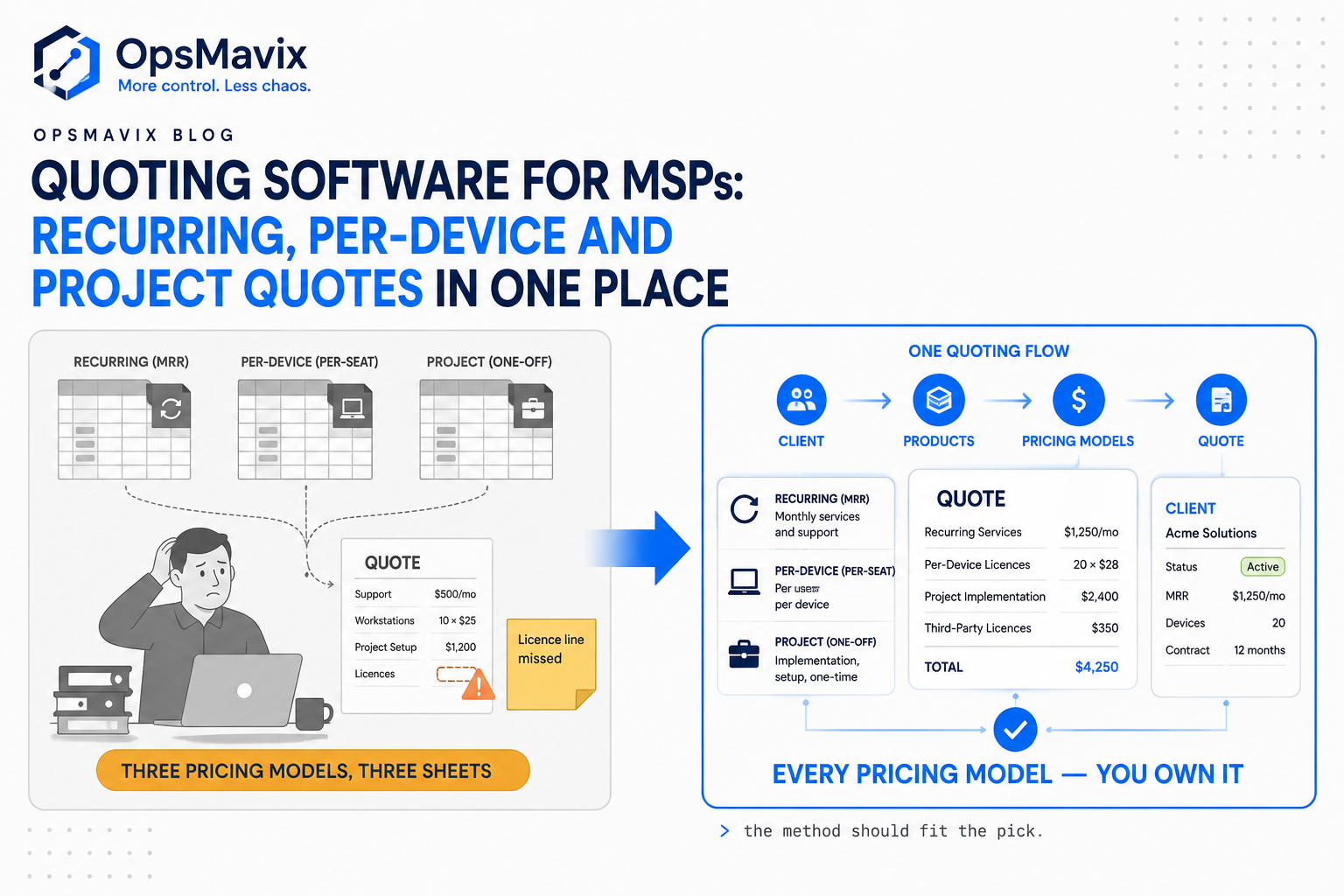
Quoting software for MSPs prices a managed-services proposal and turns it into a document a client can sign. For most industries that is a simple job: one product, one price, one sale. For an MSP it is three jobs stapled together: a recurring monthly agreement, a per-device or per-user layer that has to be counted and re-counted, and a one-off project (onboarding, migration, hardware) that behaves nothing like the monthly.
The better tools do not stop at the PDF. They hand the signed quote into your PSA (professional services automation platform, the system that runs your tickets, contracts and billing) as a contract, a billing schedule and a project, without a person retyping the numbers. That handoff is where most of the money leaks, so it is what a tool should be judged on, not how the proposal looks.
Quoting software for MSPs: the comparison
| Tool | Worth considering when… | Pricing approach | Important buying detail |
|---|---|---|---|
| QuoteWerks | You want a mature, standalone quoting tool that plugs into several PSAs and distributors rather than being tied to one | Tiered per-user licensing, published on the vendor site; request current figures | Built for IT resellers generally, not MSPs specifically, so recurring and per-device pricing often need to be modelled as line items rather than native contract objects |
| ConnectWise CPQ (formerly ConnectWise Sell) | You already run ConnectWise PSA and want quoting that writes straight into it | Quoted on request as part of the ConnectWise suite | The native fit with ConnectWise Manage is the whole point; outside that ecosystem the case weakens |
| Quoter | You want a modern, standalone quoting tool aimed at MSPs with PSA integrations rather than a bolt-on inside one | Published plan tiers on the vendor’s pricing page; confirm current rates before committing | Strong at recurring and one-off proposals; per-device reconciliation against what your RMM actually manages still needs to be checked, not assumed |
| ScopeStack | Your gap is scoping and statement-of-work discipline on project work sold alongside managed services, not the recurring pricing itself | Quoted on request | Built around scoping and SOW generation for MSPs and VARs; it complements a PSA’s recurring billing rather than replacing it |
| Your PSA’s native quoting (Autotask, Kaseya, others) | Your recurring and per-device pricing are simple enough to live where you already bill | Bundled into the PSA subscription you already pay for | Convenient because there is no handoff to break, but most PSA quoting modules treat one-off project work as an afterthought |
| OpsMavix | Recurring lives in the PSA, projects live in a spreadsheet, proposals live in a doc, and none of the three numbers reliably match | Starter Fix £3,000 to £10,000, Growth System £10,000 to £25,000, Operations Platform from £25,000 | An owned quoting and operations system built around your MSP workflow and PSA, not a general CPQ suite or another single-purpose bolt-on |
Pricing for the standalone tools above is set by the vendor and changes without much notice. Check each vendor’s own pricing page and get a scoped quote before you commit. The shape of the problem each tool solves is what should drive the choice, not the headline price.
Why an MSP quote is three quotes in one
Sell a single product and the quote is arithmetic: price times quantity, done at the point of sale. An MSP proposal is rarely that clean. A typical new-client quote carries a monthly recurring managed-services fee, a per-unit layer underneath it (per device, per user, per server, per mailbox, sometimes several at once), and a one-off project to get the client live: onboarding, migration, the first-month heavy lift.
Each of those three prices differently and behaves differently after the signature. The recurring line becomes a billing schedule that runs for years. The per-unit layer has to be counted at quote time and recounted as the client’s estate grows or shrinks. The project is a fixed or time-and-materials job with its own margin, unrelated to the monthly fee. A tool that treats all three as flat line items on one document will let you produce the quote, but it will not keep the three numbers honest against each other over time.
Per-device and per-user pricing: where the count drifts
Per-device and per-user pricing is the MSP standard for a reason: it scales with the client and it is easy to explain in a sales conversation. It is also where quotes quietly go wrong, because the count on the quote and the count in reality drift apart the moment the ink is dry.
You quote 40 workstations and 3 servers. Six months in, the client has hired eight people and added a NAS and two virtual machines, and nobody has re-quoted. Your tools are managing 53 endpoints. Your invoice still says 43. This is not fraud, it is a device count captured once at quote time and never reconciled against what the RMM actually reports.
For an MSP, the quote is not the end of pricing, it is the start of a reconciliation loop. The number you quote has to stay checkable against the number you actually manage, for the life of the contract. A quoting tool that cannot close that loop is handing you a monthly leak dressed up as a signed deal.
The recurring line is where the margin really lives
On a one-off sale, a £200 pricing mistake costs you £200, once. On an MSP recurring line, a £200-a-month scoping error costs you £200 every month until someone renegotiates: £2,400 a year, £7,200 across a typical three-year agreement, on one client, from one quote that was slightly wrong on day one. That asymmetry is why MSP quoting deserves more discipline than product quoting, not less.
It cuts both ways. Under-scope the monthly and you carry the loss for years. Over-scope it and you lose the deal to the MSP who priced it tighter. Getting the recurring right means building it from the actual cost to serve, the per-device tooling cost, the expected ticket load, the SLA overhead, rather than a round number that felt right in the sales call.
The PSA tie-in: where the quote goes to die
Here is the failure that makes MSP quoting harder than most quoting problems: the quote and the system that bills it are usually two different tools. You win the deal, and someone has to turn the quote into a contract in the PSA, a billing schedule with the right recurring lines, and a project with the onboarding tasks attached. If that step is a re-key, three things tend to go wrong.
The device counts get transposed incorrectly. The recurring line gets rounded or mistyped. And the project scope in the signed proposal does not match the project set up in the PSA, so the delivery team works against a different spec than the client agreed to. It is the same re-keying problem you would see anywhere data is copied by hand between systems, except here the thing retyped is a multi-year revenue schedule, not a one-off order.
A quote that flows straight into the PSA as a contract, a schedule and a project, with no one retyping the numbers, is the difference between a quote that is just a document and a quote that is the actual origin of your billing. The general principles behind that kind of join are covered in quoting software best practices; the MSP version of the problem is specifically the recurring-plus-per-device-plus-project combination, not a single price on a single item.
What MSP quoting actually needs to hold together
The reason MSPs end up running three tools and a spreadsheet is that no single mainstream quoting product is happy holding all three shapes at once. A PSA quotes recurring reasonably well but treats projects as an afterthought. A project-quoting tool such as the kind covered in quoting and estimating software costs the one-off work properly but has no real concept of a per-device monthly. A general CPQ tool does neither in MSP language. So the recurring lives in one place, the project lives in another, and reconciling the two is a manual job nobody enjoys or does consistently.
What an MSP actually needs is narrower than a good-looking PDF. It needs the recurring fee, the per-unit tiers and the project priced from one rate structure, so the numbers on the document the client signs are guaranteed to agree. It needs the per-device count to stay reconcilable against what the RMM and PSA actually manage. And it needs the signed result to land in the PSA as billing and delivery without a re-key, the same discipline as the estimating approach covered in micro estimating, applied to a recurring line instead of a one-off job.
Worked example: an MSP whose spreadsheet was quietly costing it
A 14-person MSP in the Midlands runs its recurring agreements in its PSA and everything else around them in spreadsheets. Proposals get built in a shared slide deck, per-device counts get pulled from whoever last checked the RMM, and project work (onboarding, a migration, a hardware refresh) gets priced separately in a spreadsheet that never quite lines up with what the PSA later bills.
The operations lead runs a check across the client base and finds a pattern: on nine of their forty managed clients, the device count in the PSA billing is lower than the device count the RMM is actually managing, by four to eleven endpoints per client. None of it is deliberate, clients grew and IT added kit and nobody re-quoted. Averaged out, the MSP is under-billing by roughly £1,400 a month across those nine clients, close to £17,000 a year given away, on top of the time spent reconciling a slide deck, a spreadsheet and a PSA contract that were never built to talk to each other.
The fix was not a bigger quoting tool. It was one place where the recurring rate, the per-device count and the project scope are built from the same numbers and checked against the PSA and RMM on a schedule, rather than trusted once at the point of sale and left alone.
How much does quoting software for MSPs cost?
Standalone quoting tools aimed at MSPs and IT resellers, such as QuoteWerks and Quoter, publish tiered per-user pricing on their own sites, and ConnectWise CPQ is quoted as part of the wider ConnectWise suite. Figures are not repeated here because they change, and because the right comparison is not the licence line, it is what the tool saves you in re-keying and reconciled revenue against what it costs. Get a current, scoped quote from each vendor before deciding.
For an owned system built around your PSA, device counts and recurring-plus-project mix, OpsMavix project bands run Starter Fix £3,000 to £10,000, Growth System £10,000 to £25,000, and Operations Platform from £25,000. These are project prices for a scoped piece of work, not a per-seat subscription, set against the reconciliation problem in front of you rather than a general licence.
A practical checklist for choosing
- Write down how many of your managed clients you have actually checked device counts on in the last quarter.
- Separate your three pricing shapes on paper: recurring, per-unit, project. If you cannot show where each lives today, that is the gap to close first.
- Ask whether the tool writes the signed quote into your PSA as a contract, schedule and project, or whether someone still retypes it.
- Price the leak before you price the tool: what would a 10 to 15 percent device-count drift across your client base be worth in a year.
- Check whether the tool is built for MSP recurring and per-device pricing specifically, or is a general CPQ product you would be bending to fit.
- Decide whether your project work needs its own scoping discipline (statements of work, T&M tracking) or is simple enough to sit inside the same system as the recurring quote.
Frequently asked questions
What is the best quoting software for MSPs?
There is no single best tool, only the best fit for how you already bill. If you run ConnectWise PSA, ConnectWise CPQ has the tightest native fit. If you want a standalone tool with broader PSA integrations, QuoteWerks and Quoter are the established names to evaluate. If your gap is specifically project scoping and statements of work, ScopeStack is built for that. Compare them against your actual recurring, per-device and project mix, not a generic feature list.
Can quoting software handle recurring, per-device and project pricing at once?
Some can, most do one or two of the three well and force the rest into workarounds. A PSA’s native quoting usually handles recurring cleanly but treats project work as an afterthought, and a project-quoting tool does the reverse. Check this specifically before buying rather than assuming a tool covers all three because it says “MSP” on the box.
How does quoting software connect to my PSA?
The better tools push a signed quote into the PSA as a contract, a billing schedule and a project with tasks attached, using the PSA’s API rather than an export and import. If a tool cannot describe exactly how that handoff works, assume it means someone retyping the numbers.
Is my PSA’s built-in quoting enough, or do I need a separate tool?
If your recurring and per-device pricing are straightforward and your project work is simple, your PSA’s native quoting may be enough, and there is no reason to add another tool on top of a subscription you already pay for. The case for something more grows once you are regularly discovering device-count drift, or project work that does not fit cleanly into the PSA’s model.
How much does quoting software for MSPs cost?
Standalone tools such as QuoteWerks and Quoter publish tiered pricing on their own sites and it changes, so check current figures directly with the vendor. ConnectWise CPQ is quoted as part of the ConnectWise suite. An owned system built around your specific PSA and pricing structure, such as an OpsMavix project, runs from £3,000 for a scoped fix up to £25,000 and beyond for a full operations platform, priced to the work rather than per seat.
What happens if my device counts drift after the quote is signed?
They drift for almost every MSP, because clients hire, grow and add kit without anyone re-quoting. The fix is not vigilance, it is a reconciliation step, comparing what the quote and PSA say you bill against what the RMM reports you manage, on a set schedule rather than only when someone happens to notice.
Should I build my own quoting system instead of buying one?
Not if an existing tool genuinely fits how you price and bill. Build, or rather commission, an owned system only once you can point to a specific, recurring leak, drifted device counts, mismatched recurring and project numbers, a re-key between quote and PSA, that a general tool is not closing. At that point the leak usually has a number attached to it, and that number is what you are weighing against the cost of the fix.
How long does it take to set up quoting software for an MSP?
A standalone quoting tool can usually be live within days once your rate structure and PSA integration are configured. An owned system that reconciles quoting, device counts and PSA billing together is a scoped project, typically weeks rather than days, because it is built around your specific PSA, your specific pricing tiers and your specific data.
How OpsMavix can help
OpsMavix builds operations systems for UK businesses, including managed-services providers whose quoting, device counts and PSA billing have drifted apart without anyone deciding it should happen that way.
Start with the question this guide opened on: if a client added devices this quarter, do you know today whether your invoice matches what your tools actually manage, or would it take a manual check across the PSA and RMM to find out?
If it would take the manual check, bring that example to an Operations Leak Audit. We map how your recurring, per-device and project pricing flow today, show where the numbers stop agreeing, and give an honest read on whether a scoped fix to the quote-to-PSA handoff, or a broader operations dashboard across your client base, is the right answer. Review our current project price bands before getting in touch.
Whichever way it goes, the number that matters is the one your invoice and your RMM agree on, not the one on the quote from the day you signed the client.
Keep reading

Getting value from OpsMavix? Add us as a preferred source on Google — you'll see more of our operations content in your AI Overviews, AI Mode and Search.