
Purchase Requisition: The Approval That Should Happen Before You Buy
A purchase requisition is the internal request to buy something, raised and approved before any purchase order goes to a supplier. It's the checkpoint where spend gets tested against budget and authority — the step that decides whether money leaves the business on purpose or by accident. Here's how the requisition form, approval routing and requisition-to-PO conversion actually work, and why skipping them is how maverick spend creeps in.
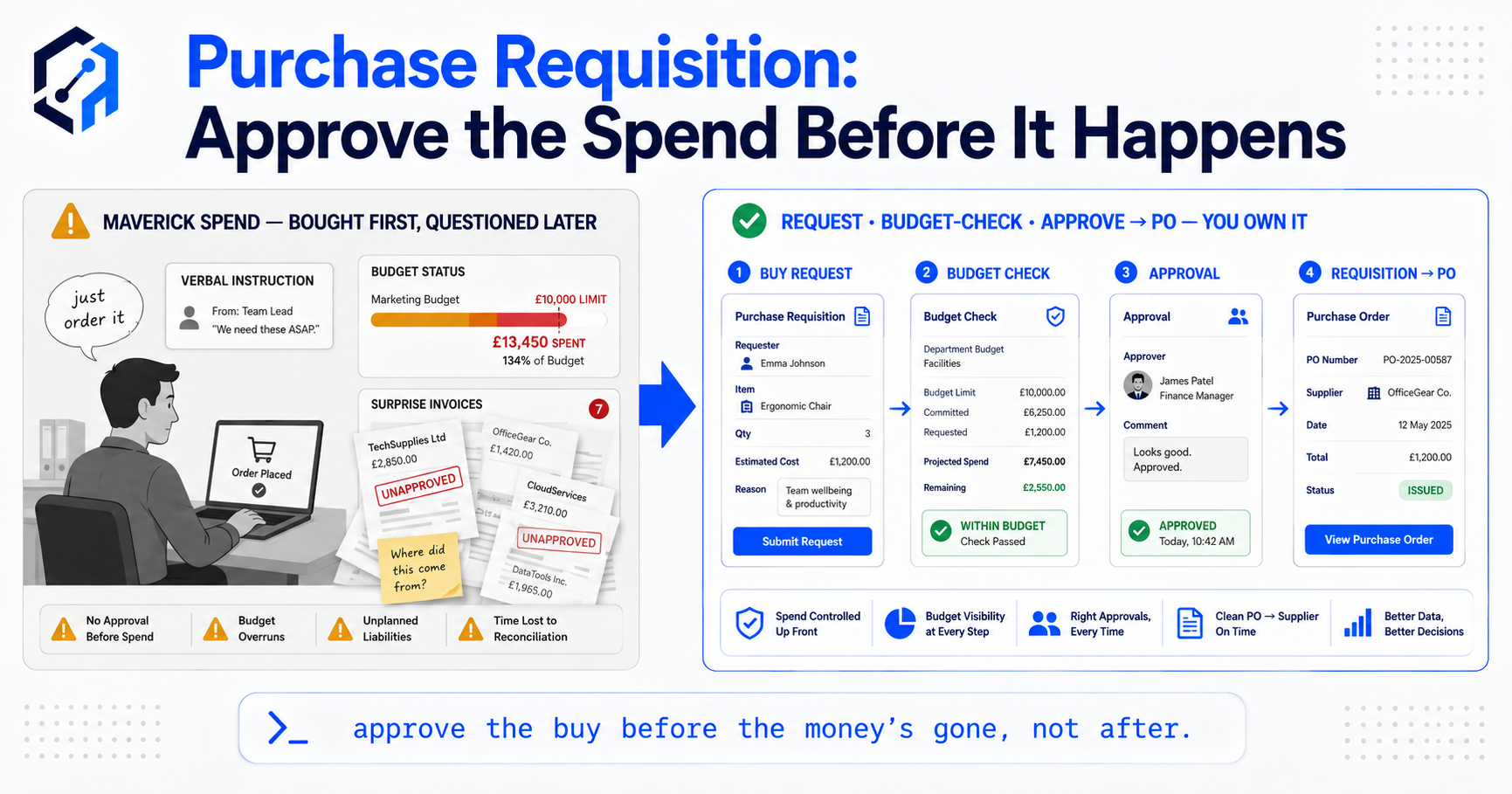
A purchase requisition is the internal request to buy something — raised by whoever needs it, checked against budget, and approved by the right person before any order goes to a supplier. It’s not the order itself. It’s the step before the order: the moment the business decides yes, we’re spending this money, and here’s who signed it off. Get that step right and every pound that leaves has a name against it and a budget it came out of. Skip it, and you find out what was bought only when the invoice lands.
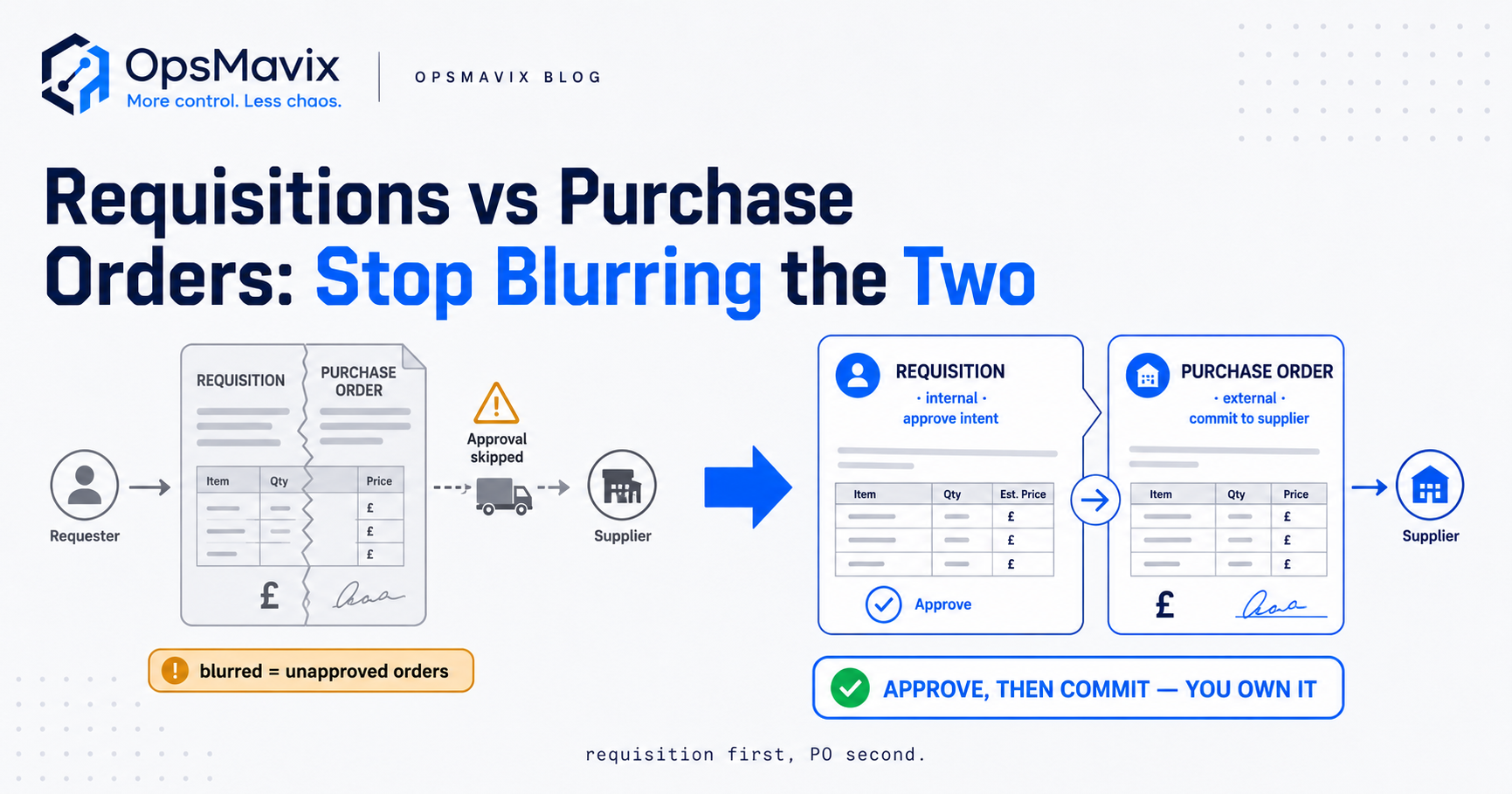
The distinction trips people up because the requisition and the purchase order look similar on paper — same supplier, same items, same numbers. But they do opposite jobs. The requisition is internal and asks permission: can we buy this? The purchase order is external and gives instruction: supplier, send us this. One is the request and its approval; the other is the commitment to a third party. When there’s no requisition step, the two collapse into one — someone just places the order — and the approval that should have happened first never happens at all.
Key Takeaways
- A purchase requisition is the internal request-to-buy and its approval, raised before a purchase order exists — it’s how spend gets authorised, not how it gets ordered.
- The requisition form captures what, how much, why, and which budget it comes from — enough for an approver to decide without a back-and-forth.
- Approval routing sends each request to the right person by amount, department or category — so a £200 order and a £20,000 one don’t get the same rubber stamp.
- Authority limits define who can approve what: the checkpoint that stops anyone committing spend above their level without a second signature.
- Requisition-to-PO conversion turns an approved request into a purchase order in one step — no re-keying, and no PO that skipped approval.
- Without this step, you get maverick spend: money committed off-process, discovered only when the invoice arrives, with no budget owner and no way to say no.
1. What a Purchase Requisition Actually Is
A purchase requisition is a formal, internal ask: someone in the business needs to buy something, so they raise a request that says what it is, how much, and why — and it goes to someone with the authority to approve it before a penny is committed. That’s the whole job. It sits entirely inside your business. No supplier sees it. It exists so that the decision to spend is made by the right person, on the record, before the order goes out — not reconstructed afterwards from a pile of invoices.
The reason it matters is sequence. In a business with no requisition step, the first time anyone with budget responsibility hears about a purchase is when the bill turns up — by which point the goods are ordered, delivered, sometimes used, and the money is as good as gone. The requisition moves that decision to the front. It’s the difference between approving spend and merely paying for it. An operations lead we spoke to described the shift bluntly: before, finance were bookkeepers reacting to whatever landed; after requisitions, they were gatekeepers deciding what got bought in the first place.
2. What Goes on the Requisition Form
A requisition form is only useful if it carries enough for an approver to decide without chasing the requester. That means more than a line item and a price. It needs the what — item, specification, quantity — and the who — who’s requesting, for which team or project. It needs the why: a one-line justification, because “we need it” and “the line’s down without it” are very different decisions. And critically it needs the where from: which budget or cost centre this comes out of, and ideally the preferred supplier and expected cost.
That budget line is the part people leave off, and it’s the part that makes the whole thing work. An approver looking at a request without knowing which budget it hits is guessing — they can see the number but not whether there’s room for it. Put the cost centre on the form and the approval becomes a real question with a real answer: is there budget for this, and is this the right use of it? A good requisition form is designed so the answer to that question is visible on the same screen as the request — not two systems and an email thread away. Get the form right and most approvals take seconds; get it wrong and every one becomes an interrogation.
3. Approval Routing: Getting It to the Right Person
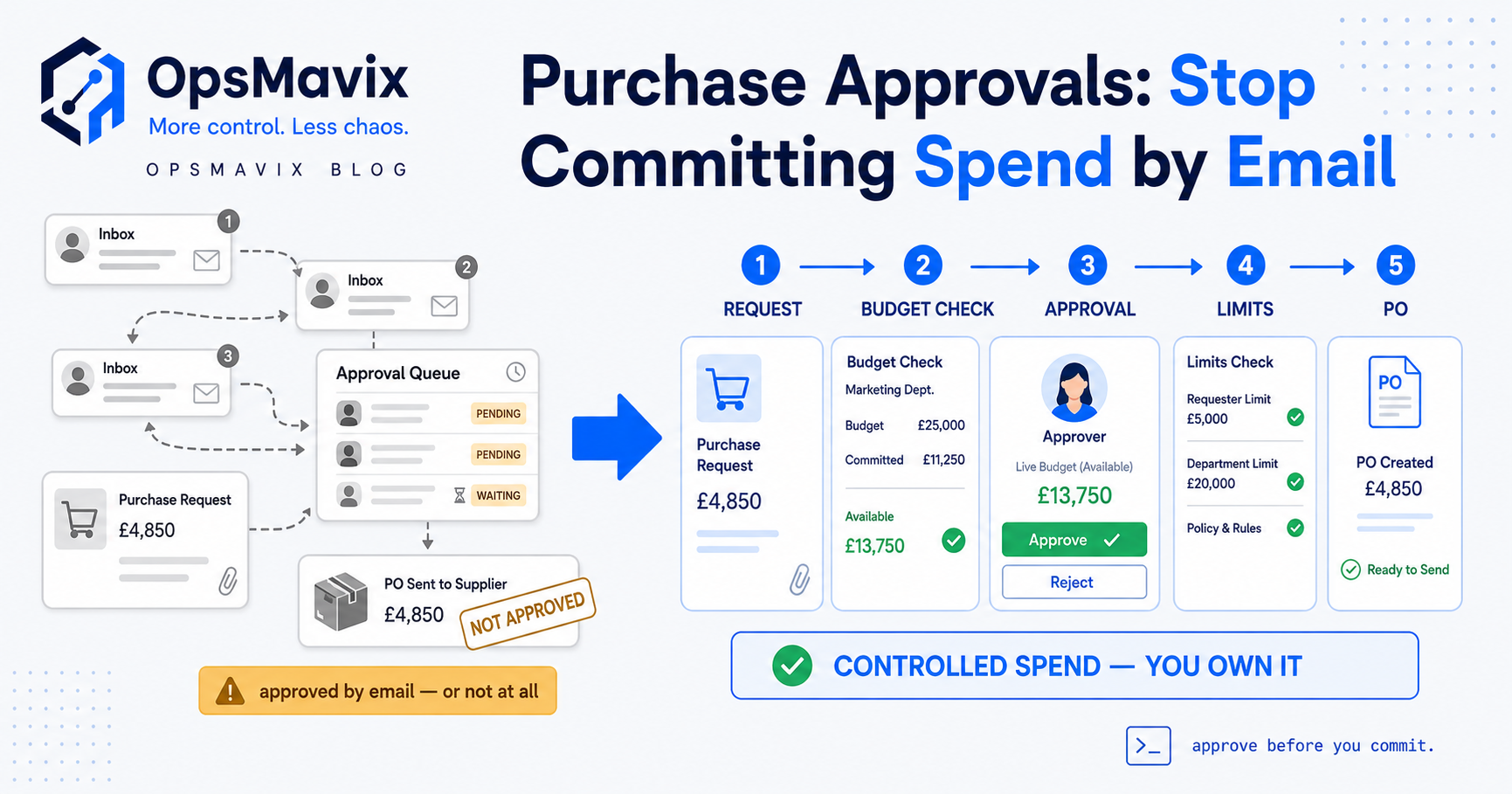
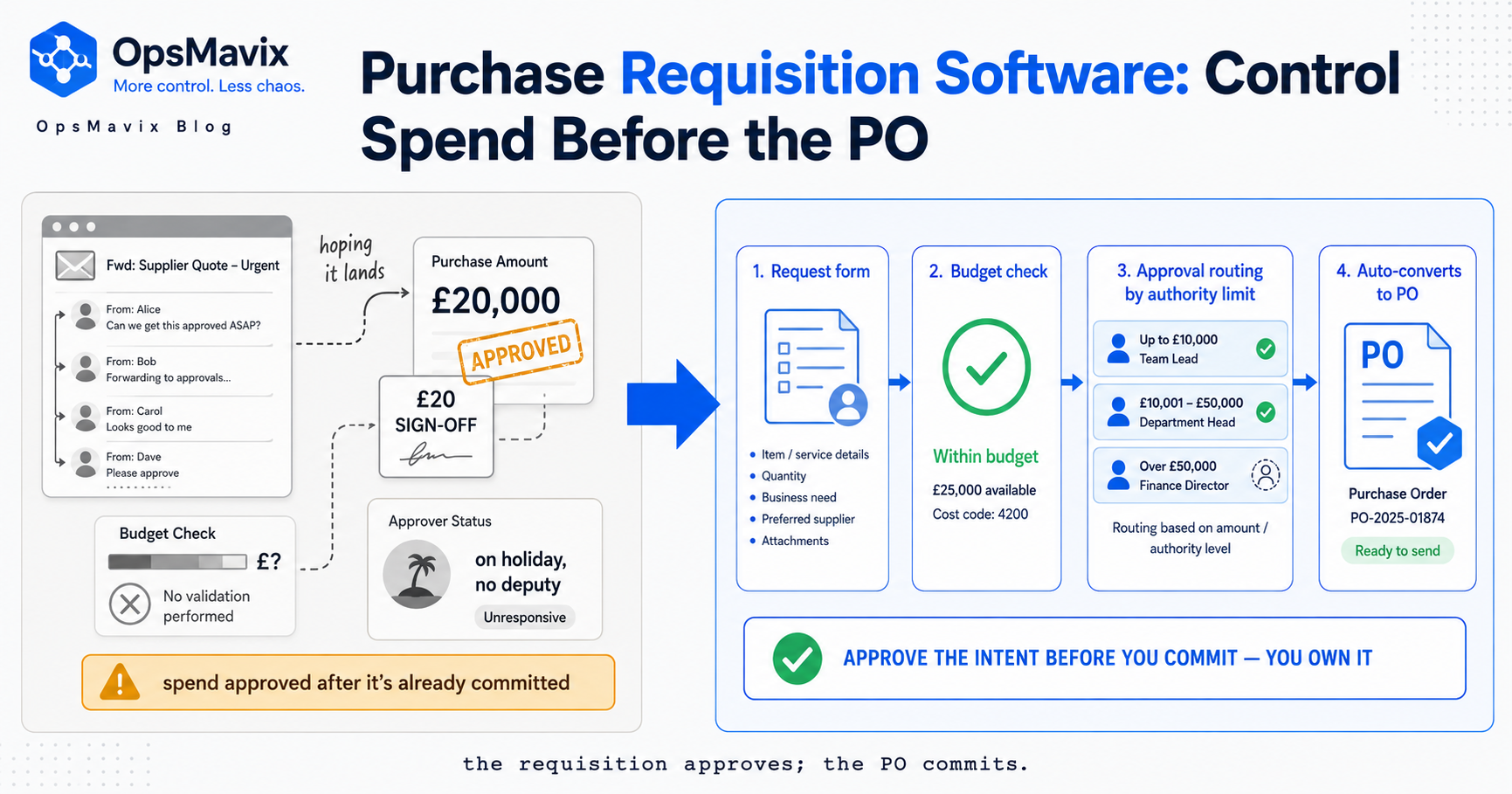
Not every purchase deserves the same scrutiny, and a good requisition process knows it. Approval routing is the logic that decides where a request goes: a £150 box of consumables might need one manager’s nod, while a £15,000 bit of kit routes to a director, and anything touching a capital budget goes higher still. Route by amount, by department, by category — usually some mix. The point is that the size and type of the spend decides who looks at it, automatically, rather than everything piling into one overloaded inbox or, worse, nobody’s.
The failure mode is routing that’s either too flat or too manual. Too flat, and the person approving a £20 stapler order is the same person approving a £20,000 machine — so either the small stuff wastes their time or the big stuff gets the same three-second glance as the small stuff. Too manual, and routing means someone forwarding an email and hoping it lands, with requests stalling because the approver’s on holiday and there’s no deputy. This is the same routing discipline that governs invoice approvals further down the chain — but requisitions are where it should start, because approving the request is cheaper than approving the bill for something already bought.
4. Authority Limits Are the Real Control
Underneath routing sits the thing that gives it teeth: authority limits. These are the rules that say who can approve up to what — a team lead to £1,000, a department head to £10,000, a director above that, board sign-off beyond some ceiling. Without limits, “approval” is theatre: anyone can wave anything through, and the signature on the requisition means whatever the signer wants it to mean. With limits, the approval is only valid if the approver had the authority to give it — and a request above someone’s limit escalates automatically to someone who does.
This is where a requisition process quietly earns its keep. A finance manager we spoke to described the recurring problem before they tightened this up: a well-meaning site manager kept approving orders that were genuinely needed but well above what he was authorised to commit — nobody was acting in bad faith, but the business had no cap on what any one person could sign for, so budgets got blown by people who didn’t know they were blowing them. Authority limits fix that without slowing the honest majority: most requests sit comfortably inside someone’s limit and clear fast, and only the ones that breach a threshold get escalated. The limit does the enforcing so no individual has to be the one saying “you’re not allowed to sign that.”
5. From Requisition to Purchase Order
The payoff of doing requisitions properly is what happens at the end: an approved requisition converts into a purchase order in one clean step. The items, quantities, supplier and budget line are already captured and already signed off, so raising the PO is a conversion, not a re-entry — no retyping, no drift between what was approved and what gets ordered. The PO that goes to the supplier is, by construction, one that passed approval, because it was born from an approved requisition rather than typed up from scratch.
That’s the join a lot of businesses miss. When requisition and PO live in separate systems — or the requisition is just an email and the PO a spreadsheet — someone re-keys the order, and every re-key is a chance for the number to change, the quantity to grow, or an unapproved line to sneak in. Conversion closes that gap: what was approved is what gets ordered, full stop. And it draws a clean line to the next stage — once the PO is out, delivered and invoiced, the three-way match checks the bill against the order and the goods. Requisition approves the intent; the PO commits it; the match verifies the invoice. Three jobs, in order, each depending on the one before.
6. How Requisitions Stop Maverick Spend
Maverick spend is money committed outside the approval process — the order someone placed directly, the supplier engaged without a check, the recurring charge nobody signed off. It’s rarely dishonest. It’s usually someone busy, solving a problem, buying what they need and skipping the step that felt like friction. But the cost is real: no budget owner testing whether there was room, no chance to consolidate with other orders or negotiate, and no ability to say no before the commitment instead of grumbling about it after. Every off-process purchase is a decision the business never got to make.
A requisition process is the structural answer, not because it makes people more honest but because it makes the right path the easy path. When raising a proper request is faster than going around it — a quick form, routed automatically, approved in seconds when it’s within budget and authority — the reason to skip it evaporates. The before-and-after is stark: before, spend is discovered at invoice time and finance’s job is to explain overruns; after, spend is approved at request time and the overruns mostly don’t happen, because the requests that would cause them get caught at the door. One growing manufacturer we spoke to caught a five-figure annual leak this way — a tail of small, off-process orders to convenience suppliers that, once routed through requisitions, either got consolidated to a contracted supplier or declined outright.
7. Building a Requisition Process That People Actually Use
Here’s the contrarian view from building these systems: most requisition processes fail not because they’re too weak but because they’re too heavy. A business, stung by an overrun, bolts on a rigid approval chain with five sign-offs for a box of pens, and within a month everyone’s routing around it because it’s faster to just buy the thing and apologise. A requisition process that people bypass is worse than none — it gives you the illusion of control while the real spend flows through the side door. The goal isn’t maximum friction. It’s the right friction: heavy where the money is, invisible where it isn’t.
A right-sized system gets there with the same tools done proportionately — a form that carries the budget line, routing keyed to amount and category, authority limits that escalate only what genuinely needs escalating, and one-step conversion to a PO so nothing gets re-keyed. Low-value, in-budget, routine requests clear in seconds with a single approval; the big, the unusual and the over-budget get the scrutiny they deserve. Off-the-shelf procurement tools tend to force one rigidity on everything, or bolt requisitions onto an accounts package that can’t see your budgets or your suppliers. At OpsMavix we build the process to fit how you actually buy — so the approval is real where it matters and never in the way where it doesn’t. The routing and sign-off machinery that carries this through to invoices is covered in our invoice approval workflow automation work; the requisition is where that discipline should begin.
FAQ
What is a purchase requisition?
A purchase requisition is the internal request to buy something, raised and approved before any purchase order goes to a supplier. It’s an in-house document: the requester states what they need, how much, why, and which budget it comes from, and it routes to someone with authority to approve the spend. Once approved, it converts into a purchase order that’s sent to the supplier. The requisition is where the business decides whether to spend; the purchase order is where it commits that spend to a third party.
What’s the difference between a purchase requisition and a purchase order?
A purchase requisition is internal and asks permission — can we buy this? — while a purchase order is external and gives instruction to a supplier — send us this. The requisition comes first: it captures the request and gets it approved against budget and authority. Only after approval does it become a purchase order that goes out to the supplier. In short, the requisition is the request and its sign-off; the PO is the commitment. Skipping the requisition means the approval that should precede the order never happens.
What should a purchase requisition form include?
Enough for an approver to decide without chasing anyone: the item and specification, the quantity, who’s requesting it and for which team or project, a one-line justification, and — importantly — which budget or cost centre it comes out of. Ideally it also names a preferred supplier and expected cost. The budget line is the part most often left off and the part that matters most, because it lets the approver see whether there’s room for the spend on the same screen as the request itself.
How does requisition approval routing work?
Approval routing sends each request to the right person based on rules — usually the amount, the department, or the category of spend. A small, in-budget order might need one manager’s approval, while a large or capital purchase escalates to a director or beyond. Underneath routing sit authority limits: rules defining who can approve up to what, so a request above someone’s limit automatically escalates to someone who has the authority. Good routing matches the seniority of the approver to the size of the decision, without anyone manually forwarding requests.
How do purchase requisitions reduce maverick spend?
Maverick spend is money committed outside the approval process — orders placed off-process with no budget owner and no chance to say no before the commitment. Requisitions catch it by moving the decision to the front: spend has to be requested and approved against budget and authority before an order is placed, not discovered when the invoice lands. The trick is making the approved route faster than the workaround, so people use it rather than route around it — a quick form, automatic routing, and instant approval when a request is within budget and authority.
How OpsMavix Can Help
OpsMavix builds right-sized systems for businesses stuck in the gap — outgrowing spreadsheets and disconnected tools — and the requisition step is one of the clearest places that gap leaks money. We build a request-to-buy process that fits how you actually purchase: a form that carries the budget line, routing keyed to amount and category, authority limits that escalate only what needs escalating, and one-step conversion from an approved requisition to a purchase order — so nothing gets ordered that didn’t get approved, and nothing gets re-keyed on the way. From there the same discipline carries through to invoice approval workflow automation and three-way matching, so spend is controlled from the first request to the final payment.
If purchases get committed before anyone with budget authority has seen them — orders placed off a quick email, invoices that are the first finance hears of the spend — you’ve got maverick spend, and it’s invisible one order at a time. We’ll show you where it’s happening, what it’s worth, and how a proportionate requisition process closes it without turning every box of pens into a five-stage sign-off. Book a Free Operations Leak Audit.
Keep reading
Getting value from OpsMavix? Add us as a preferred source on Google — you'll see more of our operations content in your AI Overviews, AI Mode and Search.