
Mintsoft Pricing: What It Really Costs as You Scale
Mintsoft pricing is built around throughput — priced by order volume, banded tiers and paid modules rather than a flat licence — so the model stays cheap at low, steady volume and quietly turns a growing 3PL's success into a rising bill. Here's how the pricing structure actually works, the costs that never show on the headline quote, why per-order pricing fights a fulfilment operation as it scales, and the three-year point where a fixed-cost system you own becomes the cheaper answer than the one you rent.
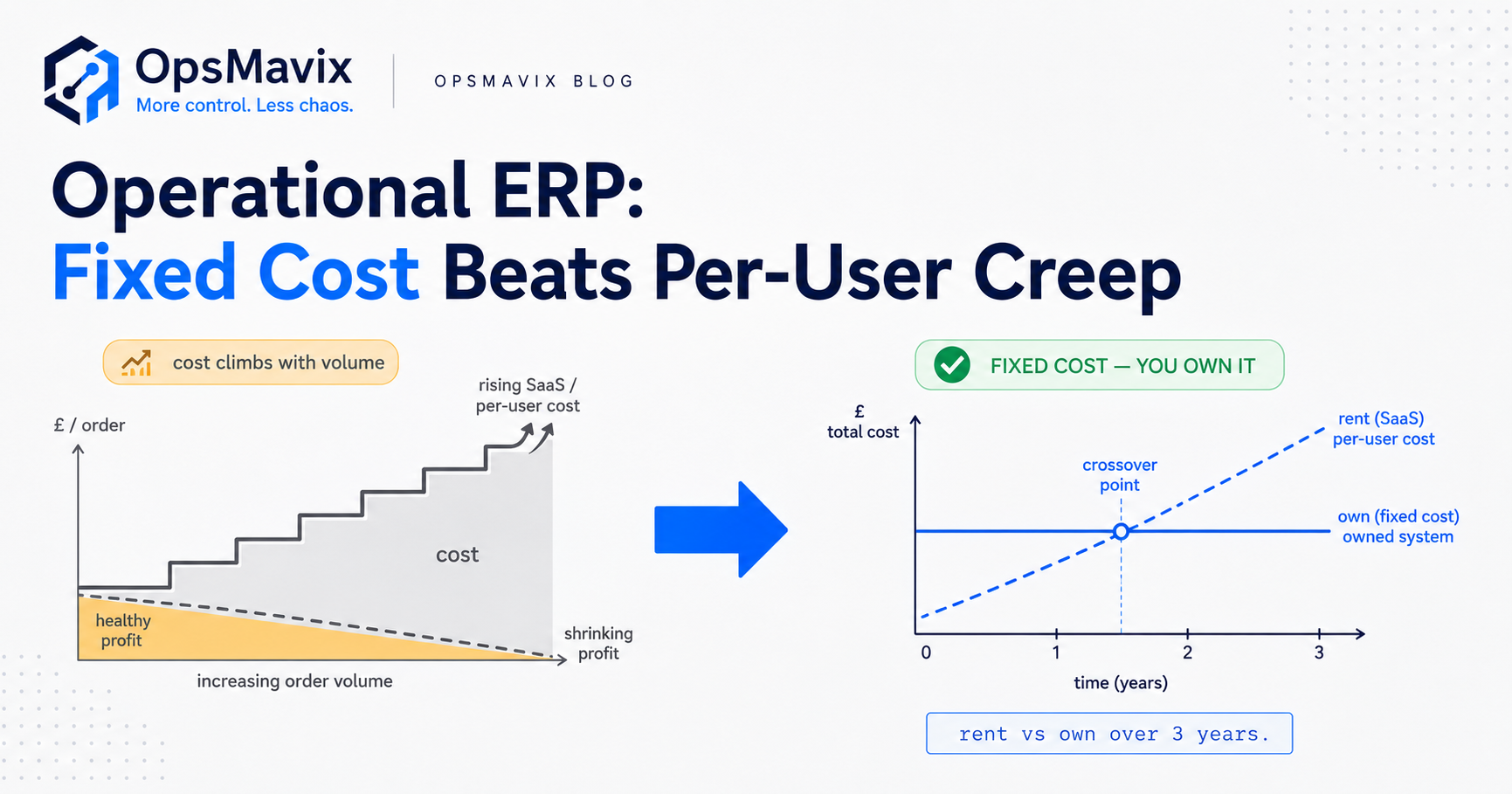
Mintsoft pricing is the number every scaling fulfilment operation ends up staring at, usually the month the invoice steps up before the volume that caused it has been billed to clients. Mintsoft is a UK cloud order and warehouse management system, now part of the Access Group, built largely for third-party logistics providers (3PLs) and multichannel sellers — and like most software in its class it doesn’t charge a flat fee for a box. It prices around how much you push through it, which for a fulfilment system means order volume. That single choice is the thing to understand before you commit, because it decides whether the tool stays cheap as you grow or starts taxing the growth you were paying it to support.
This post is about the shape of that cost, not a price list. Mintsoft doesn’t publish firm figures for its tiers, quotes are given per business, and the numbers move — so anyone quoting exact monthly amounts from a blog is guessing; confirm current pricing directly with Mintsoft. What doesn’t change is the structure: a tier tied to volume, modules stacked on top, add-on costs when you cross a line, and running costs that never appear on the headline quote. Understand the structure and you can model where the bill lands as you scale.
Key Takeaways
- Mintsoft pricing is throughput-based, structured around order volume and banded tiers rather than a flat licence, so the bill is designed to rise as your fulfilment operation does.
- The headline tier is only the base — deeper warehouse, listings, forecasting and connector modules stack on top, several also scaled to volume, so two 3PLs on the same order band can pay very different totals.
- The real costs sit off the sticker: crossing a volume band steps the base up, and onboarding, data migration, training, non-standard integrations and premium support each add their own line.
- Per-order pricing fights a 3PL by design — the more parcels you ship, the more you pay, which runs against the per-unit efficiency scaling is supposed to earn you.
- Low, predictable volume keeps SaaS pricing genuinely cheap — if that’s you, stay; the maths only flips at sustained, growing scale.
How Mintsoft Actually Prices (the Structure, Not the Numbers)
Mintsoft uses a model built around throughput. You sit in a band defined by how many orders your operation processes in a period, and that band sets your base cost. As your monthly order count climbs — more clients, more parcels, busier peak — you move up bands and the base moves with you. That’s the spine of the bill: it’s indexed to the volume flowing through the warehouse, which for a 3PL is the same thing as growth.
On top of the base sit the modules. The core platform gives you order management and warehouse fulfilment; the pieces many operations depend on — deeper warehouse features, client-billing detail, particular marketplace or courier connectors, returns, reporting — can be priced as separate lines, some also scaling with usage. So the “price” of Mintsoft isn’t one figure: it’s a base band plus whatever modules you run, and two 3PLs on the same order band can pay very different totals depending on how much they bolt on. Because the tiers aren’t firmly published and contracts are typically annual, the only reliable way to know your number is a current quote for your volume and module list — treat any second-hand figure, this post included, as illustrative only.
The Costs That Never Show on the Headline Quote
The subscription is the visible cost; the ones that catch operations out are the setup and running costs around it. Onboarding and configuration can carry a real fee, and the more clients, warehouses and odd billing rules you run, the bigger it is — matching the platform to how you actually fulfil and invoice is a project, not a switch-flip. Data migration is its own line: getting your existing clients, SKUs, stock positions and open orders in cleanly takes work, and a dirty import causes months of stock drift and mis-billing.
Then there’s training — every picker, packer and account handler has to learn the system, real time even when no invoice names it. Integration work is another line: connecting a client’s store, courier account or accounting package the way you need it often means paid development or a third-party app with its own subscription. And support can be tiered — a same-day human may sit behind a higher plan than your order volume alone would put you on, which matters when an order desk can’t wait days on a ticket.
None of this is unique to Mintsoft; it’s the normal iceberg under any platform quote — but it’s exactly what people forget when comparing a monthly SaaS fee to the one-off price of a build. Count the whole iceberg or the comparison is dishonest.
Why Per-Order Pricing Fights a Growing 3PL
Here’s the structural tension at the centre of throughput pricing: it charges you more precisely when things go well. Win a new client, land a bigger contract, ship a busy Black Friday — each pushes your order count up, and your volume-indexed bill with it. It can feel like being charged more for winning business — and structurally that’s exactly what’s happening.
For a 3PL this bites harder than for a plain seller, because volume is the product. Your margin per parcel is thin and your model is built on doing more of them cheaply; a cost line that scales with parcel count eats into the per-unit efficiency that scaling is meant to earn. Picture a fulfilment operation that doubles from one big client to three: labour and rent per parcel should fall as fixed costs spread across more volume, but a bill indexed to orders takes a growing slice of that efficiency back and hands it to the platform. That’s not a reason to avoid SaaS — it’s a reason to know your slope before you sign.
Rent vs Own: The Three-Year Frame
The honest way to compare a subscription to a built system is over time, not on day one. On day one SaaS wins every time — a low monthly fee against the larger one-off cost of building. The comparison only becomes real across three years: add up every rented pound including modules, connectors and hidden costs, and let volume grow the way you actually expect a scaling 3PL to.
A rented platform is an operating cost that recurs forever and rises with your throughput. A built system is a capital cost you pay largely once, own outright, and run at a low fixed cost after — no per-order meter, no per-module creep, nothing a vendor can reprice or switch off. Over three years the rented line starts low and climbs with your parcel count; the owned line starts high and stays flat. Somewhere they cross, and after that the owned system keeps getting cheaper in relative terms, because your growth no longer feeds the bill. For a 3PL whose whole business is volume, that rented line is steeper than for almost anyone — so the crossover arrives sooner.
When the Maths Actually Flips
The crossover isn’t a slogan, it’s a calculation. It flips toward owning when a few things stack together: your banded base and modules add up to a serious annual figure; you’re running several paid add-ons and connectors; your volume is still growing, so the rented line is steepening; and your operation has enough quirks — client-specific billing, odd intake, non-standard integrations — that you’re paying for configuration and workarounds on top. Add those and three years of renting can quietly overtake the cost of owning the exact fulfilment system you need.
It does not flip when your volume is modest and steady, your fulfilment is standard, and you run few add-ons. Then the meter barely ticks, the base band stays cheap, and building a custom system would be spending a large fixed sum to escape a small recurring one — bad maths. This is the part people selling custom software won’t tell you: for a lot of operations, staying on the SaaS is the right call. Mintsoft is a capable platform for a 3PL that fits its shape, and churning off working software is its own kind of leak. To know which camp you’re in, do the sum on your real projected volume — with a current quote, not a guess — over three years.
What You’re Really Buying When You Own It
The rent-versus-own decision isn’t only about cost — it’s about what you end up holding. Three years of subscription leaves nothing but the next invoice; you’ve paid for access, not an asset. A custom inventory system built around how you actually receive, store and ship other people’s stock does the same job as a fixed-cost asset on your side of the ledger — with no meter on your parcel count and no vendor able to reprice or sunset it.
To be clear about scope: this isn’t “build a cheaper Mintsoft clone.” A custom system is the slice of functionality you genuinely use — client accounts, the pick-and-ship flow, the billing model that matches how you invoice — owned outright. If you’ve outgrown the platform’s fit rather than only its price, the full Mintsoft alternative decision covers when to stop renting fulfilment software, and the wider competitor landscape maps every other box first so you don’t build what you could have bought.
Questions to Ask Before You Commit
Before you sign an annual contract, get the structure in writing, not just a headline number. Ask which band your current order volume puts you in, and which band your projected volume in twelve and twenty-four months will — then price all three, because a 3PL that expects to grow is buying next year’s bill, not this one’s. Ask which features are in the base and which are paid modules, whether each is flat or also scaled to volume, and what happens when you cross a band mid-period: automatic step-up, extra charge, or renegotiation.
Then the costs around the subscription: the onboarding and configuration fee, what migrating your clients and open orders involves, which support level gets you a same-day human, which non-standard connectors you need and what they cost, and the contract term and exit. Total three years of that on your real growth curve and compare it honestly to owning what you need. If the numbers say stay, stay. If they say the rented line has passed the owned one, that’s your answer, and it’s arithmetic, not a sales pitch. If you’re weighing a like-for-like move first, the Fulfillor alternative comparison is the other 3PL box to price against Mintsoft before you consider a build.
FAQ
How does Mintsoft pricing work?
Mintsoft prices around throughput. You sit in a band defined by how many orders your operation processes, which sets your base cost, and you step up bands as volume grows. On top of the base, deeper warehouse features, client-billing detail and particular connectors can be separate paid modules, some also scaling with usage. Exact figures aren’t firmly published and contracts are usually annual, so confirm current pricing directly with Mintsoft for your volume and module list.
What are the hidden costs of Mintsoft?
Off the headline quote sit onboarding and configuration fees, data migration for your clients and open orders, training for warehouse and account staff, integration work for non-standard client stores, couriers and accounting tools, and the support tier you need for a same-day response. None are unusual for a platform of this class, but they’re the costs people forget when comparing a monthly SaaS fee to the one-off price of a build.
Is a custom system cheaper than Mintsoft?
On day one, no — SaaS is a low monthly fee against a larger one-off build cost. The honest comparison is over three years on your real volume: total every rented pound including modules and hidden costs, let it grow as a scaling 3PL expects, and compare to owning the system plus its low running cost. At high, growing volume with several modules the rented total often overtakes the owned one. At low, steady volume it doesn’t — and staying on Mintsoft is the right call.
When does Mintsoft’s per-order pricing start to hurt?
When your parcel volume grows faster than the price you can pass to clients. The bill is indexed to throughput and a 3PL’s margin per parcel is thin, so every extra order adds cost as well as revenue. At flat volume the model is fine; on a steep growth curve, model where the bill lands in two and three years — that’s where the pressure shows up.
How OpsMavix Can Help
OpsMavix builds right-sized fulfilment systems for 3PLs and multichannel operations that have done the maths and found the rented line climbing past the owned one — paying more every year for a platform that taxes the volume they worked to win. Instead of a throughput meter with a stack of modules, you get a system shaped to how you actually receive, store, pick and bill — multichannel stock and order automation or wholesale and client order management, owned outright at a fixed cost, an asset on your side of the ledger rather than a subscription on someone else’s.
If your Mintsoft bill is rising with your parcel volume and you’re not sure whether you’ve hit the crossover, start by seeing the number. Book a Free Operations Leak Audit and we’ll model your three-year rent-versus-own picture on your real volume, tell you honestly whether the maths has flipped, and show what a right-sized owned system would cost against what you’re renting now.
Keep reading
Getting value from OpsMavix? Add us as a preferred source on Google — you'll see more of our operations content in your AI Overviews, AI Mode and Search.