
The fabricator running twenty welders on paper travellers
Fifteen years established, laser and plasma and press-brake work, and one man who knows where every job is.
- Sector
- Metal fabrication
- Where
- Lancashire, England
- Size
- About 20 staff, three workshops and an office
Where the business was
An established bespoke fabricator: laser cutting, plasma up to 65mm plate, tube laser, press-brake bending, heavy steel and architectural metalwork. Mostly one-off complex jobs rather than repeat runs.
Jobs moved around the shop on paper travellers, with whiteboards for the schedule. That works until the owner is the only person who can answer "where is that job", and it stops working entirely across three separate workshops.
They were moving premises within months and wanted people trained on a system before the move, not during it.
What discovery surfaced
The things that decided the shape of the system. Most of them were not on the original wish list.
Traceability was the real question, not scheduling
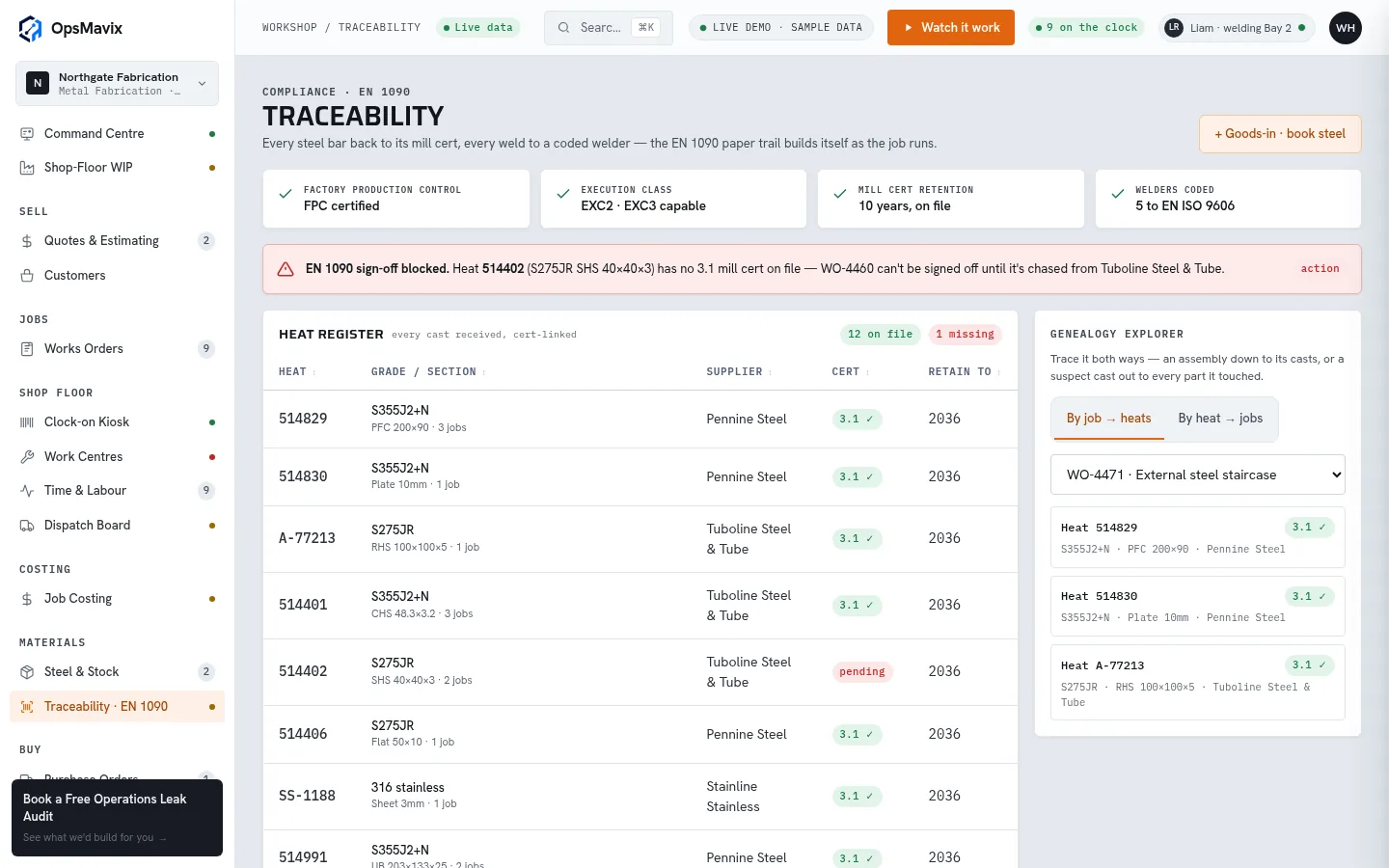
The owner's single biggest question was whether the serial number on a reel of welding wire could follow a job through to dispatch, tied to the machine that ran it and the welder who ran it. For EN 1090 work that is not a nice-to-have, it is the audit trail.
The shop floor cannot use phones
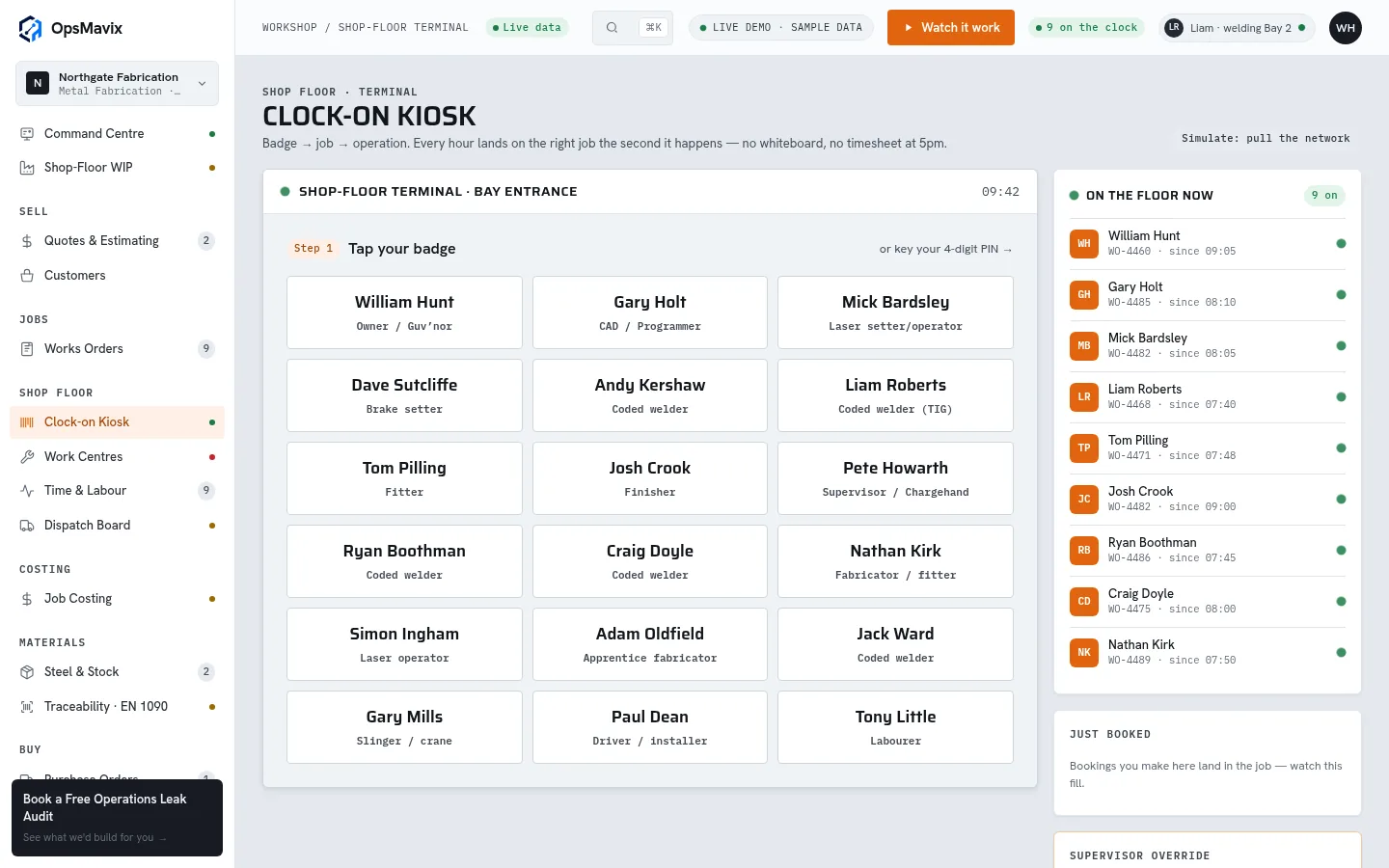
Mobiles are banned on the floor. Any system that assumed a phone in every pocket was dead on arrival. Foremen and managers get phones, the floor gets fixed kiosks.
Connectivity is not guaranteed
Lookups had to keep working when the connection dropped. We were specific about the line: viewing and lookup work offline, automations and alerts need a connection. Promising more than that would have been a lie we would meet again at go-live.
Drawings live with the operation, not in a folder
CNC program numbers and drawings needed to attach to the operation and open in the app, without downloading a file to a machine that should not have files on it.
The accounts package stays
They run Xero and are keeping it. The job was to integrate with it, never to replace it.
What we built
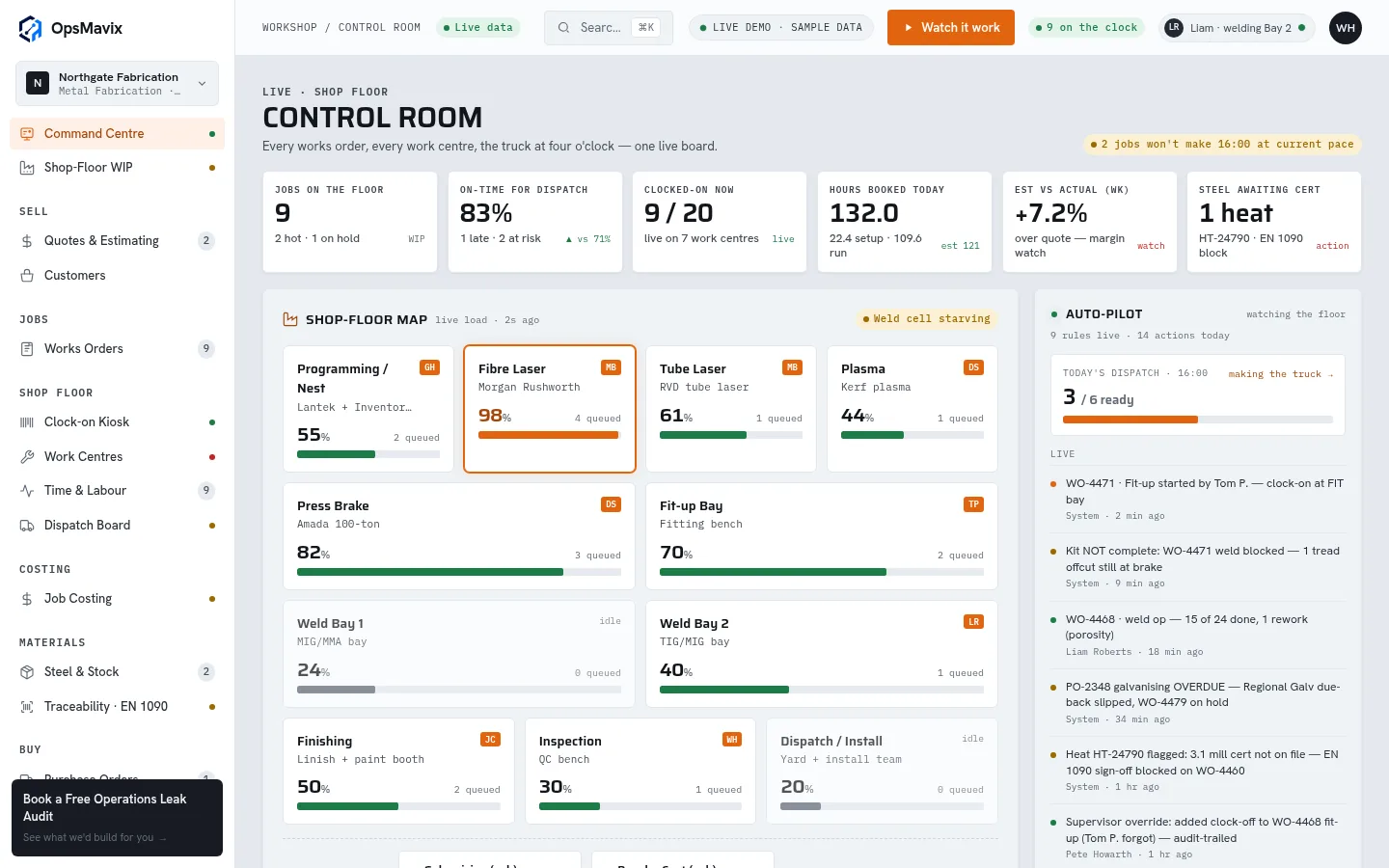
A command centre for three sites
Every live job, machine and hour on one board, with concurrent users on the same job and per-role access across three workshops and the office.
Clock-on kiosk
Touchscreen clock-on at the machine, so hours land against the job as the work happens instead of being reconstructed on Friday.
Consumable traceability
Wire serial tied to job, machine and operator, so the EN 1090 trail is a query rather than an archaeology project.
Job costing against the quote
Real hours and real material against what was quoted, per job, while the job is still open and something can be done about it.
Dispatch board with signature capture
Proof of delivery signed on the driver's device and attached to the job.
Workshop Control Room
The system described above, running. Click through it yourself.
The system that was built
Real screens from the working system, not mockups. You can open the whole thing yourself.
Scope, as agreed
- Sites
- Three workshops and an office, on one system, with concurrent users on the same job
- Shop floor
- Fixed touchscreen kiosks rather than phones, because mobiles are banned on the floor
- Offline
- Viewing and lookup work without a connection. Automations and alerts need one, and we said so up front
- Accounting
- Integrates with their existing package. Replacing it was never in scope
- Migration
- Bulk load of existing jobs and customers, not hand entry
- Timing driver
- Trained before a premises move, not during it
The reality it had to respect
A system that ignores any of these is a system this business cannot actually run on.
- EN 1090 execution class and consumable traceability
- Welding procedure and operator records
- Multi-site work in progress
- Xero integration, not replacement
What is missing from this page, and why
A case study usually carries four more things. Here is exactly why each one is absent, so you are not left wondering.
- The client's name. This is a live commercial conversation and we do not have written consent to name them. Consent, then the name goes on, not before.
- A customer quote. Same reason. We will not write one on their behalf.
- Before-and-after numbers. Nothing has launched, so there is no measured after. Any percentage here would be invented, and invented numbers are the thing this industry has too much of already.
- Time-saved and accuracy figures. These need a real baseline captured at day zero and re-measured after launch. That is our own process, and it has not run its course here yet.
When one of these launches with real baselines and written consent, this page gains an outcomes section. Until then it stays as it is.
Want the same treatment
Every one of these started with a conversation about how the business actually runs, not a feature list. If your operation has a version of these problems, that is the conversation to have.
Book a free 30-min call →