
E-Invoicing in the UK: What It Is and What Is Changing
E-invoicing means structured invoice data, not a PDF. What is confirmed for 1 April 2029, what is still undecided, and how to prepare accounts payable.
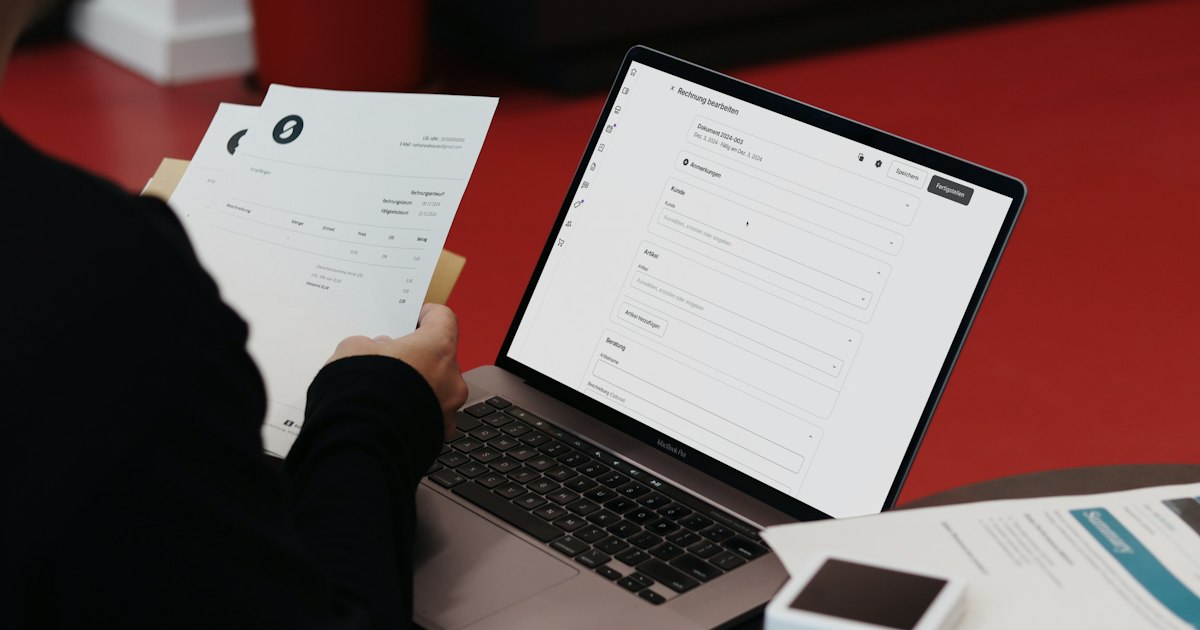
E-invoicing is the exchange of invoice data in a structured format, sent directly from the seller’s software to the buyer’s software, so the invoice arrives ready to process with nothing retyped. A PDF attached to an email is not an e-invoice. In the UK it is optional today, and the government has confirmed that VAT invoices must be issued as e-invoices from 1 April 2029.
What e-invoicing is
The government’s e-invoicing roadmap defines e-invoicing as the digital exchange of invoice data directly between the buyer’s and supplier’s financial systems, even when those systems differ. The invoice is written into the buyer’s system automatically.
The same document lists what does not count: PDFs, word-processed documents, image files, HTML invoices on a web page or in an email, and faxes. These are digital files, but a person or a scanning tool still has to read them.
There is one source of confusion. HMRC’s current guidance, VAT Notice 700/63, uses “electronic invoicing” in a wider sense that includes unstructured formats such as PDF. So a PDF is an electronic invoice under today’s VAT guidance, but it will not be an e-invoice under the 2029 rules.
| Paper invoice | PDF by email | E-invoice | |
|---|---|---|---|
| How it travels | Post or by hand | Email attachment | System to system, over a network such as Peppol |
| What the buyer receives | A document | A picture of a document | Structured data: each field labelled |
| Data entry | Typed by hand | Typed, or read by a capture tool and checked | None; a draft bill appears in the software |
| Checks before it arrives | None | None | Validated against the standard’s rules |
| Matching to a purchase order | By eye | By eye, or by software after capture | Automatic, if the PO number is on the invoice |
| Valid for VAT today | Yes | Yes, if the customer agrees and the conditions are met | Yes, on the same conditions |
| Meets the 2029 requirement | No | No | Yes, if it follows the UK standard once that is published |
How e-invoicing works
Two things make it work: a common format and a network.
The format. An e-invoice is a data file in which every item (supplier, VAT number, PO number, line, quantity, price, VAT rate) sits in a labelled field. The Peppol billing specification, called Peppol BIS Billing 3.0, uses the UBL invoice and credit note formats and is built on the European e-invoicing standard EN 16931.
The network. Peppol is a framework of document specifications, a network and a set of binding agreements. It is not a portal. A business connects through a Peppol service provider, and can then exchange documents with any other business on the network, whichever provider that business uses. The roadmap calls these connection points Access Points and says most businesses will reach one through their accounting or finance software. You will not need to become an Access Point.
Each business on the network has an identifier that works as a digital address, so the invoice is routed to the right recipient.
Who runs it. The organisation OpenPeppol governs the framework internationally, and each country has a Peppol Authority. HMRC’s policy paper says the UK Peppol Authority currently sits within Supply Chain Coordination Limited, which operates NHS Supply Chain, and OpenPeppol’s list of authorities shows the same body. The government has said HMRC will take over the role. The date of that handover is not decided.
E-invoicing UK rules: today and what is planned
Everything in this section was checked on official government pages on 26 November 2026. Each row names its source.
Confirmed
| What | Detail | Source and date |
|---|---|---|
| E-invoicing is optional today | You may invoice electronically if your customer agrees and you can ensure the authenticity of origin, integrity of content and legibility of the invoice. You must normally keep invoices for 6 years | VAT Notice 700/63, last updated 26 May 2022 |
| Public bodies must accept e-invoices | Section 67 of the Procurement Act 2023 implies a term into every public contract covered by the Act: the contracting authority must accept and process undisputed electronic invoices that meet the standard BS EN 16931-1:2017. This continues a rule made in 2019 | Cabinet Office guidance, updated 20 July 2026; Procurement Policy Note 03/19, 20 May 2019 |
| The consultation | HMRC and the Department for Business and Trade consulted from 13 February to 7 May 2025 and received 342 responses | Consultation page, response published 26 November 2025 |
| The mandate | Announced at Budget 2025: e-invoicing will be mandatory for all VAT invoices from 2029 | Same consultation response, 26 November 2025 |
| The network | Peppol will be the UK’s core framework for exchanging e-invoices | Tax update 2026 summary, 23 June 2026 |
| The start date | VAT invoices must be issued in a specified electronic format from 1 April 2029. The roadmap gives this single date and describes no phasing by business size | Budget 2026 and the roadmap, both 28 October 2026 |
| The legal route | Enabling powers will be in Finance Bill 2026-27. The detail will follow in regulations. HMRC will be given the functions of the UK Peppol Authority | HMRC policy paper, 28 October 2026 |
Planned, with the government’s own dates
- Spring 2027: a technical consultation on the UK e-invoicing standards and on Access Point certification. The Finance Bill is expected to become law, subject to Parliament.
- Autumn 2027: guidance on how existing EDI and other legacy systems fit in. The stated intention is that they can continue, provided the business can also exchange e-invoices through the UK framework.
- October 2027 to April 2028: the full requirements: scope, exemptions, standards, business identifiers and rules for software providers. The government promises at least 12 months’ notice before the start date.
- By April 2028: details of taxpayer obligations, updated VAT guidance and the exemption process.
- Summer and winter 2028: readiness testing with software providers, then live infrastructure.
- Autumn 2028 or early 2029: the regulations may not complete their passage until then.
- 1 April 2029: the requirement takes effect.
Not decided
- The exact standard. Peppol is chosen, but any UK-specific requirements are still to be consulted on.
- Which business identifiers will be accepted.
- The exemptions. One is promised for digitally excluded businesses, following the approach used for Making Tax Digital. Others will be narrow.
- Penalties. The roadmap says the existing VAT invoicing penalty framework will be the basis, with detail to follow.
- Costs to business. Estimates will be published with the regulations.
- Reporting invoice data to HMRC. A separate consultation opened on 28 October 2026 and closes on 20 January 2027. It states that no decision has been taken on whether digital reporting will be introduced. The roadmap also says the Peppol Authority will not receive copies of VAT invoices.
Who is affected
The roadmap says the requirement will apply broadly to VAT-registered persons. That includes companies, sole traders, partnerships, charities and public bodies that are registered for VAT.
- In scope: taxable supplies between VAT-registered parties in the UK, where a VAT invoice is already required. You must issue the e-invoice and your customer must be able to receive it. HMRC’s policy paper adds anyone who needs a VAT invoice to recover input tax, including some public bodies that are not VAT registered.
- Not required: sales to consumers, invoices from businesses that are not VAT registered, and supplies where no VAT invoice is needed. Cross-border invoices are not covered.
- Voluntary use: businesses outside the rule may still send e-invoices.
- Overseas sellers registered for UK VAT will follow the same rules as UK businesses.
The rules on when a VAT invoice is needed and what it must contain do not change. Those are in section 16 of VAT Notice 700.
Benefits and risks for accounts payable
For a business that buys stock or materials, receiving is the bigger change.
Benefits
- No keying. The bill arrives as data. Errors from typing or misread scans go.
- Faster matching. With a PO number in a known field, software can match the invoice to the order and the goods received note without a person. See two-way vs three-way matching.
- Duplicate detection. The same invoice number from the same supplier is easy to catch when both are data, not text in a PDF.
- Fraud checks. The roadmap notes that e-invoicing allows automated checks, such as comparing the bank details on an invoice with those the supplier used before.
- Faster payment. The roadmap cites NHS Shared Business Services reporting that e-invoices are paid 26 days faster on average than paper or email invoices.
Risks
- Bad data moves faster. A wrong or missing PO number now reaches your ledger in seconds. E-invoicing checks the format of an invoice, not whether you ordered the goods.
- Duplicates through two channels. Until every supplier has moved, the same invoice can arrive as a PDF and as an e-invoice. Your duplicate check must cover both.
- Fraud does not vanish. A valid e-invoice from a newly added, fake supplier is still fraud. Controls over new suppliers and bank detail changes stay essential.
- Approval still matters. Structured data cannot tell you the goods arrived or the price was agreed. An invoice approval workflow is still needed for exceptions.
Our accounts payable software guide compares tools for the whole process.
How to prepare
The roadmap says there is no need to implement e-invoicing before the detailed requirements are published. These steps cost little and pay back anyway:
- Clean your supplier master data. One record per supplier, with legal name, VAT number, company number and verified bank details. Identifiers route e-invoices, so duplicates and gaps will hurt.
- Put a PO number on every order. Ask suppliers to quote it on every invoice. Our guides to the purchase order number and purchase order vs invoice explain how.
- Decide your matching rules. Which spend needs a goods received note, and what price and quantity tolerances will pass without review?
- Record goods received on the day. Automatic matching fails if receipts are entered a week late.
- Ask your software provider in writing whether it will support the UK requirements, when, and at what cost.
- Watch for the 2027 and 2028 publications before buying anything new.
Which accounting tools support e-invoicing
We read each supplier’s UK pages on 26 November 2026. The table states only what those pages say.
| Tool | What its UK page says | What it does not say |
|---|---|---|
| Xero | UK businesses can send and receive e-invoices in Xero over Peppol. Registration is free. In the UK only VAT-registered businesses can register. Received e-invoices appear as draft bills | Whether it will meet the 2029 UK standard, which is not yet published |
| Sage | E-invoicing is offered through integrations in Sage Network, with partners, to create, send and receive invoices as structured data | The page does not mention Peppol or name which Sage products are covered |
| QuickBooks | Its UK guide, dated 8 October 2026, explains e-invoicing and the April 2029 date, and says QuickBooks helps streamline the process | The guide does not say that QuickBooks Online sends or receives Peppol e-invoices in the UK |
The roadmap says several providers have committed to including e-invoicing in their core package at no extra cost once it is required.
A worked example (hypothetical)
Hypothetical: a VAT-registered wholesaler in Leeds receives 420 supplier invoices a month, 300 as PDFs and 120 on paper. Each takes about 4 minutes to key and 3 minutes to match to the order.
- Today: 420 x 7 minutes = 2,940 minutes, or 49 hours a month.
- With e-invoices and a PO number on 85% of them: 357 match automatically. The other 63 are exceptions at about 10 minutes each: 630 minutes, or 10.5 hours a month.
- Time saved: 38.5 hours a month. At a hypothetical £16 an hour, that is £616 a month.
The saving depends on the 85%, which comes from PO discipline, not from the e-invoice format.
Now one invoice. The wholesaler raises a purchase order for 40 units at £12.50: £500 plus £100 VAT, £600 in total. The warehouse receives 36. The supplier’s e-invoice arrives for all 40. The data is perfectly valid, and it is still wrong. A three-way match flags 4 units short: £50 plus £10 VAT. The business approves £540 and holds £60 until a credit note arrives. E-invoicing delivered the invoice faster; the matching rule protected the money.
Common mistakes
- Calling a PDF an e-invoice. It will not meet the 2029 requirement.
- Thinking only about sending. You must be able to receive e-invoices too.
- Buying software before the standards exist. The requirements are due between October 2027 and April 2028.
- Assuming HMRC will see every invoice. Reporting is under consultation and not decided.
FAQs
What is e-invoicing?
E-invoicing is sending and receiving invoices as structured data, directly between accounting or finance systems. The buyer’s software reads the invoice without anyone typing it in.
Is e-invoicing mandatory in the UK?
Not yet. It becomes mandatory for VAT invoices between VAT-registered parties from 1 April 2029, unless an exemption applies. Until then it is optional, though public bodies must already accept compliant e-invoices from their suppliers.
Is a PDF invoice an e-invoice?
Not under the 2029 rules. The government’s roadmap says PDFs, word-processed documents and images are not e-invoices. A PDF is still a valid electronic VAT invoice today if your customer agrees to receive it.
What is Peppol?
Peppol is an international framework and network for exchanging business documents such as invoices. Businesses connect through a certified provider and can then reach any other business on the network. The UK has chosen it as the core framework for e-invoicing.
Do I need new software for e-invoicing?
Possibly not. The government expects many accounting packages to include it, and says free or low-cost products already exist. Ask your provider in writing, and wait for the published requirements before buying.
Will HMRC receive a copy of every e-invoice?
That is not decided. A consultation on digital reporting runs until 20 January 2027, and the government says it has taken no decision. The roadmap says the Peppol Authority will not receive copies of VAT invoices.
How OpsMavix can help
OpsMavix does not offer a Peppol Access Point, and it is not an e-invoicing network provider. You will get that connection from your accounting software or a certified provider. We also cannot promise compliance with a UK standard that has not been published.
What we build is the part e-invoicing does not do for you: invoice approval and matching workflows. That means purchase orders with proper numbers, goods received records, two-way or three-way matching with your tolerances, duplicate checks, approval routes by amount and department, and an audit trail. It works with invoices however they arrive today. Taking structured invoices from your provider would be scoped once the UK standard is published.
First systems start from £4,950 at a fixed price in writing and go live in about 30 days. You pay half to start and half when it works. There are no per-seat fees, and you own the code, data and hosting. If your accounting package already matches and approves bills well enough, you do not need us for this. See pricing, read is OpsMavix right for you, or contact us.
Keep reading
Getting value from OpsMavix? Add us as a preferred source on Google — you'll see more of our operations content in your AI Overviews, AI Mode and Search.