
CRM and Inventory Management Software: Joining Sales to Stock
CRM and inventory management software is meant to link your pipeline to what is actually on the shelf. This guide explains why two bolted-together apps drift out of sync, and why one owned operations system fits a business that has outgrown spreadsheets and disconnected tools.
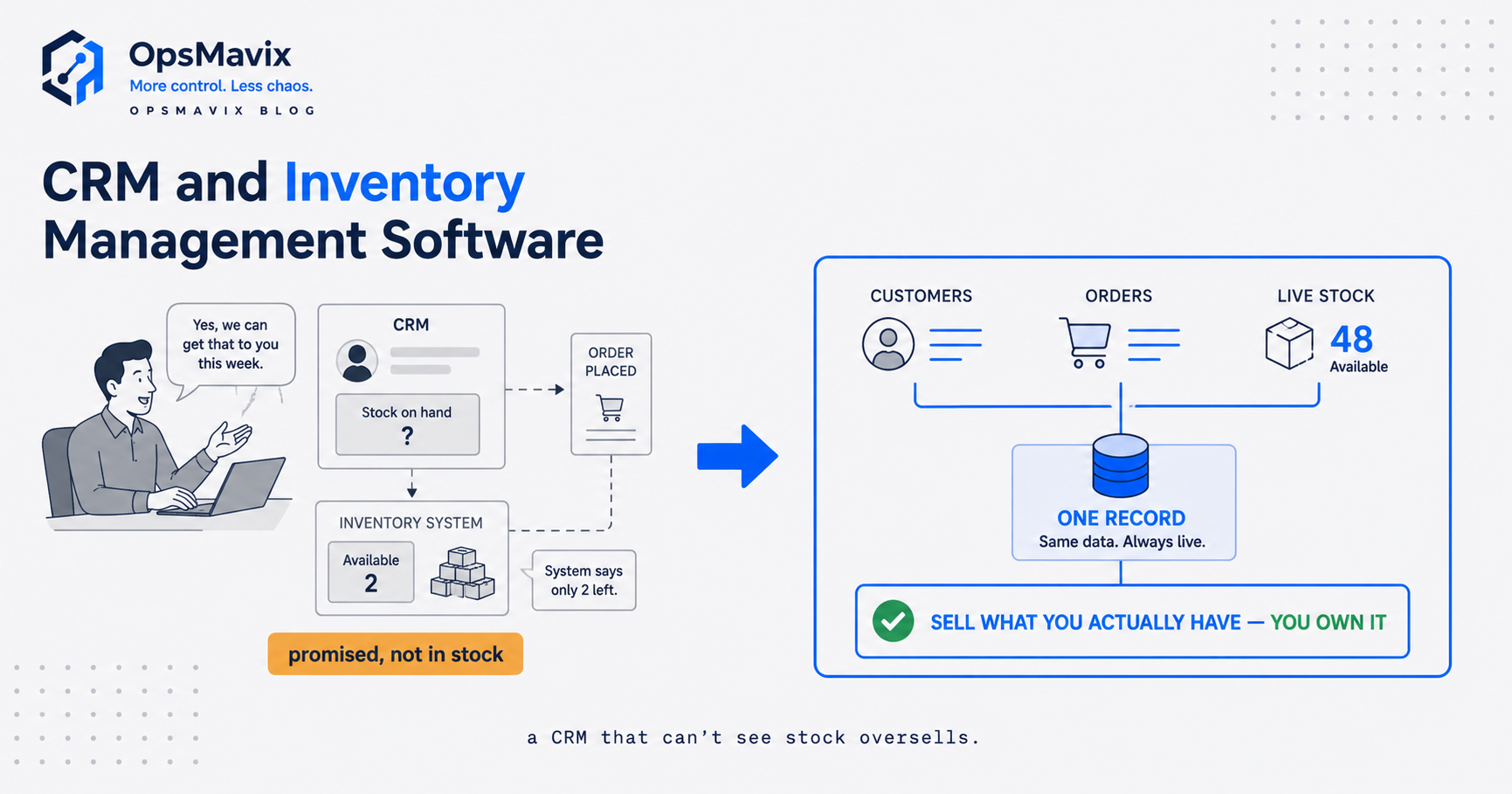
CRM and inventory management software describes any setup where your customer and sales records sit alongside, or connect to, your live stock and order data. The point is simple. When a salesperson looks at a deal, they should be able to see whether the goods to fulfil it actually exist. Most businesses buy two separate tools for this, wire them together with an integration, and assume the two will agree. They rarely do.
The pain shows up in a specific, expensive way. Sales promises a delivery date, the order lands in the warehouse, and the stock is not there. Someone spends the afternoon on the phone apologising. The customer remembers. This is the leak: not a missing feature, but the gap between what your CRM says you can sell and what your shelves can actually ship.
What CRM and inventory management software actually does
At the surface, the two halves do different jobs. A CRM tracks people and deals: contacts, conversations, quotes, the stage each opportunity sits at, the forecast. Inventory software tracks things: what you hold, where, how much, what is reserved, what is inbound. Neither is unusual on its own, and you are already comparing options, so you know this.
The value only appears where the two meet. A joined view answers questions that neither tool can answer alone:
- Can I actually fulfil this quote today, or am I promising against air?
- When this deal closes, does it commit stock that another rep has already sold?
- Which pipeline value is backed by goods on hand, and which depends on a purchase order that has not landed?
- If a customer doubles their usual order, do we have the units, or do we need to buy in first?
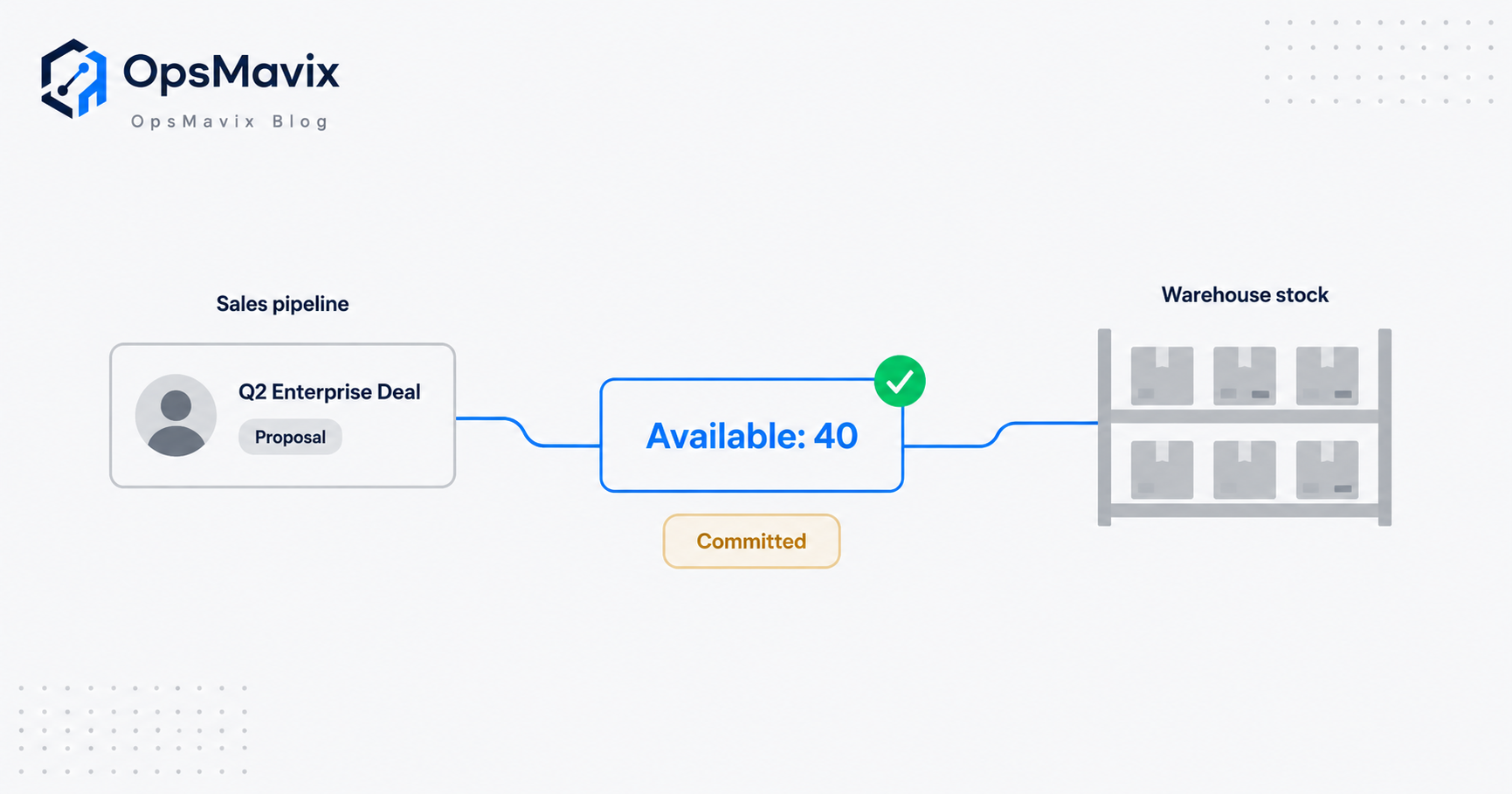
That last column, the one that reconciles a sales promise against physical availability, is the entire reason to link the two. Everything else is bookkeeping. A useful system treats a quote or a won deal as a claim on real stock, decrements availability when it is committed, and flags the moment a promise outruns supply.
The blind spot: promising stock you do not have
Here is the quiet cost. Research from the Auburn University RFID Lab and GS1 US found that when orders were not tracked with RFID, 69 percent of shipments between brands and their retail partners contained data errors, against 99.9 percent order accuracy once the data was reconciled properly. The number to sit with is not the technology. It is that, left unmanaged, the record and the reality disagree most of the time.
When the record and the reality disagree, sales works off the record. So they sell the phantom units. The customer feels it in two ways: the order slips, or it gets cancelled outright. Both erode trust fast. In one survey, 66 percent of consumers said they were less likely to trust a business after experiencing overselling, and 68 percent viewed a retailer more negatively after being told an item was in stock when it was not. A UK survey of over 1,000 shoppers by Pricer found the same instinct: 58 percent actively avoid retailers that are regularly out of stock, and 42 percent sometimes leave without buying anything because they could not get what they came for.
It is not only a retail problem. Wholesalers, manufacturers, and distributors run the same play with bigger order values and longer lead times, so the apology is more expensive and the customer harder to replace. The classic study of shelf availability by Corsten and Gruen found stockouts cause roughly a 4 percent loss of sales for a typical retailer, and that 72 percent of stockouts trace back to internal planning and ordering rather than the supplier. Internal. The goods were gettable. The system just did not know its own position.
Why sales and the warehouse keep two versions of the truth
Two teams, two tools, two incentives. Sales lives in the CRM because that is where the commission, the forecast, and the next call live. The warehouse lives in the stock system because that is where picking, receiving, and counts happen. Each team trusts its own screen and distrusts the other one, usually with good reason.
A few structural causes keep the two versions apart:
- Sync lag. An integration that runs on a schedule, say every fifteen minutes or overnight, means the CRM shows a stock figure that was true at the last sync, not now. In a busy day that window is long enough to double-sell.
- Reservations that do not travel. The CRM knows a big quote is out. The stock system does not, so it still shows those units as free. Two reps sell the same pallet.
- Field mismatches. SKUs, units of measure, and product names differ between the two systems, so the mapping breaks on edge cases and quietly drops the ones it cannot match.
- No shared owner. When the integration breaks, it belongs to nobody. Sales blames the warehouse, the warehouse blames the software, and the person who set up the connector left last year.
Disconnected tools do not just cause a bad afternoon. They force people to reconcile by hand, cross-checking one screen against another before they dare promise anything, which is slow and still wrong often enough to matter. A single source of truth removes the reconciliation entirely, because there is only one number to trust. This is the same principle behind a good inventory management dashboard: one place where the position is the position.
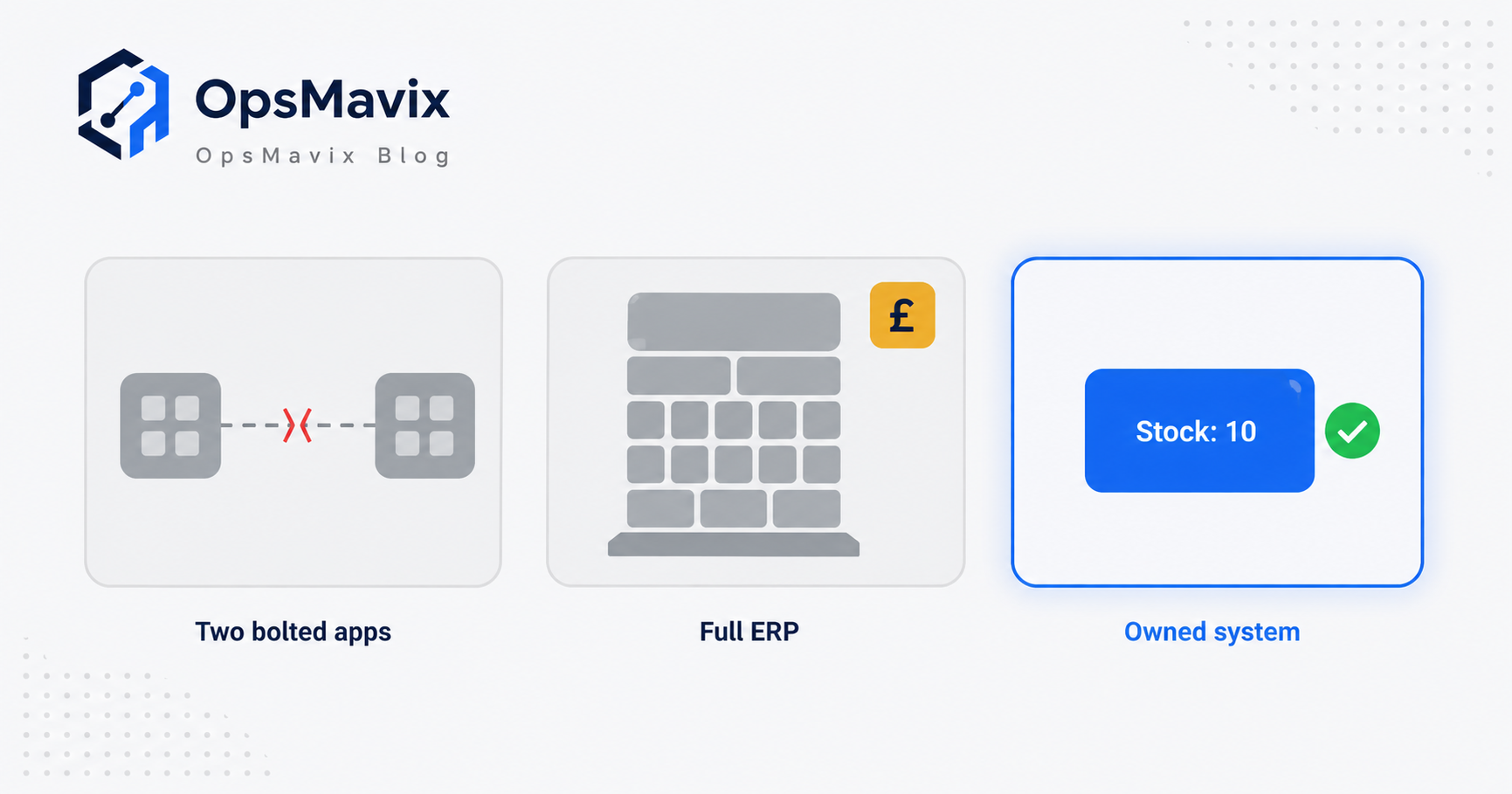
Two bolted tools versus one owned system
There are three honest ways to solve this, and the right one depends on how much the leak is actually costing you. Buy the cheapest thing that closes it.
| Generic CRM plus stock app | Full ERP | Right-sized owned system | |
|---|---|---|---|
| Setup cost | Low. Two subscriptions plus a connector | High. Large licence, long implementation | Moderate. Built once around your workflow |
| Ongoing cost | Per seat on both tools, forever, plus the sync tool | Per seat on everything, forever | You own it; hosting and support only |
| How well sales sees real stock | Only as fresh as the last sync; reservations often missed | Accurate if configured, but heavy to run | Live, because both read one dataset |
| Fits how you actually work | You bend your process to two apps | You bend hard to the ERP’s model | The system fits your process |
| Who owns it when it breaks | Nobody; the connector is an orphan | The vendor and their partners | You do |
| Room to grow | Bolt on more apps, more sync points | Everything, at a price | Expand it module by module, ERP-scale later |
| Best when | Volumes are low and errors are rare | You are large, complex, and multi-entity | You have outgrown apps but want to stay lean |
The generic pairing is genuinely fine until you outgrow it. If you ship a handful of orders a day and rarely oversell, keep your money. A full ERP does everything, but you pay per seat forever, the implementation is long, and you bend your business to its assumptions rather than the reverse. An owned system sits in the middle: it links pipeline to availability the way your business actually runs, you own the logic instead of renting two vendors and the glue between them, and it can grow toward full ERP scope later without a rebuild. For businesses that have outgrown apps but do not want the weight of an ERP, that middle path is usually the cheapest real fix. It is the same logic behind custom inventory systems built around one warehouse’s reality rather than a template.
A worked example: the wholesaler who oversold a pallet
The following is illustrative, not a claim about a specific client.
Picture a UK kitchenware wholesaler doing around £3.2m a year across trade accounts and a small online shop. Sales runs on a popular CRM. Stock runs on a separate app. A connector syncs the two every thirty minutes.
On a Monday, two reps are each working a large order for the same fast-moving line. There are 40 units of a stand mixer in the warehouse. Rep A quotes 30 units to a garden centre chain at 10:12. The sync has not run, so the stock app still shows 40 free. Rep B quotes 25 units to a department store at 10:20. Both quotes get accepted the same afternoon. The business has now sold 55 units of a product it holds 40 of.
The knock-on:
- One customer gets a call explaining the shortfall. Fifteen units are back-ordered with a two-week lead time.
- The garden centre, a repeat account worth roughly £48,000 a year, drops a chunk of its next order and starts pricing a competitor.
- Ops spends most of a day rebooking hauliers and reissuing paperwork, call it 6 hours across two people at a loaded cost near £180.
Now the same Monday with one owned system. Rep A’s quote for 30 units commits stock the instant it is accepted. Availability drops to 10 in real time. When Rep B opens the same line, the system shows 10 free and flags the gap before the quote goes out. Rep B either sells 10 now and back-orders the rest with the customer’s agreement up front, or triggers a purchase order on the spot. No surprise. No apology call. The £48,000 account never learns there was a problem, because there was not one. The leak was never the mixers. It was the thirty-minute blind spot between two screens.
Integrations and why ownership matters
No system stands alone. A joined CRM and inventory setup still needs to talk to your accounting package, your ecommerce store, your couriers, and your suppliers. So integration is not the question. Who owns the joins is the question.
With two rented tools plus a connector, you own none of the three moving parts. The CRM vendor changes an API, the connector breaks, and you wait for someone else to fix a business-critical link. Each new channel is another sync point, another place for the two versions of the truth to drift. The 69 percent error rate in unmanaged order data from the Auburn study is what that drift looks like at scale.
An owned system inverts this. The core, your customers, your pipeline, your stock, your orders, lives in one place you control, and integrations hang off that single spine. When you add a sales channel, it decrements the same availability every other channel reads. When you add a courier, it books against the same committed stock. There is one number, and you own the rules that govern it. That is what stops the phantom sale: not a better connector between two apps, but one dataset that both sales and the warehouse are looking at when they make a promise. An inventory automation system built this way turns reorder points, reservations, and low-stock alerts into rules the system enforces on its own, rather than checks a person has to remember.
FAQ
Do I need a full ERP to link my CRM and my stock?
No. An ERP will do it, but it is the heaviest and most expensive way, and you bend your process to the software. If your leak is specifically sales promising stock you do not have, you can close that with a lighter owned system and scale toward ERP scope later if you ever need it.
Can I just use the built-in inventory feature in my CRM?
Sometimes, for a while. If your volumes are low and your product range is small, a CRM’s basic stock module or a cheap add-on may be all you need. It starts to fail when reservations, multiple channels, or real reorder logic enter the picture, because those features tend to be shallow bolt-ons rather than the core of the tool.
Why not just buy a better integration between the two apps?
A better connector shortens the sync lag but does not remove it, and it still leaves you owning none of the moving parts. When one vendor changes an API, the join breaks and you wait. The reason overselling persists is that two systems each hold their own version of the truth. A connector copies numbers between them; it does not make them one number.
How is this different from the combined-tool lists I keep finding?
Most search results pair a named CRM with a named inventory app and call it a stack. That works on a slide. In practice it is two subscriptions, two vendors, and a fragile link that belongs to nobody. The honest version is to decide whether you need two bolted tools, a full ERP, or one owned system, then pick the cheapest of those that actually closes your leak.
What does it cost to move to an owned system?
Less than an ERP and more than two subscriptions, up front. The trade is that you stop paying per seat on two tools plus the sync layer forever, and you own the logic rather than renting it. For a business losing repeat accounts to oversells, the payback is usually the first few saved relationships.
How OpsMavix can help
OpsMavix builds right-sized operations systems for businesses that have outgrown spreadsheets and bolted-together apps but do not want the weight and per-seat bill of a full ERP. If sales keeps promising stock the warehouse cannot ship, we design one owned system where your pipeline and your real availability read from the same source, so a quote commits stock the moment it is accepted and nobody sells the same pallet twice. It fits how you already work, you own it rather than renting two vendors and the glue between them, and it can grow toward full ERP scope when you are ready. Start by finding the leak: Book a Free Operations Leak Audit.
Sources
- Auburn University RFID Lab and GS1 US study (PR Newswire) 99.9 percent order accuracy with reconciled data, versus 69 percent of unmanaged orders containing data errors.
- Slimstock, The hidden cost of stockouts Corsten and Gruen finding that stockouts cost around 4 percent of sales and that 72 percent trace to internal planning.
- Queue-it, Overselling explained 66 percent of consumers less likely to trust a business after overselling; 68 percent view a retailer more negatively after a false in-stock promise.
- Retail Times, Stockouts cost loyalty as UK shoppers walk away Pricer survey of over 1,000 UK shoppers on stockout loyalty and lost baskets.
Keep reading
Getting value from OpsMavix? Add us as a preferred source on Google — you'll see more of our operations content in your AI Overviews, AI Mode and Search.