
Bonded Stock: How Bonded Warehouses Work for UK Importers
Hold imported goods with duty suspended without losing control of stock. A UK guide to bonded stock, HMRC warehouse records and a worked GBP example.
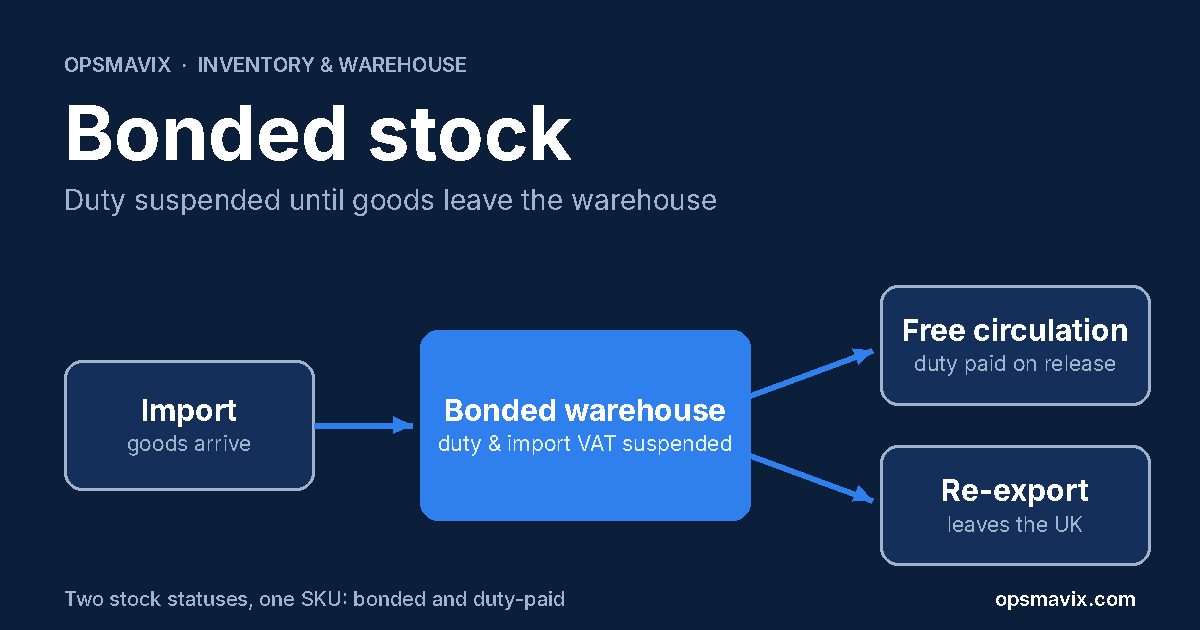
Bonded stock is stock you own, or are responsible for, but have not yet paid the import duty, import VAT or excise duty on, because it is sitting in a warehouse HMRC has authorised to hold goods under suspension. For a UK importer or wholesaler, it changes two things at once: when the tax bill lands, and how your stock records have to work.
This guide explains bonded stock in plain terms, the difference between customs and excise warehousing, and what HMRC’s published guidance says about records. It then shows what that means for stock control, with a worked example. It is general information based on GOV.UK guidance, not legal or tax advice; check your own position with HMRC or a customs adviser.
What is bonded stock?
“Bonded” is the everyday trade term. HMRC’s guidance talks about customs warehousing and excise warehouses, but the idea is the same: goods are stored in an approved place and the tax is held back while they stay there.
HMRC describes customs warehousing as “a customs special procedure that allows importers to store goods while suspending duties and import VAT” (GOV.UK). Those warehouses are “managed by authorised warehousekeepers who are approved and supervised by HMRC”. There are two kinds:
- Public customs warehouses, for businesses storing other people’s goods (the owners are called depositors).
- Private customs warehouses, for businesses storing their own goods, where the warehousekeeper and depositor are the same person.
For excise goods, Excise Notice 196 states plainly: “You must be authorised to deal in duty-suspended goods” (GOV.UK).
Customs warehousing vs excise (bonded) warehousing
The two regimes are often both called “bonded”, but they cover different taxes and have their own guidance.
| Customs warehousing | Excise warehousing | |
|---|---|---|
| What is suspended | Import duties and import VAT | Excise duty |
| Typical goods | Imported goods | Alcohol, tobacco and vaping products (motor and heating fuels have their own warehouse rules) |
| Who runs it | An HMRC-authorised warehousekeeper (public or private warehouse) | An HMRC-approved excise warehousekeeper |
| When tax becomes due | When goods are entered to free circulation and the entry is accepted by HMRC | When goods are removed to home use on payment of duty |
| Record-keeping highlight | Stock records must always show current stock under the procedure; kept for at least 4 years after discharge | Records must show all excise goods received, stored and removed; regular stocktakes |
| Main guidance | Special procedure: customs warehousing | Excise Notice 196 and Excise Notice 197 |
Who uses bonded stock, and why
Three groups use bonded stock most:
- Importers who land goods in bulk but sell them gradually. Duty and import VAT are not paid on the whole consignment on arrival, only on what is released.
- Wholesalers and distributors, especially of wine, spirits and tobacco, who hold stock in an excise warehouse and pay duty as they draw it down for UK customers. Excise Notice 197 also notes that owners of duty-suspended goods in a warehouse “may sell their goods in duty suspension at any time”, after telling the warehousekeeper.
- Re-exporters who bring goods into the UK only to send them on. HMRC lists export and re-export as ways to discharge the customs warehousing procedure, so those goods do not go through the free-circulation step at which duty and import VAT become due.
The main reasons are cash flow (tax paid later, in smaller amounts) and flexibility (decide where goods go once a buyer is confirmed). HMRC also allows limited “usual forms of handling” in a customs warehouse, operations that preserve goods, prepare them for distribution or sale, or improve their appearance without changing their nature.
There is one VAT point worth knowing. GOV.UK says that if you declare goods into a special procedure such as customs warehousing, you can choose postponed VAT accounting when you clear them into free circulation, provided your business is VAT-registered in the UK and meets the conditions (GOV.UK). That changes how much of the cash-flow benefit comes from VAT, so the worked example below looks at duty only.
Bonded vs duty-paid stock: what changes in your stock records
The biggest stock-control change is that one product can sit in two tax statuses. A case of wine in bond and the same case after release share a SKU, a description and a barcode, but they are not interchangeable in your records.
| Field | Bonded stock | Duty-paid stock |
|---|---|---|
| SKU and description | Same | Same |
| Status | Bonded (duty suspended) | Duty-paid / free circulation |
| Available to sell to UK customers for delivery | Only after release | Yes |
| Location | Inside the authorised warehouse | Any normal stock location |
| Linked customs or excise reference | Required for the audit trail | Release declaration or duty payment reference |
| Can be re-exported without duty becoming due | Yes, through the correct removal route | Duty already paid |
| Stock value | Excludes the suspended duty | Includes duty paid, if your costing policy adds it |
This is the same idea as a quarantine or inspection hold: stock that physically exists but must not be treated as freely available. Our guide to quarantine inventory software explains stock statuses in more detail. The difference with bonded stock is that the status has tax consequences and HMRC expects the records to prove it.
For the basic structure of an item record, see what a stock record is.
Record-keeping and stock control obligations
This section covers only what we read in HMRC’s guidance on GOV.UK on 25 October 2026. Your authorisation may add conditions of its own.
Customs warehousing
- Stock records must be live. HMRC says “customs warehouse stock records must always show the current stock of goods under the procedure” and that “stock records must be updated as soon as information becomes available” (duty management and closing stock balance systems).
- Keep records for at least 4 years after the goods have been discharged from the procedure.
- The warehousekeeper is responsible for the duty management system’s accuracy, and “the commercial records and duty management system are to be regarded as one system.”
- Arrival and discrepancies. Goods are expected to arrive at the warehouse within 5 working days, and warehousekeepers “must report to their supervising office all discrepancies” between the declaration and the goods received. Shortages must be notified within 14 days of entry to the procedure (receiving goods).
- No physical removal before release. Goods must not be physically removed until the warehousekeeper has evidence HMRC have released them and the stock account is updated (this differs where Entry in Declarant’s Records is used) (discharge).
- Losses are not free. HMRC states that “goods that are missing, mislaid or stolen cannot be considered non-chargeable losses in a warehouse” (losses in warehouse).
Excise warehousing
- Full movement history. “Your records must show details of all excise goods received, stored in and removed from the excise warehouse” (Excise Notice 196).
- Identifiable goods. “You must mark all excise goods, so that you can identify them in your stock accounts.” Stock accounts record details such as description, quantity, alcoholic strength, a unique reference, date received and owner, and must record any change of ownership.
- Regular stocktakes. Stock must be taken monthly for bulk goods in vats or storage tanks and annually for all other excise goods, alongside an inventory-checking system agreed with HMRC.
- Duty before release. Excise Notice 197 explains that goods removed to home use are released once HMRC has accepted the duty warrant or matched the payment.
A worked example
Hypothetical example, GBP. All figures are illustrative assumptions, not real tariff rates, HMRC figures or client results.
A UK wholesaler imports 10,000 units with a customs value of £20 each (£200,000). Assume a duty rate of 8% for illustration only. It expects to sell 3,000 units a month to UK customers for three months and to re-export the last 1,000 units to an overseas buyer in month four.
| Duty paid on import | Goods held in a customs warehouse | |
|---|---|---|
| Duty paid at month 0 | £16,000 | £0 |
| Duty paid at months 1, 2 and 3 | £0 | £4,800 each (3,000 × £20 × 8%) |
| Duty on the 1,000 re-exported units | Included in the £16,000 | £0 (not entered to free circulation) |
| Total duty paid | £16,000 | £14,400 |
Two effects show up:
- £1,600 less duty paid on the re-exported units (1,000 × £20 × 8%). If the duty had been paid on import, whether any of it could be recovered is a separate question we have not covered here.
- Later payment on the rest. £14,400 is paid in three instalments instead of on day one. At an assumed 8% annual cost of borrowing, that delay is worth about £192 (4,800 × (1 + 2 + 3) months × 8% ÷ 12).
The example ignores import VAT, warehouse charges, insurance and handling, which can be larger than the financing saving. Run it with your own figures before deciding.
Common stock-control mistakes with bonded stock
- Mixing statuses. Bonded and duty-paid units booked against one stock figure, so sales staff promise bonded stock to a UK customer before it has been released.
- Releasing without records. Goods leave the bonded area before the release is confirmed and the stock account is updated. HMRC’s guidance says the opposite order is required.
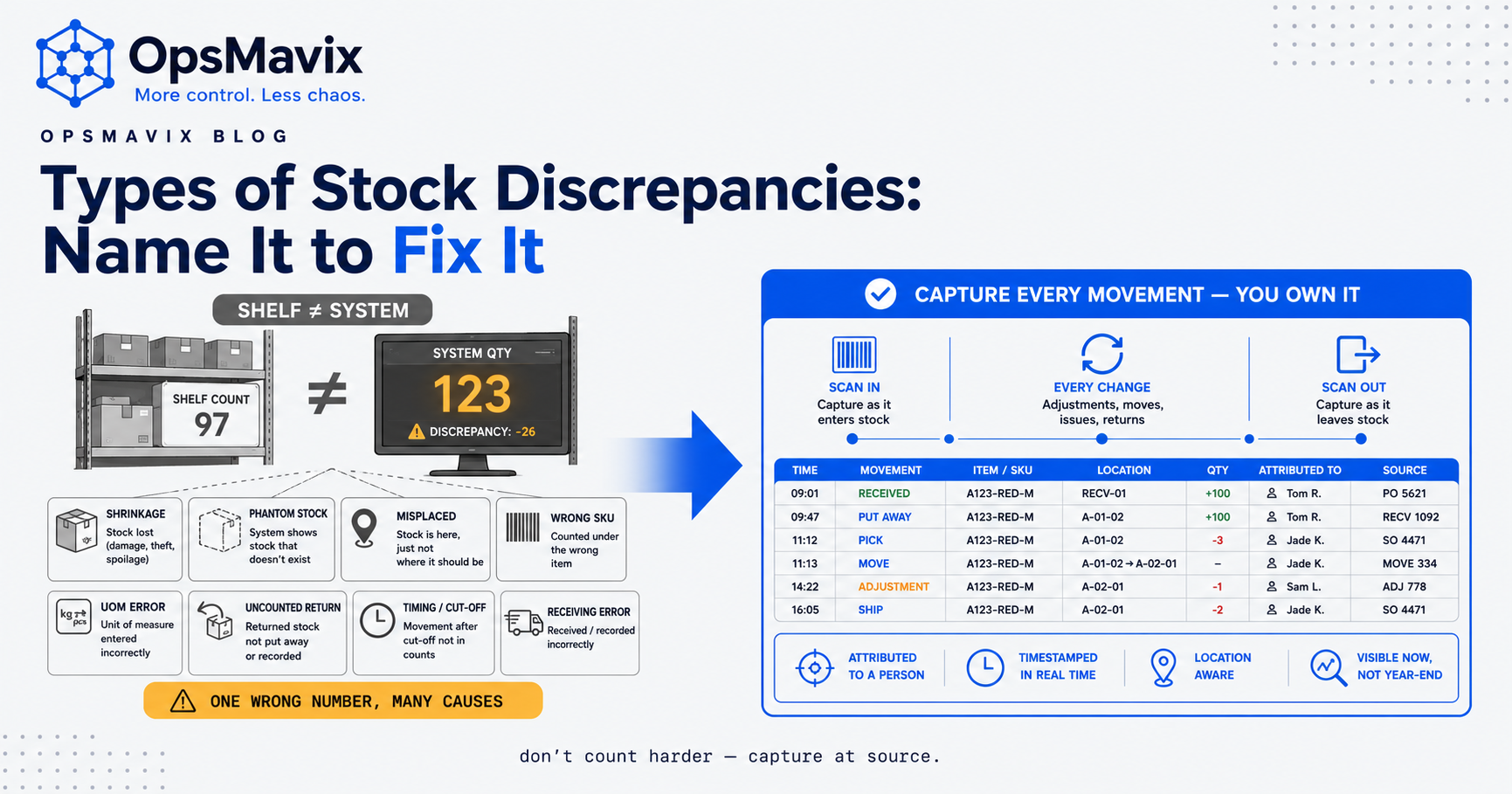
- Counts not reconciled to customs records. The warehouse count, your system and the customs or excise stock account each say something different, and nobody reconciles them until an HMRC visit. Our guide to types of stock discrepancies explains how to trace each kind of gap.
- Receiving against paperwork. Booking in what the declaration says rather than what arrived, so shortages are missed in the reporting window. A proper goods received note is the first control.
- Write-offs without evidence. Damaged or missing bonded goods adjusted out quietly, when missing or stolen goods are not treated as non-chargeable losses.
When a spreadsheet stops coping
A spreadsheet can track bonded stock for one warehouse, a few dozen lines and occasional releases. It struggles when:
- the same SKU is sold from bonded and duty-paid stock in the same week;
- several people book receipts, releases and re-exports;
- you need to show, on any given day, exactly what is held under suspension and the declaration behind each movement;
- duty-paid availability has to feed your sales orders automatically.
At that point stock status needs to be part of the record itself, with a reference on every status change.
FAQ
What does “bonded stock” mean?
Goods held in an authorised customs or excise warehouse with duty (and, for customs warehousing, import VAT) suspended. The tax becomes due when the goods are released for UK use; re-exported goods follow a different discharge route.
Is a bonded warehouse the same as a customs warehouse?
“Bonded warehouse” is the common trade term. HMRC’s guidance uses “customs warehouse” for import duty and import VAT, and “excise warehouse” for excise goods such as alcohol and tobacco. They are separate regimes with separate approvals.
Do I need my own authorisation to use a bonded warehouse?
To run a customs warehouse, yes: HMRC says authorisation is required to become a warehousekeeper. Depositors storing goods in a public customs warehouse do not need HMRC authorisation, but they accept responsibility if duties or import VAT become due. Excise has its own approval rules, set out in Excise Notice 196.
How long must bonded stock records be kept?
For customs warehousing, HMRC says records must be kept for a minimum of 4 years after the goods have been discharged from the procedure. Check Excise Notice 196 and your approval for excise record rules.
Can bonded and duty-paid stock share a SKU?
Yes, and in most businesses they do. What matters is a separate status (and usually location) so the two quantities never merge.
How OpsMavix Can Help
OpsMavix builds owned, fixed-price stock and order systems for UK wholesalers and importers who have outgrown spreadsheets but do not need a full ERP. For bonded stock, that means one SKU with separate bonded and duty-paid statuses, releases that only move stock once the reference is recorded, and a daily view of what is held under suspension. Bonded stock can only be allocated after release.
See our inventory automation system and wholesale order management system, or tell us how your bonded stock works today.
Sources
All reviewed 25 October 2026.
- HMRC: Special procedure: customs warehousing (introduction)
- HMRC: Using a customs warehouse
- HMRC: Receiving goods into a customs warehouse
- HMRC: Discharge of the customs warehousing procedure
- HMRC: Duty management and closing stock balance systems
- HMRC: Losses in warehouse
- HMRC: Usual forms of handling, other processing and records
- HMRC: Excise Notice 196, registration and approval of excise goods held in duty suspension
- HMRC: Excise Notice 197, receive goods into and remove goods from an excise warehouse
- HMRC: Check when you can account for import VAT on your VAT Return
The duty rate, quantities and costs in the worked example are hypothetical. The cover is an OpsMavix diagram.
Keep reading

Getting value from OpsMavix? Add us as a preferred source on Google — you'll see more of our operations content in your AI Overviews, AI Mode and Search.