
Quarantine Inventory Software: A US Warehouse Buying Guide
Keep inspection holds and returns out of sellable stock. A practical US guide to quarantine inventory workflows, costs and software acceptance tests.
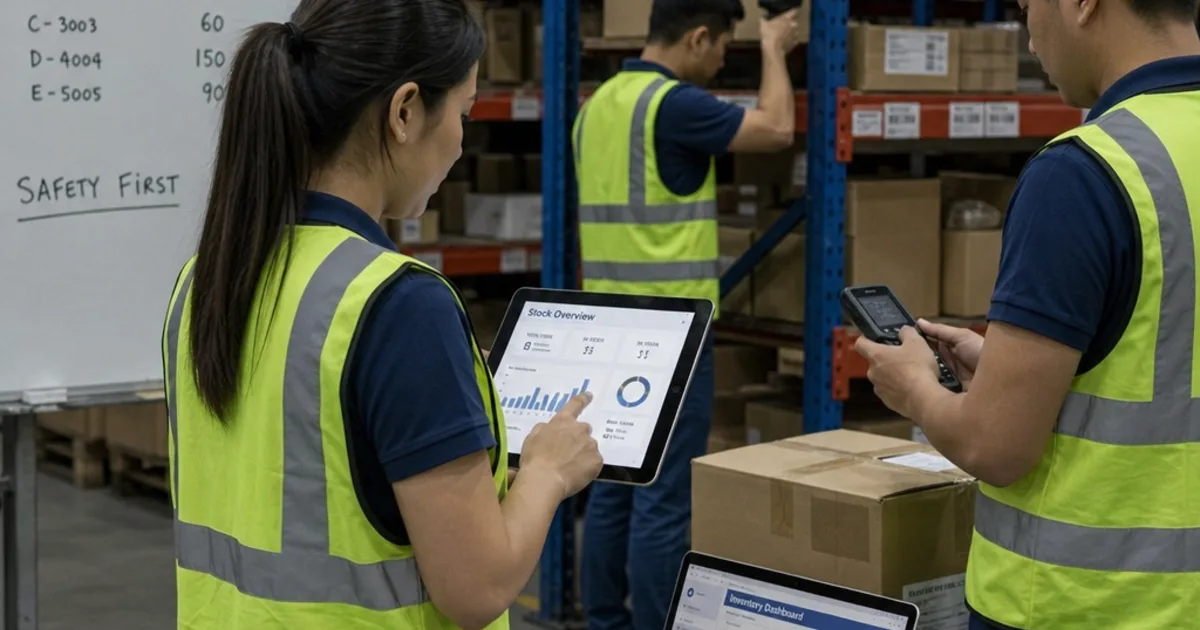
Quarantine inventory software keeps goods that need inspection, investigation or a release decision out of the stock your team can sell and ship. For a US distributor, the buying question is whether that hold survives every route an order can take: warehouse picking, a sales desk reservation, an ecommerce sync and a manual adjustment.
A separate spreadsheet can record a problem. It cannot reliably stop another application from allocating the same stock.
This guide explains the control to specify, a worked example in US dollars and the tests to run before buying. It focuses on ordinary warehouse operations; regulated products can require additional industry-specific controls.
Quarantine inventory in 30 seconds
- On hand means physically recorded in your operation.
- Quarantined means held from normal use while a decision is pending.
- Released means approved for the next permitted activity.
- Available to allocate means eligible stock left after existing commitments and other applicable restrictions.
Those are separate questions. A warehouse can hold 500 units and still have only 260 available for new orders.
An inventory automation system should make those differences visible and enforce the agreed rules wherever inventory is used. Agree the precise scope with your supplier; a dashboard alone does not establish that enforcement.
What should trigger an inventory hold?
Start with the situations your receiving and customer service teams already recognize:
| Trigger | Initial action | Decision needed |
|---|---|---|
| Damaged inbound cartons | Hold affected quantity | Inspect, return or release |
| Product differs from the purchase order | Separate the receipt | Accept substitution or reject |
| Customer return | Receive into returns inspection | Restock, repair or dispose |
| Missing batch or supplier information | Hold identified goods | Obtain and check evidence |
| Suspected defect found during picking | Stop affected allocation | Define the affected scope |
Do not automatically block every receipt because one carton is damaged. Equally, do not release the whole delivery because one sample passed. Define whether the hold applies to units, cartons, a lot or the entire receipt, and record the reason.
A useful starting point is your existing goods receiving process. Add the decision at the point the discrepancy is discovered, before the goods become eligible for routine allocation.
Location, status and ownership are different
A quarantine cage is a physical control. An inventory status is a software control. You may need both.
Consider a returned item that is still sitting on the receiving bench. Its location says where it is. Its status says whether anyone may use it. Its ownership says whose goods they are. Moving it to a different shelf should not silently change either of the other two facts.
Ask the software provider to show:
- The physical location of the goods.
- The quantity and unit of measure covered by the hold.
- The status and reason for the restriction.
- The source receipt, return or stock movement.
- The person allowed to release it.
- The events that change downstream availability.
Microsoft documents inventory blocking in Dynamics 365 as a way to prevent processing or consumption during quality inspection. Its documentation describes several blocking methods. That illustrates why you should test the behavior of your chosen configuration rather than assume all holds work alike.
Worked example: 500 units on hand, 260 available
The following is a hypothetical US warehouse example, not an OpsMavix customer result.
A distributor records 500 units of a replacement component. Of those, 120 units are awaiting inspection and 80 have already been reserved for confirmed orders. Purchasing also protects a 40-unit operational buffer from new commitments.
| Stock bucket | Units |
|---|---|
| Total physical on-hand quantity | 500 |
| Inspection hold | 120 |
| Existing reservations from released stock | 80 |
| Protected buffer from otherwise eligible stock | 40 |
| Available for new allocation under this policy | 260 |
The calculation is 500 − 120 − 80 − 40 = 260. Each deduction is a separate, non-overlapping bucket in this example. Real systems may represent buffers differently; do not subtract the same restriction twice.
Now inspection releases 90 of the held units and rejects 30. Available quantity rises from 260 to 350 if nothing else changes. The rejected 30 remain excluded while their return or disposal is recorded. Do not reduce physical on hand merely because a decision has been made if the goods are still present and your stock model requires a separate movement.
Suppose the component’s illustrative cost is US$18 per unit. The original hold covers US$2,160 of goods. That is stock tied up pending a decision, not automatically a loss. Reporting all held inventory as a write-off would hide the difference between recoverable stock and confirmed damage.
The workflow to specify before you buy
1. Receive into the correct state
Capture actual quantity, item identity and any required lot information. Where inspection is required, make the held state explicit. A receipt should not need an employee to remember to send a separate warning email.
2. Assign a reason and an owner
“On hold” is too vague for follow-up. Use reasons such as transit damage, return inspection or supplier discrepancy. Assign the next action, responsible person and review date.
3. Prevent prohibited use
Test reservation, picking, production consumption and transfers according to your policy. Some transfers may remain permitted, such as moving held goods to an inspection area. The system should distinguish a permitted internal move from release for sale.
4. Record the disposition
Allow partial release when appropriate. Record who made the decision and what happened to each quantity. Rejection, repair, supplier return and disposal should not all be collapsed into a generic adjustment.
5. Update connected channels
A correct warehouse screen is insufficient if an ecommerce connector continues advertising the held quantity. Agree which quantity is exported, when updates occur and how failed updates are surfaced. Related ecommerce inventory automation needs to use the same availability policy.
Seven acceptance tests for a software demonstration
Use your own sample item and ask the demonstrator to perform these actions live.
| Test | Expected evidence |
|---|---|
| Hold 12 of 50 units | 50 remain physically recorded; only the eligible balance can be allocated |
| Try to pick the held units | The normal workflow prevents it or requires the explicitly agreed exception |
| Release 7 of the 12 | Exactly 7 become eligible; 5 remain held |
| Move the held stock | Its restriction survives the location change |
| Receive a customer return | It stays unavailable until the chosen inspection decision |
| Attempt an unauthorized release | Access rules prevent the action and expose the attempt as configured |
| Interrupt a channel update | The failure is visible and recoverable without sending an inflated balance |
Also test simultaneous orders. Two sales users should not each be promised the same remaining stock because both opened an old availability screen.
These tests are a buying specification. They are not a claim that every inventory package, or every custom build, includes every control by default.
Spreadsheet, packaged WMS or custom workflow?
A spreadsheet can be adequate for a low-volume, physically separated hold area with one responsible person. The weakness appears when several people or applications can allocate inventory independently.
A packaged warehouse system may be appropriate when its stock status, quality and integration rules match your operation. Test the edition and configuration being quoted, including any separate quality module.
A custom workflow becomes worth evaluating when your team needs a narrow control across existing tools, unusual release approvals or a supplier-specific process that a package does not handle well. Compare the cost of that work with configuring software you already own.
OpsMavix describes its inventory offering as a system built around the operation, with stock visibility, movement records and reorder workflows. Bring the quarantine requirements to the scoping discussion so the proposal explicitly covers blocking, approvals and integration behavior.
What affects implementation cost?
There is no useful universal price for quarantine inventory software. Scope the work in five parts: inventory records, permission rules, warehouse devices, connected systems and migration.
A single warehouse with one sales channel is different from several facilities with serial tracking and independent order systems. Ask whether the quote includes returns, partial releases, failed-sync recovery, historical audit records and training.
For a simple business case, calculate the admin time separately from product loss. Hypothetically, 15 investigations a week taking 12 minutes each use three staff hours. At an illustrative US$30 per hour, that is US$90 per week in investigation time. Only count the portion a tested workflow could realistically remove. Do not present the entire figure as guaranteed savings.
Metrics that reveal whether the process works
Track open held quantity and value, age by reason, cases without an owner and time from hold to disposition. Review any incident where restricted goods reached a customer.
Keep the inventory balance and case count separate. One case may contain thousands of units; many cases may concern a single unit each. Show overdue decisions prominently so an accurate hold does not become a permanent parking place.
FAQ
Is quarantine inventory the same as safety stock?
No. Quarantine is a restriction pending a decision. Safety stock is a planning buffer. They may both reduce what your business chooses to promise, but the reasons and release rules differ.
Can held inventory still appear in the accounting balance?
It can. Physical status, ownership and accounting treatment are separate considerations. Agree valuation and any write-downs with your finance team; an operational hold alone does not determine the accounting entry.
Do we need a separate quarantine warehouse?
Not always. You need clear physical separation or identification and effective software restrictions. The right arrangement depends on your products, risks and facility.
Can a barcode stop quarantined goods from shipping?
A scan identifies the item or handling unit. Prevention depends on the status checks, permissions and workflow connected to that scan. A barcode on its own does not enforce a hold.
Can we add this without replacing our whole ERP?
Possibly. First identify which system owns stock availability and which applications can change it. A focused integration can work if it enforces a consistent rule and handles failures; another disconnected spreadsheet will not solve that problem.
Make the release decision part of inventory control
Specify what your team may do with held goods, who may release them and how that decision reaches every connected tool. Then test those rules with a partial release and an attempted pick before choosing software.
If your US warehouse has stock that looks available on screen but cannot actually ship, explore an inventory control system built around your warehouse and bring one recent hold or return to the discussion. It is a concrete starting point for mapping the workflow.
Sources and further reading
- Microsoft Learn: Inventory blocking — a product-specific example of inspection and blocking methods; behavior depends on configuration.
- OpsMavix inventory automation system — current service scope.
- OpsMavix: Goods receiving process — related receiving guidance.
The workflow, acceptance tests and dollar examples above are proposed operating practices and illustrative calculations, not regulatory requirements or measured customer outcomes. Authorized release and product-specific quality requirements must be defined for your operation. Updated 16 October 2026. It is intended for US warehouse and distribution teams.
Keep reading

Getting value from OpsMavix? Add us as a preferred source on Google — you'll see more of our operations content in your AI Overviews, AI Mode and Search.