
Credit Control: Getting Your Customers to Pay You on Time
Credit control is the discipline of getting your customers to pay you on time — setting credit terms and limits, watching the aged-debtors report, and chasing overdue invoices before they turn into cash you can't get back. Here's how the reminder sequence, statements and DSO actually work, and why doing it by memory quietly leaves money stuck in debtors.
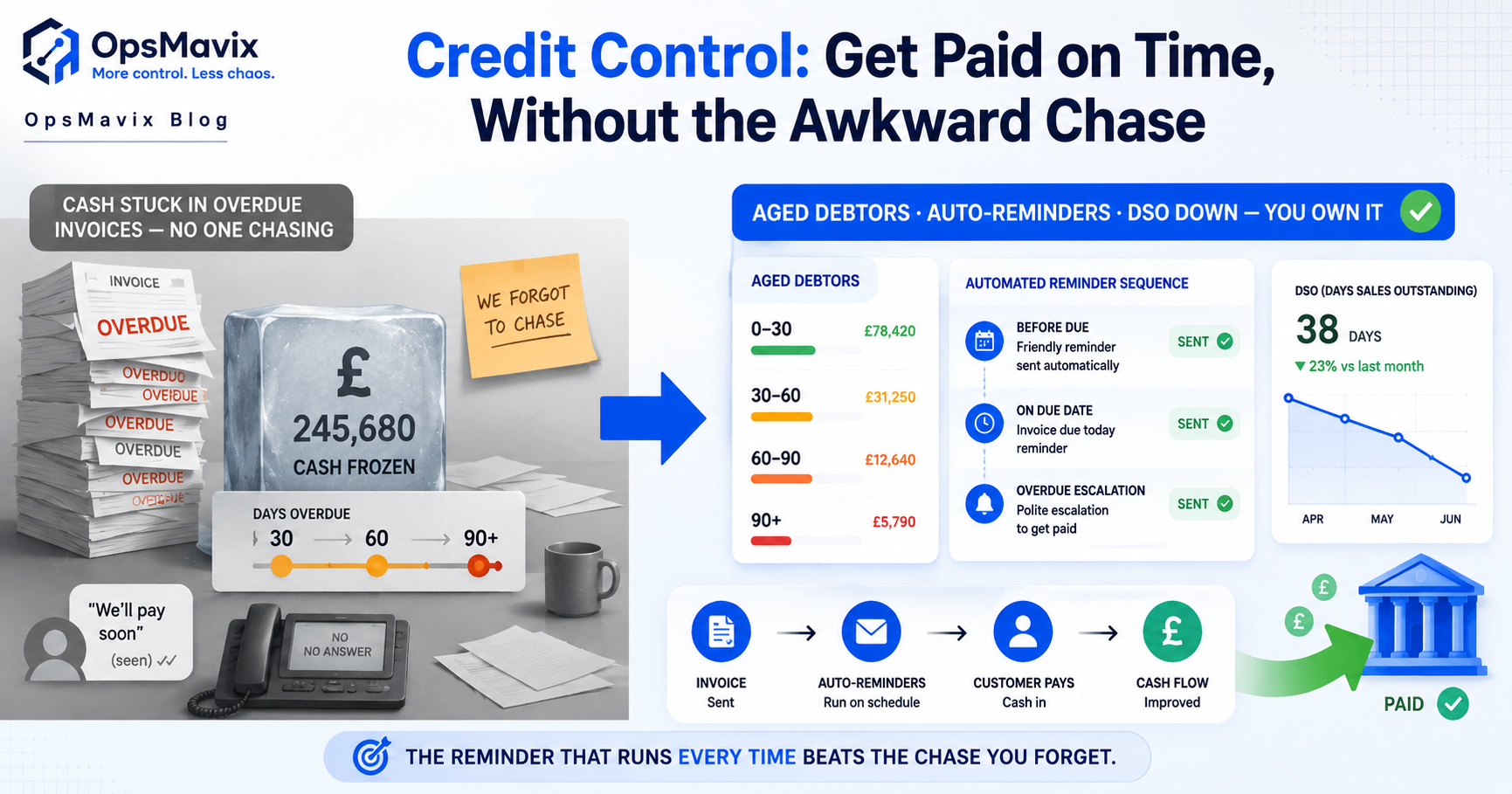
Credit control is the discipline of getting the money you’re owed into your bank on time — setting the terms customers buy on, tracking who owes what, and chasing overdue invoices before they harden into bad debt. It sits on the receivable side of the ledger: the work you’ve already done and billed for, now waiting to be paid. Do it well and cash lands roughly when you expect it. Do it loosely and you end up funding your customers’ cash flow with your own — the invoice is out, the work is done, and the money is somewhere between “sent” and “sorry, we’ll sort it this week.”
The manual version is a spreadsheet of who owes what, a memory of who’s usually late, and a Friday-afternoon guilt about the chasing emails nobody got round to. It holds up while you’ve a dozen open invoices and know every customer by name. It stops holding up the moment you’ve a few hundred, because the chasing that keeps cash moving is exactly the job that gets bumped every time something more urgent lands — and slow payers learn, quickly, which suppliers chase and which don’t.
Key Takeaways
- Credit control is accounts receivable — getting your customers to pay you — the opposite side of the ledger from paying supplier invoices.
- The aged-debtors report is the spine: every unpaid invoice bucketed by how overdue it is, so the oldest, riskiest money is impossible to ignore.
- Credit terms and credit limits, agreed up front, decide how much rope each customer gets before an order is held — collection starts at the sale, not the due date.
- An automated reminder sequence — before due, on due, and escalating overdue — chases every invoice the same way, without anyone remembering to.
- DSO (days sales outstanding) turns “we’re a bit slow getting paid” into a number you can watch move, and tie to the cash it frees.
- The leak is real £: every day of DSO is working capital stuck in debtors instead of in your account, quietly funding customers who’ve learned you don’t chase.
1. What Credit Control Actually Covers
Credit control is often mistaken for “sending reminders,” but chasing is only the tail end. It starts much earlier — at the point you decide to let a customer buy on account at all. The full job runs from before the sale (do we extend credit to this customer, and how much?) through the invoice itself (are the terms and due date clear on it?) to the follow-up (who’s overdue, by how long, and what happens next?). Treat only the last part as credit control and you’re forever fighting fires you lit at the start by giving open terms to customers who were never going to pay on time.
The through-line is simple: money you’re owed is not money you have. An invoice sitting at 45 days is revenue on paper and a hole in your bank in practice. Credit control is the set of habits that keeps the gap between those two things as small and as predictable as you can make it — so you can pay your own suppliers, your own staff, and your own invoice approvals queue without wondering which customer’s late payment is about to make that awkward.
2. The Aged-Debtors Report Is the Spine
If you keep one thing, keep the aged-debtors report. It takes every unpaid invoice and sorts it into buckets by how overdue it is — current, 1–30 days, 31–60, 61–90, 90-plus — so the money that’s been outstanding longest, and is least likely to ever arrive, sits right at the top where you can’t pretend it isn’t there. Without it, all your debt looks the same: a big number labelled “owed.” With it, you can see the difference between a customer who’s two days late and one who’s been ducking you for three months.
The buckets matter because risk isn’t linear. An invoice at 90-plus days isn’t three times worse than one at 30 — it’s the one that turns into a write-off, a payment plan, or a solicitor’s letter. A business owner we spoke to described running their first proper aged-debtors view after years on a flat spreadsheet and finding nearly a fifth of their outstanding balance was sitting past 60 days with three customers — money they’d mentally counted as “coming” that was, in truth, at serious risk. You can’t chase what you can’t see grouped. The report is what turns a vague sense that “a few people owe us” into a ranked list of exactly who to call first.
3. Credit Terms and Credit Limits Start the Clock
Collection doesn’t start when an invoice goes overdue — it starts when you agree the terms. Credit terms are the deal: net 14, net 30, net 60, deposit up front, whatever you’ve set. They decide the day the clock says “pay by,” and half the battle of getting paid on time is having terms that are written down, on the invoice, and actually agreed — not assumed. Plenty of late payment is really just terms that were never clear: the customer thought 60 days, you thought 30, and now it’s a disagreement instead of a debt.
Credit limits are the other half — a ceiling on how much any one customer can owe you at once before new orders get held. They’re how you stop a single slow payer quietly running up a balance big enough to hurt if they go under. A customer at net-30 who’s already £8k over their limit and 40 days late shouldn’t be able to place another order that ships before they’ve paid down — but without a limit enforced somewhere, they will, because the person taking the order rarely knows the person chasing the money. Set the limit, tie it to order approval, and the risk gets capped at the front door instead of discovered at the back.
4. The Reminder Sequence: Before, On, and After Due
The single most effective piece of credit control is a reminder sequence that runs on every invoice, the same way, without anyone having to remember. It has three phases. Before due — a gentle “this invoice falls due in a few days” a week out — does more than anything else, because it catches the honest-but-disorganised payers who simply forgot, and it does so before there’s any awkwardness. On the due date — a clear “this is due today” — removes the “I didn’t realise” excuse entirely. After due — an escalating series, firmer at 7 days, firmer still at 14 and 30, with a statement attached — is where you separate the forgetful from the avoidant.
The word for this is dunning, and the point of automating it is consistency, not aggression. A human chaser is uneven: they chase the customers they find intimidating less, chase on the days they’ve time, and skip the small invoices that feel not-worth-it. An automated sequence chases the £400 invoice as reliably as the £40k one, on the exact day it’s due, in the same measured tone, every time. One credit controller we spoke to said the change that moved the needle wasn’t harder emails — it was simply that every invoice now got chased on day one overdue, including the small ones she used to let slide, and the small ones turned out to add up to more than she’d guessed. Reliability, not volume, is what trains customers to pay you on time.
5. Statements and DSO: Seeing the Whole Picture
Two tools turn individual chasing into a system you can actually manage. A statement is the customer’s whole account on one page — every open invoice, what’s due, what’s overdue — sent on a schedule, usually monthly. It does a quiet job people underrate: it catches the invoices that “never arrived,” gives the customer’s own finance team a single document to reconcile against, and removes the last honest excuse for non-payment. Half the value of a statement run is discovering the invoices a customer swears they never got, weeks before they’d otherwise have surfaced at 60 days overdue.
DSO — days sales outstanding — is the number that tells you whether the whole thing is working. It’s roughly the average number of days it takes you to get paid after invoicing, and it turns “we’re a bit slow collecting” into something you can watch. A DSO of 34 against net-30 terms means you’re collecting about on time. A DSO of 58 means you’re effectively lending every customer an extra month, unfunded, out of your own working capital. The point of tracking it isn’t the number for its own sake — it’s that every day you knock off DSO is cash that moves from “owed” to “banked,” and you can see the reminder sequence and credit limits actually pulling it down month over month.
6. Why Doing It by Memory Quietly Costs You
Manual credit control fails in a specific, predictable way: it scales with how much attention one person can spare, not with a rule, so it breaks exactly when you have the most invoices to chase. At a dozen open invoices, the spreadsheet-and-memory approach is fine — you know who’s late, you fire off a couple of emails, cash comes in. At a few hundred, the chasing becomes a job in itself, and it’s the job that always loses to whatever’s on fire this week. The reminders slip a few days, then a week, then only the big invoices get chased, and the aged-debtors report grows a fat tail of small-to-medium invoices that everyone’s stopped looking at.
Put rough numbers on it. Say you carry £180k in receivables and your DSO sits at 55 days against net-30 terms. Tighten the chase — every invoice reminded before due, escalated on schedule, limits enforced at order — and pull DSO to 38. That’s not a change to your revenue at all; it’s the same sales collected faster. But it frees weeks of working capital that was sitting in debtors: cash you can use to pay suppliers early, take on the next job without a bridging worry, or simply stop sweating the end of the month. The leak was never a customer refusing to pay. It was the invoices nobody had time to chase, funding other people’s businesses with your money. It’s the same working-capital logic behind knowing your true project profitability — you can’t manage the cash you can’t see.
7. Where Credit Control Meets the Rest of Your Operations
Credit control doesn’t live in a box marked “finance.” It touches sales (who gets credit, and how much), fulfilment (do we ship this order to a customer over their limit?), and the books (which invoices are really collectable when you forecast cash). The reason it’s so often a mess is that these live in different places — the salesperson doesn’t see the debtor balance, the warehouse doesn’t see the credit limit, and the person chasing doesn’t see what’s about to ship. Everyone has a piece; nobody has the picture.
That’s the case for treating it as a connected system rather than a spreadsheet bolted onto a memory. When the aged-debtors view, the credit limits, the order flow and the reminder sequence share the same data, the awkward gaps close on their own: an order to an over-limit customer flags before it ships, a chased invoice updates the moment payment lands, and DSO becomes a dial you can actually turn. This is the exact opposite side of the ledger from paying your suppliers — the invoice approval workflow automation that governs the money going out. Credit control governs the money coming in, and for most growing businesses it’s the side where more cash is left on the table, because chasing feels like nagging and nagging is the first thing to get dropped.
FAQ
What’s the difference between credit control and accounts receivable?
They overlap heavily. Accounts receivable is the whole function of money owed to you by customers — the invoices, the ledger, the balances. Credit control is the active discipline within it: setting terms and limits, and chasing to make sure that money actually arrives on time. Receivable is the ledger; credit control is the work that keeps it moving.
What is DSO and what’s a good number?
DSO — days sales outstanding — is roughly the average number of days between invoicing a customer and getting paid. A “good” DSO is one close to your terms: if you sell on net-30, a DSO in the mid-30s means you’re collecting about on time. Much above your terms means cash is stalling in debtors. The useful move is less about hitting a magic number and more about watching your own DSO trend down as you tighten the chase.
When should I start chasing an overdue invoice?
Before it’s overdue. A reminder a few days ahead of the due date catches the customers who simply forgot, with no friction at all. Then chase on the due date, and escalate on a schedule after — firmer at a week, at two weeks, at a month. The trick isn’t harsher emails; it’s chasing every invoice consistently, including the small ones, so customers learn you always follow up.
Do I really need credit limits for small customers?
Yes — that’s often where the quiet risk hides. A limit isn’t a judgement on a customer; it’s a cap on how much you’re exposed if any single one stops paying. Small customers running up a balance nobody’s watching are exactly how a manageable debt becomes a painful write-off. Set a limit, tie it to order approval, and the exposure is capped before it grows.
Isn’t chasing customers bad for the relationship?
Consistent, professional chasing tends to help the relationship, not hurt it — because it’s predictable and impersonal rather than an occasional awkward confrontation. A polite reminder sequence that treats every customer the same removes the emotion. The customers who resent being reminded of a debt they agreed to are, usually, exactly the ones costing you the most.
How OpsMavix Can Help
Most credit-control leaks aren’t a collections problem — they’re a visibility problem. The aged-debtors view lives in one person’s spreadsheet, the credit limits live in someone’s head, and the chasing depends on whoever has a spare Friday afternoon. OpsMavix builds the connected system underneath: a live aged-debtors dashboard that ranks who to chase first, credit limits that flag over-limit orders before they ship, an automated reminder sequence that runs before, on and after due without anyone remembering, and a DSO number you can actually watch fall. Not another tool to log into — a system that fits how your business already sells and collects, so the cash stuck in overdue invoices starts landing when it should.
We don’t start with software. We start by finding where the money’s leaking. The free Operations Leak Audit maps exactly how much working capital is tied up in your debtors today, which slow-payment habits are costing you, and what tightening the chase is worth in cash back in your account — no obligation, just a clear picture of the leak and what it’s worth to close.
Keep reading


Getting value from OpsMavix? Add us as a preferred source on Google — you'll see more of our operations content in your AI Overviews, AI Mode and Search.