
Climbing Walls With Gecko Skin: What JLaser's Spider-Man Suit Held, Where It Failed, and What Tom Holland Saw
JLaser climbed a glass wall on gecko skin tiles after two failed versions. What the material is, what it held and why you cannot buy it for climbing.
Climbing walls with gecko skin is real, within limits. In a video published on 3 October 2026, YouTuber Jake Laser of JLaservideo hangs from one hand and climbs a glass-fronted building on silicone tiles that copy a gecko’s foot. Getting there took two batches of tiles and several failed versions.
Quick summary: The suit uses dry adhesive tiles made by geCKo Materials, which grip only when pulled along a surface and leave no residue. The idea predates the video: in a 2014 Stanford study, a 70 kg climber went up a 3.7 m glass wall with 140 cm² of adhesive per hand (Hawkes et al., Journal of the Royal Society Interface).
The odd part is that the material is not sticky. In the video, tape falls off it. Rest a tile on glass and nothing happens. Pull it downwards and it locks on. Lift it and it lets go. Stranger still, one of the biggest fixes in the build was a wire.
What is the gecko skin in JLaser’s Spider-Man suit?
The gecko skin in JLaser’s Spider-Man suit is a synthetic dry adhesive: a thin layer of silicone moulded into rows of microscopic wedges and mounted on small metal tiles. A company called geCKo Materials makes it, and it copies the way a gecko’s toe grips, with no glue and no suction.
Laser opens the video by calling it a “$1,000 sheet of silicone”. That price is his statement, and the company’s purchase page lists no prices to check it against. Each tile, in his words, is “just a metal piece with a little bit of silicone on it”.
The video had 107,832 views when we checked on 3 October 2026. What follows comes from its captions, stills from its footage and primary sources.
geCKo Materials
geCKo Materials makes the tiles, and the odd capitalisation is its own. Founder and chief executive Capella Kerst holds a PhD in mechanical engineering from Stanford, according to the company’s About page, which lists Stanford professor Mark Cutkosky as technical adviser. Its product, gMDA, is described by the company as “ultra-strong, reusable, leaves no residue, and requires no force to detach”. In the video, Kerst visits Laser’s workshop to coach him.
TechCrunch reported in October 2025 that Ford, NASA and Pacific Gas & Electric were customers, and the company’s applications page states: “Dry adhesive used on the International Space Station.”
How does gecko skin stick if it is not sticky?
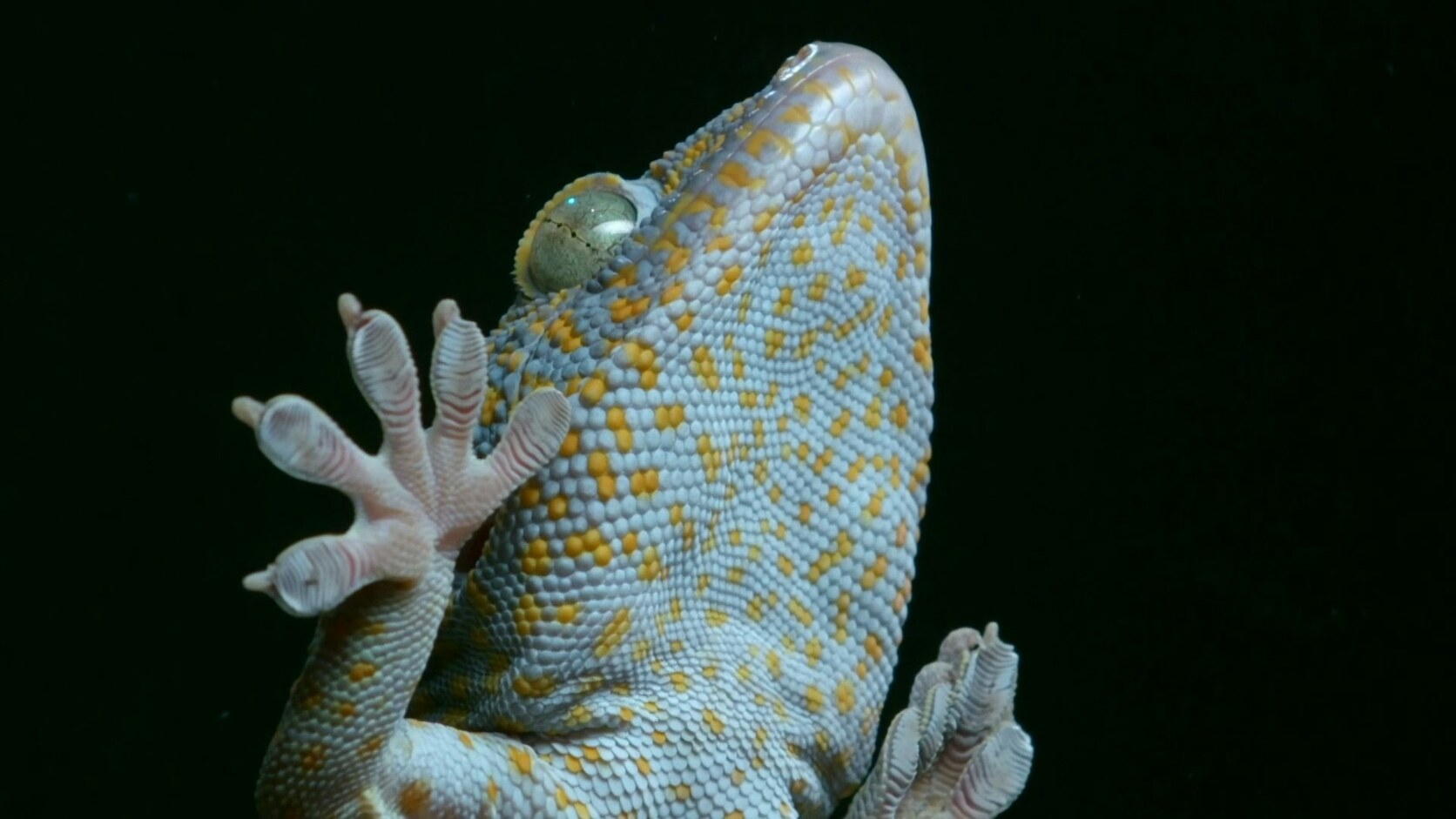
Gecko skin sticks through van der Waals forces, the weak attraction between molecules that only counts when two surfaces get extremely close. A gecko’s toes carry millions of microscopic hairs called setae, each splitting into hundreds of tips roughly 200 nanometres across, and those contacts add up.
The evidence is in Autumn and colleagues in PNAS, 2002, which reported “the first direct experimental evidence for dry adhesion of gecko setae by van der Waals forces”.
The video says a gecko can hold its whole body from one toe. DARPA’s 2014 release on gecko-inspired climbing says the same: “adhesive pressures of 15-30 pounds per square inch for each limb, meaning that a gecko can hang its entire body by one toe”.
The synthetic version is cruder: angled wedges in place of branching hairs. At rest, only the wedge tips touch the glass. Pulled parallel to the surface, the wedges bend over and the contact area jumps.
NASA’s Jet Propulsion Laboratory built space grippers on the same principle. “This is how the gecko does it, by weighting its feet,” JPL engineer Aaron Parness said in a 2015 JPL article.
How Jake Laser built the gecko skin climbing suit
The build fills most of the 33-minute video. In 2022 Laser climbed a 400-foot building in a suit of suction cups and air pumps, racing Tom Holland’s stunt double, as Nerdist reported. This time he wanted pads small enough to hang from one hand.
1. The first tiles: “fine at best”, then “almost zero grip”
Laser first tried to make gecko skin himself. He fixed a thin razor blade at an angle to a CNC machine, cut rows of wedge-shaped slots into a block of wax, and poured Sylgard 170 silicone into that wax mould. The result was “fine at best”, in his words. The real thing, he concludes, needs more precision than his workshop has.
With company tiles in hand, he built a pad of 31 and a glass test wall, with Kevlar cord to a foot strap so the tiles were loaded in shear. It gave “almost zero grip”.
From behind the glass he could see why: tiles in contact turn white, and very few did. A softer pad reached “almost 30” lb. A nine-tile rig expected to hold 60 to 70 lb managed half.
2. The nitinol wire that made the tiles share the load
The fault was load sharing. Tiles that grip first take all the weight, one lets go and the rest follow. Laser compares it to ten people of different heights lifting something overhead: the tall ones do the work. He needed tendons that pull with the same force however far they stretch, and found them in nitinol, a memory metal wire that stretches like rubber past a set load.
3. The “pro” tiles and the one-hand hang
Even with two grippers he could only hang outdoors for about a second. On a call, the company offered a stronger polymer. “Pre-launch right now. It’s not on the market,” says a voice the captions do not name. In his test an old tile let go at about 5 lb, and a new one was still attached at 20 lb when the string broke.
| Version | What changed | What it held, per the video |
|---|---|---|
| 31-tile pad | Kevlar cord to a foot strap | “Almost zero grip” |
| Nine-tile rig | More flexible backing | About 30 lb, with 60 to 70 expected |
| 33-tile gripper | Nitinol tendons | Over 120 lb, with 200 expected |
| Two grippers | Second hand, foot loop | Full weight on the test wall, a second outdoors |
| Hand and foot pieces | Tension screws, building corner | Hand “kind of works”, foot “really awful” |
| Final suit | Pro tiles, shoe tethers, harness | One-hand hang, climb to the top of a building |
A sheet of perforated rubber, which works more like suction, lets him lean out without tipping backwards. Rope tethers from the grippers to his shoes make climbing feel, he says, like going up a ladder.
Where the gecko suit failed
Each failure shows a condition the material needs.
Contact came first. A tile only works if it sits flat on the surface, and at the 120 lb mark Laser reckoned only about 60% of his 33 tiles were sticking. The Stanford paper keeps its tiles flat to within 35 micrometres over 2.5 cm.
Direction came second. The tiles hold only when pulled along the wall, so leaning back peels them off. The coaching during Kerst’s visit is about this: centre of mass close to the wall, small steps.
Feet came third. At the corner of a building, Laser says the hand “kind of works” but “the foot is really awful”. The finished suit takes his weight on the hand grippers, with tethers down to his shoes.
Then the surface. When a voice in the cast interview asks “only glass”, Laser answers: “any smooth surface it works the best on”. Stills from the video show the finished suit also holding him on a polished stone wall.
The Stanford authors write that their system “may be able to outperform a gecko on relatively flat, smooth and clean vertical glass”, but “on other surfaces, it has poor performance compared with the gecko”.
What did Tom Holland and the Spider-Man cast make of it?
Tom Holland and the Spider-Man cast were shown a gecko tile on a piece of glass, and the captions record plain disbelief: “What do you mean it’s not sticky, though?” Laser says the Spider-Man team called and gave him under 48 hours’ notice.
A caution: the transcript is auto-captioned and does not label speakers. One voice greets him with “I just want to say I love all the stuff that you do. I’ve seen your stuff.” Laser’s narration says only “he”: “Fact that he already knew who I was just made it 100 times better.” His sign-off adds that Holland “watched my videos already”.
After his other gadgets, Laser sets the tile on glass, shows that it holds when pulled down and pops off when lifted, and hands it over. The reactions include “You know, witches were burned for less”. He calls the tile the first “prototype for the gloves”.
So the cast handled the material. Our reading is that they did not see the suit climb, because Laser talks about climbing a building in the future tense. Near the end a voice says “Make sure you stay safe, bro”, and the scene closes on “Nice to meet you, Tom. We will be very careful.”
The video ends at a Spider-Man premiere, for a film Laser calls “the third biggest movie of all time”. The captions do not name it, but the interview backdrop reads Spider-Man: Brand New Day, and that film was third on Box Office Mojo’s worldwide chart on 3 October 2026.
The final climb: no safety rope, one airbag
Laser says he did not want a safety rope because he wanted it “to look exactly like Spider-Man”. The protection was an airbag and a professional to run it, after his own first airbag test felt “worse than hitting the ground”.
The video names the professional only as Scott. Its description credits “Scott (First Spider-Man)” and links the Instagram account levascott, so we read him as stuntman Scott Leva. The video calls him an Oscar winner. The Academy’s record for Leva is a Technical Achievement Award, presented in February 2006 “for the design and development of the Precision Stunt Airbag for motion picture stunt falls”.
The building is a glass-fronted house in the desert that Laser puts at “at least 40 ft tall”, roughly 12 metres. Laser says Scott did not want him above halfway without fall practice. He passes that limit and touches the top.
The climb ends on the airbag. The captions include “I got a little confident”, “When you fell” and “I just dropped”, without labelling who says what. Whether that was a planned drop or a slip is not clear from the transcript. Either way it is a supervised stunt: one ascent of one glass wall.
Has anyone climbed walls with gecko skin before?
Yes, people have climbed walls with gecko-style adhesive before: at least twice, both times on glass and both more than a decade ago.
Stanford’s 2014 glass wall climb and DARPA’s Z-Man paddles
In late 2014 a Stanford team (Elliot Hawkes, Eric Eason, David Christensen and Mark Cutkosky) published a system that took a 70 kg climber up a 3.7 m glass wall on 140 cm² of adhesive per hand, divided into 24 tiles. Each tile was loaded through its own element of superelastic nitinol, the same fix Laser arrives at. With nylon in its place, the average tile carried 70% of the load on the busiest tile. With nitinol it was 94%.
DARPA says its Z-Man programme got there first. Its 2014 release describes “the first known human climbing of a glass wall using climbing devices inspired by geckos”: a 218 lb climber going up and down 25 ft of glass on hand-held paddles, carrying an extra 50 lb in one trial. Draper Laboratory developed the adhesive, and DARPA dates the first human demonstration to February 2012.
Gecko skin gloves, gecko tape and what you can actually buy
As of 3 October 2026, nothing in the sources offers gecko skin gloves or a gecko skin climbing suit to the public. The geCKo Materials purchase page lists one product specification, a 3 by 4 inch sheet about 0.3 mm thick, and a “Contact for Estimate” button. There are no prices and no checkout.
The applications page has one household entry, Home & Office, which reads “Coming soon!” The stronger tiles in the finished suit were, per the video, pre-launch, and the grippers, tendons and tethers are Laser’s own one-off engineering.
The suit does not use the double-sided “gecko tape” sold for household jobs, and none of the sources here show anyone climbing on it.
On cost, the only figures are Laser’s. He says a standard tile is rated for about 8 lb and that the 80 or so he needed “brings the cost to about $10,000”. He then paid “another $10,000” for the pro batch. A parts list like that is what manufacturers call a bill of materials.
Strength figures do not line up across sources. Laser quotes 8 lb per tile without giving its size. The company’s purchase page gives 10 lbf per square inch in shear. Its specifications page gives about 120 kPa, which converts to roughly 17 lbf per square inch. TechCrunch reported 16 lb for a one-inch tile.
Put plainly, this is an industrial adhesive adapted for a stunt. It is not a consumer climbing product: nothing we read sells or certifies it as climbing equipment, and nobody should trust their body weight to it.
What the gecko suit shows about scaling an operation
One tile on a bench is a solved problem. Thirty-three tiles holding a person was a different one, and the same shift catches a business when a process that works for one person has to carry the whole operation.
Laser’s 33-tile gripper should have held over 200 lb and held 120, because roughly 60% of the tiles were sticking. His fixes went to sharing first: tendons, then tension screws. The stronger tiles came after.
In the systems we build, the design starts from the same point: load should not sit on whatever grips first. If one planner or one spreadsheet carries the orders, then when that one lets go, everything behind it drops.
There is also the clean glass problem. A process that works in a demo meets dust on the shop floor: late deliveries, part-shipped orders, stock that is not where the sheet says it is. That is why a shared stock record matters, and why safety stock is sized for variation.
OpsMavix builds custom internal systems for inventory, orders, purchasing, production and reporting, replacing spreadsheets and disconnected tools. The demos show what those systems look like.
FAQ
Is JLaser’s gecko skin Spider-Man suit real?
Yes, on the evidence available. The adhesive comes from a company that sells to industry, the physics matches published research, and Stanford and DARPA both showed human climbing on glass over a decade ago. What the video cannot show is repeatability: it has one climb to the top of a building, on glass, over an airbag.
How much weight can gecko skin hold?
It depends on the source. In the video, a standard tile is rated at about 8 lb and a pre-launch tile held 20 lb before the test string broke. geCKo Materials lists 10 lbf per square inch on one page and about 120 kPa (roughly 17 lbf per square inch) on another. Stanford’s hand-sized system averaged a 95.6 kg maximum load.
Can you buy gecko skin gloves?
Not as a consumer product, on what we could find on 3 October 2026. geCKo Materials lists an industrial sheet with a “Contact for Estimate” button and no prices. The gloves in the video are grippers Laser built himself, with tiles described on a company call as pre-launch.
Can you climb walls with gecko tape?
Not on the evidence here. The suit uses rigid tiles of directional dry adhesive, loaded through tendons, and that setup failed several times before it held a person. Household gecko tape appears nowhere in the research cited above, and Laser tells the cast his tiles work best on “any smooth surface”.
Did Tom Holland try the gecko skin suit?
Not the suit itself, as far as the captions show. Laser showed the cast a gecko tile on glass and let them feel it. He called it the first “prototype for the gloves” and spoke of the building climb as still to come.
Final takeaway
Climbing walls with gecko skin has been done on glass, with a tuned rig and a stunt professional’s airbag underneath. It is not something to copy. The video is honest about how much failed first, and the research made the same point over a decade earlier: the adhesive carries a person once the tiles share the load.
If your operation holds on paper and slips under real weight, Book a free Operations Leak Audit and we will show you where the load is sitting.