
Modern ERP Playbook: An Executive Guide to Selecting, Integrating, and Governing Enterprise Systems
A practical executive guide to modern ERP systems, covering real ERP examples, vendors, modules, implementation, integration, costs, governance and selection criteria for CIOs, CFOs and operations leaders.
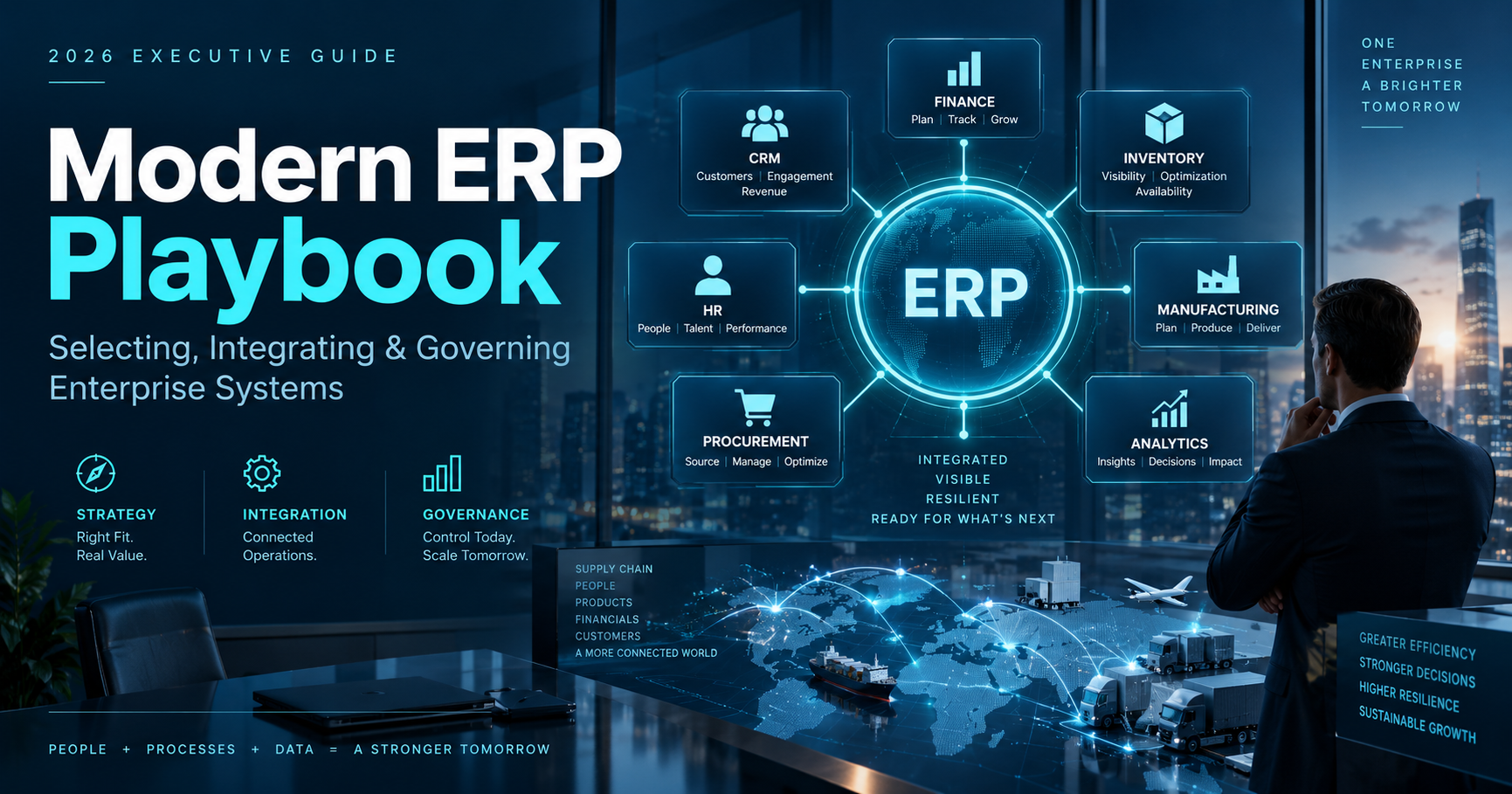
Overview and fundamentals of enterprise resource planning
A modern ERP (Enterprise Resource Planning) system is the operational backbone that connects finance, purchasing, inventory, manufacturing, sales, fulfilment, projects, people, and reporting. The important point is not simply that these modules exist. The value comes from making them work from the same data model and the same operational rules.
For an executive team, ERP selection is therefore not an IT-only decision. A CIO is looking at integration, security, architecture and upgradeability. A CFO is looking at financial controls, auditability, total cost of ownership and measurable return. A COO is looking at whether the system can actually run the warehouse, factory, supply chain, service operation or project delivery model without creating more manual work.
A technically impressive platform can still be the wrong ERP if the business has to rebuild every critical process around it. Equally, a highly flexible ERP can become expensive and fragile if every exception is solved through custom code.
The core ERP question
The wrong question is:
The better question is:
That changes the evaluation completely.
What a modern ERP normally covers
Most modern ERP platforms provide some combination of:
- Financial management: general ledger, accounts payable, accounts receivable, cash, assets, tax, consolidation and reporting.
- Procurement: supplier management, requisitions, purchase orders, approvals, receipts and invoice matching.
- Inventory and warehouse management: stock by location, replenishment, lots/serials, barcode operations, picking, packing and dispatch.
- Manufacturing: bills of materials, routings, material requirements planning, work orders, shop-floor control, subcontracting and costing.
- Sales and order management: quotations, pricing, order fulfilment, invoicing, returns and customer-specific rules.
- Supply-chain planning: forecasting, replenishment, availability, lead-time planning and supplier collaboration.
- CRM, service, projects, HR and payroll, depending on the platform and industry.
- Analytics, automation, APIs, integrations and increasingly embedded AI.
The boundary between ERP and adjacent systems is also becoming less rigid. A manufacturer may run ERP plus MES, PLM, WMS and eCommerce. A distributor may use ERP plus Shopify, EDI, carrier platforms and a specialist demand-planning tool. The goal is not to force everything into one application. The goal is to make sure ownership of each process and each data object is unambiguous.
Visual: how a modern ERP sits in the operating model
flowchart LR
    C[Customers / eCommerce / CRM] --> ERP[ERP Core]
    S[Suppliers / EDI / Portals] --> ERP
    B[Banks / Payments / Tax] --> ERP
    ERP --> F[Finance & Accounting]
    ERP --> P[Purchasing]
    ERP --> I[Inventory & WMS]
    ERP --> M[Manufacturing / MRP]
    ERP --> O[Sales & Order Management]
    ERP --> R[Reporting / BI / AI]
    M <--> MES[MES / Shop Floor / IoT]
    I <--> LOG[3PL / Carriers / TMS]
    ERP <--> DATA[Data Warehouse / Integration Layer]
Practical implementation rule: every arrow in this diagram needs an owner, a direction of truth, an error-handling process and a reconciliation method. If those four things are not defined, the integration is not finished even if the API technically works.
Cloud, on-premise and hybrid ERP
Cloud ERP has become the default direction for many new implementations because it reduces infrastructure management and gives customers access to continuous product updates. But “cloud” does not remove the hard parts of ERP. Data quality, process ownership, integration design, testing, training and governance still determine whether the implementation works.
Panorama Consulting made this point explicitly in 2026: moving ERP to the cloud does not automatically fix process gaps, poor data or weak governance. Those organizational problems can simply be carried into the new platform. See: Why Your Cloud Migration Isn’t Fixing Your Global ERP Implementation Challenges.
Cloud SaaS
Best suited where the business wants vendor-managed infrastructure, predictable upgrade cycles and a lower internal platform-management burden. The trade-off is usually more discipline around standard processes and vendor-defined release cycles.
Private cloud / managed cloud
Useful when an organization needs more control over configuration, upgrade timing, integrations or performance while still moving infrastructure management away from the internal IT team.
On-premise
Still relevant where local infrastructure, regulation, latency, highly specialized integrations or existing investment makes it appropriate. The organization owns more of the operational burden, security maintenance and upgrade planning.
Hybrid
Common in manufacturing and logistics. The ERP may be cloud-hosted while shop-floor systems, scanners, machines or edge services continue to run locally.
OpsMavix practical rule: do not choose a deployment model in isolation. Map your most critical integrations first. A system that looks ideal in a product comparison can become the wrong choice if warehouse scanners, plant-floor equipment, legacy finance interfaces or external customer portals cannot operate reliably in the chosen architecture.
Core ERP modules and what executives should actually test
A feature checklist tells you whether a vendor says a function exists. It does not tell you whether that function will work for your process.
The safest evaluation method is to test scenarios rather than features.
| Area | What the vendor will normally show | What you should actually test |
|---|---|---|
| Finance | Journals, AP, AR, dashboards | Multi-entity close, intercompany, tax edge cases, audit trail, corrections, period lock |
| Purchasing | PO creation and approvals | Short shipment, supplier substitutions, partial receipt, price variance, landed cost |
| Inventory | Stock-on-hand and transfers | Lots/serials, damaged goods, stock corrections, backorders, multi-warehouse availability |
| Manufacturing | BOM and work order | Variant BOMs, scrap, subcontracting, partial completion, rework, component shortage |
| Sales | Quote to invoice | Deposits, split fulfilment, returns, credit hold, customer-specific pricing |
| Warehouse | Pick/pack/ship | Barcode exceptions, partial picks, wrong location, missing stock, replenishment during picking |
| Reporting | Dashboards | Reconciliation back to transactions, drill-down, historical comparatives, access control |
| Integration | API demo | Retry logic, duplicates, failed messages, changed records, rate limits, reconciliation |
1. Financial management
Financial management is usually the least forgiving area of an ERP implementation because a process can appear operationally correct while still posting incorrectly.
CFO-level testing should include:
- Multi-company and multi-currency transactions.
- Tax and localization requirements.
- Period close and lock controls.
- Revenue and expense recognition where relevant.
- Inventory valuation and cost-of-goods-sold treatment.
- Intercompany transactions and eliminations.
- Audit trail from financial statement to originating transaction.
- Reversals, corrections and backdated transactions.
The key test is not whether the ERP can produce a P&L. It is whether finance can explain every important number and trace it back to the operational event that created it.
2. Procurement and supplier management
Procurement must be tested as an exception-heavy process. Real purchasing includes changing quantities, late suppliers, substitutes, partial receipts, invoice differences, currency movements and landed costs.
A strong procure-to-pay flow should make these exceptions visible without forcing users into spreadsheets or manual journals.
3. Sales and order-to-cash
Sales-order demos are often too clean. Test real commercial conditions: deposits, trade pricing, credit limits, partial delivery, returns, backorders, cancellations after allocation, and order changes after purchasing or production has started.
4. Inventory and warehouse management
Inventory accuracy is not only a warehouse problem. It affects purchasing, sales promises, production planning, cash flow and margin reporting.

Example of handheld scanning in a warehouse environment. Source: U.S. Army image, public domain via Wikimedia Commons.
A useful public-sector example from 2025 shows why seemingly simple warehouse technology matters: a U.S. Air Force team reported that adopting barcode scanning reduced equipment inventory time by about 60%. This is not an ERP ROI benchmark, but it is a practical illustration of how better transaction capture can change the economics of inventory work. Source.
xychart-beta
    title "Illustrative effect of barcode scanning on inventory time"
    x-axis ["Before", "After"]
    y-axis "Indexed time" 0 --> 100
    bar [100, 40]
Indexed from the reported ~60% reduction: before = 100, after = 40. This visual is an index, not a claim about every warehouse.
5. Manufacturing, MRP and shop-floor control
Manufacturing is where generic ERP claims are most likely to break down. “Supports manufacturing” can mean anything from basic BOM explosion to finite scheduling, subcontracting, quality, work-center control and machine-level execution.

Automotive assembly line in Ningbo. Source: Siyuwj, CC BY-SA 3.0 via Wikimedia Commons.
For a manufacturer, build the demo around one real product family. Use the real BOM depth, units of measure, subcontracting rules, lead times, batch sizes, scrap assumptions and variants. Then force exceptions into the test:
- A component is short.
- A supplier is late.
- A work order produces less than planned.
- A substitute material is used.
- A subcontract operation returns a different quantity.
- The customer changes the order after production has started.
- A finished product is partially completed and partially scrapped.
If the vendor cannot demonstrate those scenarios clearly, a polished MRP screen is not enough evidence of manufacturing fit.
6. Analytics and reporting
Reporting should be tested backwards. Start with the executive KPI and ask the vendor to drill all the way to the operational transactions. If the number cannot be reconciled, the dashboard is decoration rather than management information.
ERP vendors and representative system examples in 2026
The market is not a simple “best ERP” ranking. Different systems are optimized for different scales, industries, architectures and implementation models.
SAP S/4HANA
SAP remains a major choice for complex and global enterprises. SAP currently offers S/4HANA Cloud Public Edition, Cloud Private Edition and on-premise S/4HANA options. SAP describes Public Edition as a public-cloud service with vendor-managed operations and ongoing innovation, while Private Edition provides broader functional scope and more upgrade flexibility. SAP S/4HANA Cloud Public Edition and SAP offering comparison.
Best evaluated when the organization needs global finance, complex supply chains, manufacturing depth, standardized enterprise processes and a large implementation ecosystem.
Oracle Fusion Cloud ERP
Oracle Fusion Cloud ERP covers Financials, Procurement, Project Management, Enterprise Performance Management, Risk Management and related applications, with Oracle Fusion Cloud SCM covering supply-chain and manufacturing functions. Oracle’s current documentation lists these as integrated parts of the Fusion Cloud Applications Suite. Oracle Fusion Cloud Applications and Oracle Finance and Accounting.
It is particularly relevant where finance, global operations, procurement, controls and cloud standardization are central to the business case.
Microsoft Dynamics 365 Finance and Supply Chain Management
Microsoft continues to develop Finance and Supply Chain Management as connected enterprise applications. Its 2026 release material emphasizes global finance, period-end automation, planning, supplier collaboration, warehousing and AI-assisted workflows. Dynamics 365 2026 release plan and Supply Chain Management overview.
Dynamics is often attractive to organizations already heavily invested in Microsoft identity, Power Platform, Power BI, Azure and Microsoft 365, but the actual fit still depends on industry and process depth.
NetSuite
NetSuite remains a common cloud ERP option for growing and multi-entity businesses, especially where financial consolidation, order management, inventory and a SaaS operating model are priorities. Buyers should validate manufacturing, warehouse and localization requirements carefully where those processes are complex.
Infor CloudSuite
Infor focuses strongly on industry-specific ERP, including industrial manufacturing. Its current manufacturing offering highlights industry processes, supply chain, AI, process mining and cloud architecture. Infor industrial manufacturing ERP.
Epicor Kinetic
Epicor Kinetic is positioned for manufacturers, including discrete and make-to-order environments. The 2026.100 release includes continued investment in planning, financial workflows, browser-based operations and AI-assisted capabilities. Epicor Kinetic and 2026.100 release.
IFS Cloud
IFS Cloud focuses on complex industrial operations and combines ERP with asset management, service and supply-chain capabilities. It is especially relevant where assets, field service, project delivery or industrial operations are central to the business model. IFS ERP.
Acumatica
Acumatica targets small and mid-market organizations and has editions for manufacturing, distribution, construction, retail and professional services. Its 2026 R1 release added further supply-chain, shop-floor and AI features. Acumatica Cloud ERP and 2026 R1 release.
Odoo
Odoo is modular and can cover accounting, CRM, sales, purchasing, inventory, manufacturing, eCommerce, projects and other functions. Its manufacturing documentation includes BOMs, work centers, subcontracting, shop-floor processing, master production scheduling and manufacturing costing. Odoo Manufacturing documentation.
Odoo can be especially attractive where flexibility, broad application coverage and a lower software entry cost matter. The main governance question is how custom modules, integrations and future upgrades will be controlled. Odoo’s pricing model also differs significantly by deployment and edition, so buyers should model implementation and maintenance separately from the subscription. Odoo pricing.
Executive comparison template
Use this as a first-pass shortlisting framework. Replace the example weights with your own priorities before scoring any vendor.
| Evaluation area | Example weight | What evidence to demand |
|---|---|---|
| Core process fit | 25% | End-to-end demonstration using your scenarios |
| Financial controls | 15% | Close, tax, audit, intercompany, corrections |
| Manufacturing / operations fit | 15% | Real BOM/WMS/MRP/service scenarios |
| Integration architecture | 15% | API docs, sandbox test, failure/retry handling |
| Data and reporting | 10% | Reconciliation and drill-down from KPI to transaction |
| Security and governance | 10% | SSO, RBAC, SoD, audit logs, certifications |
| Upgradeability / maintainability | 5% | Extension model, release process, regression approach |
| Commercial / 5-year TCO | 5% | License, implementation, integrations, support, change budget |
Do not score a vendor from a slide deck. Only score a criterion after the vendor has supplied evidence: a working demo, documented capability, reference architecture, contractual commitment or verified customer reference.
Industry-specific ERP fit
Different industries expose different weaknesses in ERP products.
Manufacturing
Prioritize BOMs, routings, production planning, subcontracting, shop-floor transactions, quality, traceability, costing and engineering change. For complex plants, determine whether ERP-native manufacturing is enough or whether MES is required.
Wholesale distribution
Prioritize inventory availability, purchasing, replenishment, warehouse execution, batch/serial control, customer pricing, EDI, carrier integration, returns and multi-channel order management.
Retail and omnichannel
Prioritize POS/eCommerce integration, stock accuracy, promotions, returns, customer data, store replenishment and real-time availability across channels.
Food, beverage and process manufacturing
Prioritize batch/lot traceability, expiry, recipes/formulas, yield, allergens, quality holds, recalls and variable-weight handling.
Construction and project-centric businesses
Prioritize job costing, commitments, progress billing, project procurement, labor, subcontractors and cash-flow visibility by project.
Service and asset-intensive businesses
Prioritize installed assets, service history, contracts, field scheduling, parts availability, work orders and lifecycle cost.
A practical ERP selection process
The selection phase should produce evidence, not impressions.
Step 1: Define the business outcomes
Examples:
- Reduce month-end close from eight days to four.
- Remove manual stock reconciliation between warehouse and finance.
- Give sales reliable available-to-promise dates.
- Automate purchase planning for core inventory.
- Trace every finished product to supplier lot and production batch.
- Consolidate five legal entities without spreadsheet eliminations.
These outcomes become the basis for testing and later ROI measurement.
Step 2: Build the process catalogue
Do not document every process at the same level. Start with:
- High-volume processes.
- High-risk financial or compliance processes.
- High-exception processes.
- Processes that currently depend on specific people or spreadsheets.
- Processes that cross system boundaries.
Step 3: Create a scenario-based demo script
Use a template like this:
| Field | Example |
|---|---|
| Scenario | Customer orders a made-to-order product with 30% deposit |
| Trigger | Web order confirmed |
| Required result | Deposit recorded, production/purchase demand created, promised date calculated |
| Exception 1 | One component is short |
| Exception 2 | Customer changes quantity after confirmation |
| Exception 3 | Supplier delivery is partial |
| Financial check | Deposit liability/revenue treatment and final COGS |
| Reporting check | Order margin visible and reconcilable |
| Pass criteria | No spreadsheet/manual journal required for standard exception path |
A vendor should receive the scenario before the demo so the session tests capability rather than presentation skill.
Step 4: Run a technical proof of concept for the hardest integration
Do not start with the easiest API. Test the integration most likely to threaten the program: legacy MES, high-volume eCommerce, EDI, payment provider, bank, warehouse automation, complex product configurator or another critical dependency.
Step 5: Validate references
Ask reference customers questions that vendors rarely put on case-study pages:
- What cost appeared after contract signature that you did not expect?
- Which process was hardest to make work?
- What customizations caused upgrade problems?
- What would you standardize if you started again?
- Which reports still require external tools?
- How much internal ERP ownership did you need after go-live?
- What broke during the first three months?
The 5-year TCO template most ERP evaluations miss
License cost alone is a poor basis for comparing ERP systems.
Use a model that includes:
| TCO category | Year 0 / implementation | Recurring annual cost | Often missed? |
|---|---|---|---|
| Software subscription / licenses | ✓ | ✓ | No |
| Implementation partner | ✓ | No | |
| Data migration | ✓ | Often underestimated | |
| Integrations / middleware | ✓ | ✓ | Yes |
| Custom development | ✓ | ✓ maintenance | Yes |
| Testing / regression | ✓ | ✓ for releases | Yes |
| Training and change management | ✓ | ✓ onboarding | Yes |
| Internal project team time | ✓ | ✓ support ownership | Very often |
| Reporting / BI tooling | ✓ | ✓ | Sometimes |
| Environments / hosting | ✓ | ✓ | Depends on platform |
| Support / managed services | ✓ | Yes | |
| Upgrade remediation | Periodic | Yes | |
| Decommissioning legacy systems | ✓ | Often |
TCO calculation template
5-Year ERP TCO =
  software subscriptions
+ implementation services
+ internal project cost
+ data migration
+ integrations and middleware
+ custom development
+ training/change management
+ support and managed services
+ reporting/analytics tools
+ upgrade/regression cost
+ infrastructure where applicable
- retired legacy-system cost
Run at least three scenarios: expected, 20% implementation overrun, and high-integration-cost. That makes commercial comparisons more realistic.
Integration design: the part that usually becomes visible too late
An ERP integration should have a defined system of record for every important object.
Integration inventory template
| Object / flow | System of record | Destination | Direction | Frequency | Failure handling | Reconciliation owner |
|---|---|---|---|---|---|---|
| Customer | CRM | ERP | CRM → ERP | Real time | Retry + exception queue | Sales Ops |
| Product | ERP/PIM | eCommerce | ERP → Store | Scheduled/event | Error log + reprocess | Product team |
| Sales order | eCommerce | ERP | Store → ERP | Real time | Duplicate protection | Customer service |
| Shipment | ERP/WMS | eCommerce | ERP → Store | Event | Retry | Warehouse |
| Payment | PSP | ERP | PSP → ERP | Event/batch | Reconcile to settlement | Finance |
| Inventory | ERP | eCommerce | ERP → Store | Near real time | Snapshot reconciliation | Operations |
Practical rule: API success is not the same as process success. An integration is production-ready only when duplicates, retries, late messages, corrections and reconciliation have been tested.
ERP implementation roadmap
A good ERP program is phased by risk and dependency, not only by module name.
flowchart LR
    A[1. Discovery & process decisions] --> B[2. Solution design]
    B --> C[3. Configuration & integrations]
    C --> D[4. Data migration rehearsals]
    D --> E[5. End-to-end testing]
    E --> F[6. User acceptance & training]
    F --> G[7. Cutover rehearsal]
    G --> H[8. Go-live]
    H --> I[9. Hypercare]
    I --> J[10. Optimization & governance]
Phase 1: discovery and process decisions
The goal is not to recreate every existing process in a new system. Separate requirements into:
- Regulatory or genuinely mandatory.
- Competitive or operationally important.
- Historical preference.
- Workaround created by the limitations of the old system.
This is one of the highest-value decisions in the entire program. Automating a bad process simply produces a bad process faster.
Phase 2: solution design
Lock down:
- Legal entities and financial structure.
- Master-data ownership.
- Warehouses and locations.
- Product/BOM model.
- Tax and accounting design.
- Approval rules.
- Integration responsibilities.
- Reporting model.
- Security roles.
Phase 3: configuration and integrations
Build the standard process first, then exceptions. Custom development should have a clear business owner and documented reason. Every customization should also have an upgrade owner.
Phase 4: data migration rehearsals
Do not treat migration as a one-time upload. Run multiple rehearsals.
For every data object, define:
- Source.
- Owner.
- Clean-up rules.
- Transformation rules.
- Validation totals.
- Reconciliation method.
- Cut-off date.
For finance, reconcile opening balances. For inventory, reconcile quantity and value. For AR/AP, reconcile customer and supplier totals to the legacy ledger. For manufacturing, validate BOM structure and units of measure with production users.
Phase 5: end-to-end testing
Test across functions. A purchase order test that stops at goods receipt is incomplete if finance later cannot reconcile the invoice or inventory valuation.
End-to-end examples:
- Quote → sales order → purchase/production → pick → ship → invoice → payment → margin reporting.
- Requisition → PO → receipt → vendor bill → payment → supplier reporting.
- Forecast → MRP → purchase/production → stock → customer order → COGS.
Phase 6: UAT and training
UAT should be performed by users who understand the process, not only by the project team. Training should focus on roles and decisions, not screen tours.
Phase 7: cutover rehearsal
Run the cutover before the real cutover. Time every migration, configuration switch, integration activation, opening balance load and validation step.
Go-live readiness gate template
Do not declare the system ready because development is complete.
| Gate | Minimum evidence before go-live |
|---|---|
| Critical processes | All critical end-to-end scenarios passed |
| Finance | Opening balances and posting logic reconciled |
| Inventory | Quantity and value reconciled to agreed baseline |
| Integrations | Retry, duplicate, outage and reconciliation tests passed |
| Security | Roles, privileged access and SoD reviewed |
| Data | Migration rehearsal completed with signed validation |
| UAT | Business owners signed off critical scenarios |
| Training | Named users trained by role |
| Cutover | Timed rehearsal completed |
| Support | Hypercare owners, escalation path and priorities agreed |
| Rollback / contingency | Decision criteria documented |
A red critical item should not become green because the go-live date is inconvenient to move.
Real-world ERP failure lessons
ERP failures are rarely caused by one bad configuration screen. They usually combine compressed timelines, weak testing, poor data, process ambiguity, integration problems and inadequate change management.
Revlon: ERP disruption became a financial and control problem
Revlon disclosed that its February 2018 U.S. ERP launch caused service-level disruption at its Oxford, North Carolina manufacturing facility. In its 2018 annual filing, the company estimated that the launch resulted in an inability to fulfil product shipments representing approximately $64 million in net sales and $53.6 million in incremental charges. The company also disclosed a material weakness in internal control over financial reporting connected to the ERP implementation. SEC filing.
xychart-beta
    title "Revlon 2018 ERP disruption: reported financial impact"
    x-axis ["Unfulfilled net sales", "Incremental charges"]
    y-axis "USD millions" 0 --> 70
    bar [64, 53.6]
The lesson is broader than SAP or Revlon: ERP go-live can become a revenue, customer-service and financial-control event. Operational validation and financial-control validation must happen together.
Hershey: compressed schedule plus peak-season cutover
A widely cited Hershey case involved a rushed enterprise-systems rollout in 1999, using SAP R/3, Manugistics and Siebel. CIO’s retrospective says Hershey compressed the program, went live during a critical seasonal period and was unable to process more than $100 million in orders even though products were available. CIO case summary.
The useful lesson is not “never use big-bang ERP.” It is that cutover timing, integration testing and realistic schedule pressure are executive risk decisions, not merely project-management details.
Change management: where technically correct implementations still fail
Cloud ERP updates make change management a continuing operating discipline rather than a one-off training exercise. Panorama’s 2025 guidance emphasizes role-specific education, change champions and adoption metrics for cloud ERP environments. Change Management in Cloud ERP Implementations.
A practical adoption plan should track more than training attendance. Useful indicators include:
- Percentage of transactions completed in the ERP rather than spreadsheets.
- Error rate by process and user group.
- Helpdesk volume by topic.
- Frequency of manual overrides.
- Number of shadow spreadsheets still used.
- Time to complete high-volume tasks.
- Data-quality defects by owner.
- Unused licensed functionality that was part of the business case.
ERP governance after go-live
Go-live is not the end of the ERP program. It is the moment responsibility moves from project delivery to operational ownership.
Minimum governance model
Business process owners own how the process should work.
System owner / ERP product owner owns priorities, releases and cross-functional impact.
Data owners approve master-data rules and resolve quality issues.
Finance control owners validate posting, reconciliation and segregation of duties.
Integration owners monitor interfaces, errors and reconciliations.
Change board decides which requests should be configuration, customization, process change or rejected.
Customization decision test
Before approving custom code, answer:
- Is the requirement legally or commercially mandatory?
- Can the standard process achieve the outcome with a different workflow?
- How often does the exception occur?
- What is the financial value of automating it?
- What happens during every future upgrade?
- Who owns regression testing?
- What is the exit path if the customization becomes obsolete?
If those questions cannot be answered, the customization is not ready for approval.
Security, access and compliance
ERP holds some of the most sensitive and operationally important data in the organization. Core controls should include:
- SSO and MFA where supported.
- Role-based access and least privilege.
- Segregation of duties for sensitive finance flows.
- Audit logging and traceability.
- Periodic access review.
- Encryption in transit and at rest.
- Backup and recovery planning.
- Integration credential management.
- Vendor security and compliance evidence.
- Data-retention and residency requirements.
Security design should be tested through business scenarios. For example, can the same user create a supplier, enter a supplier invoice and release payment? Can a warehouse user alter product cost? Can a developer change production logic without an audit trail? The answers matter more than a generic statement that the ERP has “role-based security.”
ERP and AI in 2026
AI is increasingly embedded inside ERP platforms rather than delivered only as an external analytics layer.
SAP’s 2026 product messaging describes Joule assistants and agents operating across enterprise workflows, while Microsoft’s 2026 Dynamics release plan includes agentic and Copilot-based finance and supply-chain capabilities. Oracle positions Fusion Applications as an integrated AI-powered cloud suite, and Acumatica’s 2026 R1 release introduced AI Studio and further AI-assisted workflows. Sources: SAP Business AI 2026, Microsoft Dynamics 365 2026, Oracle Fusion Cloud Applications, and Acumatica 2026 R1.
The executive question should not be “does the ERP have AI?” Almost every major vendor now has an AI story. Ask instead:
- Which decisions can the AI make versus only recommend?
- What data can it access?
- How are permissions inherited?
- Can its actions be audited?
- What happens when its recommendation is wrong?
- Can sensitive prompts or business data leave the governed environment?
- Which workflows produce measurable time or cost savings?
AI makes ERP governance more important, not less.
Practical executive checklist before selecting an ERP
Use this as a final pre-contract review:
- Business case: Are the target outcomes measurable and owned by executives?
- Process fit: Have the hardest real-world scenarios been demonstrated?
- Finance: Have posting, tax, close and reconciliation requirements been tested?
- Operations: Have warehouse/manufacturing/service exceptions been tested, not just happy paths?
- Data: Is there a named owner and migration rule for every critical data object?
- Integration: Has the hardest integration been proven with real transactions?
- Security: Have roles, SoD, audit and identity requirements been validated?
- TCO: Does the model include internal effort, integration, support, upgrades and change management?
- Implementation partner: Has the proposed team delivered comparable projects in the same industry?
- Governance: Who owns ERP after go-live?
- Upgrade strategy: How will extensions and customizations be regression-tested?
- Cutover: Is there a tested rehearsal, fallback plan and go/no-go authority?
Conclusion
A successful ERP choice and rollout is ultimately a strategic program that balances technical architecture, financial reality and operational fit. The strongest selection process does not ask vendors to prove that their software has hundreds of features; it asks them to prove that the system can run the business’s most important and most difficult scenarios.
For CIOs, that means architecture, integrations, security, maintainability and data ownership. For CFOs, it means auditability, financial control, TCO and measurable benefit. For COOs, it means whether inventory, manufacturing, fulfilment, service and supply-chain processes actually work under real operational pressure.
The implementation should be treated the same way. Standardize where the business can standardize. Customize only where the value is clear. Rehearse migration and cutover. Test end to end. Reconcile finance and inventory. Train by role. Keep a clear owner for every integration and every critical dataset. Then continue governing the platform after go-live rather than allowing it to become a new collection of workarounds.
The objective is not simply to install ERP. It is to build an operating system for the business that can still be understood, controlled and improved years after the implementation team has left.
Source and image notes
- SAP S/4HANA Cloud Public Edition: https://www.sap.com/products/erp/s4hana.html
- SAP S/4HANA offering comparison: https://help.sap.com/docs/SAP_S4HANA_CLOUD_PE/b89b8b9026e1456bb2a1df7c0d59c937/1485d139460246d2a4b936c0bb0ca272.html
- Oracle Fusion Cloud Applications: https://docs.oracle.com/en/cloud/saas/
- Oracle Finance and Accounting: https://www.oracle.com/erp/finance-and-accounting/
- Microsoft Dynamics 365 2026 release plan: https://learn.microsoft.com/en-us/dynamics365/release-plan/2026wave1/
- Microsoft Dynamics 365 Supply Chain Management: https://learn.microsoft.com/en-us/dynamics365/release-plan/2026wave1/enterprise-resource-planning/dynamics365-supply-chain-management/
- Infor industrial manufacturing ERP: https://www.infor.com/en-gb/solutions/erp/industrial-manufacturing
- Epicor Kinetic: https://www.epicor.com/en/products/enterprise-resource-planning-erp/epicor-kinetic/
- IFS Cloud ERP: https://www.ifs.com/en/products/erp
- Acumatica Cloud ERP: https://www.acumatica.com/cloud-erp-software/
- Odoo pricing: https://www.odoo.com/pricing
- Odoo Manufacturing documentation: https://www.odoo.com/documentation/18.0/applications/inventory_and_mrp/manufacturing.html
- Revlon 2018 Form 10-K ERP disclosure: https://www.sec.gov/Archives/edgar/data/887921/000088792119000004/rev201810-k.htm
- Hershey ERP case retrospective: https://www.cio.com/article/278677/enterprise-resource-planning-10-famous-erp-disasters-dustups-and-disappointments.html
- Panorama Consulting — cloud ERP organizational challenges: https://www.panorama-consulting.com/cloud-migration-not-fixing-global-erp-challenges/
- Panorama Consulting — change management in cloud ERP: https://www.panorama-consulting.com/change-management-in-cloud-erp-implementations/
- Warehouse image: U.S. Army / public domain, via Wikimedia Commons.
- Manufacturing image: Siyuwj / CC BY-SA 3.0, via Wikimedia Commons.