
Bespoke Software Development UK: Costs & How to Choose
What bespoke software development costs in the UK, how a sound project runs, who owns the code, and the checks to make before you hire a supplier.
A common starting point is a business that has outgrown spreadsheets and a patchwork of apps, but finds heavyweight ERP too rigid or too expensive per seat. If that is your situation and the work centres on stock, orders, production or approvals, OpsMavix builds custom operations systems for UK SMEs on a fixed price. Either way, the questions below apply to any supplier you speak to.
When bespoke software is worth it, and when it isn’t
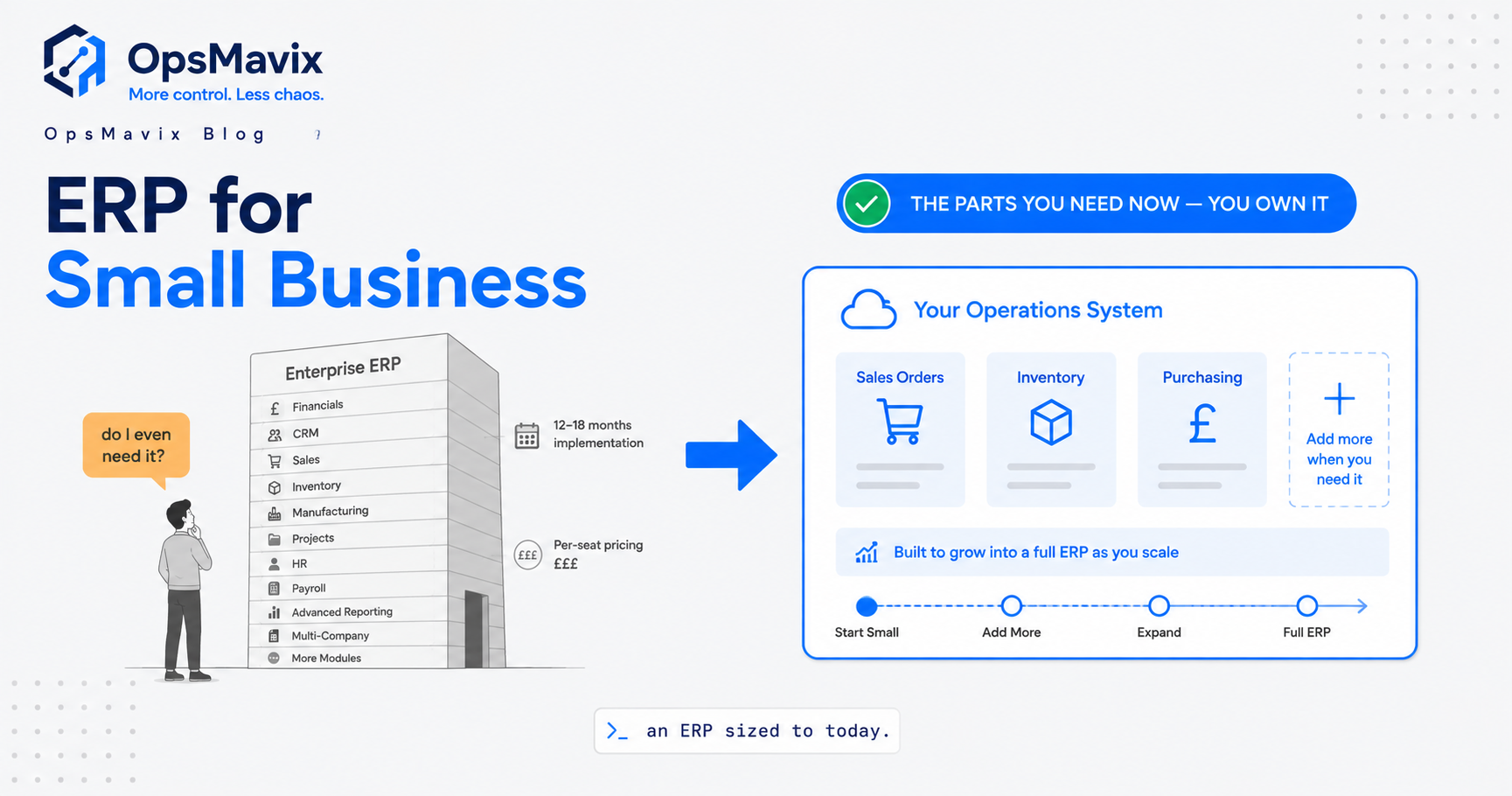
Bespoke is a way of building software, not a size of project. It can be one focused tool or a full system that replaces several products. It is worth paying for when the work that matters most to your margin or service level is still a workaround after you have configured the tools you already own.
| Your situation | Usually the better answer | Why |
|---|---|---|
| Your process matches common practice (payroll, standard bookkeeping) | Off-the-shelf software | Mature products already do it well and keep up with rule changes |
| Each tool works, but they don’t talk to each other | Integration | Connecting what you have is cheaper than replacing it |
| One high-value workflow that no package handles cleanly | A focused bespoke application | You pay only for the part that is genuinely different |
| Several core workflows are distinctive and central to the business | A bespoke system, delivered in phases | One set of records that matches how you run, built a phase at a time |
| A simple internal tool for a few users | Low-code or no-code first | Quicker to try, and it shows you the requirements if you outgrow it |
If you are weighing a package against a build, our guides to Odoo versus custom software and bespoke ERP costs in the UK go deeper on the ERP side of the decision.
The five kinds of bespoke software supplier in the UK
“Bespoke software company” covers very different businesses. Knowing which kind you are talking to tells you what to check.
| Supplier type | Best fit | Watch out for |
|---|---|---|
| Freelance developer | Small, well-defined tools with a clear owner on your side | Single point of failure; holidays, illness and handover need a plan |
| Small UK agency (roughly 2 to 20 people) | SME systems where you want to speak directly to the people building it | Capacity limits and key-person risk; ask who actually writes the code |
| Large UK consultancy | Enterprise or regulated programmes with internal project teams | Day-rate totals and junior staff doing much of the work |
| Offshore or nearshore team | Cost-sensitive builds where you have strong project management in-house | Time zones, which country’s law governs the contract, and how UK GDPR is met for any personal data |
| Specialist builder for one domain | Faster delivery where it has built similar systems before | Ownership of its reusable framework; make sure your licence survives the relationship |
None of these is wrong. The right choice depends on the size of the job, how much project management you can provide, and how long you will need the system supported.
How a well-run bespoke software project runs
Good suppliers follow broadly the same shape, whatever they call it. If a proposal skips a stage, ask why.
- Discovery. A short phase, paid or free, that maps the workflows, the data and the exceptions that cause rework today. Ask whether the outputs belong to you, so you could take them to another supplier.
- Written scope. The processes in and out of scope, the records each system owns, the integrations and the user roles. Each requirement is written so someone can test it.
- Acceptance tests. The scenarios that prove each phase works, including the awkward ones: a short delivery, an order changed after picking starts, a credit note.
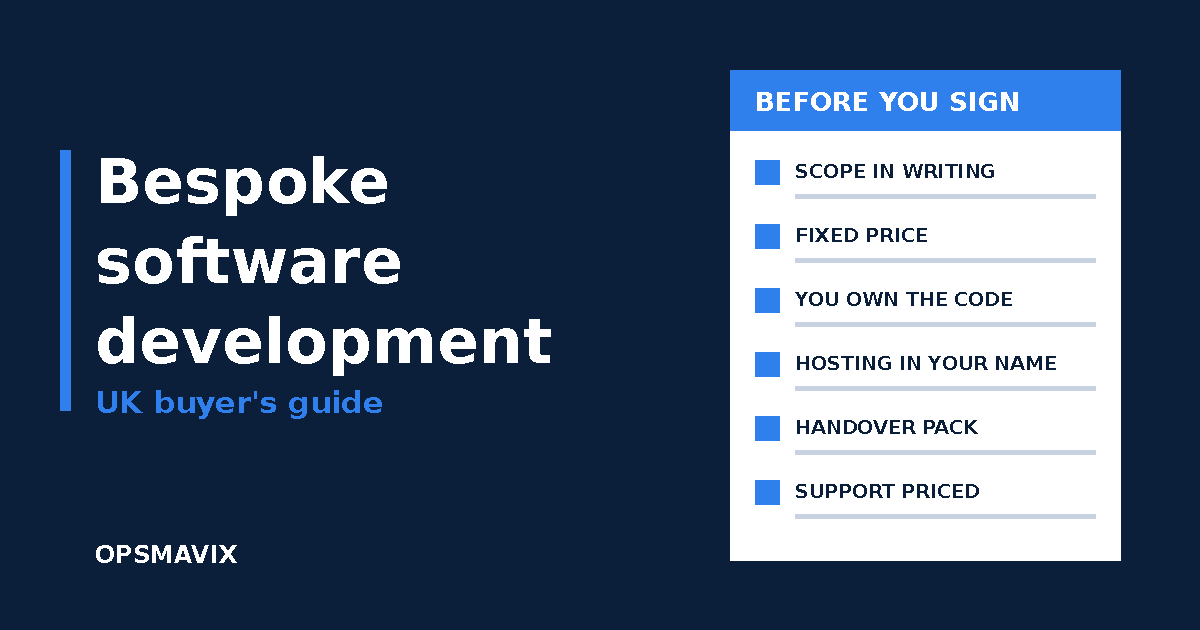
- Price in writing. A fixed price for the agreed scope, or a capped estimate, with the payment schedule tied to delivery rather than paid up front.
- Build in short cycles. You see working software every week or two in a test environment, not just at the end.
- Data migration rehearsal. Open orders, stock and customers are moved and reconciled before go-live, not on the day.
- Go-live with a fallback. A plan for the first days, including what happens if something stops.
- Handover and support. A handover pack, access to every account, and a priced support arrangement.
Phasing is the single biggest risk reducer. Each phase should run a complete workflow end to end, so you get value and evidence before committing more budget.
What bespoke software costs: how to read a quote
There is no honest single price for bespoke software, because the cost is driven by scope: the number of workflows, integrations, user roles and exceptions, plus how much data has to move. What you can control is how you compare quotes. Send every supplier the same scope and the same three difficult scenarios, then compare on the same period.
| Pricing model | Who carries the overrun risk | When it fits |
|---|---|---|
| Fixed price | The supplier | A clear, written scope with acceptance tests |
| Time and materials | You | Exploratory work where the scope is genuinely unknown |
| Capped time and materials | Shared, up to the cap | A mostly known scope with some open questions |
| Monthly retainer | You, but spending is predictable | Continuous improvement after the first release |
Hypothetical worked example: two quotes over three years
The figures below are hypothetical. They show the method, not market rates and not OpsMavix prices. A 12-person wholesaler asks two suppliers to quote for the same order and stock system.
| Quote A (fixed price) | Quote B (time and materials) | |
|---|---|---|
| Build | £18,000 fixed | 30 days × £550 = £16,500 estimated |
| Hosting | Included in support | £60 a month |
| Support | £300 a month | About 1 day a month at £550 |
| Monthly running cost | £300 | £610 |
| Running cost over 36 months | £10,800 | £21,960 |
| Three-year total | £28,800 | £38,460 |
Quote B looks £1,500 cheaper on the build, but costs £9,660 more over three years. If B’s build also runs 25% over (37.5 days rather than 30), the build becomes £20,625 and the three-year total £42,585. The lesson: compare totals over the same period, and ask who pays when the estimate is wrong.
Who owns the code: the UK position in brief
Paying for software does not by itself make you its owner. Under the Copyright, Designs and Patents Act 1988, the author is normally the first owner of copyright, and an outside developer is not your employee. The Act also says that “an assignment of copyright is not effective unless it is in writing signed by or on behalf of the assignor” (section 90(3)).
In practice, ask for three things:
- A signed written assignment of the code built for you, taking effect when you pay.
- A list of the supplier’s reusable components and open-source libraries, with a perpetual licence for anything not assigned.
- The source code repository, hosting account and domain in your business’s name, with the supplier given access rather than the other way round.
This is general information, not legal advice. Our bespoke ERP guide has a fuller ownership and exit checklist.
Checks to make before you sign
These take an afternoon and filter out most bad fits.
- Companies House. Look the supplier up on the free Find and update company information service: registered address, incorporation date, officers, filing history, and whether accounts are filed on time.
- Cyber Essentials. The NCSC describes Cyber Essentials as “a UK government-backed certification” covering controls that “protect against most common cyber threats”. Cyber Essentials Plus adds hands-on technical verification (NCSC). Ask whether the supplier holds either.
- Data protection. If the supplier will handle personal data for you, it is likely to act as a processor under UK GDPR, and the contract needs the terms the ICO lists (ICO guidance).
- References. Ask to speak to a client whose system has been live for more than a year, not just a recent launch.
- R&D tax relief, carefully. Some software projects qualify, but only where the project seeks “an advance in science or technology” by resolving scientific or technological uncertainties (HMRC CIRD81300). A business system built with established methods may not meet that bar, so check with your accountant before budgeting for it.
Twelve questions to ask a bespoke software company
| Question | A good answer sounds like |
|---|---|
| Which of our needs would you solve with existing software? | A straight answer that names tools, even if it shrinks their job |
| What exactly is fixed in the quote, and what would change the price? | A written scope and a short list of named assumptions |
| How do you handle change requests? | A simple process with a stated rate or allowance |
| Who will write the code, and where are they based? | Named people, and what happens if one leaves |
| How often will we see working software? | Every one to two weeks, in a test environment we can use |
| When does the code become ours? | On payment, by signed written assignment |
| Whose accounts hold hosting, repository and domain? | Yours, with their access delegated |
| How do you migrate and reconcile our data? | A rehearsal before go-live, with reconciliation reports |
| What does support cost after go-live? | A priced arrangement with response times by severity |
| What would a handover to another developer include? | Repository access, environment details, data model and documentation |
| Can we speak to a client who has been live for over a year? | Yes, with a name and contact |
| How do we pay? | Staged against delivery, never 100% up front |
Red flags
- A quote arrives before anyone has asked how your work actually flows.
- Ownership is “discussed later” or covered only by a licence that ends with the contract.
- Hosting must stay in the supplier’s own account.
- You will see the software only at the end.
- Full payment is due before work starts.
- No one can name the people who will build it.
Frequently Asked Questions
How much does bespoke software development cost in the UK?
It depends on scope: the number of workflows, integrations, user roles and the data to migrate. Ask several suppliers to quote the same written scope, then compare build, hosting and support over the same three to five years rather than the build price alone.
How long does a bespoke software project take?
A focused first release covering one workflow can be live in weeks; a system replacing several tools usually runs as phases over months. Be wary of any timeline given before a scope exists.
Do I own the code if I pay for it?
Not automatically. In the UK, copyright usually stays with the author unless it is assigned in writing and signed. Make the assignment part of the contract and take legal advice on the wording.
Is bespoke software better than off-the-shelf?
Only where your processes are genuinely different and important to the business. For standard functions, a configured package is usually cheaper and lower risk. Many businesses do best with a mix: packages for the standard work, bespoke for the part that sets them apart.
Can bespoke software work with Xero, Shopify or Sage?
Usually, yes. Most of these products publish APIs, so a bespoke system can exchange orders, invoices and stock with them. Agree which system owns each record and how failed transfers are spotted and fixed.
How OpsMavix Can Help
OpsMavix is a UK company that builds bespoke operations systems for wholesalers, distributors, ecommerce businesses and manufacturers: stock, orders, purchasing, production and approvals, built around how you already work. Every build has a fixed price in writing: one area from £4,950, each further area from £2,500, and a whole operation from £25,000. You pay half to start and half on delivery, own the system outright and pay no per-seat fees.
Depending on where the pain sits, that might be a wholesale order management system, an inventory automation system, manufacturing production tracking or ecommerce inventory automation.
Contact OpsMavix to book a free call, and bring one recent order or job that went wrong. We will talk through what we would build first and how the fixed price works.
Keep reading
Getting value from OpsMavix? Add us as a preferred source on Google — you'll see more of our operations content in your AI Overviews, AI Mode and Search.