What Is Gemini 4 Argon? 1M Output Tokens, Pricing, API & Release Date
Google’s Gemini 4 Argon supports up to one million output tokens for complex workflows. Here’s what its pricing, benchmarks and restricted rollout mean for developers and businesses.
What Is Gemini 4 Argon? 1M Output Tokens, Pricing, API & Release Date
Google has announced Gemini 4 Argon, but the most interesting thing about its newest frontier AI model is that most people cannot use it yet.
Argon is designed for long, complex jobs across software engineering, finance, legal work and cybersecurity. Google has also increased its maximum output limit to 1 million tokens, up from 64,000 on previous models.
But instead of immediately putting Argon inside Gemini for everyone, Google is starting with a restricted group of trusted cybersecurity defenders.
That makes the launch unusual.
Google is effectively saying:
Here is our next frontier model. It can work through unusually long and difficult tasks. But we want to test the safeguards before giving everyone access.
And that raises a more useful question than simply asking whether Gemini 4 beats the latest GPT or Claude model:
That is the bigger idea behind Gemini 4 Argon.
Google announced Gemini 4 Argon on 30 September 2026, describing it as a frontier model built for complex, long-horizon workflows. Initial access is being provided to selected cyber defenders through Google’s Fairwind Program before wider availability. (Google announcement)

Source: Google / Google DeepMind.
Gemini 4 Argon in 30 seconds
Gemini 4 Argon is Google’s new frontier AI model designed to perform long, multi-step professional tasks rather than only responding to individual prompts.
Google is focusing on four areas:
software engineering → enterprise knowledge work → cybersecurity → long-running AI workflows
The standout specification is its 1 million token maximum output, designed to give the model room to continue reasoning and acting through much longer tasks. Google says Argon is already being used internally for coding, research, optimisation and large-scale software work. (Google announcement)
Its initial pricing is:
| Gemini 4 Argon pricing | Cost per 1M tokens |
|---|---|
| Input | $2 |
| Output | $10 |
| Cached input | 95% discount on input price |
| Later standard input price | $4 |
| Later standard output price | $20 |
Those introductory prices come directly from Google’s launch announcement. Google has not published an end date for the introductory period. (Google announcement)
The catch?
You probably cannot use Gemini 4 Argon yet.
Access begins with selected cybersecurity defenders. Google says expansion will then start with paid API customers and Google AI Ultra subscribers, before broader availability. (Google announcement)
What is Gemini 4 Argon?
If you searched what is Gemini 4 Argon, the simplest answer is:
Gemini 4 Argon is Google’s latest frontier Gemini model, built to sustain reasoning and work across unusually complex, long-running tasks.
It is part of the new Gemini 4 generation from Google DeepMind.
Argon is not being positioned simply as a better chatbot.
Google’s examples centre around work that can require many steps:
- debugging and modifying large software projects;
- conducting financial research;
- performing legal research and drafting;
- analysing large collections of information;
- interpreting long videos and documents;
- finding and fixing software vulnerabilities;
- running extended agent-style workflows.
Google says thousands of its own employees have already used Argon internally. (Google announcement)
That distinction matters.
The AI industry has spent several years improving the answer to:
“How well can a model respond to this prompt?”
Argon is increasingly aimed at another question:
“How much of this job can the model continue doing before a human needs to intervene?”
Why is Gemini 4 Argon different?
One number is attracting most of the attention:
1,000,000 output tokens.
There is an important distinction here.
This is an output-token limit, not simply a claim that Gemini 4 has a one-million-token context window.
Google says Argon’s maximum output has increased from 64K to 1M tokens so the model can sustain much longer reasoning trajectories. (Google announcement)
A normal AI interaction starts with a question. The AI thinks, produces an answer, and waits for the human to ask the next question.
A long-running agentic workflow moves closer to:
- Understand the business objective.
- Research and plan the task.
- Use tools and analyse the results.
- Change the approach where needed.
- Continue working until it can produce the final result.
The point of additional output capacity is not to generate a one-million-token blog post.
It is to give the model more room to think, use tools, revise, inspect results and continue progressing through difficult jobs.
That is potentially much more important for AI agents than it is for ordinary chatbot conversations.
What can Gemini 4 Argon actually do?
Google published several examples from its internal use of Argon.
One team used Argon agents to analyse profiling information from Google’s data centres and identify memory optimisations. Google says the resulting changes freed more than 300 TiB of memory once deployed, with further potential savings identified. (Google announcement)
Another use case involves large software migrations.
Google says Argon agents have been involved in moving C and C++ code towards Rust, including work spanning tens of thousands of lines and projects extending to more than 800,000 lines of code.
In another example, Argon worked on an existing Rust implementation of Google’s libgav1 video decoder and replaced roughly 32,000 lines of SIMD code. Google reports that the resulting version ran 2.7× faster than the previous Rust port while producing identical video output. (Google announcement)
Those numbers should be read carefully.
They are specific Google examples, not evidence that Gemini 4 Argon will make every software project 2.7× faster.
The more important signal is the type of job being attempted.
These are not ten-second chatbot prompts.
They are extended engineering workflows where an AI system needs to repeatedly inspect, change, test and evaluate something.
Gemini 4 Argon benchmarks: how good is it?
Google’s launch material gives Argon strong scores across coding, enterprise work, multimodal understanding and cybersecurity.
Some of the headline results include:
| Benchmark | Gemini 4 Argon |
|---|---|
| DeepSWE v1.1 | 77.9% |
| AutomationBench | 51.3% |
| Vals Finance Agent v2 | 65.4% |
| LVBench | 91.7% |
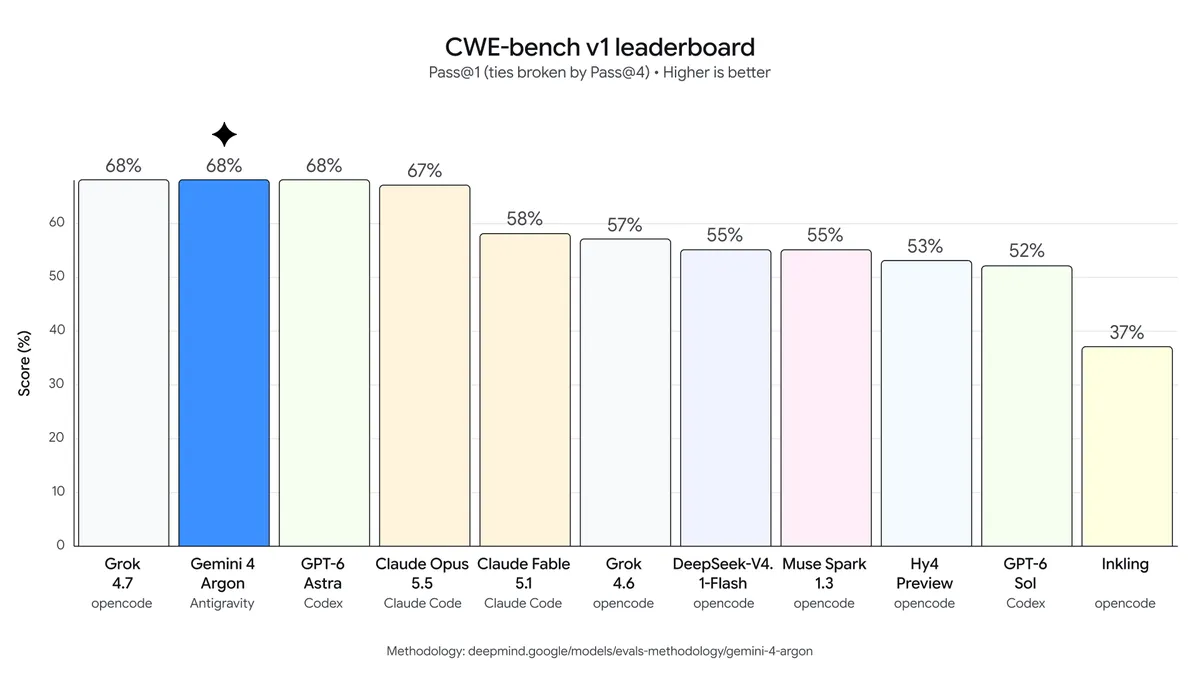
| CWE-bench v1 | 68% |
DeepSWE measures long-horizon software engineering. AutomationBench focuses on executing workflows across business functions. LVBench measures understanding of long video. CWE-bench evaluates the ability to remediate software vulnerabilities. (Google announcement)

Source: Google / Google DeepMind.
But there is an important caveat.
A benchmark table published during a model launch is not the same thing as independent proof that the model is universally better.
Google’s own chart shows Argon leading several evaluations while trailing competing models on others. Independent testing will matter more once researchers and developers can run the model under comparable conditions.
Vals AI has already independently evaluated the model across its own benchmark suite, where Argon reached 68.9% on the Vals Index and ranked first in that evaluation at the time of testing. Results varied substantially between individual tests. (Vals AI evaluation)
So “Gemini 4 Argon is the best AI model” is not a useful conclusion yet.
A better conclusion is:
Argon appears particularly strong on long, structured professional workflows — exactly the area Google says it built the model to target.
Why is Google restricting Gemini 4 Argon?
This may be the most unusual part of the launch.
Most frontier AI announcements follow a familiar pattern: a new model is announced, the API is released, and users test it.
Google is doing something closer to:
- Announce the new model.
- Give selected defenders access.
- Continue safety testing.
- Expand to paid API customers and Ultra subscribers.
- Release more broadly.
Initial access is being provided through Google’s Fairwind Program to trusted cybersecurity defenders.
Google says Argon is capable of autonomously finding, validating and patching software vulnerabilities, which creates both useful defensive capabilities and obvious misuse concerns. (Google announcement)
Google says it is strengthening safeguards around misuse, indirect prompt injection, model behaviour and the environments in which high-risk evaluations run before expanding access.
That does not automatically mean Argon is some uncontrolled superintelligence.
It means Google believes some of the model’s capabilities justify a more controlled rollout.
Why cybersecurity matters so much for Gemini 4 Argon
Cybersecurity is not simply another feature on Argon’s specification sheet.
It is central to the launch.
Google says Argon can independently identify, validate and patch critical vulnerabilities. Trusted defenders are being given access to stronger cyber capabilities so they can use the model for defensive research. (Google announcement)
Google also says security company Wiz has already used Argon as part of its Scan for Good work protecting critical infrastructure.
In one example cited by Google, Argon identified a serious vulnerability affecting healthcare software that earlier frontier models had missed. (Google announcement)
On CWE-bench v1, Argon achieved 68%, tying the top result in Google’s comparison.
Source: Google / Google DeepMind.
Again, the interesting development is larger than one score.
AI models are moving from:
“Explain this vulnerability to me.”
towards:
“Inspect this system, find the vulnerability, verify it, determine a fix and help implement the remediation.”
That is a very different level of automation.
Is Gemini 4 Argon available?
For most users, not yet.
As of 1 October 2026, Gemini 4 Argon is initially rolling out to selected cybersecurity defenders through Google’s Fairwind Program.
Google says broader availability will follow, beginning with:
- paid API customers
- Google AI Ultra subscribers
- broader developer, enterprise and consumer availability later
Google has not given a firm date for general public access. (Google announcement)
So if you are searching how to access Gemini 4 Argon today, there is currently no normal public sign-up process comparable with choosing an existing Gemini model inside AI Studio.
Is there a Gemini 4 Argon API?
Google intends to offer a Gemini 4 Argon API, but normal public API access is not yet available.
Google’s stated rollout plan specifically says paid API customers will be among the first groups to receive wider access after the initial Fairwind deployment. (Google announcement)
At launch there is no generally available public Argon model ID that developers should assume they can call.
That means developers searching for Gemini 4 Argon API or Gemini Argon API key should be careful with unofficial guides claiming that a specific model identifier already works.
The useful things to watch are Google’s official Gemini API documentation, Google AI Studio and Vertex AI as the rollout expands.
Gemini 4 Argon pricing
Google has already announced pricing even though general API access has not opened.
| Price stage | Input per 1M tokens | Output per 1M tokens |
|---|---|---|
| Introductory | $2 | $10 |
| After introductory period | $4 | $20 |
Cached input receives a 95% discount relative to the normal input price.
Google has not specified when the introductory period ends. (Google announcement)
That difference is significant when evaluating an AI agent.
An ordinary chatbot may only generate a few hundred or thousand tokens.
A model specifically designed to continue through long trajectories can potentially consume far more compute.
So for businesses, the relevant calculation will not simply be price per token.
It will be cost of completing the workflow versus the labour, delay and errors the workflow currently requires.
That is a much more useful way to evaluate agentic AI.
Gemini 4 Argon vs GPT-6 Astra
The inevitable comparison is Gemini 4 Argon vs GPT-6 Astra.
Google’s own benchmark table has Argon ahead on some evaluations and Astra ahead on others.
For example, Google reports Argon at 77.9% on DeepSWE v1.1, compared with 74.1% for GPT-6 Astra.
But on FrontierSWE v2, Google’s chart puts Argon at 55.0% and GPT-6 Astra at 65.5%. On Terminal-bench 4.0 the two are much closer, with Argon at 57.4% and Astra at 58.2%. (Benchmark comparison)
That alone shows why one headline benchmark is not enough.
Different models can be stronger at different types of work.
The useful comparison will eventually be:
Which model completes your actual workflow most reliably, at what cost, with how much human intervention?
For a business, that matters more than which company can put the largest number at the top of a launch chart.
Gemini 4 Argon vs Claude
The same applies to Gemini 4 Argon vs Claude.
Google’s own launch comparisons show Argon performing strongly on several knowledge-work and coding tests while Claude models remain competitive — and sometimes lead — in other agentic environments.
For example, Google’s published numbers show Claude Opus 5.5 ahead of Argon on Terminal-bench 4.0. (Benchmark comparison)
So it is too early to conclude that businesses should replace Claude with Gemini 4 Argon.
A mature AI stack may use several models.
One could handle research. Another could write. Another could work through code. Another could classify incoming data quickly and cheaply.
The interesting competition is becoming less about which chatbot is smartest and more about which model belongs at each stage of an automated workflow.
What could Gemini 4 Argon mean for business automation?
This is where Argon becomes more relevant to businesses outside software development.
Imagine a company currently running a monthly process like this:
- Export data and clean a spreadsheet.
- Compare records and investigate anomalies.
- Open another system and check supporting documents.
- Prepare a report.
- Send exceptions to managers.
Current AI can help with individual steps.
A long-running agent attempts something more ambitious: collect permitted information, analyse it, find exceptions, investigate each exception, use business tools, prepare an action and ask for approval where required.
That does not mean businesses should give an AI unrestricted control of finance, stock or customer records.
Quite the opposite.
As models become capable of doing more work independently, permissions, approvals, audit trails and clearly defined boundaries become more important.
But this is the direction that makes models such as Argon relevant to operational software.
Gemini 4 Argon and ERP systems
For an ERP or operations system, the opportunity is not to bolt a chatbot onto every screen.
A more useful architecture could eventually look like this:
- The ERP provides operational data and a defined business objective.
- An AI agent investigates using approved tools and records.
- It produces a recommendation or proposed action.
- A person approves the action where required.
- The ERP records the result.
Consider purchasing.
Instead of simply asking:
an agent could potentially work through:
current stock → open sales orders → incoming purchases → supplier lead times → demand → minimum order quantities → cash constraints
and prepare a purchasing recommendation.
Or in manufacturing:
late works orders → missing materials → available capacity → supplier dates → dispatch commitments
could be analysed as one connected operational problem.
The value is not that Gemini produces a clever paragraph.
The value would be whether the AI can safely move through the underlying workflow and help the business make a better decision.
That is also why the system underneath the AI matters.
An agent working across inconsistent spreadsheets and disconnected applications still inherits inconsistent data.
AI does not remove the need for clean operational systems.
It makes that need more obvious.
Will Gemini 4 Argon replace business software?
Probably not.
A model such as Argon can become an intelligence layer around software.
Your core business system still needs authoritative records for things like:
- customers;
- stock;
- orders;
- suppliers;
- manufacturing jobs;
- invoices;
- permissions;
- approvals;
- audit history.
AI can reason across those records and potentially take permitted actions.
But the AI should not become the database itself.
That distinction is important.
Business system = source of truth.
AI agent = reasoning and action layer.
The stronger AI agents become, the more important that separation may become.
What are the limitations of Gemini 4 Argon?
Argon is extremely new.
There are several things we still do not know from widespread real-world use.
Most developers have not had an opportunity to test it. Independent comparisons are still limited. Google’s published benchmark table naturally reflects Google’s own model launch and evaluation choices.
The public rollout schedule is not fixed. Actual API rate limits and production behaviour are not yet clear.
And a one-million-token maximum output does not mean every application should allow an agent to run for hundreds of thousands of tokens.
Longer autonomous work can also mean:
more cost, more opportunities to make a wrong decision and more need for monitoring.
The right question is therefore not:
“How autonomous can we make the AI?”
It is:
“At what point can the AI work independently, and at what point should a human approve what happens next?”
For serious business workflows, that boundary matters.
What to watch next
Gemini 4 Argon has only just been announced.
Before treating the early claims as settled, watch for:
- the public Gemini 4 Argon API launch;
- the first Google AI Ultra availability;
- an official API model identifier;
- production rate limits;
- independent benchmark testing;
- real API latency and cost;
- independent coding-agent comparisons;
- enterprise case studies;
- reliability across very long agent runs;
- prompt-injection testing;
- how often long tasks require human correction;
- whether Google’s 1M output capacity creates practical advantages in real workflows;
- future Gemini 4 models following Argon.
The most important evidence will not be another benchmark.
It will be companies showing that Argon can complete a long real-world process more reliably or economically than the models and human workflows it replaces or assists.
FAQ
What is Gemini 4 Argon?
Gemini 4 Argon is Google’s new frontier AI model designed for complex, long-running tasks across software engineering, enterprise knowledge work and cybersecurity.
Who created Gemini 4 Argon?
Gemini 4 Argon was developed by Google DeepMind and announced by Google on 30 September 2026. (Google announcement)
Is Gemini 4 Argon available?
Gemini 4 Argon is currently available only to selected cybersecurity defenders through Google’s Fairwind Program. Broader access is planned.
When is Gemini 4 Argon being released?
Google has not announced a firm public release date. It says access will expand first to paid API customers and Google AI Ultra subscribers before broader availability. (Google announcement)
How do I access Gemini 4 Argon?
Most users cannot access Gemini 4 Argon yet. Google is beginning with selected cyber defenders and plans to expand availability gradually.
Is Gemini 4 Argon available in Gemini Advanced?
Not generally at launch. Google says Google AI Ultra subscribers will be among the first groups to receive broader access.
Does Gemini 4 Argon have an API?
Google has confirmed that paid API customers are part of the planned rollout, but general Gemini 4 Argon API access is not yet available.
What is Gemini 4 Argon pricing?
Google’s introductory pricing is $2 per million input tokens and $10 per million output tokens. The planned standard price after the introductory period is $4 input and $20 output per million tokens. (Google announcement)
Is Gemini 4 Argon free?
Google has not announced a free Argon tier. Initial broader availability is planned for paid API users and Google AI Ultra subscribers.
Does Gemini 4 Argon have a 1M context window?
Be careful with this claim. Google’s announcement specifically says Argon has a 1 million token output limit, increased from 64K. That should not automatically be rewritten as a one-million-token context-window claim. (Google announcement)
What is the Gemini 4 Argon output limit?
Google says Gemini 4 Argon can output up to 1 million tokens in a trajectory, designed to support deeper and longer-running work. (Google announcement)
Is Gemini 4 Argon better than GPT-6 Astra?
There is not enough independent evidence to make a universal claim. Google’s own published tests show Argon ahead on some benchmarks and GPT-6 Astra ahead on others.
Is Gemini 4 Argon better than Claude?
It depends on the workload. Google’s launch results show Argon leading some professional and coding evaluations while Claude models remain ahead on certain agentic and terminal-based benchmarks.
Can Gemini 4 Argon write code?
Yes. Software engineering is one of Google’s main use cases for Argon. Google says its own engineers have used it for debugging, optimisation and large codebase migrations. (Google announcement)
Can Gemini 4 Argon find security vulnerabilities?
Google says Argon can autonomously find, validate and patch software vulnerabilities. Its strongest cybersecurity capabilities are initially being made available to trusted defenders. (Google announcement)
What is the Gemini 4 Argon Fairwind Program?
Fairwind is the program Google is using to provide selected cybersecurity defenders with early access to Argon’s advanced defensive cyber capabilities.
Why is Gemini 4 Argon restricted?
Google says it is using a phased rollout while strengthening safeguards against misuse, prompt injection and unintended agent behaviour before expanding access.
Can businesses use Gemini 4 Argon?
Not generally yet. But Google’s stated focus on coding, financial research, legal work, automation and other enterprise workflows indicates that business use is a major part of the model’s intended application.
Can Gemini 4 Argon be used with ERP software?
Potentially, once API access becomes available. A model with long-running agent capabilities could analyse ERP information, investigate exceptions and prepare or execute permitted workflow actions. Actual deployments would need appropriate permissions, validation and human approval controls.
The bigger story behind Gemini 4 Argon
The biggest change in Gemini 4 Argon may not be another benchmark win.
It may be the type of work Google expects an AI model to do.
Chatbots made AI useful one conversation at a time.
Agents are trying to make AI useful one workflow at a time.
Gemini 4 Argon’s one-million-token output capacity, long-running reasoning and emphasis on software and enterprise work suggest Google is building for that second world.
If that direction works, businesses may eventually stop thinking about AI as a separate box where employees type prompts.
Instead, AI could sit behind the software they already use: an order arrives, the system records it, and AI investigates what needs to happen. Business rules define what it may do, a human approves exceptions, and the system records the result.
That is where AI becomes less visible — but potentially more valuable.
The question for businesses is therefore not whether they should replace everything with Gemini.
It is whether their underlying processes and data are organised well enough for increasingly capable AI agents to work with them safely.
At OpsMavix, we build operational systems around the way a business actually works — connecting areas such as orders, stock, purchasing, production and reporting into one source of truth.
Because before an AI agent can automate your operation, it needs an operation it can actually understand.