Supply Chain Management Software Solutions: What to Buy and What to Skip
Supply chain management software solutions range from a single point tool to a full enterprise suite, and most growing businesses get sold far more than they need. This guide breaks down the real categories, explains why buying the whole chain rarely pays off, and shows how a right-sized owned system fixes the one link that is actually leaking.
Supply chain management software solutions are the tools businesses use to plan, run and see across the flow of goods, from buying stock or raw materials, through storing and making, to taking orders and getting products out the door. The phrase covers a lot of ground. It can mean a single app that does one job well, or a sprawling enterprise platform that claims to run the entire chain from one screen. That range is exactly where growing businesses get lost, and where they get oversold.
Here is the pain most owners feel before they ever search for supply chain management software solutions. Stock counts that do not match the shelf. Orders promised against numbers that turned out to be wrong. A purchasing spreadsheet that is always a step behind. The instinct is to reach for one big system that fixes everything at once. The honest truth is that most businesses do not have a whole-chain problem. They have one or two links that leak, and the rest works well enough.
Quick summary: McKinsey’s study of 325 companies across 13 industries found that supply chain disruptions lasting a month or longer now hit the average company every 3.7 years, and that over a decade those shocks cost the equivalent of roughly 42% of one year’s profits (Consulting.us on McKinsey’s Risk, Resilience and Rebalancing report). The lesson is not “buy more software”. It is that the cost lives in specific weak links, and fixing the right one matters far more than covering every function on a feature list.
Contents
- What supply chain management software solutions actually are
- The categories of SCM software solutions
- The problem with buying the whole suite
- Start with the link that is actually leaking
- Point tools vs full SCM suite vs right-sized owned system
- Integrations and ownership
- A worked example: a £6m food wholesaler
- FAQ
- How OpsMavix can help
- Sources
What supply chain management software solutions actually are
At its simplest, supply chain management (SCM) is the coordination of everything it takes to get a product from supplier to customer. SCM software is the set of tools that plans and tracks that flow so the right stock is in the right place at the right time, without tying up cash or disappointing customers. Our broader overview of supply chain management software walks through the category as a whole.
The confusion starts because “SCM software solutions” is an umbrella, not a single product. Under it sit tools that do very different jobs: buying, storing, forecasting, selling and shipping. Some vendors sell one of those pieces. Others bundle all of them into a suite and call it end-to-end. Both can be right. The mistake is assuming the bundle is automatically better because it covers more. The question that matters is not “which supply chain software is best”, it is “which part of my chain is costing me money, and what is the smallest reliable thing that fixes it”. Answer that honestly and the shortlist shrinks fast.
The categories of SCM software solutions
Most supply chain software falls into five broad categories. Knowing them by name makes it far easier to see what a vendor is really selling, and to spot the modules you would pay for but never switch on. For a deeper split, our guide to the types of supply chain management software breaks each one down further.
- Procurement and purchasing. Raising purchase orders, managing suppliers, tracking lead times, and controlling spend. Get it wrong and you either run out of fast movers or tie up cash in slow ones.
- Inventory and warehouse management. Stock levels, locations, reorder points, valuation, and the physical flow of receiving, put-away and picking. For most product businesses this is the beating heart of the operation, and where the biggest leaks hide.
- Demand planning and forecasting. Predicting what you will sell so you buy and make the right amounts. Powerful for businesses with thousands of SKUs and heavy seasonality, often overkill for a stable, well-understood range.
- Order management. Taking orders across every channel, checking availability, allocating stock, pricing and moving each order to despatch. Disconnected from live stock, this is where overselling and month-end chaos start.
- Logistics, transport and visibility. Planning routes, choosing carriers, tracking shipments, and giving customers a straight answer on where their order is. Essential if you run your own fleet, frequently irrelevant if couriers and a pallet network handle it.
Two things are worth noticing. First, these categories overlap: procurement leans on inventory data, order management is useless without a live stock figure. Second, almost every growing business lives and dies by just two or three of them, usually inventory, orders and purchasing. The rest are either handled elsewhere, already working, or not complex enough to justify dedicated software yet.
The problem with buying the whole suite
A full enterprise SCM suite, or an ERP with a supply chain module, promises to cover all five categories from one shared database. One source of truth, no double entry, every screen reading the same numbers. For large, genuinely complex operations that can be exactly right. But there are three reasons the whole suite so often disappoints a growing business.
First, you pay for breadth you never use. These platforms are priced per user and per module, forever, and the demo dazzles precisely because it shows all five categories, including the two or three you have no use for. You end up renting a transport module with no fleet, or a demand engine for a range you already know inside out.
Second, you bend to the tool. Enterprise suites are built to a template, and adoption means reshaping how you work to fit it. That is a multi-quarter project with real disruption, and the common outcome is a team that quietly keeps its old spreadsheets running alongside the new system, so now you pay for both.
Third, the risk is concentrated in one big switchover. UK research from Ivalua found that 47% of UK businesses saw supply chain disruption rise over the previous year, based on a survey of 300 UK supply chain and procurement decision-makers (Ivalua). Ripping out the core of your operation for a long, all-or-nothing implementation, in an environment already this volatile, is a big bet to fix a couple of workflows. When ERP genuinely is the right fit, our guide to distribution ERP software covers how to tell.
To be fair to the suites: if you run multiple depots, thousands of suppliers, serious forecasting complexity and a dedicated ops team, the breadth earns its keep. The point is not that suites are bad. It is that they are aimed at a level of complexity most growing businesses have not reached.
Start with the link that is actually leaking
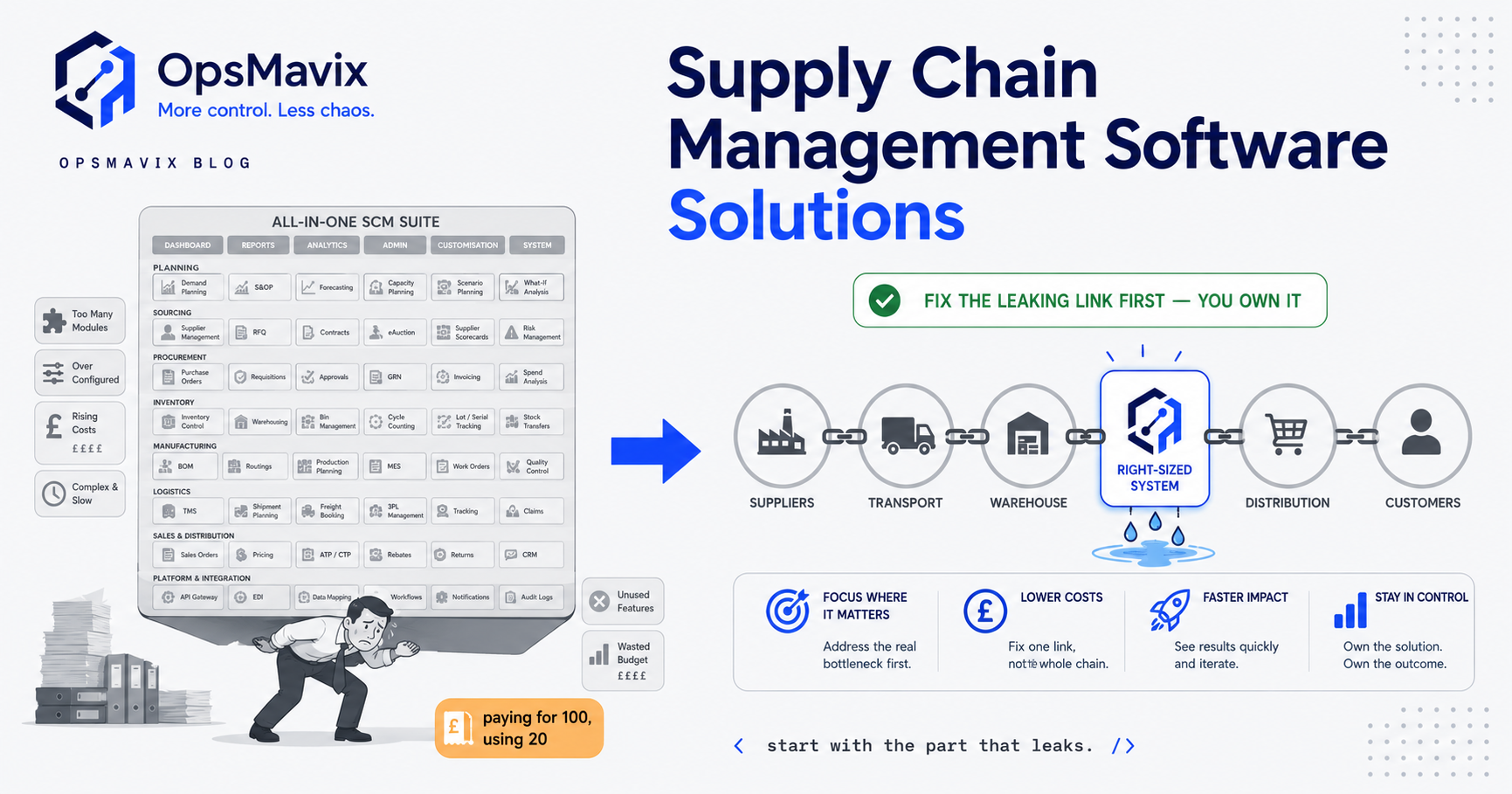
There is a third option that rarely makes the shortlist, because no vendor is incentivised to suggest it: fix the one or two links that leak, build that as a right-sized owned system that fits how you already run, and expand later only if you need to.
The logic is simple. Your chain is only as strong as its weakest link, and money leaks at the weak link, not evenly across all five categories. If your stock is wrong, no amount of demand-planning sophistication saves you, because every downstream decision is built on a bad number. Find the leak, fix it properly, and most of the daily friction disappears. For the majority of growing product businesses, the leak sits in one of three places:
- Stock accuracy. The system says twelve, the shelf has nine, and everyone stops trusting the numbers. This is the highest-leverage fix in most operations, and exactly what an inventory automation system is built to solve.
- Order-to-despatch. Orders arrive in one place and stock lives in another, so availability is checked against stale figures and the same stock gets committed twice. A wholesale order management system closes that gap by reading one live stock figure.
- Purchasing. Reorder points run off a spreadsheet that is always slightly out of date, so you swing between stockouts and overstock and nobody can say what is on order without opening three files.
The advantage of starting at the leak is that value arrives fast, from the first fixed workflow, instead of waiting a year for a full platform to bed in. And because you own what gets built, you add the next piece when the business actually needs it, not because it came bundled.
Point tools vs full SCM suite vs right-sized owned system
Three honest ways to buy supply chain software, and where each genuinely fits. Point tools stitched together are cheap and quick but leave no single truth. The full suite gives you one database but charges for breadth and demands you adapt. A right-sized owned system targets the real bottleneck and grows with you.
| Factor | Point tools / spreadsheets | Full SCM suite / ERP | Right-sized owned system |
|---|---|---|---|
| Best for | Very small or single-workflow needs | Large, multi-site, high-complexity operations | “outgrowing spreadsheets and disconnected tools” |
| Single source of truth | No, data lives in silos | Yes, one shared database | Yes, for the workflows you build |
| Scope | One job each, loosely connected | All five categories, used or not | Only the links that are leaking |
| Fit to your process | You improvise around the gaps | Partial, you adapt to the template | High, built around how you work |
| Setup time | Fast per tool, slow to integrate | Months to over a year | Weeks, focused on the bottleneck |
| Cost model | Several subscriptions plus manual glue | Per-user, per-module licences, forever | One-off build, you own it |
| Time to value | Immediate but shallow | Long, value after full adoption | Fast, value at the first fixed link |
| Ownership | You rent each piece | You rent the whole platform | You own the system outright |
| Main risk | No single truth, fragile handoffs | Over-scoping, low adoption, lock-in | Scoped too narrow if complexity is truly broad |
Point tools deserve a fair word. If you genuinely have one isolated job, a good single-purpose app is often the smartest, cheapest choice, and there is no shame in a spreadsheet doing what a spreadsheet is good at. The trouble starts when you run five of them held together by manual copy-paste, because that is where the single-source-of-truth problem lives. The right-sized system is the middle path: the connectedness of a suite, aimed only at the links that actually hurt.
Integrations and ownership
Whatever you buy, two questions decide whether it helps or hurts a year from now: does it talk to what you already run, and do you control it.
Integration matters because no supply chain tool lives alone. Your accounting software, sales channels, couriers and suppliers all hold data the system needs. Point tools do not share cleanly, so someone re-keys numbers and errors creep in. A full suite has the opposite fault: it wants to replace everything, including the accounting tool your finance person trusts, just to deliver the operational bits you actually wanted. A right-sized owned system takes the middle line, covering only the leaking workflows and talking to the tools you keep.
Ownership is the quieter issue, and often the more expensive one. With a suite or a stack of subscriptions, you rent the core of your operation: the monthly cost never ends and the roadmap is set by the vendor. An owned system flips that. You pay once, own it outright, and it changes when your business changes, not when a vendor deprecates a feature. Over three years the difference in cost and control is substantial.
A worked example: a £6m food wholesaler
The numbers below are illustrative, built to show the shape of the decision rather than any real client.
Picture a food wholesaler turning over around £6m a year. Roughly 900 active SKUs, four people in the office, one chilled warehouse, deliveries split between two of their own vans and a pallet network, and accounts kept in software the finance manager has no wish to change.
The pain. Stock is counted weekly and is wrong by the next morning. Orders come in by phone, email and a trade website, and get keyed into a separate system, so the same pallet gets promised twice and short-dated stock slips past its window. Purchasing runs off a shared spreadsheet, so the buyer either over-orders to feel safe or gets caught short on a fast mover. Three afternoons a week vanish into reconciling numbers that should already agree.
The oversold option. A full SCM suite is quoted. It bundles demand planning, a transport module and a full warehouse layer, and wants to replace the accounting software too. The price is a per-user monthly licence plus a five-figure implementation across three quarters. The transport module would sit unused, the demand engine is overkill for a stable range, and the finance manager would spend months migrating off a tool that already works.
The right-sized option. A system that does three things and nothing else: one live stock figure, with short-date tracking, that both the order desk and the buyer read from; an order screen built on a wholesale order management system that checks live availability across all three channels before anything is promised; and reorder points calculated from real sales velocity and supplier lead times. It leaves the accounting software alone and talks to it. No transport module, no demand engine, no per-seat rent. Built in weeks, scoped to the real leaks, owned outright.
The outcome that matters. Double-promised pallets stop, because there is one stock figure instead of two. Short-dated waste drops, because it is visible before it expires. The three lost afternoons come back, and the owner can answer “what is on order” in a single click. That is the difference between buying the whole chain and fixing the links that bleed.
FAQ
What are supply chain management software solutions?
They are the tools used to plan, run and see across the flow of goods from supplier to customer, spanning five broad categories: procurement and purchasing, inventory and warehouse management, demand planning, order management, and logistics and visibility. A solution can be a single app covering one category or a full suite claiming to cover all five from one database. Our supply chain management software overview covers the wider landscape.
Do I need a full end-to-end SCM suite?
Usually not. Full suites are built for large, multi-site operations with genuine complexity across every category. Most growing businesses feel real pain in only one or two links, almost always stock, orders or purchasing, and can fix those with a right-sized system rather than renting functions they will never switch on. The trigger is not company size, it is when errors and reconciliation time become one of your biggest hidden costs.
Are point tools and spreadsheets ever the right answer?
Yes, for genuinely isolated jobs. A good single-purpose tool, or even a spreadsheet, can be the smartest and cheapest choice when a task stands alone. The problem appears when you run several glued together by manual copy-paste, because that is where you lose a single source of truth and errors multiply. At that point, connecting the workflows that matter beats adding another disconnected tool.
How do I know which link in my chain is leaking?
Follow the errors and the wasted time. Write down where mistakes, delays or admin actually cost you money, in plain terms like “stock is wrong and we double-promise” rather than “we need better systems”. The leak is almost always concentrated, not spread evenly, and naming it precisely is what stops you buying five categories to fix one. An inventory automation system often addresses the most common one.
Is an owned system cheaper than a full SCM suite?
Over a three-year horizon it usually is, because you pay a one-off build cost and own the result, instead of per-user, per-module licences that run forever. It is not always cheaper on day one, and if your complexity is genuinely broad, a suite can be better value. The real saving is scope: you pay to fix the links that leak, not to rent functions you never use. Our types of supply chain management software guide helps map which categories you actually need.
How OpsMavix can help
OpsMavix builds right-sized, owned operations systems for growing UK businesses that are outgrowing spreadsheets but not looking for a full supply chain suite. We are not an ERP vendor and we do not sell generic custom code. We sell the outcome: one live source of truth for stock, an order flow that stops overselling, and purchasing that runs on real numbers, built around your actual process, connected to the tools you already trust, and owned outright with no per-seat rent. If a full platform genuinely is your fit, we will tell you, the same way our distribution ERP software guide does. We start by finding exactly where your chain leaks, then build only what fixes it. When you are ready to see the leaks in yours: Book a Free Operations Leak Audit.
Sources
- Consulting.us, reporting McKinsey’s “Risk, resilience, and rebalancing in global value chains” study of 325 companies across 13 industries, finding disruptions lasting a month or more hit the average company every 3.7 years and cost roughly 42% of one year’s profits over a decade: https://www.consulting.us/news/4743/billions-in-profits-evaporate-due-to-supply-chain-disruptions
- Ivalua — “UK businesses in the middle of a chain reaction”, finding 47% of UK businesses saw supply chain disruption increase over the previous year, based on a survey of 300 UK supply chain and procurement decision-makers: https://www.ivalua.com/press-releases/uk-businesses-in-the-middle-of-a-chain-reaction-with-nearly-half-experiencing-a-surge-in-supply-chain-disruption/