Supply Chain Management ERP Software: What You Actually Need to Buy
Supply chain management ERP software promises to run procurement, inventory, warehousing, demand planning and logistics from one platform. This guide explains what those SCM modules really do, why most growing firms overbuy them, and how a right-sized owned system fixes the parts that actually leak when you are outgrowing spreadsheets and disconnected tools.
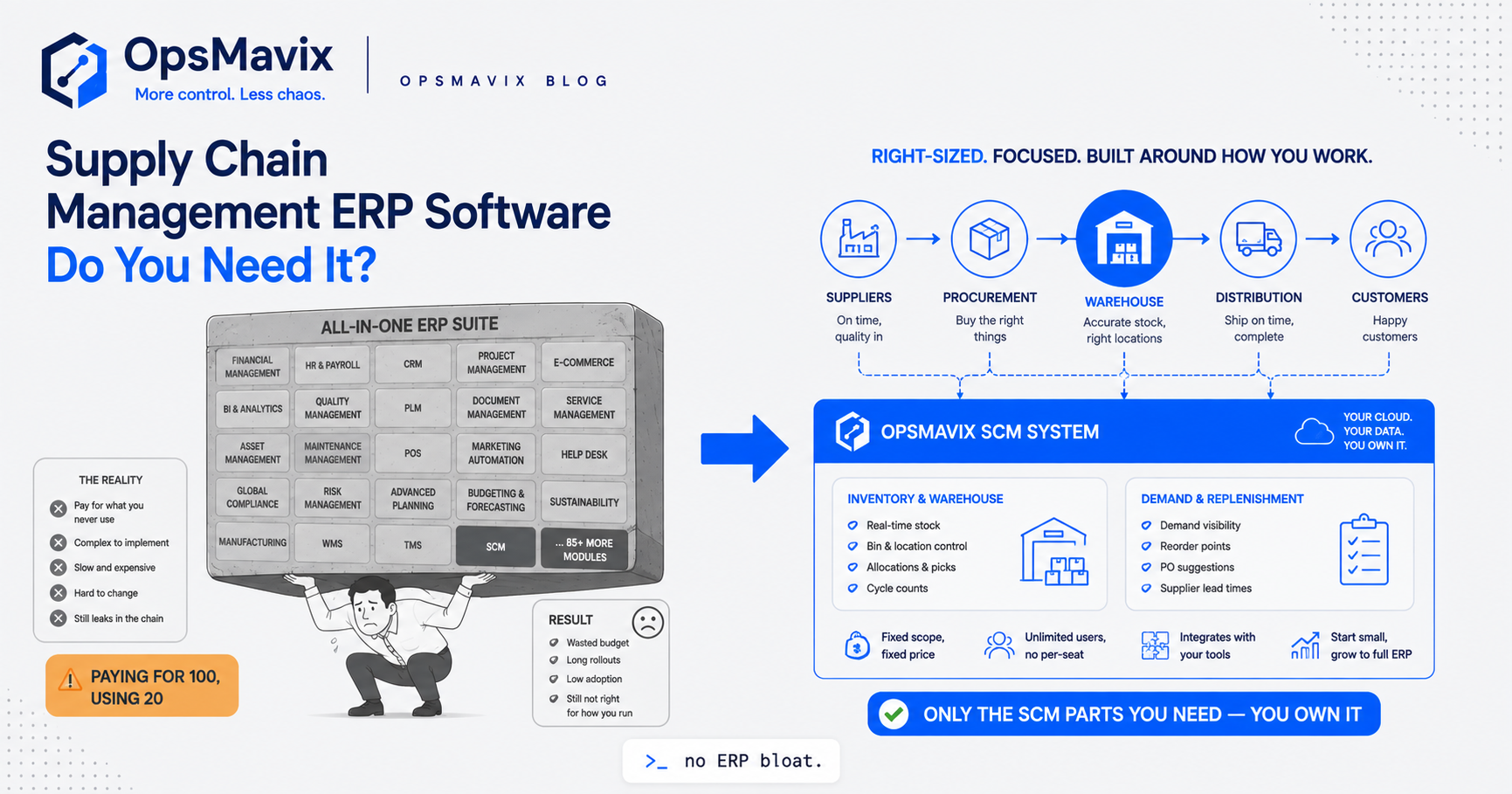
Supply chain management ERP software is a broad, integrated platform that tries to run every link in how goods move through your business, from raising a purchase order with a supplier, through receiving and storing stock, to fulfilling customer orders and shipping them out, all from one shared database. The pitch is that procurement, inventory, warehousing, demand planning and logistics stop being separate spreadsheets and inboxes and become one connected flow. For a large, genuinely complex operation, that is a real and valuable thing to own.
The honest problem is that most growing businesses looking at supply chain ERP are shopping at the wrong weight class. You feel the pain of stock going missing, of buying the wrong things, of orders slipping, and the market answers with a platform built for a company ten times your size. You end up paying for procurement engines, warehouse robotics integrations and multi-tier logistics planning you will never switch on, to fix two or three workflows that a much smaller system could handle. This guide is about telling those two situations apart before you sign anything.
Quick summary: Supply chain pressure is not a rare event for mid-sized UK firms. BDO’s 2025 survey of 500 UK mid-market business leaders (companies turning over roughly £10m to £300m) found that supply chain challenges were the single biggest operational risk named for the year, with 29% grappling with significant disruption from delayed deliveries and inventory shortages (BDO). The pressure is real. The question is whether the answer is a full ERP suite or a much smaller system aimed at the specific link that keeps breaking.
Contents
What supply chain management ERP software actually does
Enterprise resource planning (ERP) is the wide system of record for a business, one database tying finance, operations, stock and reporting together so a single change ripples through everything. Supply chain management (SCM) is the discipline of moving goods efficiently from supplier to customer. Supply chain management ERP software is where those two ideas meet: an ERP that leans hard into the supply chain modules, so procurement, inventory, warehousing, demand forecasting and logistics all read from and write to the same shared data.
The appeal is coherent. When a purchase order, a goods receipt, a stock level and a sales order all reference the same numbers, you stop double-entering data and you stop reconciling three files that should agree and do not. You get one live picture of what you have, what is committed, and what is on the way. If you have ever oversold something the system swore you had in stock, that promise lands hard.
The catch sits in the word “enterprise”. These platforms were designed for scale and are priced and structured to match: per-user, per-module licences that run indefinitely, an implementation often measured in quarters rather than weeks, and the quiet expectation that you reshape your process to fit the software’s template. That trade genuinely pays off for a large distributor with several depots, thousands of suppliers and a dedicated planning team. For a growing firm feeling sharp pain in one or two places, it is an expensive way to solve a small number of problems. Our companion guide to supply chain management software walks through where ERP sits among the other systems in this space.
The SCM modules an ERP bundles
A full supply chain ERP typically claims to cover five or six supply chain areas on top of finance and reporting. Knowing them by name matters, because the gap between the modules you touch daily and the ones that sit dark is exactly where your overspend lives.
- Procurement and supplier management. Raising purchase orders, tracking deliveries, managing lead times, supplier scorecards and contract terms. For most product businesses this is one of the modules that genuinely earns its keep.
- Inventory management. Stock levels, locations, reorder points, valuation and movements. This is the beating heart of the operation, and almost always one of the two or three modules that truly pays for itself.
- Warehouse management (WMS). Receiving, put-away, pick paths, packing and despatch, usually with barcode or scanner support. Essential for a large multi-aisle operation, overkill for a single small warehouse.
- Demand planning and forecasting. Predicting what to buy and when, using sales history, seasonality and statistical models. Powerful when you have thousands of SKUs and heavy seasonality, close to noise when you have a few hundred steady lines.
- Logistics and transport (TMS). Route planning, carrier selection, freight cost optimisation. Real if you run your own fleet, largely irrelevant if you hand everything to couriers and a pallet network.
- Finance and reporting. The general ledger, invoicing, payments and the dashboards that tie it all together. Many firms already run this perfectly well in accounting software they have no wish to replace.
Most growing firms live and die by the first two, procurement and inventory, with order fulfilment sitting close behind. The warehouse, demand-planning and transport modules are frequently either handled outside the business, not complex enough to justify dedicated software, or simply switched off. That single observation is the whole argument of this article. The same pieces are sold outside ERP too; our guide to supply chain management software modules covers all nine and who needs each.
Why most growing firms overbuy
Nobody sets out to buy too much software. Overbuying happens because of how these platforms are sold and how the decision feels from the inside when you are under pressure.
First, the sales motion rewards breadth. A vendor selling a six-module suite is incentivised to demo all six, because the licence value grows with every module you switch on. The demo dazzles precisely because it covers everything, including the parts you will never use in anger.
Second, fear closes the gap. When you are drowning in reconciliation, month-end oversells and chased deliveries, “one platform that does everything” sounds like safety. It is emotionally easier to say yes to total coverage than to name, precisely, which two workflows are actually bleeding money.
Third, the failure rate quietly points at over-scoping. Gartner figures widely cited across the industry put ERP shortfalls at roughly 55% to 75% of projects failing to meet their objectives (Rand Group). “Failure” rarely means the project is abandoned. More often it means late, over budget, a fraction of the promised functionality live, and the team quietly keeping their old spreadsheets running alongside the new system, so now you are paying for both.
The through-line is simple. You are sold a platform, but what you have is a process problem concentrated in a few links of the chain. Double entry and no single source of truth is an integration-and-process issue, not a reason to rent an enterprise suite for the rest of the company’s life.
Generic tool vs full ERP vs right-sized owned system
Most growing firms sit awkwardly between three options, and the middle one rarely makes it onto the shortlist because no salesperson is paid to put it there. To be fair to each, a cheap off-the-shelf tool is often exactly right until you outgrow it, and a full ERP is genuinely the correct answer when your complexity is real and permanent. Here is the honest comparison.
| Factor | Cheap off-the-shelf tool | Full supply chain ERP | Right-sized owned system |
|---|---|---|---|
| Best for | Early-stage, simple, low-volume operations | Large, multi-site, high-complexity supply chains | Firms “outgrowing spreadsheets and disconnected tools” |
| Scope | One narrow job, done adequately | All five or six SCM modules, used or not | Only the two or three links that are leaking |
| Fit to your process | You bend to the tool’s defaults | Partial, you adapt to the template | High, built around how you actually work |
| Setup time | Days | Months to over a year | Weeks, focused on the real bottleneck |
| Cost model | Low monthly per-seat, rises with growth | Per-user, per-module licences, forever | One-off build, you own it, no per-seat rent |
| Time to value | Immediate but shallow | Long, value arrives after full adoption | Fast, value at the first fixed workflow |
| Adoption risk | Low, but you outgrow it | High, teams often keep old spreadsheets too | Lower, it mirrors the process people already run |
| Ownership | You rent it | You rent it and depend on the vendor | You own the system outright |
The pattern owners recognise is this. The cheap tool is fine until the seams show. The full platform solves the reconciliation problem but charges you for ninety functions to fix three. The right-sized system fixes the three and leaves the ninety on the shelf where they belong. The skill is telling honestly which situation you are actually in, and that is a question about your operation, not about the software.
Integrations and why ownership matters
The single most common reason firms reach for supply chain ERP is not that any one tool is bad. It is that the tools do not talk to each other. Orders arrive in one system, stock lives in another, purchasing runs off a spreadsheet, and accounts sit in a fourth. Every gap between them is a place where data gets re-keyed, drifts out of sync, and produces the oversells and reconciliation afternoons that make you feel you need to replace everything.
A full ERP solves that by absorbing everything into one platform, which works, but the price is that you also absorb its opinions about how procurement, warehousing and finance should run, and you often have to rip out tools that were doing their job perfectly well. A right-sized owned system takes the opposite route. It covers only the links that leak, procurement and inventory for most firms, and it integrates with the accounting software, the sales channels and the courier accounts you already trust, rather than demanding you replace them.
Ownership is where this compounds over time. When you rent a supply chain ERP, the core of your operation lives on someone else’s roadmap and pricing. Per-seat costs climb as you grow, the modules you never use still appear on the invoice, and changing anything means a change request and a wait. When you own a right-sized system, it is built around your process, it changes when your business changes, and it can be expanded later, module by module, right up to a full ERP if you genuinely grow into one. You keep the option open instead of paying for it up front. For the order side of that picture specifically, our wholesale order management system shows what owning a single fulfilment workflow looks like in practice.
A worked example: a £6m wholesaler
Consider a wholesaler turning over £6m a year, around 1,200 active SKUs, four people in the office, one small warehouse, all deliveries handled by couriers and a pallet network, and accounts kept in software the finance person likes and trusts. This scenario is illustrative and not a claim about a specific client.
The pain. Procurement runs off a shared reorder-point spreadsheet that is always a step behind, so they either run out of fast movers or tie up cash in slow ones. Sales orders arrive through a separate system, so stock gets committed twice and oversells spike at month-end. Nobody can answer “what is on order and when does it land” without opening three files and chasing an email thread. Roughly two afternoons a week vanish into reconciling numbers that should already agree.
The oversold option. A full supply chain ERP is quoted. It bundles a warehouse management layer, a transport optimisation module, multi-tier supplier risk scoring and a demand-planning engine, none of which this business needs, and it expects to replace the accounting software that already works. The cost is a per-user monthly licence plus a five-to-six-figure implementation running across three quarters. The transport and WMS modules would never be switched on, and finance would spend months migrating off a tool they were happy with to end up roughly where they started.
The right-sized option. A system that does three things and nothing else. It holds one live stock figure that both procurement and sales read from. It calculates reorder points automatically from real sales velocity and actual supplier lead times. It shows one screen of “on order, in stock, committed, available”. It leaves the accounting software alone and simply talks to it. No transport module, no WMS, no demand-planning engine, no per-seat rent. Built in weeks, scoped to the two real leaks, and owned outright.
The outcome that matters. Oversells stop because there is one stock figure instead of two. The two lost afternoons come back. The owner can answer “what is on order” in a single click. Finance keeps the tool they trust. That is the difference between buying a platform and fixing the actual problem, and it is why the right question is never “which supply chain ERP” but “which links are bleeding”. If inventory is your worst leak, our inventory automation system is built around exactly that fix.
FAQ
What is supply chain management ERP software?
It is an integrated platform aimed at businesses that move physical goods, tying procurement, inventory, warehousing, demand planning, logistics, finance and reporting into one shared database. The goal is a single source of truth so that a purchase order, a stock movement and a sales order all reference the same numbers and update each other automatically. It is powerful for large, complex operations, but it typically bundles far more than a growing firm needs.
Do small and mid-sized businesses need a full supply chain ERP?
Usually not the full enterprise kind. Most growing firms feel real pain in just two or three links of the chain, almost always procurement, stock accuracy and order fulfilment, and can fix those with a right-sized owned system rather than a five or six-module platform. The trigger to act is not company size, it is when errors, double entry and reconciliation time have quietly become one of your biggest hidden costs.
Why do so many supply chain ERP projects fail?
Figures widely attributed to Gartner put ERP shortfalls at roughly 55% to 75%, where “failure” usually means late, over budget, under-delivered, or quietly worked around rather than fully abandoned. A common cause is over-scoping: buying a broad platform to fix a narrow set of problems, then losing the adoption battle because the team keeps using their old spreadsheets alongside the new system. Scoping tightly to the workflows that actually hurt is one of the most reliable ways to avoid that outcome.
Can a right-sized system integrate with my existing accounting and sales tools?
Yes, and that is often the whole point. A right-sized owned system can be built to cover only procurement and inventory while talking to the accounting software, sales channels and courier accounts you already trust, rather than forcing you to replace them. A full supply chain ERP frequently wants to absorb finance and everything else too, just to deliver the operational pieces you were actually after, which is exactly the kind of over-reach worth avoiding.
Is a right-sized owned system cheaper than a supply chain ERP?
Over a three-year horizon it usually is, because you pay a one-off build cost and then own it, instead of per-user, per-module licences that continue forever. It is not always cheaper on day one, and if your complexity is genuinely broad, a platform can be better value. The real saving is scope: you pay to fix the links that leak, not to rent modules you will never switch on. If your complexity is genuinely growing, our guide to distribution ERP software covers the signals that you have earned a bigger platform.
How OpsMavix can help
OpsMavix builds right-sized, owned operations systems for growing UK businesses that are outgrowing spreadsheets but not looking for a full supply chain ERP. We are not an ERP vendor and we do not sell generic custom code, we sell the outcome: one live source of truth for stock, procurement that runs on real sales velocity and lead times rather than a stale spreadsheet, and order fulfilment that stops overselling, all built around your actual process, owned by you, with no per-seat rent and backed by a delivery guarantee. We start by finding exactly where your supply chain leaks, then build only what fixes it, with room to expand later if you genuinely grow into a bigger platform. When you are ready to see the leaks in yours: Book a Free Operations Leak Audit
Sources
- BDO — “Supply chain challenges top risk for businesses in 2025”, a survey of 500 UK mid-market business leaders (turnover ~£10m to £300m) finding supply chain the biggest named operational risk, with 29% grappling with significant disruption: https://www.bdo.co.uk/en-gb/news/2025/supply-chain-challenges-top-risk-for-businesses-in-2025
- Rand Group — “What percentage of ERP implementations fail?”, reporting figures widely attributed to Gartner that approximately 55% to 75% of ERP projects fail to meet their objectives: https://www.randgroup.com/insights/services/solution-implementation/what-percentage-of-erp-implementations-fail/