
StockSync Alternative: Custom Multichannel Stock Sync
A sync app keeps your stores roughly aligned. A custom system makes one live stock count the truth across every channel. Here's when each one fits, and when you've outgrown the app.
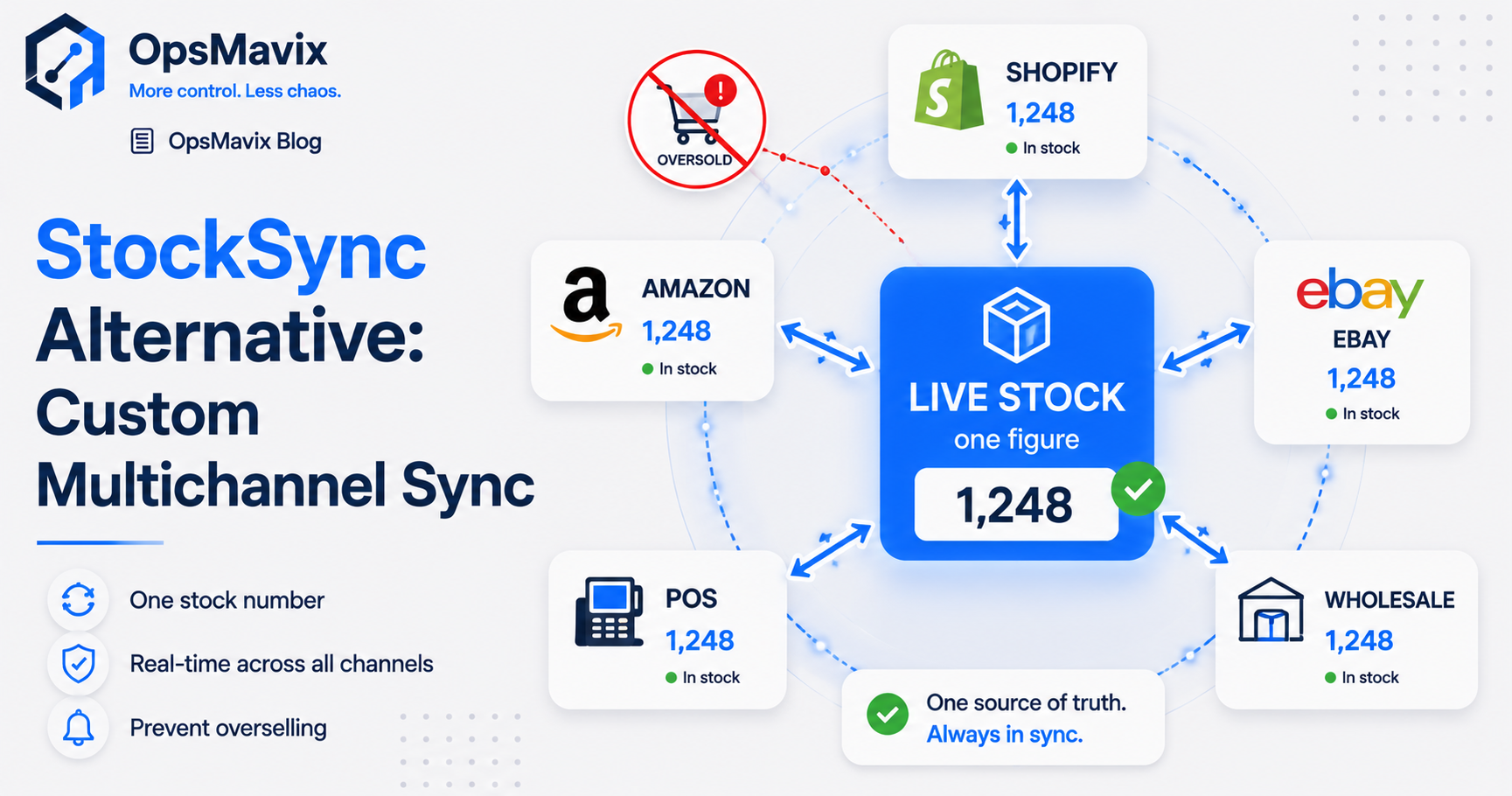
If you’re searching for a StockSync alternative, the real alternative isn’t another app in the gap. It’s a custom system where one live stock count is the source of truth, and every channel reads from it and writes back to it. A sync app sits between your stores and tries to keep them roughly aligned, so the count stays its own moving part you have to trust, configure and babysit. This post covers when a sync app is the right call, when you’ve outgrown it, and what a built-for-you system does differently.
Let’s keep the comparison fair. Sync apps like StockSync exist because connecting channels by hand is brutal, and for plenty of sellers they’re enough. The only question that matters is whether “enough” still describes you.
Key Takeaways
- A sync app bridges channels you already run; a custom system makes one live count the truth those channels obey.
- You’ve outgrown an off-the-shelf sync tool when its model, speed or pricing starts dictating how you operate.
- The dread that drives most switches isn’t features. It’s phantom stock and overselling you can’t explain.
- Custom doesn’t mean enterprise or expensive. It means sized to your channels and volume, not someone else’s.
- The biggest hidden risk with any third-party app is lock-in and abandonment; ownership removes it.
1App vs System: What You’re Actually Choosing Between
A sync app is a connector. It reads stock from one place, writes it to another, and repeats on a schedule or a trigger. That’s genuinely useful. But the count itself still lives inside your channels, and the app is one more layer that can lag, mis-map a SKU, or fall out of step. You’re trusting the bridge, not the river.
A custom system flips that round. The live stock count becomes the centre of gravity. Shopify, Amazon, eBay and the rest read from it and report sales back to it in real time. There’s no separate “sync state” to wonder about, because there’s one number and everything else is just a view of it. For a multichannel seller, that’s the difference between hoping the channels agree and knowing they draw from one truth.
| Sync app (e.g. StockSync) | Custom stock system | |
|---|---|---|
| Source of truth | The count lives in each channel | One live count every channel obeys |
| Sync model | Bridges channels on a schedule or trigger | Channels read and write in real time |
| When the number drifts | A black box to reconcile | Every change traces to a real event |
| Pricing | Tiered by orders or seats, climbs as you grow | Scoped once, owned, no per-seat creep |
| Lock-in | Vendor roadmap and sunset risk | You own the system and the data |
| Best for | Getting channels roughly aligned, fast | Making one count the truth at scale |
2The Real Reason People Switch (It Isn’t Features)
Sellers rarely leave a sync tool because it’s missing a checkbox. They leave because of a specific, sickening pattern. One eCommerce founder described it exactly: “We would consistently oversell items we didn’t even have on hand.” What follows is cancellations, refunds, and a slow slide in marketplace metrics.
That’s the fear underneath every “StockSync alternative” search. As one seller put it, the choice turns brutal: “It’s either switch FBM off or risk the account! Losing so many sales.” When you can’t trust the number, you either pull listings and lose the sales, or leave them up and gamble the account on a rising defect rate. No app should put you in that corner. If yours does, that’s the signal you’ve outgrown it.
3Phantom Stock and the Numbers You Can’t Explain
The most corrosive failure isn’t a sync that’s late. It’s a count that’s wrong for no visible reason. Sellers on bigger inventory platforms describe exactly this: “inventory numbers change for no reason”, and in one case a stock value difference that simply “cannot be explained.” When the figure drifts and the tool can’t tell you why, you stop trusting it entirely. And an untrusted number is worse than no number, because you act on it anyway.
A custom system is auditable by design. Every change to the count traces to a real event: a sale on a named channel, a goods-in, a return, a write-off. So the number on screen always ties back to something that happened on the shelf. There’s no black box to argue with. It’s the same principle behind why your stock never matches the system: accuracy comes from capturing every movement once, in one place, not from a connector reconciling lists after the fact.
4“Punished for Growing”: When the App’s Model Starts to Bite
Off-the-shelf tools are built around a model: a way of mapping SKUs, a sync cadence, a pricing tier per order volume or seat. That model is fine until your business grows past the shape it assumes. Then you start bending your operation to fit the tool. You work around its mapping rules, you accept its sync interval, and you pay more precisely because you’re succeeding. Growth should lower your cost per order, not raise your software bill for the privilege.
A custom alternative is built around your channels and workflow as they are now, then extends as you add channels or locations. You’re not renting a slot in someone else’s model. The system is shaped to how you actually sell. For sellers who also handle B2B or wholesale orders alongside retail, that means one stock count feeding both, instead of two tools fighting over the same shelf.
5Lock-In, Sunsets, and Why Ownership Matters
Here’s the risk nobody markets to you: the tool you depend on isn’t yours. One founder learned this the hard way when a platform was wound down. “Invalidates two years worth of work… scramble to find an alternative.” You migrate everything onto it, train yourself on it, build your whole rhythm around it, and then a banner appears and you’re stranded.
A custom system you own removes that exposure. There’s no per-seat fee climbing with your team, no vendor roadmap that can deprioritise you, no sunset that torches your setup overnight. You hold the system the way you hold the rest of your business. That’s the quiet, real advantage of building over buying, and the one that matters most after you’ve been burned once.
FAQ
Is a custom system the same as just buying a more expensive sync app?
No. A pricier app is still an app, a connector sitting between channels that hold their own counts. A custom system makes one live count the source of truth your channels obey, built around your specific stack rather than a fixed model you adapt to.
Do I need to be a big business to justify building instead of buying?
That’s the common misconception, that real software is only for large operations. The middle path is exactly for sellers who are outgrowing spreadsheets and a patchwork of apps, but not looking for a full ERP. It’s sized to your volume now, not an enterprise tier.
Will a custom build keep up with marketplace speed?
That’s the whole point of building around your channels. The count updates the moment a sale happens anywhere, so you’re not relying on a third party’s sync interval. Real-time accuracy is what protects you from overselling and the account-health knock-on.
What happens to my data and setup if I ever stop?
With a system you own, the setup and data are yours. There’s no vendor sunset that invalidates your work and no scramble to migrate before a tool is switched off. That ownership is the main reason sellers move off rented sync apps after a bad experience.
How is this different from Shopify’s own multichannel sync?
Shopify is strong at running a Shopify store, but keeping a live, two-way count across external marketplaces in real time usually needs a dedicated system behind your channels. A custom build connects every channel into one figure, and can fold in wholesale, locations and reporting too.
How OpsMavix Can Help
OpsMavix builds custom eCommerce inventory automation where one live stock count is the truth across Shopify, Amazon, eBay and every channel you sell on: auditable, sized to your volume, owned by you. No phantom stock, no per-seat creep, no sunset risk. If a sync app got you most of the way but you still oversell, still can’t explain the numbers, or still dread peak season, that’s the gap a built-around-you system closes.
When the bridge between your channels turns into the thing you’re most afraid of, the app stopped being the answer. Book an Operations Leak Audit and we’ll map where your stock sync is leaking, and what it’s costing you in lost sales and risked accounts.