
RFID in the Warehouse: Worth It for a Growing Business?
An RFID reader sounds like the cure for a warehouse that can't trust its stock figure. Here's when it's actually worth it versus barcode, and the problem it can't fix.
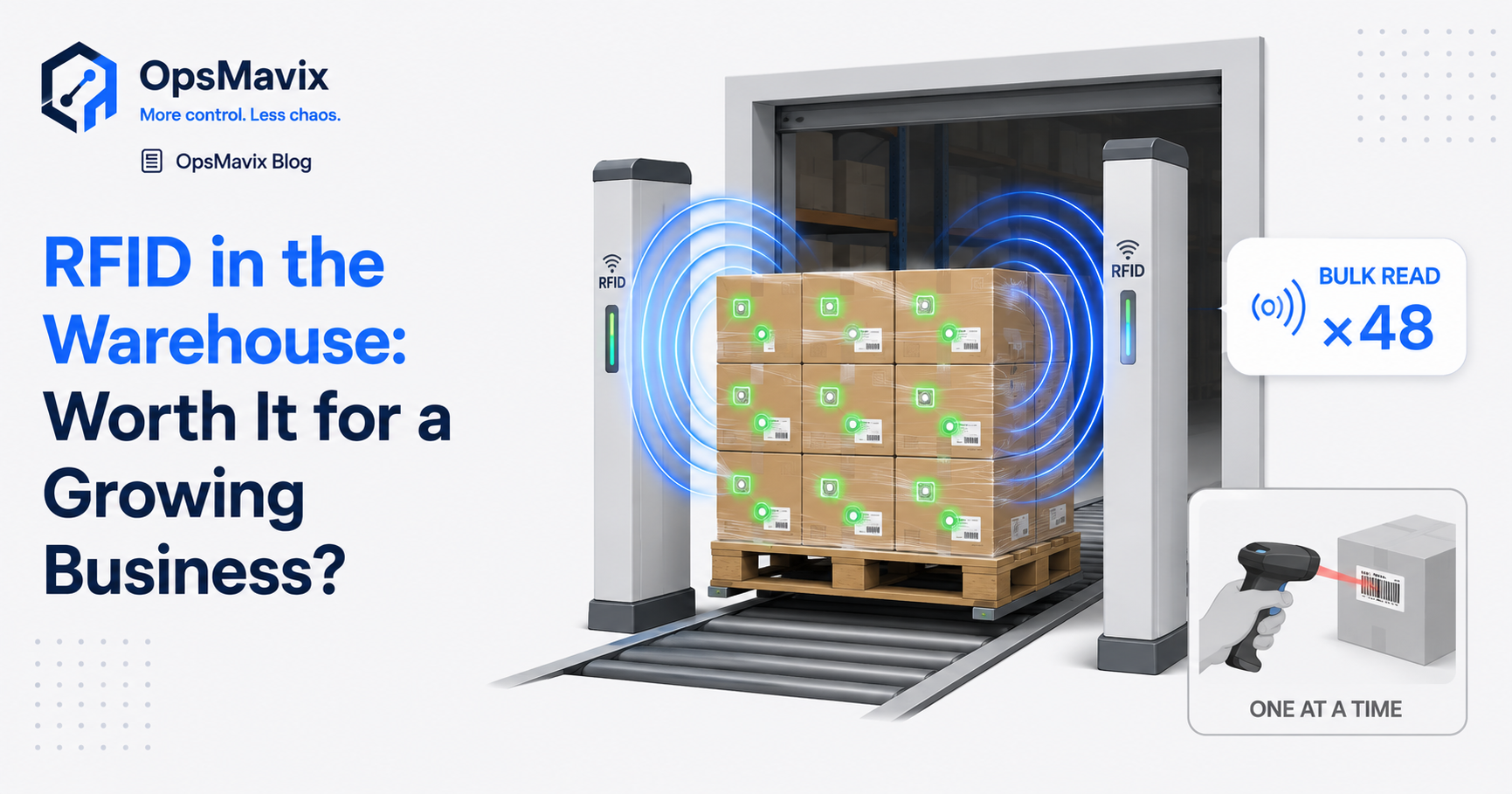
For most growing warehouses, an RFID reader is not the first thing to buy. A connected stock system is. RFID earns its place when you move high volumes of similar items fast, can’t afford to stop and scan each one, and the per-tag cost is small against the item value. Below that, a barcode scanner feeding a live count does the same job for a fraction of the spend. Either way, the hardware only matters if the data behind it is trustworthy.
That last part is where most decisions go wrong. Managers reach for RFID hoping it will end the gap between the shelf and the screen, then find the gap is still there, because the cause was never the scanner. Here’s an honest read on when an RFID reader is worth it in the warehouse, when barcode wins, and the leak it won’t plug on its own.
Key Takeaways
- RFID reads many tags at once without line of sight. Its real advantage is speed and bulk, not accuracy by itself.
- Barcode is cheaper and proven, and enough for most growing SMEs until volume or speed makes scanning each item a bottleneck.
- RFID won’t fix phantom stock if untracked returns, write-offs and transfers still bypass the system.
- The honest test is per-tag cost against item value and read frequency, not the brochure demo.
- The hardware is the easy part. A connected stock system that captures every movement is the part that decides whether any reader is worth buying.
1What an RFID Reader Actually Does Differently
A barcode scanner reads one label at a time, in line of sight. An RFID reader picks up many tags at once, through boxes and without aiming. Wave a handheld past a pallet, or drive it through a dock portal, and dozens of items register in seconds. That is the genuine edge: throughput. You receive a full pallet, count a bay, or check a dispatch in one sweep instead of bleeping each carton.
What it does not do is make your numbers honest by magic. An RFID read is still only as good as what the system does with it, and whether every other stock movement is captured too.
2The Problem RFID Is Sold to Solve (and Usually Doesn’t)
The pitch lands hard on a warehouse manager who already lives the pain: a stock figure that never matches the shelf, “a million messy spreadsheets for the warehouse,” and the dread of overselling something you don’t actually have. One operator put it plainly: “we would consistently oversell items we didn’t even have on hand.” RFID gets framed as the cure for that distrust.
But the distrust rarely comes from slow scanning. It comes from movements that never hit the system at all: a return restocked but not recorded, a damaged unit written off in someone’s head, a transfer between bays nobody logged. Another operator described a well-known inventory SaaS as a place where “inventory numbers change for no reason, phantom stock.” Faster reads on the movements you already capture won’t close a gap caused by the ones you don’t. You will scan quicker and still not trust the total.
3The Honest Cost Test: Per-Tag vs Item Value
RFID is not one purchase. It is readers, antennas or portals, and a tag on every single item. That per-tag cost is what makes or breaks the case. The maths is simple and unsentimental:
- High item value, low tag cost (electronics, tools, branded goods): the tag is rounding error, and RFID makes sense.
- Low item value, high volume (fasteners, packaging, consumables): a few pence per tag across thousands of units can outweigh the saving, and barcode wins.
- Slow-moving or one-touch stock: if you only handle an item once, the time saved per read is tiny, and the reader sits idle.
This is why “we’re not big enough for real software” cuts both ways. Plenty of growing warehouses aren’t too small for good systems. They are too small for RFID’s per-tag tax, and barcode is the right call for years.
4When RFID Genuinely Earns Its Place
There is a real band where RFID stops being a gadget and starts paying for itself. You are likely in it when several of these are true:
- You receive or dispatch in bulk, and scanning each item one by one is a daily bottleneck.
- Items are valuable enough that tag cost disappears against margin.
- You need fast, frequent counts of full bays or zones, not the odd spot check.
- Stock is handled many times between goods-in and dispatch, so each faster read compounds.
- Speed at the dock directly limits how many orders you can ship in a day.
If most of those are false, you don’t have an RFID problem. You have a data-capture problem, and a barcode scanner wired into a live count solves it cheaper.
5Barcode and a Connected System: the Boring Answer That Usually Wins
For the typical growing SME warehouse, the upgrade that moves the needle isn’t RFID. It is making every barcode scan update one shared, live stock figure the moment it happens. Goods received, picked, transferred, returned, written off: each captured against the right SKU, in real time, in a system you own. That is what ends the “stock never matches the system” loop, because the count stops drifting between updates.
Get that right first and two things follow. Your numbers become trustworthy on cheap, proven hardware. And if you later hit the genuine RFID band, you are bolting fast reads onto a clean system instead of pouring speed into a leaky one. You also skip the trap that bit so many warehouses before you: thinking the only choices are a near-free spreadsheet or a six-figure WMS. A right-sized connected inventory system is the middle path, and it decides whether any reader is worth buying.
FAQ
Is an RFID reader more accurate than a barcode scanner?
Not inherently. Both are accurate at reading a label or tag. The accuracy of your stock figure depends on whether every movement reaches the system. RFID just reads faster and in bulk. If untracked returns or write-offs are the problem, neither scanner fixes it.
When is RFID worth it for a small or mid-size warehouse?
When bulk reading speed is a real bottleneck and items are valuable enough that the per-tag cost is negligible, typically high-value goods moved or counted in large batches. Below that, barcode plus a live stock system gives most of the benefit for far less.
Will RFID stop us overselling stock we don’t have?
Only if the reason you oversell is slow or missed scanning. More often, overselling comes from movements that never get recorded, or from counts that aren’t shared live across channels. Fix the data capture first. RFID won’t rescue a count that drifts the moment you look away.
How much does an RFID system cost compared with barcode?
RFID adds readers, antennas or dock portals, and a tag on every item. That recurring per-tag cost is the big difference. Barcode reuses printed labels at near-zero marginal cost. For low-value, high-volume stock the tag cost alone can sink the business case.
Do I need RFID before I can have a proper inventory system?
No, it is the other way round. A connected system that captures every stock movement is the foundation. An RFID reader is an optional speed upgrade you add later, if and when bulk throughput becomes the limiting factor.
How OpsMavix Can Help
OpsMavix builds custom inventory systems that make every movement (goods received, picked, transferred, returned, written off) update one live stock figure the moment it happens, scanned on hardware you already trust. We would rather make your barcode scans honest than sell you a reader that puts faster numbers into a spreadsheet you can’t believe. And you own it outright: no per-seat fees, no vendor sunsetting it, no scramble for an alternative. If RFID’s bulk speed genuinely fits your volume, you will be adding it to a clean system instead of a leaky one.
If your stock figure can’t be trusted, that is a measurable operational leak in oversells, dead stock, and hours spent counting twice. Book an Operations Leak Audit and we’ll map where your stock accuracy actually breaks down, and whether a reader would change anything.