
PSL Datatrack vs a Custom Production System
Packaged job-costing software like PSL Datatrack is built for the average shop. A custom production system is built for yours. Here's the honest comparison.
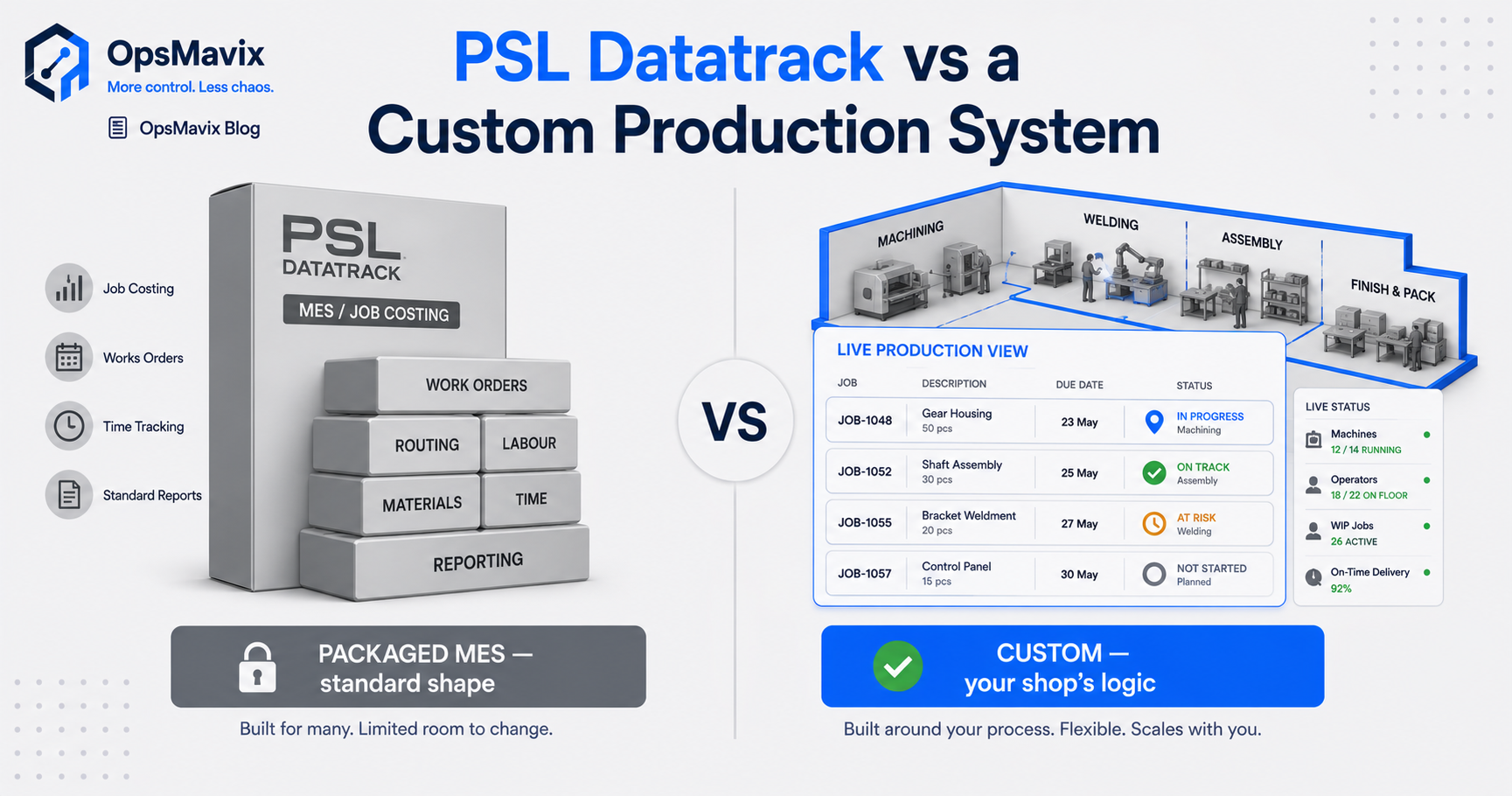
PSL Datatrack is a packaged production-control and job-costing system aimed at precision and subcontract manufacturers. The honest comparison is short. A packaged product gives you a proven feature set you adopt as-is. A custom production system is shaped around how your shop already works and is owned outright by you. For a high-mix, low-volume shop the deciding factor isn’t the feature list. It’s fit, adoption, and what happens when your process doesn’t match the software.
Most owners typing “psl datatrack” into Google aren’t really comparing software. They want to stop jobs falling off the plan, get costing they can trust, and see the floor without walking it. This post is about which route actually gets you there.
Key Takeaways
- A packaged tool like PSL Datatrack ships a ready-made feature set; a custom system is built around your floor and owned by you.
- The real risk with any off-the-shelf tool is adoption — if the floor won’t use it, the data rots and the spend is wasted.
- High-mix shops bounce off packaged tools because their process doesn’t fit the software’s one way of working.
- What you’re buying is live job status and costing you can trust, not the longest feature list.
- Start with the leak that hurts most, prove it, then expand.
1What PSL Datatrack Is Positioned to Do
PSL Datatrack is sold as a production-control package for engineering and subcontract manufacturers. It covers the familiar ground: works orders, scheduling, traceability and job costing in one product. Like any packaged system, its strength is that it already exists and is used across many shops, so you skip the build phase and inherit a mature, supported feature set.
The trade is the one every packaged tool asks of you. You adopt its model of how a shop should run. For a textbook engineering shop, that’s an easy fit. For a messy high-mix floor that runs half its work on a whiteboard and WhatsApp, the real question is which way the bending goes: does your process bend to the product, or should the product bend to your process?
2What a Custom Production System Is
A custom production system does the same core jobs. Works-order visibility, due dates, material usage, actual-vs-quote costing. The difference is that it’s built around the way your floor already works rather than a generic template. You get the capability the shop needs, in your language, without the modules you’ll never open. And you own it outright. No per-seat meter, no lock-in, no single fragile file living in one person’s head.
This is the gap the owner we built for actually sits in. Packaged systems rarely serve it well, because the owner is caught between two objections at once: “we’re not big enough for real software” on one side, “our mess is too bespoke” on the other. A custom system answers both.
3Fit: Adopt the Software’s Way, or Build Around Yours
This is the deepest difference, and it’s where most off-the-shelf spend goes to die. Manufacturers tell the same story across the niche-MRP and packaged-MES world. The tool is rigid, so the floor quietly reverts. One owner described a niche MRP as “as flexible as a wooden door.” Another warned you’ll “still have manual input… despite paying high dollars.” When a packaged tool only has “‘One’ way of doing things,” a high-mix shop ends up changing “almost every procedure” to suit it.
That isn’t a knock on PSL Datatrack specifically. It’s the structural risk of any packaged system meeting a non-standard floor. A custom system removes the gamble because the fit is designed in from the start. The software follows the shop, not the other way round.
4The Failure Mode Both Routes Have to Beat
Whichever route you pick, the thing you’re really trying to kill is the silent ball-drop. The owner we built for put it plainly:
Jobs “fall off the plan and only get noticed when a customer calls.” The whiteboard gets wiped. The spreadsheet, “a 47-tab monster that only you understand,” never gets updated. Then a repeat customer rings asking where their order is, because it was never scheduled. A production system only earns its keep if it ends that. A packaged tool can do it on paper, but only if the floor keeps it current. A custom one is shaped so keeping it current is the path of least resistance. The same stale-data trap is why stock never matches the system.
5Job Costing: A Number on a Screen vs One You Can Trust
Job costing is where production software either pays for itself or doesn’t. The owner’s second goal is dead simple. He wants to know “how close my quote was to actual” so he stops quoting margin away in the dark. Both packaged and custom systems promise this. What separates them is whether the cost data flows in by itself.
If actuals depend on the floor manually keying time and material into a tool they find clunky, the costing is only as honest as the data entry. On a busy floor, that means it’s a guess again. A custom system ties costing to the way work already moves, so actual-vs-quote falls out of normal operation instead of demanding extra admin. The point was never a costing report. It’s a costing report you can trust.
6PSL Datatrack vs Spreadsheets vs a Custom System
| Whiteboard / spreadsheet | Packaged system (e.g. PSL Datatrack) | Custom production system | |
|---|---|---|---|
| Fit for high-mix | Stretched to breaking | Its model, you adapt | Built around your floor |
| Adoption | One person’s head | Depends if the floor buys in | Shaped so the floor uses it |
| Job costing | A guess | Good if data stays current | Falls out of normal work |
| Setup time | “Free” but fragile | Implementation project | Weeks, one area first |
| Cost | Hidden in lost jobs | Licence + per-seat over time | Fixed scope, £k |
| Ownership | A file in your head | Renting the platform | Yours, no lock-in |
7How to Choose Without Boiling the Ocean
Pick by the problem in front of you, not the broadest feature set on the shelf. If you’re a fairly standard engineering shop whose process genuinely matches a packaged product, off-the-shelf can be the faster route. Buy it, but pressure-test adoption before you commit. If you’re high-mix and your process has already bent every tool you’ve tried, that’s the signal a custom system fits better.
Either way, don’t instrument the whole factory on day one. Start with the cell or line where the ball-drops hurt most. Get live production tracking and trusted job status working there, then prove it. A focused first step lands useful visibility in weeks, and because it fits how that area already works, the floor adopts it instead of reverting. If you’re still weighing the category itself, here’s operational systems versus a full ERP.
FAQ
Is PSL Datatrack good for a small high-mix shop?
It depends entirely on how closely your process matches its model. Packaged production systems work well for shops that fit their assumptions and struggle where the floor runs on its own logic. For high-mix, low-volume work that’s already bent off-the-shelf tools, a system built around your process is usually the safer fit.
What’s the difference between PSL Datatrack and a custom production system?
A packaged product gives you a ready-made feature set you adopt as-is and typically rent over time. A custom production system delivers the same core jobs, such as visibility, due dates and job costing, built around how your shop already works, and is owned outright by you with no per-seat lock-in.
Will the people on the floor actually use it?
That’s the deciding factor for any production tool. The common complaint about packaged systems is that they’re rigid, so the floor reverts to the whiteboard and the data rots. A system shaped around how a cell already works, updated in seconds as jobs move, is the one that stays current.
Do I need a packaged MES to get real job costing?
No. You need accurate actuals flowing in from how work already moves. A packaged tool can deliver that if the floor keeps it current. A custom system ties costing to normal operation, so actual-vs-quote doesn’t depend on extra admin nobody has time for.
How long until we have live production visibility?
Starting with one cell or line, useful and trusted visibility typically lands in weeks, rather than the months a full packaged implementation can take before you see any return.
How OpsMavix Can Help
OpsMavix builds custom production tracking systems for small and mid-sized manufacturers. Works orders, due dates, material usage and actual-vs-quote costing on one screen, kept live as jobs move, built around how your shop already works rather than a generic template. We start with one area, prove the visibility, then expand. Fixed scope, yours to own, no lock-in. Material and reporting connect through your stock and reporting systems once the floor is solid.
If jobs are falling off the plan and you only hear about it when the customer calls, and a packaged tool feels like it’ll make you change how the shop runs, that’s a leak worth mapping before you buy anything. Book an Operations Leak Audit and we’ll show you where your production loses jobs.