
PartKeepr Alternative: When Free, Self-Hosted Parts Inventory Isn't Free
PartKeepr is free, open-source, self-hosted parts inventory — no licence fee, which is exactly why the real cost hides. Here's where the bill lands (a developer to install and host it, security, support you own), when it genuinely fits, and what a right-sized built-for-you stock system does that DIY can't.
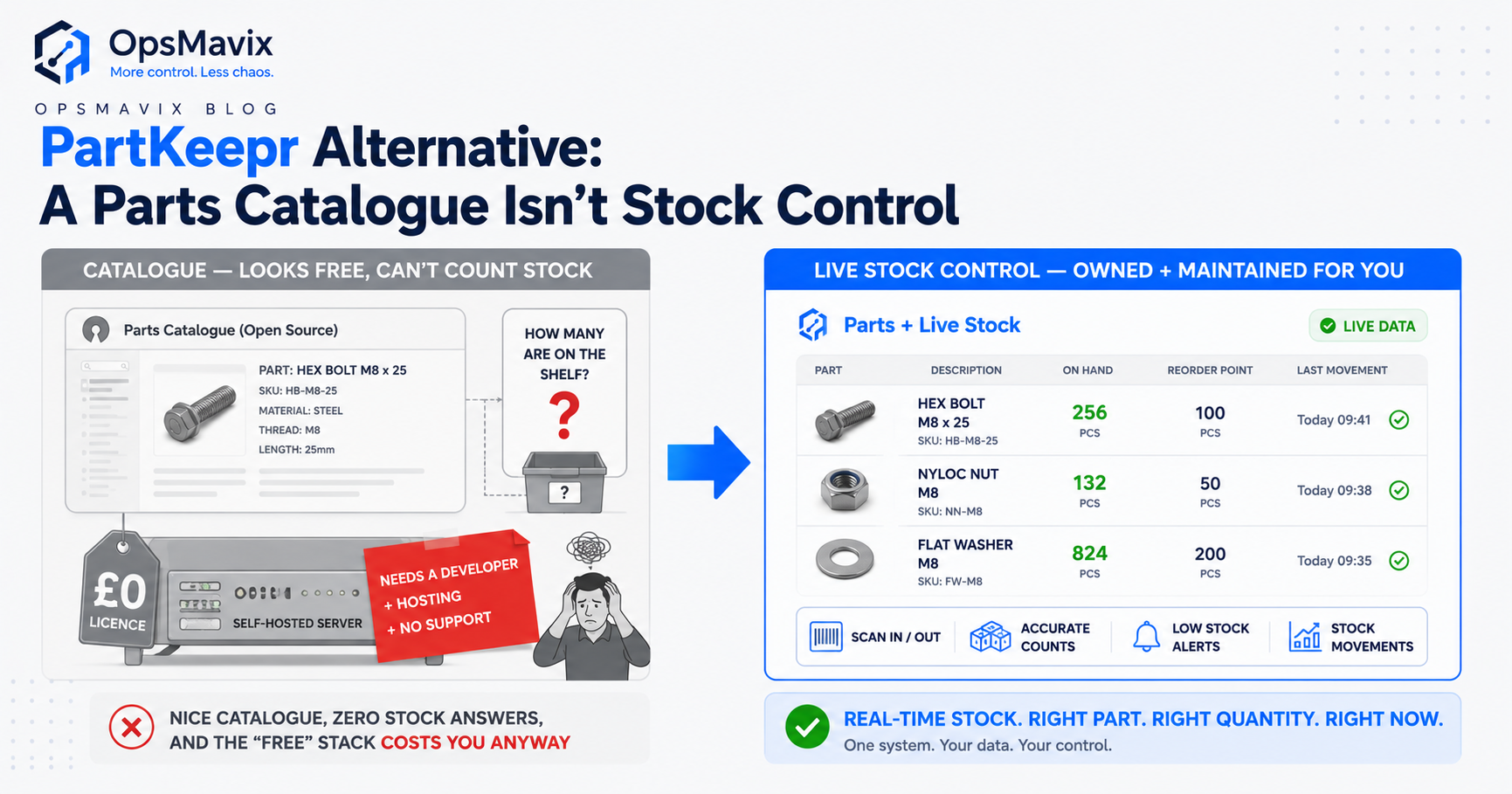
The best PartKeepr alternative depends on one honest question: do you have someone to run a server? PartKeepr is free, open-source and self-hosted, so it looks like the cheap option — but the cost doesn’t disappear, it relocates. It lands on whoever installs it, hosts it, keeps it patched, backs it up and fixes it when it falls over. If you’ve got an in-house engineer or a genuinely technical owner who owns that, a free parts catalogue can be excellent. If you don’t, “free” is the most expensive stock system you’ll run, because the bill is paid in your weekends and a database nobody quite trusts. The alternative isn’t another download — it’s a right-sized parts and stock system built around how you actually work, that you own without having to keep a server alive yourself.
This post covers when PartKeepr is the right call, where the real cost hides, and what a built-for-you system changes. If you’re earlier in this — still on spreadsheets — start with tracking parts in a spreadsheet; for the production-floor equivalent of this open-source-versus-built debate, see the OpenMES alternative.
Key Takeaways
- PartKeepr has no licence fee — the cost moves to install, hosting, security patching, backups and support, paid by you, forever.
- “Free” only works if you have someone technical who genuinely owns the server. Without one, you get a half-set-up catalogue and no one to call.
- A parts inventory the whole team relies on can’t be a system only one person understands and nobody is obliged to fix.
- A right-sized built-for-you system gives you the ownership of open-source without the DIY burden — built around your stock, maintained for you.
- Choose PartKeepr when you have the engineering to host and run it. Otherwise total cost beats the headline price of zero every time.
When PartKeepr Is the Right Call
PartKeepr is a legitimate, useful tool. For a maker, an electronics hobbyist, or a small shop with someone genuinely technical, a free open-source parts catalogue you control is a strong fit — you keep your data, there’s no per-seat fee, and you’re not renting from a vendor who can change the deal. That’s the scenario open-source is built for, and plenty of capable teams run it well precisely because they’re equipped to.
You start looking for a PartKeepr alternative when that “if” isn’t true. Most small manufacturers and stock-holding businesses don’t employ a spare developer, and the warehouse or workshop isn’t the place to start learning Linux. The people who’ll actually use it are, in one manufacturer’s words, “people who struggle using a computer, so simpler the better” — and a self-hosted PHP app on a server you maintain is rarely the simplest thing in the building. When the tool meant to save time needs a specialist you don’t have just to stay alive, the free option has quietly become the expensive one.
1“Free” Means the Cost Moved, Not Vanished
The licence is the cheapest part of any inventory system, open-source or not. With PartKeepr the sticker is zero, which is exactly why the real cost hides — it shifts onto installing it, configuring it, hosting it somewhere, securing it, patching it, backing it up, and supporting it when the team has questions. None of that is free. It’s just unbilled, paid in someone’s time instead of an invoice, and it never stops, because a parts database you self-host is a system you maintain forever.
Operators describe the same trap on the lightweight tools they already lean on: stock work that still leaves you “guessing and manually counting material.” With a free tool and no one to own it, the manual gaps and half-finished corners are the default state, not the exception. The honest comparison isn’t licence-versus-licence; it’s total cost of ownership over a few years, and that’s where “free” usually loses for a business without engineering to spare.
2The Killer Question: Who Hosts It and Fixes It When It Breaks?
Open-source lives or dies on who runs the server, and for many businesses the honest answer is “nobody, yet.” A self-hosted app needs somewhere to live, an SSL certificate, regular backups, and updates when a security hole turns up. When it goes down — and self-hosted things go down — there’s no vendor to ring. It’s you, or the one person who set it up, or the freelancer who’s now unreachable.
That single-point-of-failure dread is the same one that already haunts businesses running stock by hand, where “the entire shop is run from my head.” Self-hosting open-source doesn’t remove that fragility; it moves it from a spreadsheet into a server config nobody documented. A parts catalogue the team depends on to know what’s in the bin can’t be a system only one person understands and no one is contractually obliged to fix. Reliability and a clear owner aren’t luxuries here — they’re the point of having a system at all.
3A Parts Catalogue Isn’t a Stock-Control System
Here’s the part the “free” framing skips. PartKeepr is excellent at what it’s built for — cataloguing parts, storing where things live, organising components. But knowing what a part is and knowing how many you actually have on the shelf right now are different jobs. A catalogue that drifts out of sync with the physical shelf recreates the exact wound businesses are trying to escape.
The thing that bleeds money isn’t a missing part description. It’s overselling or over-promising stock you don’t physically have. One distributor put it plainly: “we would consistently oversell items we didn’t even have on hand — the stock never matches the system.” A catalogue you keep up by hand, run alongside the orders and accounting it doesn’t talk to, tends to land right back in that gap: a tidy list of parts, and a count you still can’t trust. The win isn’t a prettier database — it’s stock that matches the shelf because movements feed it automatically. That’s the difference between a SKU tracker and real stock control.
4You Wanted Ownership — There’s a Way to Get It Without the DIY
The genuine appeal of open-source is ownership: no licence, no lock-in, no vendor who can sunset the product or hike the price. That instinct is dead right, because the opposite burns people. Inventory teams have watched a paid platform get retired “by a banner on the vendor’s website,” a move that “invalidates two years’ worth of work” and forces a scramble to a replacement. Wanting to own the system your stock runs on is the correct reaction to that betrayal.
But ownership and DIY aren’t the same thing. The reason open-source feels like the only route to owning your system is that the visible alternative looks like renting from a vendor who controls you. A right-sized built-for-you system is the third door: built around your stock, owned by you outright — no per-seat fees, no rug-pull — but maintained and supported so you’re not the one patching a server at midnight. You get the ownership PartKeepr promises without signing up to run a software stack you’re not staffed for. The honest framing of that choice is an operations system versus a full ERP.
5What a Right-Sized Parts and Stock System Covers
A built-for-you system isn’t a stripped-down clone of PartKeepr — it’s built around how your stock genuinely moves. Parts and SKUs in one place, yes, but tied to a live count that matches the shelf because receiving, picking and dispatch feed it instead of you typing twice. Reorder points that fire before you run out of a fast-mover. A capture the workshop or warehouse will actually use, not route around. And it connects to the accounting and orders you already run, so the count on the screen is the count in the books.
The difference from a generic open-source app is that nothing’s bent to fit and nothing’s left half-configured on a server you forgot about. It’s scoped to the business you run now, simple enough for the people using it, and maintained so it stays up. For the broader shape, see our inventory automation system; if parts feed a build process too, production tracking is the connected half. For a deeper look at the bespoke-build path, see custom inventory systems.
6When Open-Source Parts Inventory Is the Right Call (the Honest Bit)
Be fair to PartKeepr: when you have the engineering, it’s a strong, legitimate choice. If you’ve got someone who can own the install, the hosting, the backups and the support, and you want full control with no licence cost, it can be exactly right — especially for makers and electronics shops with the technical chops the project was built around. Don’t dismiss it on principle.
The decision isn’t “open-source bad, custom good.” It’s matching the tool to the team you actually have. The mistake is adopting a free system on the strength of the zero price tag, without anyone to run it — then paying for that gap in your own time and a count you can’t trust. Choose PartKeepr when you can host and run it. Choose a built-for-you system when you want the ownership without becoming an IT department. Either way, switch on the maths, not on the word “free.”
PartKeepr (self-run open-source) vs a Built-For-You System
| PartKeepr (open-source, self-hosted) | Right-Sized Built-For-You System | |
|---|---|---|
| Licence cost | Zero | Fixed build (£3k–£25k range) |
| Real cost | Install, hosting, security, backups, support — your time, forever | The build, then maintained for you |
| Needs someone technical | Yes, ongoing | No — built and supported for you |
| What it is | Parts catalogue you keep up by hand | Live stock count that matches the shelf |
| Fit to your business | Generic; you configure (or half-configure) it | Built around how your stock actually moves |
| Support when it breaks | You / a forum / nobody | A clear owner to call |
| Ownership | Full — and full burden | Full — without the DIY burden |
| Right when | You have engineering to host and run it | You want ownership, not a server to babysit |
FAQ
Is PartKeepr really free?
The software is free; the system isn’t. The cost moves from a licence fee to installing it, hosting it on a server, securing and patching it, backing it up, and supporting your team — paid in someone’s time, indefinitely. If you have someone technical to absorb that, it can be genuinely cheap. If you don’t, the total cost of ownership usually exceeds a right-sized built-for-you system that’s maintained for you.
What’s the catch with self-hosting PartKeepr?
Hosting and support. You need somewhere to run it, you own the backups and security updates, and there’s often no one to call when it fails. You also carry the configuration burden, which for a non-technical team tends to produce a half-set-up catalogue people route around. Open-source rewards teams with the engineering to run it and punishes teams that adopt it for the zero price tag alone.
Does PartKeepr handle full stock control, not just a parts catalogue?
PartKeepr is built around cataloguing parts and components. Cataloguing what a part is and maintaining a live, trustworthy count of how many you physically have are different jobs — and overselling stock you don’t have is usually where the real money leaks. A catalogue kept up by hand, separate from your orders and accounting, tends to drift from the shelf. A built-for-you system ties the count to actual movements so it stays accurate.
Can I get the ownership of open-source without running it myself?
Yes — that’s the whole point of a right-sized built-for-you system. You own it outright, with no per-seat fees and no vendor that can sunset you or hike the price, but it’s built around your stock and maintained and supported for you. You get the ownership open-source promises without becoming an IT department to keep it alive.
When should I choose PartKeepr over a custom build?
When you have someone who can own the install, hosting, backups and support, you want full control with no licence cost, and a parts catalogue is genuinely all you need. That’s the scenario it’s built for and it’s a strong choice there. Choose a built-for-you system when you want trustworthy live stock and ownership without staffing a server — which is most small manufacturers and stock-holding businesses.
How OpsMavix Can Help
OpsMavix builds right-sized inventory and stock systems for businesses that want to own the system their stock runs on without running a server to do it. We build the part you actually use — parts and SKUs in one place, a live count that matches the shelf, reorder alerts before you run out, simple capture the team will use — shaped to how your stock moves and connected to the orders and accounting you already have. You own it outright, with no per-seat fees and nothing a vendor can switch off, and it’s maintained for you instead of left on your plate.
If you’re weighing a free open-source parts app against building the right thing once, start by seeing where the stock actually leaks. Book an Operations Leak Audit and we’ll map where your count drifts from the shelf today, what it’s costing you, and whether self-hosted open-source or a built-for-you system is the genuine fit.