
Online Ordering System for a Small Business: What It Actually Needs to Do
An online ordering system for a small business isn't a checkout button — it's the layer that captures orders once, accurately, across every channel your customers actually use. Here's what it does, what to look for, where off-the-shelf bends you out of shape, and the re-keying and overselling leaks a right-sized one closes.
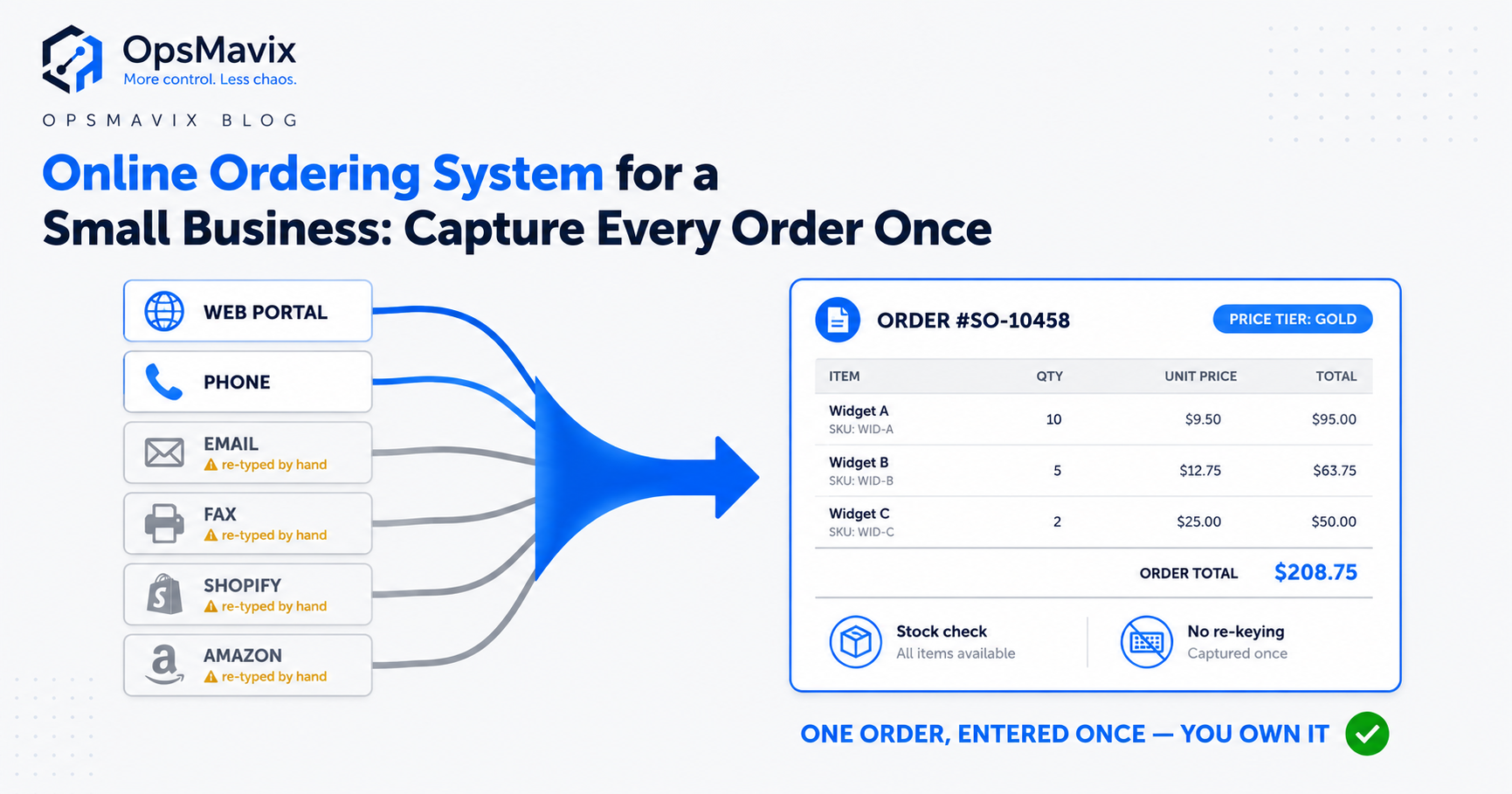
An online ordering system for a small business is the layer that captures every order once, accurately, no matter how it arrives — a customer-facing portal where buyers place orders themselves, and a structured intake that pulls in orders from phone, email, and every sales channel without anyone re-typing them. It’s not a shopping-cart button bolted onto a website. For most small businesses that sell to other businesses, or sell stock across Shopify, Amazon and eBay at once, the real job is killing the two leaks that quietly cost the most: orders re-keyed by hand (and keyed wrong), and stock that’s sold twice because no channel agrees on the count.
This post covers what an online ordering system for a small business actually is, what to look for, where off-the-shelf tools fit and where a right-sized build fits, and the specific leaks each one closes. The two flavours we cover — a B2B ordering portal and multichannel order capture — solve the same root problem from opposite ends.
Key Takeaways
- An online ordering system for small business is order capture, not just a checkout — it takes orders in once, from every channel, without manual re-keying.
- Two main shapes: a B2B self-service ordering portal (customers place their own orders), and multichannel order capture (orders from Shopify/Amazon/eBay land in one place).
- The leaks it closes are concrete: hours of re-typing orders, wrong items shipped from mis-read faxes and phone calls, and overselling stock you don’t have.
- Off-the-shelf fits when your process is standard; a right-sized build fits when your pricing, channels, or workflow are the thing that makes you money.
- Judge it on total cost — re-keying time, error credits, and lost sales add up faster than most owners expect.
1What “Online Ordering System” Actually Means for a Small Business
The phrase gets used for two different things, and confusing them wastes money. A B2C online ordering system is a checkout — a customer adds to cart and pays. That’s solved; Shopify does it. The version a small business actually struggles with is order capture for everything that isn’t a clean web checkout: trade customers who order by phone, email and fax, reps sending orders from the field in three formats, and stock sold across several marketplaces at once.
So for most small businesses, an online ordering system means one of two things. A B2B ordering portal lets your trade customers log in, see their own pricing, and place orders themselves — so the order arrives structured instead of as a photo of a handwritten note. Multichannel order capture pulls every order from every sales channel into one place, so nobody re-types Amazon orders into your accounts at midnight. Both kill the same thing: a human acting as the integration layer between how the order arrives and where it needs to go.
2Leak One: Orders Re-Keyed by Hand
This is the leak almost every small business with B2B orders is paying and barely notices, because it’s spread across the week. Orders come in by fax, email, phone, PDF, and photos of handwritten notes — and someone re-types each one into QuickBooks, Xero, or Sage. It’s slow, and worse, it’s where errors enter. One wrong item number or amount slips straight through to the customer.
One wholesaler described the daily reality plainly:
That last line is the killer: on a phone order, a mis-heard quantity gets keyed in, invoiced, picked, and shipped — with no point where anyone could have caught it. A proper ordering system removes the re-typing entirely (the customer or channel enters the order once, structured) and validates it at the source, so wrong item numbers and impossible quantities get caught before they ship. The goal operators describe is blunt: remove 90%-plus of the data inputting.
3Leak Two: Overselling Across Channels
If you sell stock on more than one channel, the second leak is overselling — selling the same unit twice because Shopify, Amazon and eBay each think it’s available. The order gets taken, then cancelled, and on Amazon a string of cancellations drags your metrics toward a suspension you can’t appeal.
A Shopify-and-Amazon seller put the trap she was stuck in this way:
She’s choosing between two losses — pull listings and lose sales, or leave them up and risk the account — because no channel shares a single, live stock count. Multichannel order capture fixes the cause: one real-time stock source every channel reads from, so you sell what you actually have, everywhere, without the nightly manual sync. The fuller version of this is in stop overselling on Shopify, Amazon and eBay.
4What to Look For in an Online Ordering System
Whether you buy or build, the same things separate a system the order desk actually uses from one it routes around:
- Captures orders once, from every channel you actually use. Portal, email, phone-to-structured, and each marketplace — not just web checkout.
- Holds your real pricing. Customer-specific price tiers, minimum order quantities, and contract pricing built in, so nobody does mental maths under pressure.
- Validates at the source. Wrong item numbers, impossible quantities, and out-of-stock lines flagged before the order is confirmed, not after it ships.
- One stock count across channels, live. So an order on one channel updates availability on all of them.
- Flows into the tools you already run. Orders should land in your accounting and pick lists automatically — re-keying anywhere defeats the point.
- Simple enough that the order desk uses it. If staff find it faster to keep using the spreadsheet, the system has failed regardless of its feature list.
A tool that does five of these and forces a manual step on the sixth just relocates the leak. The re-keying reappears at whichever edge the tool doesn’t cover. The deeper version of this for B2B specifically is in what a B2B order management system should do.
5Off-the-Shelf vs a Right-Sized Build
Off-the-shelf order tools are real and, for a standard process, often the right call — don’t build what you can buy. The trouble starts when your business has something non-standard about it, which for most established small businesses is exactly the part that makes the money: unusual pricing tiers, an odd channel mix, a workflow built around how you sell.
Off-the-shelf tools have one way of doing things, and they bend you to it. Operators describe both failure modes. The rigid kind forces a rebuild of how you work; the SaaS kind can change under you — one seller watched a tool she’d committed to get sunset: “invalidates two years worth of work.” Another described inventory software where “numbers change for no reason — phantom stock,” leaving an unexplained valuation gap. A right-sized build is the third option: scoped to how you actually take orders, owned by you outright, and maintained for you — without the per-seat creep or the rug-pull. The honest framing of when each fits is in custom inventory systems and when custom software is worth it.
Off-the-Shelf Order Tool vs a Right-Sized Build
| Off-the-Shelf Order Tool | Right-Sized Build | |
|---|---|---|
| Best when | Your ordering process is standard | Your pricing/channels/workflow are non-standard |
| Fit to how you sell | You adapt to its one way | Built around your actual flow |
| Pricing | Per-seat / per-order, rises as you grow | Fixed build (£3k–£25k range), then maintained |
| Pricing tiers / MOQs | Generic, often a workaround | Built into the order flow |
| Risk | Can be sunset or re-priced under you | You own it — no rug-pull, no lock-in |
| Re-keying | Often left at the edges it doesn’t cover | Designed out end-to-end |
| Right for | A clean, common process | “Too messy for sheets, not ready for an ERP” |
6When You Don’t Need One Yet (the Honest Bit)
Not every small business needs an ordering system. If your order volume is low, your orders genuinely arrive clean through a single web checkout, and nobody is spending real hours re-typing or chasing wrong shipments, a spreadsheet and your existing checkout are fine. Building before the leak is real is just spending money early.
You need one when the maths turns. When staff lose hours a week to re-keying, when error credits and cancelled orders become a line you’d rather not look at, when you’re pulling listings to avoid overselling — that’s the signal the manual layer now costs more than the system would. The mistake isn’t buying too late; it’s never doing the maths and assuming re-keying is just the cost of doing business. It isn’t.
FAQ
What is an online ordering system for a small business?
It’s the layer that captures every order once, accurately, regardless of how it arrives. For most small businesses that means a B2B ordering portal (trade customers place their own orders, at their own pricing) and/or multichannel order capture (orders from Shopify, Amazon, eBay and the rest land in one place). The defining feature isn’t taking payment — it’s removing the manual re-typing between how an order arrives and where it needs to go.
Isn’t an online ordering system just a Shopify checkout?
A checkout handles one path: a customer adds to cart and pays on your site. It doesn’t help with the orders that actually cause pain — trade customers ordering by phone, email and fax, reps sending orders from the field, or stock sold across several marketplaces that need a single live count. An ordering system covers those, capturing each order once and keeping channels in sync.
How much does an online ordering system cost for a small business?
Off-the-shelf tools charge monthly, usually per seat or per order, so the cost rises as you grow. A right-sized build is a fixed project — for small businesses that typically lands in the £3k–£25k range — that you then own and have maintained. Judge it on total cost, not the headline: factor in the re-keying hours, error credits, and lost sales the current setup is already costing you.
Off-the-shelf or custom — which should a small business choose?
Off-the-shelf if your ordering process is standard; don’t build what you can buy. A right-sized build when something about how you take orders is non-standard — unusual pricing tiers, an odd channel mix, a workflow specific to your trade — because that’s the part off-the-shelf tools force you to work around. The deciding question is whether the tool bends to you or you bend to it.
Will my trade customers actually use an ordering portal?
More than owners expect, once the alternative — wrong orders and slow turnaround — starts costing them too. The trick is building the portal around how they already order (their pricing, their usual items, their account) rather than a generic catalogue. And a portal doesn’t have to be all-or-nothing: phone and email orders can still be captured into the same structured system, so you remove the re-keying even for customers who never log in.
How OpsMavix Can Help
OpsMavix builds right-sized ordering systems for small businesses that have outgrown re-keying and manual sync but don’t want an off-the-shelf tool dictating how they sell. For trade and distribution, that’s a wholesale order management system — a customer ordering portal plus a single intake for phone, email and fax orders, with your real pricing built in, so orders are entered once and validated before they ship. For multichannel stock sellers, it’s ecommerce inventory automation — one live stock count across every channel so you stop overselling and stop the nightly copy-paste. Both connect to the accounting and tools you already run, and you own the system outright — no per-seat creep, no vendor that can sunset it.
If you’re not sure which leak is costing you most, start by finding it. Book an Operations Leak Audit and we’ll map where orders are re-keyed, where stock goes wrong, and what that’s costing you today — then whether off-the-shelf or a right-sized build is the genuine fit.