
Manufacturing Scheduling Software for Small Shops
You don't need a full MRP to schedule a small shop. Here's how high-mix manufacturers get a schedule that holds, without a year-long rollout or a tool the lads won't use.
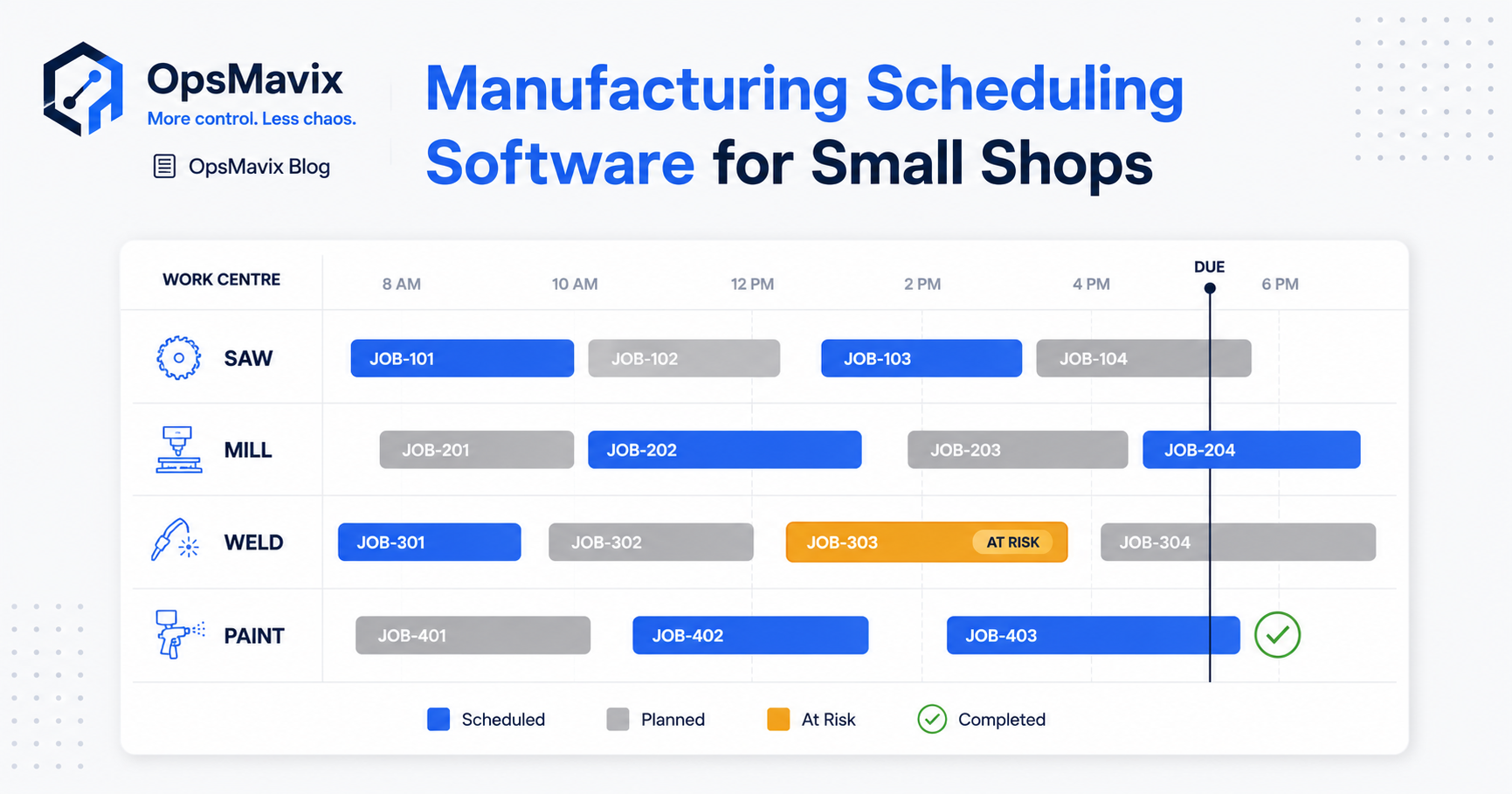
For a small shop, manufacturing scheduling software is any system that holds the running order of jobs, their due dates, and what each work centre is loaded with, so you stop running the plan from your head and a whiteboard. You do not need a full MRP to get there. A focused scheduling system built around how your floor already works does the job in weeks, not the year a heavyweight rollout demands.
Most owners get sold a false choice: keep wrestling spreadsheets, or buy a rigid MRP that bends the shop to its one way of working. There is a practical middle, and for a high-mix, low-volume shop it’s almost always the right call.
Here’s what scheduling software actually needs to do for a small shop, why MRP is usually the wrong fit, and how to start without boiling the ocean.
Key Takeaways
- Scheduling software for a small shop tracks job order, due dates and work-centre load — not the whole supply chain.
- A heavyweight MRP is usually overkill for high-mix, low-volume work, and often “as flexible as a wooden door”.
- The real failure mode is the job that falls off the plan, and you only hear about it when the customer phones.
- Start with one work centre or line, get the schedule reliable there, then expand.
- The win is a schedule the floor trusts, so adoption sticks instead of reverting to the whiteboard.
1What Scheduling Actually Means for a Small Shop
For a 10–50 person shop, scheduling isn’t the textbook finite-capacity, infinite-routing exercise the MRP vendors demo. It’s three plain questions. What’s the running order of jobs? When is each one due? What is each machine or cell loaded with right now? Get those answers in one place that stays current and you have a schedule, without the rest of the suite you’ll never touch.
The trap is reaching for software that solves planning, finance and procurement together when all you needed was a reliable order of work. That’s how shops end up paying for breadth they never use.
2Why the Whiteboard and the “47-Tab Monster” Stop Coping
The default scheduling tools in most small shops are a whiteboard and a spreadsheet that has quietly grown into “a 47-tab monster that only you understand”. Both go stale the instant a job moves. Both live in one person’s head. The owner we built this for put it plainly:
That’s the real cost of scheduling-by-whiteboard. Jobs “fall off the plan and only get noticed when a customer calls.” The board gets wiped, the sheet never gets updated, and a repeat customer rings asking where their order is, because it was never scheduled in the first place. Then there’s the fragility: “the 3 AM panic when formulas break before a board meeting”, with one file the whole business balances on. (For the whiteboard-versus-software case in full, see factory scheduling software vs the whiteboard.)
3Why a Heavyweight MRP Is Usually the Wrong Fix
MRP gets sold as the grown-up answer, but small high-mix shops keep bouncing off it for the same reasons. The tools are rigid. One shop owner called a niche MRP “as flexible as a wooden door”; another warned you’ll “still have manual input… despite paying high dollars.” So the floor quietly goes back to the whiteboard and the spend is wasted.
Then there’s the pricing trap. One manufacturer watched a niche MRP increase prices “by 523% since we started… punitive, not proportional… not sustainable for a real small manufacturer.” You don’t outgrow the tool. The tool outgrows your willingness to pay for it.
Our view: for high-mix, low-volume work, a rigid MRP that forces “almost every procedure” to change is a downgrade dressed up as an upgrade. The software should fit the shop, not the other way round. (We make that case in full in operational systems vs ERP, and weigh it as a buying decision in factory management software: build vs buy.)
4The Real Goal: A Schedule the Floor Trusts
A schedule only works if the floor believes it. The moment operators learn the board is wrong, they stop looking at it and go back to asking around. So the target isn’t a clever algorithm. It’s a live, accurate order of work that updates as jobs move and that the floor actually uses.
That means scheduling and visibility belong together. Tracking where each job sits on the floor is what keeps the schedule honest, which is why scheduling sits right next to live production tracking. The two reinforce each other. (More on the visibility side in why stock never matches the system, where the same stale-data problem bites.)
5Spreadsheet vs MRP vs a Focused Scheduling System
| Whiteboard / spreadsheet | Heavyweight MRP | Focused scheduling system | |
|---|---|---|---|
| Fit for high-mix | Stretched to breaking | Rigid, “one way” | Built around your floor |
| Stays current | Stale on the next move | If everyone updates it | Updates as jobs move |
| Setup time | “Free” but fragile | Months to a year | Weeks, one area first |
| Cost | Hidden in lost jobs | £100k+ with hikes | Fixed scope, £k |
| Who can use it | One person | The lads resist it | The floor adopts it |
| Ownership | A file in your head | Renting the platform | Yours, no lock-in |
6Start With One Work Centre, Not the Whole Factory
Don’t try to instrument the whole shop on day one. That’s the MRP mistake that takes a year. Pick the bottleneck cell, or the line where the ball-drops hurt most, get a reliable schedule and live job status working there, and prove it. A focused first step lands useful scheduling in weeks, and because it fits how that cell already works, the floor adopts it instead of reverting. Material and despatch can connect later through your stock and reporting systems once the schedule itself is solid.
FAQ
Do I need a full MRP to schedule a small manufacturing shop?
No. An MRP plans materials, finance and procurement together, and makes you implement all of it. For a small high-mix shop, the schedule itself — job order, due dates and work-centre load — can be delivered as a focused system without that scale of rollout or cost.
What should small-shop scheduling software actually track?
The running order of jobs, each job’s due date, and what each machine or cell is loaded with, kept current as jobs move on the floor. Get those reliable first. Finite-capacity planning and optimisation can come later, if ever.
Will the people on the floor actually use it?
That’s the whole design goal. The common complaint about MRP is that it’s rigid and the floor won’t touch it, so the schedule rots. A system built around how the cell already works, updated in seconds as jobs move, is one the floor trusts and keeps using.
How is this different from the spreadsheet we use now?
A spreadsheet goes stale the moment a job moves, and usually lives in one person’s head. A focused scheduling system stays current as work progresses, is visible to the floor, and isn’t one fragile file the whole business balances on.
How long until we have a working schedule in place?
Starting with one work centre or line, a useful, trusted schedule lands in weeks, not the many months a full MRP implementation typically takes before you see any return.
How OpsMavix Can Help
OpsMavix builds custom scheduling and production tracking systems for small and mid-sized manufacturers: job order, due dates and work-centre load on one screen, kept live as jobs move, without a £100k MRP and without forcing your shop to change how it works. We start with one area, prove the schedule, then expand.
If jobs are falling off the plan and you only hear about it when the customer calls, that’s a scheduling leak costing you rush jobs, overtime and trust. Book an Operations Leak Audit and we’ll map where your schedule loses jobs.