
Kardex vs a Custom Inventory System: Which Do You Need?
Automated storage hardware solves retrieval. A custom inventory system solves the gap between the shelf and the screen. Here's the honest comparison and how to choose.
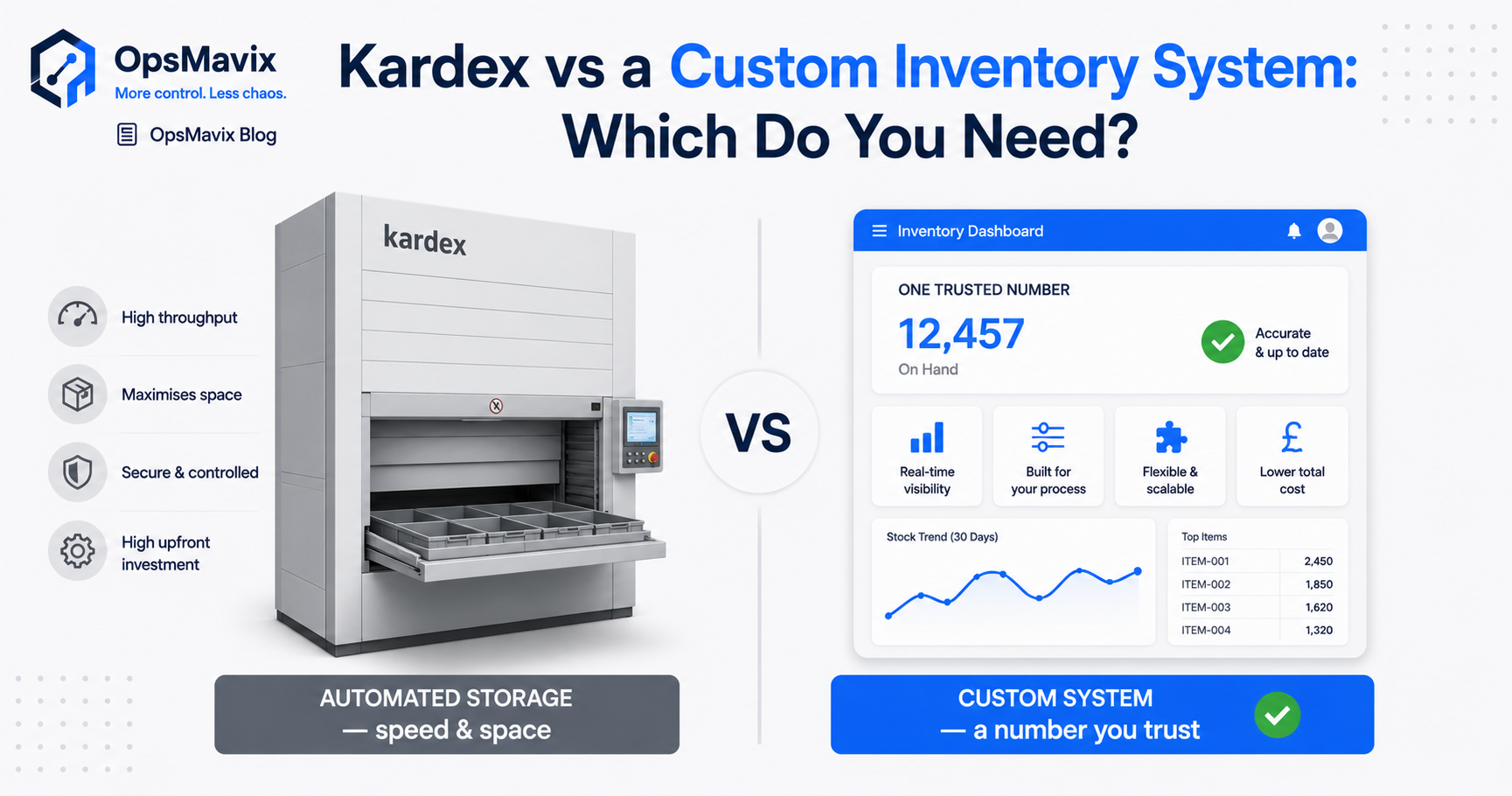
Kardex and a custom inventory system fix two different problems, so the answer depends on which one is actually costing you money. Kardex and automated storage like it make retrieving stock faster: the unit brings the item to the picker instead of the picker walking to the item. A custom inventory system makes the number trustworthy, by capturing every movement so the figure on screen matches the shelf.
So pick by the bottleneck. If your people walk miles a day to pick, automated storage earns its place. If your problem is a stock figure nobody believes, no hardware fixes that, because the cause was never how fast you retrieve. Here’s the honest comparison, and how to tell which one your operation needs.
If the numbers are the issue, start with why stock never matches the system.
Key Takeaways
- Kardex automates storage and retrieval. Its value is space and pick speed, not data accuracy.
- A custom inventory system captures every movement so one live figure stays trustworthy.
- These are different leaks: one is a throughput problem, the other a trust problem.
- Buying hardware to fix a data problem just lets you mis-count faster on a tidier shelf.
- For most growing businesses the system comes first, and it’s the cheaper, more flexible call.
1What Kardex Actually Does Differently
Automated storage and retrieval systems like Kardex change the physical side of the warehouse. Rather than staff walking aisles, the unit holds items in a compact tower or carousel and delivers the right tray to an operator at a fixed station. Goods to person, instead of person to goods. The genuine wins are floor space and pick speed: more stock in less square footage, faster picking because nobody is walking.
That’s a real benefit for the right operation. But notice what it leaves untouched: whether the figure your system holds is correct. Automated retrieval moves stock more efficiently. It does not reconcile the count when a return gets restocked off the books, or a unit is written off in someone’s head.
2What a Custom Inventory System Does Differently
A custom inventory system is software built around how your business actually moves stock. Goods received, picked, transferred, returned, written off, each captured against the right SKU, in real time, in one place you own. The point isn’t retrieval speed. It’s a single live figure that stays honest because nothing happens to your stock without the system knowing.
Off-the-shelf tools force you to work their way. A custom build maps to your real process: your locations, your channels, your suppliers. Adoption is natural and the number reflects reality. If you want the bigger picture first, here’s operational systems versus a full ERP.
3The Problem Each One Is Sold to Solve
This is where buyers get crossed wires. Automated storage is sold to a manager drowning in wasted footsteps and cramped racking, a real, physical pain. A custom system is sold to a manager who can’t trust the screen.
Plenty of operators reach for the shiny option to solve the wrong pain. One MD told us, after recoiling from a six-figure enterprise quote: “QBO is too small, NetSuite’s too expensive. Where’s the middle ground I actually own?” The instinct is to throw capital at the most impressive fix, when the real leak is a stock figure that drifts the moment you look away. A faster, tidier shelf with a wrong number on it is still a wrong number.
4Cost and Commitment: Capital Hardware vs Scoped Software
Automated storage is significant capital plant. You install it, maintain it, and live with it for years; moving or reconfiguring it is a project on its own. That can be the right investment when retrieval is genuinely your bottleneck. It’s a heavy commitment to make before you know whether speed is even the problem.
A custom inventory system is scoped software, sized to the specific leak you’re closing. That’s the middle a lot of growing businesses are hunting for. They feel stuck between the tool they’ve outgrown and the enterprise quote that would have them paying for functions they’d never use. A scoped build is that middle: pay for what fits, own it outright, no per-seat tax, no partner you’re hostage to.
5Flexibility: Fixed Machinery vs Built Around You
The deeper difference is how each one bends. A physical storage unit has a fixed footprint and a fixed way of working. Your process has to fit the machine, and when your business changes, the machine doesn’t.
A custom system is the opposite. It’s built around how your team already works, and it changes when you change. Add a sales channel, a second location, a new supplier feed, and the system adapts because it was made for you, not bought as a fixed shape you reshape your operation around. That matters most for businesses still finding their footing, where this year’s workflow won’t be next year’s. Same logic as the RFID question: the hardware is the last 10%, the data system is the 90%.
6When Kardex (or Any Automated Storage) Genuinely Earns Its Place
This isn’t anti-hardware. It’s right-tool-for-the-job. Automated storage stops being a gadget and starts paying for itself when:
- Walking time is a measured bottleneck. Pickers spend more of the day moving than picking.
- Floor space is scarce and expensive. Going vertical buys capacity you’d otherwise rent.
- Pick volume is high and frequent. The speed gain compounds across thousands of picks.
- Your stock data is already trustworthy. Faster retrieval works off a number you believe.
That last point is the gate. If your figure drifts, automated storage just delivers the wrong tray faster. Fix the data, then decide whether speed is your next constraint.
7The Order That Usually Wins: System First, Hardware Later
For most growing operations, the upgrade that moves the needle isn’t a storage tower. It’s making every stock movement update one shared, live figure the moment it happens, in a system you own. Get that right and two things follow. Your numbers become trustworthy on hardware you already have. And if you later hit the genuine automation band, you’re bolting speed onto a clean system instead of pouring it into a leaky one.
Do it the other way round and you’ve made an expensive bet that retrieval was the problem, while the screen still can’t be trusted. The connected inventory system is the foundation. Automated storage is a speed upgrade you earn the right to buy.
FAQ
Is Kardex better than a custom inventory system?
They aren’t competing for the same job. Automated storage like Kardex improves retrieval speed and floor-space use; a custom inventory system improves the accuracy and visibility of your stock figure. If your problem is walking and space, hardware helps. If it’s a count you can’t trust, only the system fixes it.
Will automated storage fix stock that never matches the screen?
No. A drifting figure usually comes from movements that never reach the system: returns restocked off the books, write-offs done in someone’s head, transfers nobody logged. Faster retrieval doesn’t capture those. A connected system that records every movement does.
Which is cheaper, automated storage or a custom system?
A scoped custom inventory system is usually the lighter, more flexible spend: software sized to the specific leak, owned outright, with no fixed machinery to install or relocate. Automated storage is capital plant that earns its cost only when retrieval speed is genuinely your bottleneck.
Can I have both Kardex and a custom inventory system?
Yes, and that’s often the right end state. The sequence matters. Get the system capturing every movement first so the number is trustworthy, then add automated storage if pick speed becomes your next real constraint. Speed on top of clean data compounds; speed on top of a leaky count just hides the leak.
How do I know which one I actually need?
Name the pain. If staff walk miles and racking is full, retrieval is your bottleneck, so look at storage automation. If you oversell, sit on dead stock, or count twice because the figure can’t be trusted, that’s a data problem a custom system solves, and no hardware will.
How OpsMavix Can Help
OpsMavix builds custom inventory systems that make every movement, goods received, picked, transferred, returned, written off, update one live figure the moment it happens, on hardware you already trust. We’d rather make your stock number honest than watch you spend capital making a wrong count move faster. If automated storage genuinely fits your volume and space, you’ll be adding it to a clean system, and you’ll own that system outright, sized to the business you run now.
If you can’t trust your stock figure, that’s a measurable operational leak: oversells, dead stock, and hours spent counting twice. Book an Operations Leak Audit and we’ll map where your accuracy actually breaks down, and whether any hardware would change anything.