
Inventory Software for Construction: Track Materials Across Every Site
Inventory software for construction has to think in sites and jobs, not one warehouse. This guide shows how site-aware stock and plant tracking, tied to job costing, stops materials being bought twice, for firms outgrowing spreadsheets and disconnected tools.
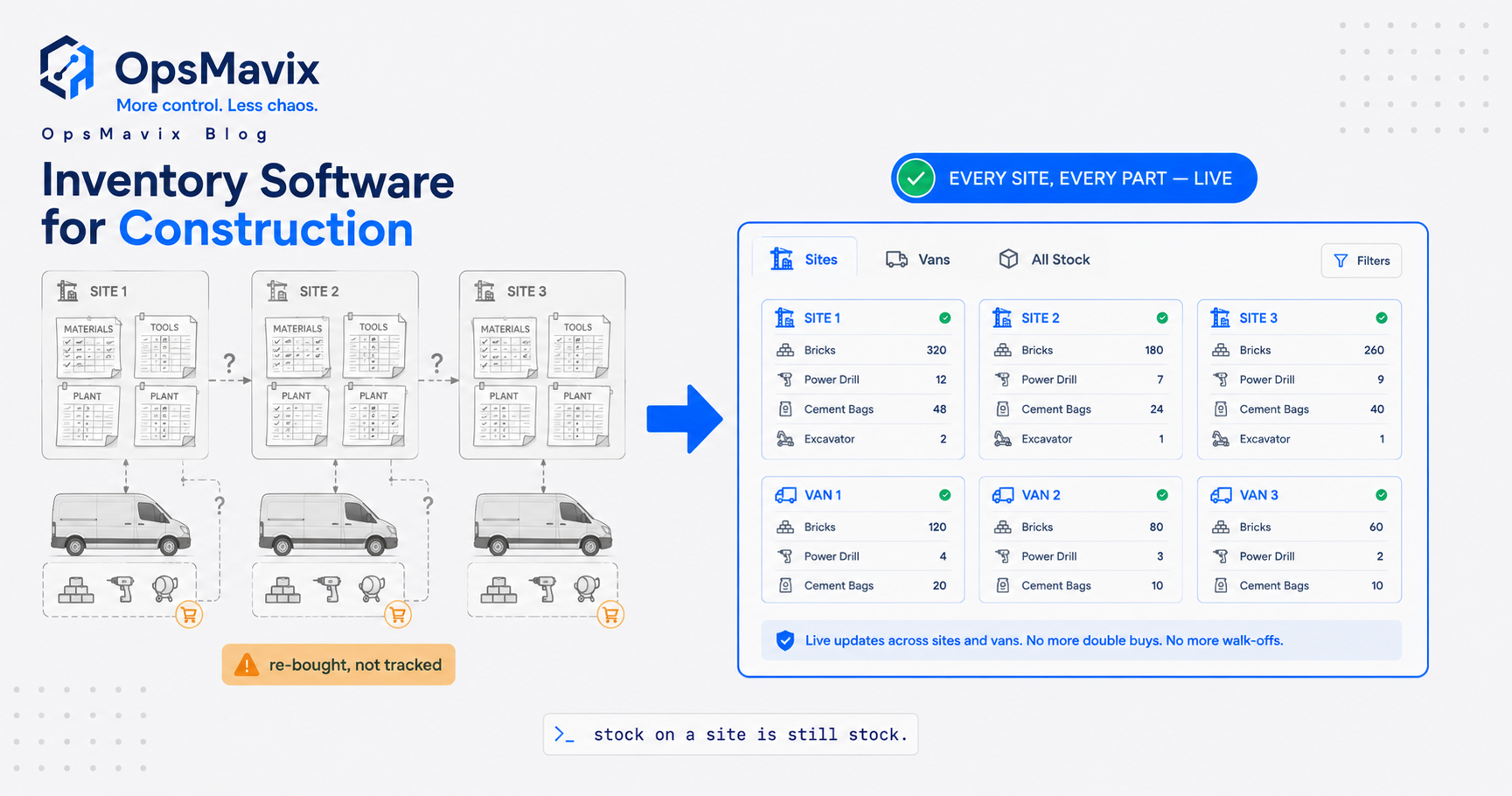
Construction inventory is not one pile in one building. It is timber on a plot in Reading, a compactor that was on the Slough job last week, a pallet of fixings someone signed for but nobody can find, and a delivery of blockwork that the site foreman swears never turned up. Generic warehouse software assumes a single location with neat aisles. Construction assumes the opposite: stock moves between sites, plant walks, and the count that matters is not “how much do we own” but “what is on which job, right now, and who authorised it there.”
That gap is where the money leaks. When you cannot see stock by site, you buy materials you already have on another plot. When plant is not booked in and out against a job, it sits idle, gets hired again, or disappears. Inventory software for construction exists to close that gap: to track materials, tools and plant across every site and tie each movement back to the job it belongs to. This guide is about that job-aware discipline, not about generic bin cards.
What inventory software for construction actually does
At its core it does four things a spreadsheet cannot hold together for long.
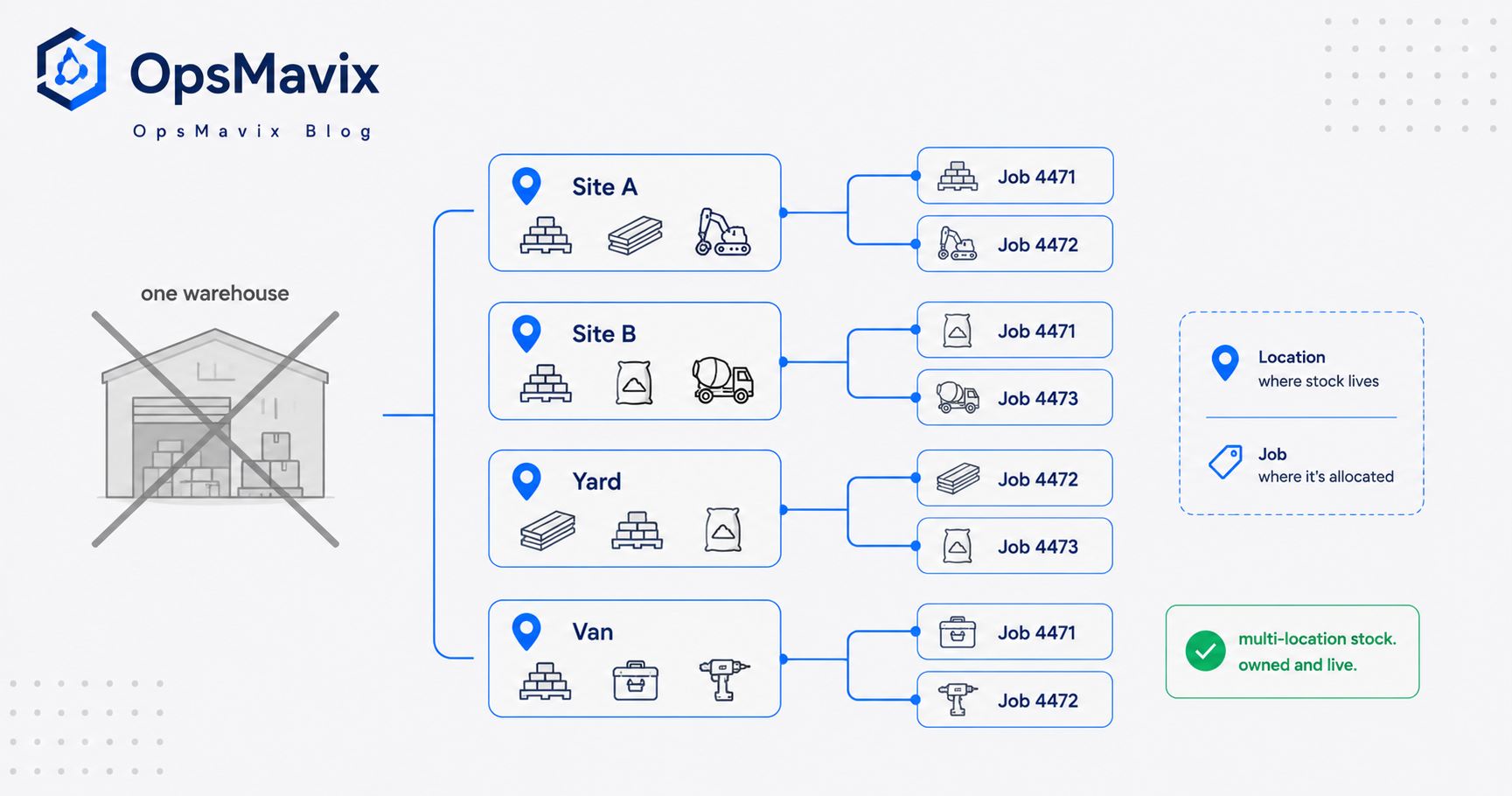
It tracks stock by location, where a location is a live site, a yard, a container, or a van, not a single warehouse. A delivery of insulation is not just “in stock”, it is on the Maidenhead plot, booked against job 4471. It records movements between sites, so when the plasterboard moves from the yard to a plot, the count follows it and both places stay accurate. It controls tools and plant as trackable assets, booked in and out against jobs and people, so an excavator is never just “somewhere”. And it allocates cost to jobs, so materials issued to a job land on that job’s cost sheet automatically, instead of being reconciled from a pile of delivery notes months later.
The difference from a warehouse app is the unit of thought. Warehouse software answers “how many do we have”. Construction inventory software answers “what is committed to which job, at which site, and what did it cost that job”. That second question is the one that decides whether a project made money.
The leak: bought twice, and plant that walks
Two leaks dominate, and both are invisible without site-aware tracking.
The first is materials bought twice. Without a live count per site, the buyer cannot see that job A already has forty bags of ballast sitting on the plot, so they order forty more for job B rather than move what exists. Multiply that across a dozen active sites and a hundred SKUs and the waste is quiet but constant. It shows up later as skips full of unused product. The designingbuildings.co.uk construction waste guidance attributes waste partly to “materials that are surplus to requirements (as a result of over-ordering or inaccurate estimating)” and cites a Technology Strategy Board figure that 13% of products delivered to construction sites are sent directly to landfill without having been used. That is not just an environmental cost. It is materials you paid for that never touched the build.
The second is plant and tools that walk off site. Some of that is theft, and the theft numbers are brutal. Reported tool theft in the UK rose 16% in a year to nearly 31,000 incidents, worth close to £19m, at an average of £610 per offence, on Monster-Mesh figures drawn from police Freedom of Information requests. Broader estimates put construction site theft at over £1bn a year, with 92% of firms hit and average plant losses in the tens of thousands per incident. But a large slice of “lost” plant is not stolen at all. It was moved to another site by a crew who did not tell anyone, left off a return, or hired in again because nobody could confirm the firm already owned one that was idle. An asset register that nobody keeps current is how a business hires a mixer it already has parked forty minutes away.
Neither leak is dramatic. Both are structural, and both come from the same root: stock and assets that are not tied to a site and a job.
Why one-warehouse software breaks on a construction site
Most cheap inventory tools are built on one silent assumption: there is a warehouse, and stock is in it. That assumption falls apart the moment your stock is spread across live sites.
A warehouse app treats a stock transfer as an edge case. Construction treats it as the main event, because materials are almost always moving from a yard or supplier to a plot, between plots, or back to store. If the software cannot hold a running count per site and log the transfer between them, your team stops trusting it within a fortnight and goes back to WhatsApp and memory. Then the count is fiction.
A warehouse app also has no concept of a job. It knows a SKU and a quantity, not that those forty sheets of ply were issued to the Bracknell refurbishment. Without the job link, you cannot answer the question that runs a construction business: did this project cost what we quoted. You end up rebuilding cost from delivery notes and gut feel after the job is done, which is exactly when the information is useless. This is the same failure that pushes firms off a parts-tracking spreadsheet once the sites and job codes multiply beyond what a grid can hold.
Site-aware stock software is not a nice-to-have layer on top of a warehouse tool. It is a different shape: locations that are sites, transfers as routine, and every issue tagged to a job.
Tool and plant control across every site
Materials get consumed. Tools and plant get used and returned, which is a different tracking problem, and one warehouse software rarely handles well.
Plant control means booking an asset in and out against a job and a person, so at any moment you can see where every excavator, mixer, generator and dumper is, and which job is carrying its cost. It means an asset register that is actually current, with serial numbers, service dates and, for the high-value kit, a link to a GPS or CESAR marking. Adoption of that kind of tracking is climbing across the sector precisely because the losses forced it, but a tracker on the machine only helps if the office record it feeds is kept live.
The payoff is threefold. You stop double-hiring kit you already own but could not locate. You cut theft losses, because a booked-out asset that does not come back is flagged the same week, not at year-end. And you get honest plant cost per job, because idle time and cross-hire show up against the project that caused them. A shovel left on a finished site is a small loss. A 13-tonne excavator hired for six weeks because nobody logged that the firm’s own machine was standing idle is a serious one.
Consumable tools sit in the middle: too valuable to ignore, too numerous to serialise individually. The practical answer is to track them by van and by site as small stock locations, so a kit shortfall shows up as a variance rather than a mystery, and the person who signed for the batch is on record.
Cheap tool vs full ERP vs a right-sized owned system
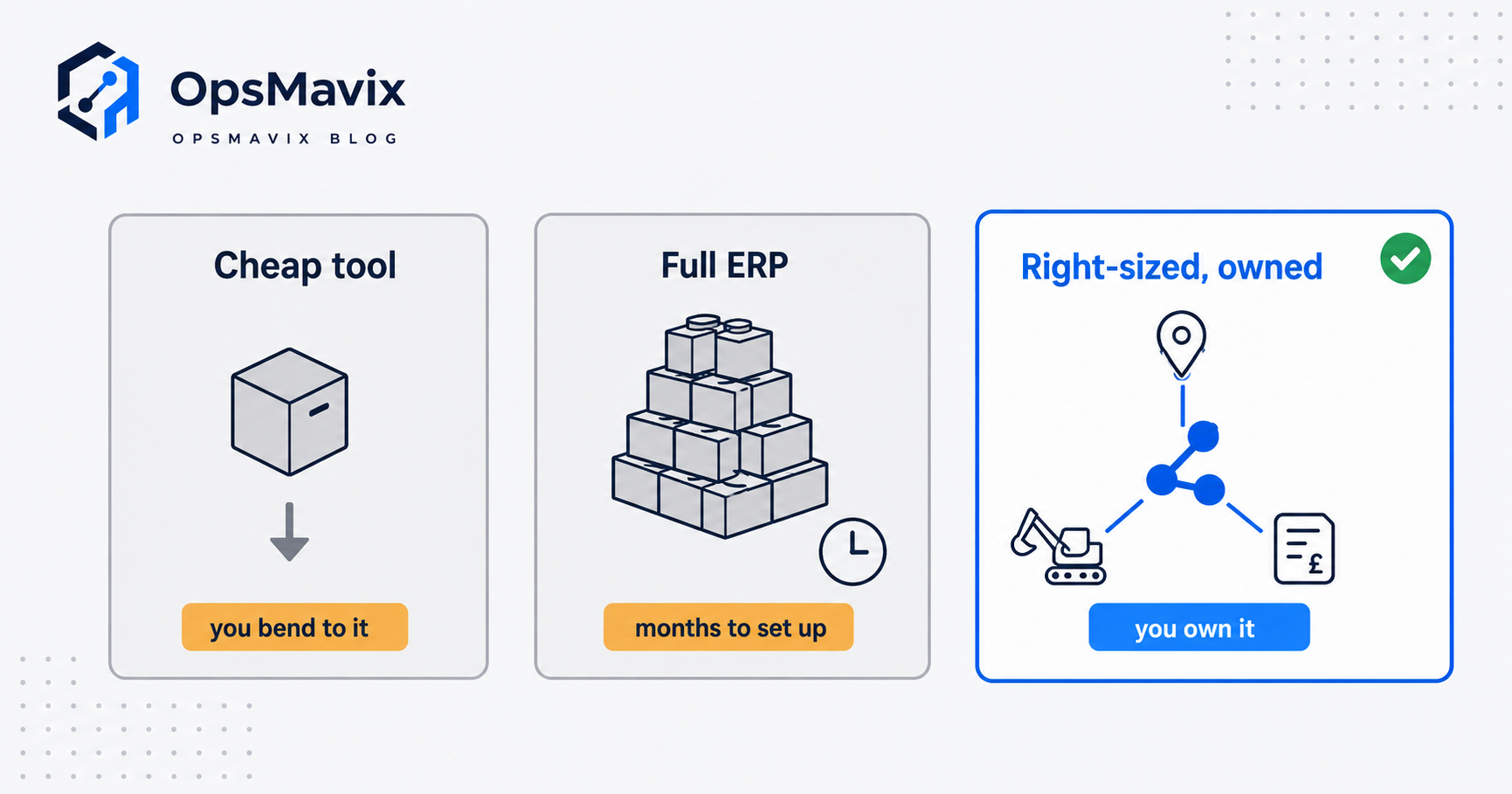
Three honest routes, and the right one depends on how many sites you run and how tangled your job costing is. Be fair to all three.
| Cheap / generic tool | Full construction ERP | Right-sized owned system | |
|---|---|---|---|
| Best for | One yard, few sites, simple stock | Large contractor, many divisions, deep finance | The “outgrowing spreadsheets and disconnected tools” middle |
| Site awareness | Usually one location; transfers awkward | Full multi-site, but generic and heavy | Built around your sites, yards and vans |
| Plant and tools | Basic asset list, if any | Comprehensive plant module | Exactly the booking and register you use |
| Job cost link | Weak or none | Deep, but you conform to its structure | Materials and plant flow to your job sheets |
| Setup time | Hours to days | Many months, often with consultants | Weeks, built around how you already work |
| Cost shape | Low monthly per-seat fee | High licence, per-module, per-seat, forever | One build cost, then you own it |
| Fit to your process | You bend to the tool | You bend the business to the ERP | The system bends to you |
| Expandable later | Limited; you outgrow it | Already vast | Yes, grow it toward a full ERP when you need to |
The cheap tool is genuinely fine if you run one yard and a couple of sites with simple stock. Do not overspend to solve a problem you do not have. The full construction ERP does everything, and for a large contractor with multiple divisions that breadth is worth it, but you pay with a long implementation, per-seat fees that never stop, and processes reshaped to fit the software. The right-sized owned system is for the firm in the middle: enough sites and job codes that spreadsheets have broken, but not so much complexity that a six-figure ERP is justified to fix what is really a tracking problem. You buy the site-aware control and plant register you actually need, tie it to your job costing, own it outright, and expand it later.
Integrations, job costing and why ownership matters
Construction inventory is only useful when it connects to the money. The count needs to flow to job costing so material and plant issues land on the right project. It needs to connect to purchasing so goods received update the site count without re-keying. And it needs to reach your accounts so stock value and job cost reconcile without a manual double entry where errors breed.
This is where ownership earns its keep. With a cheap tool you get the integrations the vendor chose to build, and when they retire one or change their pricing, that is your problem mid-project. With a full ERP, integration is possible but slow and often billable. With an owned system, the links are built around your actual stack: your supplier accounts, your accounting software, your job-costing sheets, and the view your commercial team already lives in. Nobody deprecates a connection you depend on, and nobody raises the per-seat price because you won three new contracts and hired ten people. The system is an asset on your side of the table. Feeding a live project operations dashboard from that owned stock and plant data is what turns tracking into decisions, because the commercial team can see cost against budget per job while the job is still live, not after it closes.
A worked example: a regional groundworks firm
Illustrative, not a claim about a specific client.
A groundworks contractor in the South East turns over about £4.2m a year across seven to nine live sites at any time, plus a yard and a fleet of vans. Materials are ordered by whoever spots the shortfall, plant is booked by phone and text, and job cost is pieced together from delivery notes after each project closes. It works, until it does not.
Three leaks kept recurring. Buyers over-ordered because they had no live view of what was already on other plots, and the firm was skipping a steady stream of unused product, broadly consistent with the sector pattern of materials delivered but never used. They double-hired plant twice in a year, once a mixer and once a dumper, because nobody could confirm their own idle unit’s location, at a combined cost of roughly £11,000 in avoidable hire. And every project’s true material and plant cost only became clear weeks after completion, so a job that quietly lost margin was not caught until the next quote had already gone out on the same bad numbers.
They rejected a full ERP: a six-figure commitment and months of disruption to fix what was really a tracking and job-cost problem. They rejected staying on spreadsheets too, because those could not hold a per-site count or a live plant register across nine locations. They chose a right-sized owned system: live stock by site and van, transfers logged between plots, a plant register with book-in and book-out against each job, and material and plant issues flowing straight onto job cost sheets feeding one operations dashboard.
The rough numbers, one year on. Over-ordering fell sharply once buyers could see stock on every plot before raising an order, cutting an estimated £18,000 of wasted materials and skip cost. Double-hiring stopped, saving the recurring five-figure hire waste. Most importantly, live job cost meant two loss-making job types were caught and repriced mid-year rather than a year late. Against a mid-five-figure build the firm owns outright, the tracking paid for itself well inside the first year, and the biggest gain was the one that never hits a write-off line: quotes built on real cost instead of hopeful cost.
FAQ
How is inventory software for construction different from normal warehouse software?
Warehouse software assumes one building and answers “how many do we have”. Construction software assumes stock is spread across live sites and vans, treats transfers between them as routine, tracks tools and plant as booked assets, and ties every issue to a specific job so you get true cost per project. The unit of thought is the job and the site, not the shelf.
We already use a spreadsheet per site. Isn’t that enough?
If you run one yard and a couple of simple sites, a spreadsheet or a cheap app is genuinely fine. It breaks once you have several live sites, plant moving between them, and job costing that has to be rebuilt from delivery notes after the fact. That is when you are buying twice, losing plant, and quoting on numbers you cannot trust.
How does it stop us buying materials we already have?
By holding a live count per site and van, so before a buyer raises an order they can see the ballast already sitting on another plot and move it instead. Without that per-site view, every buyer orders in isolation and the surplus ends up in a skip.
Can it track tools and plant, not just materials?
Yes, and that is often the bigger win. Plant and high-value tools are tracked as assets booked in and out against a job and a person, with a current register including serial numbers and service dates. That stops double-hiring kit you already own, flags anything that does not come back the same week, and puts idle-plant cost on the job that caused it.
Will it connect to our job costing and accounts?
A right-sized owned system is built to connect to your actual stack: purchasing, your accounting software, and your job-cost sheets. Material and plant issues flow onto the right job automatically, so cost against budget is visible while the job is live, not weeks after it closes when the information is too late to act on.
How OpsMavix can help
OpsMavix builds right-sized, owned operations systems for UK businesses that are outgrowing spreadsheets and disconnected tools. If your firm buys materials it already owns, loses plant between sites, or only learns a job’s true cost weeks after it closes, we start by finding exactly where the tracking leaks, then build the smallest system that stops it: live stock by site and van, transfers logged between plots, a plant register booked against jobs, and material and plant cost flowing straight onto your job sheets. You own it outright and expand it toward a full ERP only when your business genuinely needs more. Book a Free Operations Leak Audit
Sources
- Designing Buildings Wiki, Construction waste: materials surplus to requirements from over-ordering and inaccurate estimating, and the Technology Strategy Board figure that 13% of products delivered to sites are landfilled without being used.
- InsightDIY, Reported Tool Theft Surged 16% in 2025: Monster-Mesh analysis of police FOI data showing tool theft rising to nearly 31,000 incidents, close to £19m, at £610 average per offence.
- Veritech Security, UK Construction Site Theft Statistics 2025: construction site theft over £1bn a year, 92% of firms affected, and average plant theft losses of around £45,000 per incident.
Getting value from OpsMavix? Add us as a preferred source on Google — you'll see more of our operations content in your AI Overviews, AI Mode and Search.