
Factory Scheduling Software vs the Whiteboard
A whiteboard tells you the plan. It never tells you the truth. Here is what factory scheduling software actually changes for a high-mix shop, point by point, without a £100k ERP.
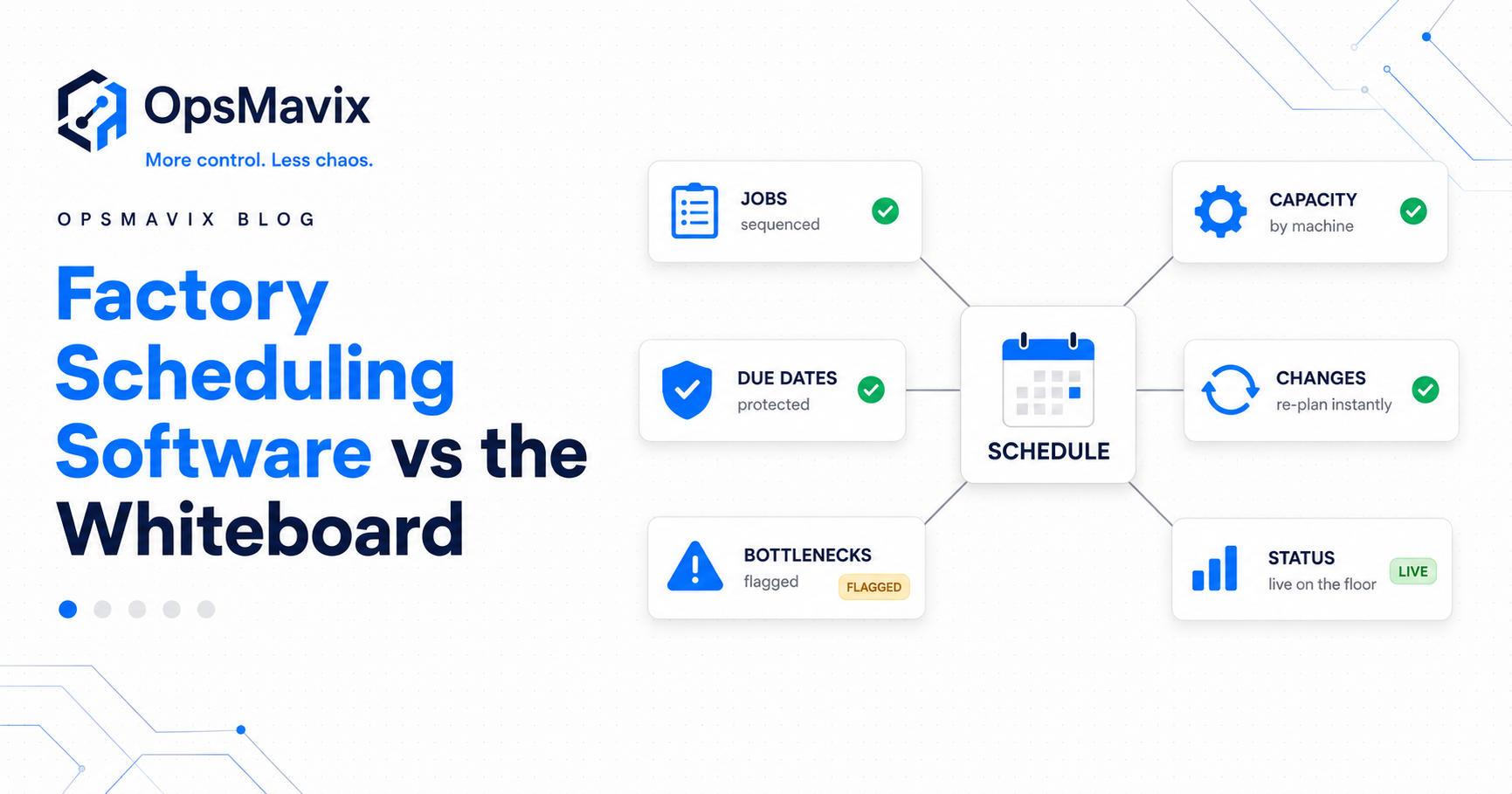
Factory scheduling software replaces the whiteboard and the spreadsheet with one live view of every job: its stage, its due date, and what is at risk. It stays current as the floor moves instead of going wrong the moment someone wipes the board. For a high-mix shop of 10 to 50 people, the win is not clever planning maths. It is never again hearing that a job has slipped from the customer before you hear it from your own system.
The whiteboard is not the enemy because it is low-tech. It is the enemy because it goes stale by mid-morning and nobody walks back across the floor to fix it. A spreadsheet is the same problem with more tabs. Below is what a real scheduler changes, what it leaves alone, and why none of it needs an enterprise ERP.
Key Takeaways
- A whiteboard shows the plan; scheduling software shows what is actually happening now.
- The leak it closes: jobs that silently fall off the plan and only surface when a customer rings.
- It can capture labour and materials against the job, so you finally see quote versus actual instead of guessing.
- You do not need a £100k ERP. A focused system on top of how your floor already runs does this.
- Start with one value stream, prove it, then expand. A forced full rollout is what the lads revolt against.
1Why the Whiteboard Goes Stale by Mid-Morning
A whiteboard is honest at 7am. By 10am a setup has overrun, a rush job has jumped the queue, and an operator has moved to a different cell. None of that reaches the board, because updating it means stopping a job and walking back across the shop. So the only accurate status sits in someone’s head. That is exactly the trap one owner described: “the entire shop is run from my head, and the first I hear a job’s slipped is when the customer phones.”
The board did not fail because it is a piece of melamine. It failed because it cannot keep pace with a shop that changes by the hour.
2The Silent Ball-Drop a Whiteboard Cannot Catch
This is the pain that costs real money. A repeat customer rings to ask where their order is, and your stomach drops, because it was never scheduled. It “fell off the plan and only got noticed when a customer calls.” The board was wiped. The sheet was never updated. Now you are scrambling a rush job, eating the overtime, and apologising to someone who used to trust you.
Worse than the late job is the wrong job. Run from a stale board, a shop ends up with “costly mistakes, missed orders, manufactured the wrong parts” — scrap and rework that nobody planned for. A scheduler closes this gap because a job is not a line on a wall you can erase. It is a record with a due date the system actively watches, so a late or unscheduled job gets flagged before the deadline rather than discovered after it.
3What “Scheduling Software” Means for a High-Mix Shop
For a high-mix, low-volume shop, this is not the MRP fantasy of perfectly optimised, infinite-capacity planning. It is plainer and more useful: every work order in one place, in the order you intend to run it, each with a due date, a stage, and a status that updates as the job moves. That is production tracking and scheduling working as a single view.
You are not trying to automate the decision of what to run next. You are the expert; that call is yours. You are trying to make that call against reality instead of a board that went stale two hours ago. If you are comparing tools rather than the whiteboard, manufacturing scheduling software for small shops covers the MRP-versus-focused-system decision.
4It Also Tells You Whether the Quote Was Right
Here is the part owners underrate. Once labour and materials are captured against each work order, scheduling stops being a planning board and starts answering the question that quietly decides your margin: how close was the quote to the actual? Today that stays a guess, so you quote partly blind and find out months later whether the job made money.
Most factory floors already have the data; it just lives in someone’s head, on a job card, or in a tab nobody reconciles. Pin it to the job and you quote the next one with real numbers, not optimism. That is the difference between a schedule and a live operations view.
5Whiteboard and Spreadsheet vs Factory Scheduling Software
| Whiteboard / spreadsheet | Factory scheduling software | |
|---|---|---|
| Accuracy | Stale by mid-morning | Current to the last update on the floor |
| “Where’s job X?” | Walk the floor and ask | One screen |
| Late jobs | Found after the due date | Flagged before it |
| Jobs falling off the plan | Surface when the customer rings | Cannot silently disappear |
| Owner of the truth | One head, one fragile file | A system the whole shop reads |
| Quote vs actual | A guess afterwards | Labour and material captured against the job |
A spreadsheet feels like a step up from the board, right up until it becomes “a 47-tab monster that only you understand” — and then it is a bus-factor risk, not a tool. Ask the owner who has lived through “the 3 AM panic when formulas break before a board meeting.” The spreadsheet never beat the whiteboard. It just made the single point of failure harder to read. Stock drifts the same way for the same reason, which is the subject of why your stock never matches the system.
6Why You Do Not Need an ERP to Schedule Jobs
The reflex is that proper scheduling means a proper ERP. That is a sledgehammer for this nail, and most off-the-shelf manufacturing tools earn their bad name right here. Owners who have trialled them describe paying “high dollars” and still doing “manual input,” with software “as flexible as a wooden door” that forced them to change “almost every procedure” to fit one rigid way of working. The lads quietly drift back to the whiteboard, and now you are more cynical than before you spent the money.
Our view at OpsMavix: scheduling visibility should be built around how your floor already runs — your stages, your job-card logic, your high-mix reality — not bolted on from a SaaS that assumes you will reshape the shop to suit it. It is one piece of the wider factory management software build-vs-buy decision. A focused system gives you a live schedule in weeks, and the floor adopts it because it matches what they already do. Stock and despatch connect later through your inventory and order systems, when you are ready and not before.
7Start With One Value Stream, Not the Whole Factory
Do not try to instrument every cell on day one. Pick one product line or the bottleneck cell where the ball-drops hurt most. Get live job order, due dates and status working there, prove it, then expand. A win the floor trusts beats a rollout they resist, and it sidesteps the “sold a dream and left to drown” disaster that scares every owner who has watched a big rollout stall. You feel the relief this quarter, not the year after next.
FAQ
Is a whiteboard or spreadsheet ever enough for factory scheduling?
For a handful of jobs a week, sometimes. Once you are high-mix with jobs moving between cells daily, the board goes stale faster than anyone can keep it updated, and that is when jobs start quietly falling off the plan. The clearest signal you have outgrown it is hearing about slipped jobs from customers rather than from your own system.
Do I need a full ERP to get real factory scheduling?
No. A full ERP bundles finance, procurement and HR and makes you implement all of it. Live job order, due dates and status can be delivered as a focused system built around your work orders, without a six-figure, year-long rollout.
Will operators actually use it, or go back to the whiteboard?
They use it when it is built around how they already work and takes seconds to update, with a simple station at each cell. Tools fail adoption when they force the floor to change every procedure to suit rigid software. Fit the system to the shop and the board stays wiped for good.
Can scheduling software tell me my real job costs?
Yes, once labour and materials are captured against the work order. You can then see how close each quote was to actual instead of guessing, which is what stops you quoting your margin away job after job.
How long until we have a working schedule in place?
Starting with one value stream, a useful live schedule lands in weeks, not the many months a full ERP implementation typically takes. You expand to other lines once the first one is trusted.
How OpsMavix Can Help
OpsMavix builds custom factory scheduling and production tracking systems for small and mid-sized manufacturers: live job order, due dates, WIP, late-job flags and quote-versus-actual against your work orders, built around how your floor already runs, without a £100k ERP, starting with one value stream.
If the first you hear of a slipped job is the customer phoning, that is a visibility leak costing you overtime, rework and trust. Book an Operations Leak Audit and we will map where your floor loses jobs, and what it would take to stop losing one silently ever again.