
Electronic Kanban: Replacing the Card Wall
Physical kanban cards get lost, wiped, or ignored the moment the floor gets busy. Here's how an electronic kanban system keeps pull-based reordering honest.
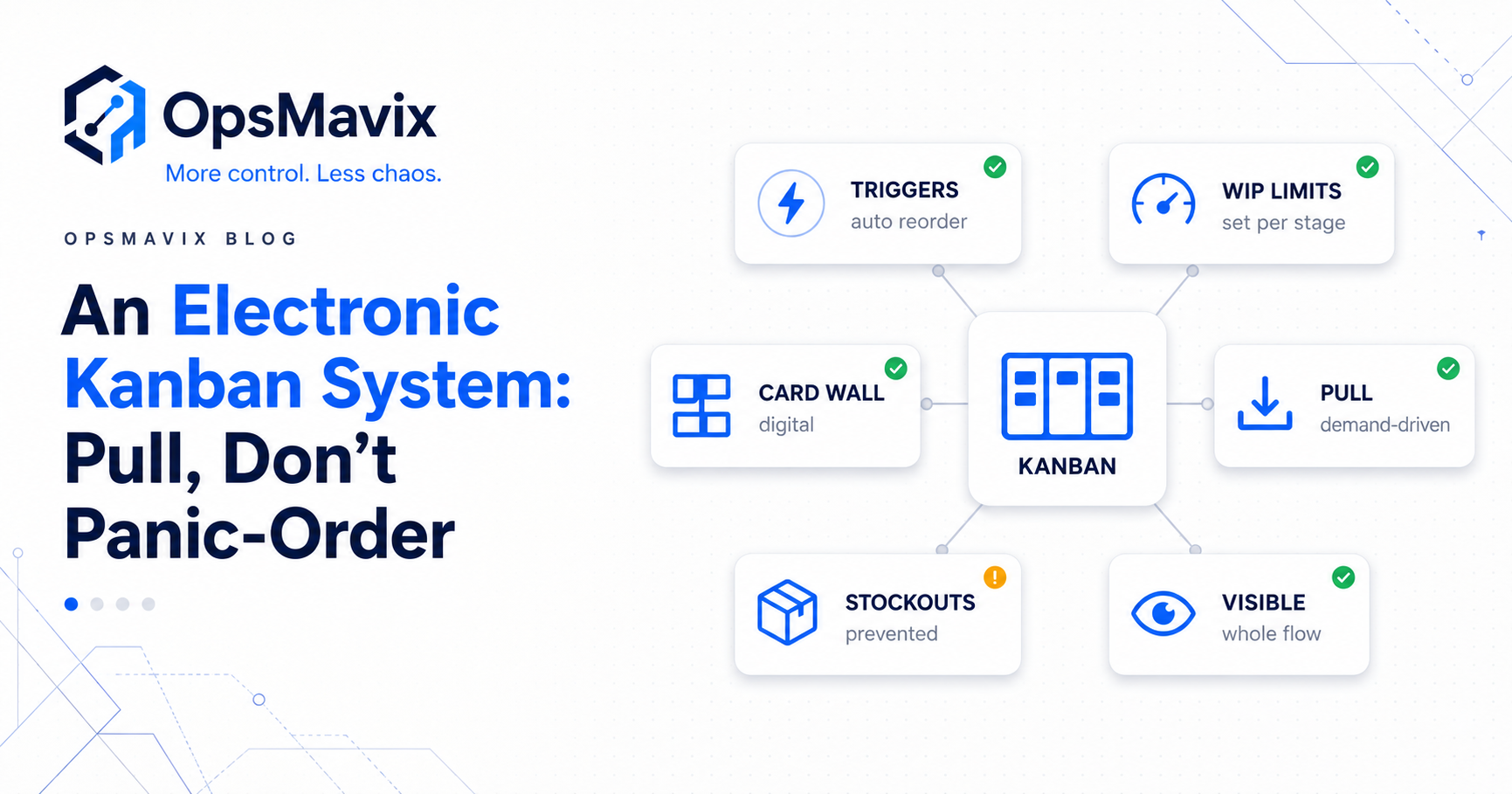
An electronic kanban system replaces the physical cards and the whiteboard with a digital pull signal. When stock or a buffer drops to its trigger point, the system raises the replenishment automatically, in one place everyone can see. You keep the discipline of pull-based reordering without betting it all on a laminated card surviving a busy shift.
Physical kanban works beautifully on a calm, single-line floor. On a high-mix shop it fails quietly: cards go missing, the board gets wiped before anyone logs it, and a signal nobody actioned stays invisible until the line starves. Going electronic isn’t about looking modern. It’s about making the pull signal impossible to lose.
Here’s how a digital kanban differs from the card wall, what’s worth keeping, and why you don’t need an ERP to run it.
Key Takeaways
- An electronic kanban system turns physical cards into a digital pull signal that can’t be wiped or lost.
- Pull-based reordering still applies: the trigger fires on consumption, not a forecast.
- The card wall fails on high-mix floors through lost cards, wiped boards, and signals nobody actioned.
- Keep what lean got right (pull, buffers, visual status). Fix only what paper can’t do: sync, audit, alerts.
- You can run electronic kanban as a focused system on your floor, not a full ERP rollout.
1Why the Physical Card Wall Breaks Down
A kanban card is a pull signal. Bin empties, card comes off, card means “make or buy more.” On a low-mix line that’s reliable. On a high-mix shop running dozens of part numbers, the cards become the weak link. One gets dropped behind a machine. Another is “borrowed”. The board gets wiped clean before anyone records what was on it. Worse, a card sitting in a tray that nobody actioned looks identical to one that’s been handled. The signal exists, but it’s silent.
It’s the same blind spot Shop-Floor Sam knows from the whiteboard: “the entire shop is run from my head, and the first I hear a job’s slipped is when the customer phones.” A card wall only tells the truth if every human keeps it current, every shift. Miss one and you don’t find out until a cell runs dry.
2Electronic Kanban Keeps the Pull, Fixes the Paper
Going electronic doesn’t mean abandoning lean. It means protecting it. Pull-based reordering is the part worth keeping: replenishment fires on what was actually consumed, not on a forecast you’ll be fighting all month. An electronic kanban system holds the buffer levels, the trigger points and the loop, then raises the signal the moment consumption crosses the line.
The change is where the signal lives. A scan, a tap, or a stock movement drops the digital card. The replenishment request appears on one screen and stays visible until someone closes it out. Nobody has to remember to walk the board, and a busy shift can’t quietly delete the evidence.
3What an Electronic Kanban System Actually Does
A useful digital kanban is narrow on purpose. Track the few things that keep the loop honest:
- Buffer levels and trigger points, per part and per location, so the system knows when to fire.
- Pull signals raised automatically on consumption: a scan, a pick, a stock decrement.
- Open vs actioned status, so nothing sits silent in a tray.
- Loop status: what’s been ordered or made, what’s in transit, what’s overdue back into the bin.
Skip MRP-style forecasting and scheduling until the pull loop is trusted. The whole win is replacing “did anyone see that card?” with one board that answers it.
4Card Wall vs Electronic Kanban
| Physical card wall | Electronic kanban system | |
|---|---|---|
| Pull trigger | Card pulled by hand | Fires automatically on consumption |
| Lost signal | Card dropped, board wiped | Signal logged, can’t disappear |
| “Was it actioned?” | Looks the same either way | Clear open/actioned state |
| Visibility | Walk to the board | One screen, anywhere |
| Audit trail | None | Every signal time-stamped |
| Multi-location | A board per site | One synced view across sites |
5You Don’t Need an ERP to Run Pull
This is where most shops get stuck. They assume electronic kanban means a six-figure MRP module, so they stay on cards. It doesn’t. A full ERP forces you to roll out planning, finance and procurement together, which for a single pull loop is a sledgehammer. Sam has already lived the alternative: niche MRP that was “as flexible as a wooden door” and still left him with “manual input… despite paying high dollars.”
A focused production tracking system can run the kanban loop on its own, built around how your floor already pulls rather than bending the floor to a rigid SaaS. Connect it to a live inventory system so the trigger fires on real stock movements, and the same discipline that fixes stock never matching the system keeps your buffers honest too. Start with one loop, prove it, then expand.
FAQ
What is an electronic kanban system?
It’s a digital version of a kanban pull system. Instead of physical cards coming off a board when a bin empties, a replenishment signal is raised automatically when consumption hits a trigger point, and it stays visible in one place until it’s actioned. You keep the lean pull principle and lose the risk of a card being dropped or ignored.
How is electronic kanban different from MRP?
MRP plans replenishment from forecasts and a schedule. Kanban pulls it from actual consumption. An electronic kanban system keeps that pull logic, so you’re reacting to what was really used rather than predicting demand. You can run it without a full MRP or ERP rollout, which is the whole point for a smaller manufacturer.
Do we have to give up our physical kanban cards completely?
No. Plenty of shops keep a visual board on the floor and run the electronic signal alongside it, so operators still see status at the cell while the digital loop captures the audit trail and alerts. Over time most teams lean on the screen, because it can’t be wiped or lost.
Can an electronic kanban system handle a high-mix, low-volume shop?
Yes, and that’s exactly where physical cards struggle most. With dozens of part numbers, lost or borrowed cards are common. A digital system holds a trigger point per part and per location, so high mix becomes a data problem the system manages instead of a wall full of cards a person has to police.
How do we start without disrupting the floor?
Pick one pull loop, a single line or a handful of high-runner parts, and put the electronic signal on that. Prove it works and that the floor trusts it, then expand. Because the system fits how the floor already pulls, useful results land in weeks rather than the year a full ERP implementation demands.
How OpsMavix Can Help
OpsMavix builds custom production tracking systems that run pull-based reordering as an electronic kanban loop: automatic signals on consumption, clear open or actioned status, and a live inventory system feeding real stock movements into the trigger. No lost cards, no wiped board, no six-figure ERP, and built around how your floor already works rather than forcing the lads onto rigid software they won’t use.
If your replenishment depends on a laminated card surviving a busy shift, that’s an operational leak: line stoppages, rush buys, and starved cells nobody saw coming. Book an Operations Leak Audit and we’ll map where your pull signals go silent, and what it’s costing you.