
Custom POS Software: When the Till Can't Keep Up
A till that takes payment but never tells your stock the truth is a leak, not a system. Here's when custom POS software is the fix, and when it isn't.
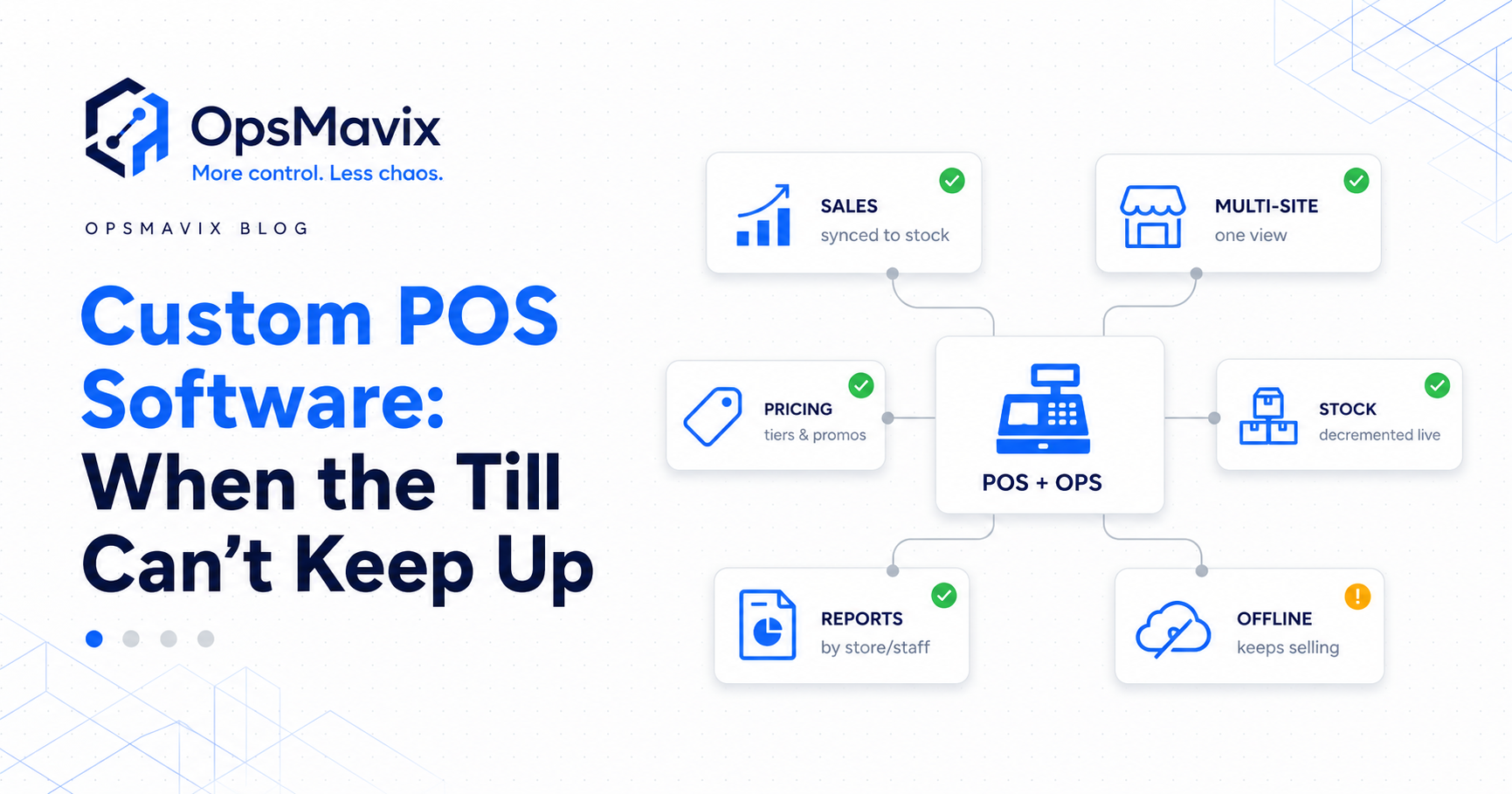
Most retailers don’t have a till problem. They have a sync problem wearing a till’s clothes. Your point of sale rings up the sale just fine. What it doesn’t do is tell your other shop, your warehouse, and your online channel that the unit is gone. So you sell what you don’t have, reorder what you already hold, and run one count behind reality. Custom POS software is worth it when a standard till can take money but can’t keep your stock honest across more than one place.
Run two or more sites, or a shop plus an online channel, and the gap between “transaction recorded” and “stock updated everywhere” is where the money quietly leaks. Below: when a custom point of sale earns its cost, what it actually changes, and when an off-the-shelf till is still the right call.
Key Takeaways
- A POS that takes payment but doesn’t sync stock across every site and channel is a reporting tool, not an operations system.
- The pain isn’t the checkout. It’s overselling, blind reordering, and counts that drift the moment a second location exists.
- Custom POS software is justified when standard tills force your multi-site workflow to bend to their model, not the other way round.
- For most growing retailers the real fix is connecting the till to one live stock count, not replacing the hardware.
- You don’t need a full retail ERP to stop the leak. There’s a middle path, sized to your sites and live in weeks.
1The Till Records the Sale, But Nothing Else Hears About It
A standard POS does one thing brilliantly: take a payment at one counter. The trouble starts the moment that sale needs to mean something everywhere else. Sell the last unit in your Leeds shop and the till is happy, but your Manchester shop, your stockroom, and your Shopify listing still show it as available. Nothing reaches across and corrects them.
So most retailers bridge the gap by hand. An end-of-day export. A spreadsheet someone reconciles after closing. A mental note to update the website later. That bridge holds until two sites sell the same unit in the same hour. It’s the exact trap the multichannel seller already knows: “we would consistently oversell items we didn’t even have on hand.” A till that doesn’t talk to your stock isn’t keeping up. It’s quietly setting you up.
2What “The Till Can’t Keep Up” Actually Looks Like
“Can’t keep up” rarely means slow card reads. It means everything downstream of the sale never catches up:
- Overselling across sites and channels — the same unit shows “available” in two places because neither count is live.
- Blind reordering — you buy stock you already hold in another location, because no single figure tells you the true position.
- Cancellations and apologies — the recurring outcome of stale stock: “had to cancel the order.”
- The marketplace gamble — sell on Amazon too, and overselling threatens your seller metrics. One retailer put the choice starkly: “It’s either switch FBM off or risk the account! Losing so many sales.”
- Evenings lost to reconciliation — staff patching counts after close instead of the system doing it live.
None of this shows up on the till’s screen, which is exactly why it gets ignored until peak season drags it into the light.
3When Custom POS Software Is Actually Worth It
The OpsMavix view is blunt: most retailers don’t need custom POS software. They need their existing till connected to a live stock count. Ripping out working checkout hardware to fix a sync problem solves the wrong layer. Custom earns its place when the off-the-shelf till genuinely can’t bend to how you trade, and that list is shorter than vendors would like:
- You run multiple sites with shared stock and need one true count across all of them, in real time.
- You blend retail, online, and wholesale from the same stock, and standard tills force three disconnected systems.
- Your workflow has a real quirk (bespoke kits, made-to-order lines, branch transfers) that no standard POS models without ugly workarounds.
- You’ve already been “punished for growing” by tiered tools whose pricing climbs with every order and seat.
If none of those apply, a good off-the-shelf till wired into a proper inventory system usually wins. Custom should earn its place, not be sold to you.
4Connect the Till, Don’t Just Replace It
The fix that actually stops the leak is simple to state: make the sale update one shared figure the moment it happens, at every counter, in every stockroom, on every channel. A custom layer sits behind your tills so a sale anywhere reduces the count everywhere within moments. It’s the same connected approach behind not overselling across Shopify, Amazon and eBay:
- Live two-way sync so every sale, return, and transfer hits one count across sites and channels.
- Stock buffers on fast movers — a small reserve so a brief sync delay never becomes an oversell.
- Branch transfers tracked — stock moving between sites updates both ends automatically.
- One reorder figure so you buy from the true position, not a guess per location.
That’s the difference between a till that takes money and an operations system that keeps your stock honest. Pair it with eCommerce inventory automation and the same live count feeds your online channels too.
5You Don’t Need a Retail ERP to Fix This
Once the pain bites, the instinct is to jump to a full retail ERP. For most growing multi-site retailers that’s the wrong end of the scale: heavy, slow to roll out, priced for businesses ten times the size. The honest middle ground sounds a lot like the seller who asked, “QBO is too small, Netsuite is too expensive. What’s a middle ground?”
The middle ground is a system sized to the sites you run now, built around your channels instead of bending you to a platform, and live in weeks rather than a multi-month migration. And you own it. No per-seat creep, no rug-pull if a vendor sunsets the product, no being told real software is “only for large businesses.” outgrowing spreadsheets and disconnected tools, is precisely the gap this fills.
FAQ
What is custom POS software?
A point-of-sale setup built around how your business trades, rather than a generic till you adapt to. In practice the valuable part is less the checkout screen and more the layer behind it: the one that keeps stock, orders, and reporting in sync across every site and channel in real time.
Do I really need custom POS software, or will an off-the-shelf till do?
For a single shop, a good off-the-shelf till is usually plenty. Custom earns its place when you run multiple sites with shared stock, blend retail with online and wholesale, or have a workflow no standard POS models cleanly. Often the smarter move is connecting your existing till to one live stock count rather than replacing it.
How does custom POS software stop overselling across sites?
By making every sale, return, and transfer update a single shared stock figure the instant it happens, so one count is true everywhere at once. Add buffers on fast-moving lines and a brief sync delay can’t turn into an oversell. Without that live count, each site keeps its own number, and eventually they disagree.
Can a custom POS connect to Shopify, Amazon, and eBay?
Yes, and that’s the point of building it around your channels. The till and your online storefronts read from and write to the same live stock count, so a sale in the shop reduces availability online, and vice versa, protecting both your marketplace metrics and your customers.
Is custom POS software cheaper than a full retail ERP?
Usually, because it’s scoped to the sites and channels you run now rather than every feature an enterprise might want. The aim is a right-sized system, live in weeks and owned outright, instead of a heavy platform priced and built for far larger retailers.
How OpsMavix Can Help
OpsMavix builds custom operations systems that sit behind your tills, so every sale across every site and channel updates one live stock count, complete with buffers, branch transfers, and a single reorder figure, instead of a checkout that records the sale and leaves the rest to a spreadsheet. Where it makes sense we connect the till you already have rather than ripping it out, and tie it into eCommerce inventory automation and wholesale order management so retail, online, and wholesale all draw from the same honest number.
If your till takes the money but your stock never keeps up, that’s a measurable operational leak: oversells, blind reorders, and time lost reconciling after close. Book an Operations Leak Audit and we’ll map where your point of sale stops talking to the rest of your operation, and what it’s costing you.