Best Talent Management System: Key Features & Integration
Discover the essential features to look for in a talent management system, from recruitment and onboarding to performance, learning, analytics, task management and integrations. Learn how to choose a platform that supports employees, managers and wider business operations.
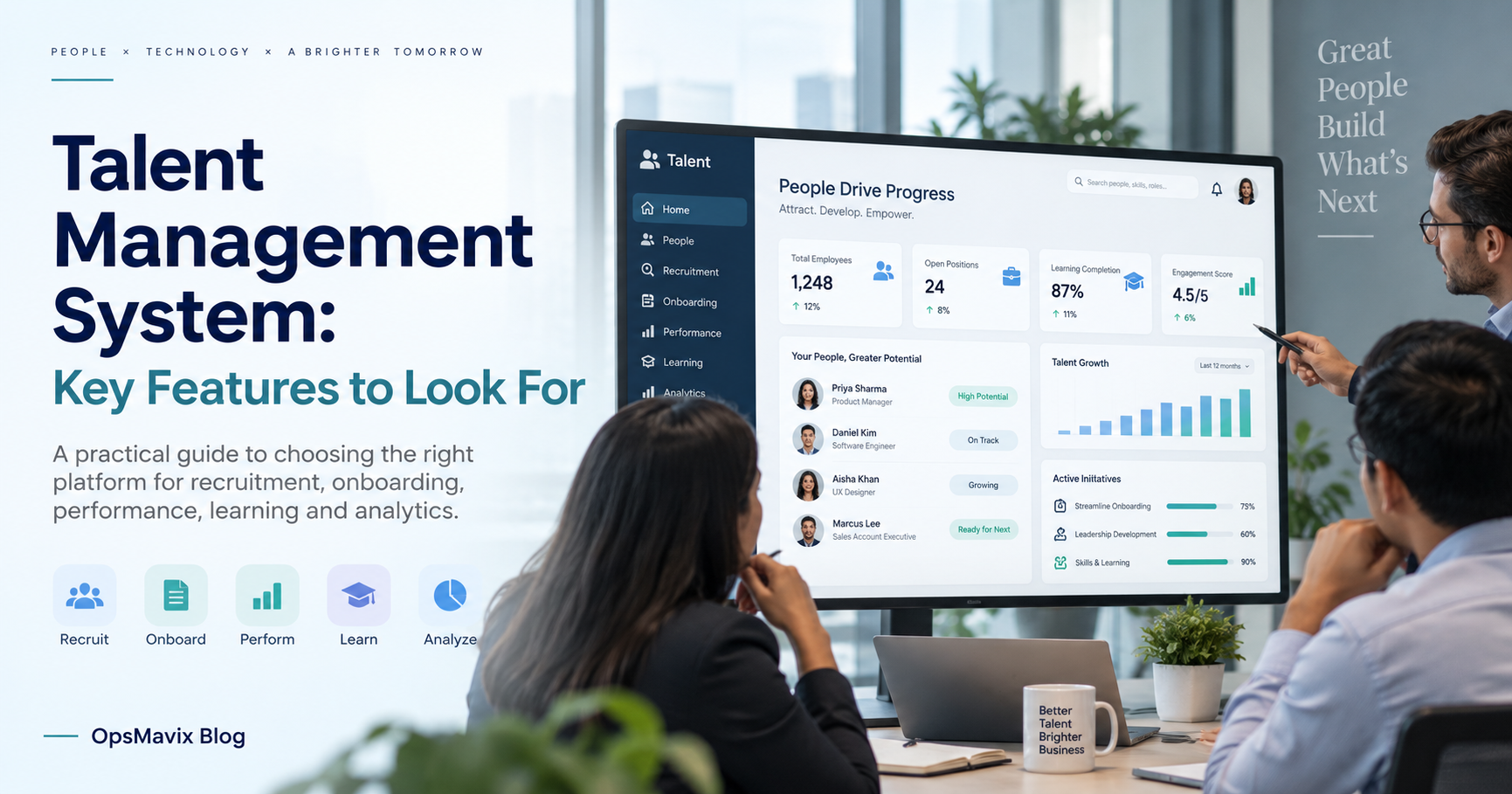
Choosing a talent management system is not just an HR technology decision; it shapes how people are hired, supported, developed and retained. The right platform should make everyday work clearer, connect employee data with wider business operations, and give leaders practical insight without creating another layer of administration. This guide explains the features to prioritise so you can assess options with confidence, whether you are reviewing a specialist HR platform, OpsMavix, or a broader business software stack.
What should a talent management system actually do?
A talent management system should help an organisation manage the full employee journey, from workforce planning and recruitment through to onboarding, performance, learning, internal mobility and succession. At its best, it gives HR teams, managers and employees one reliable place to see goals, responsibilities, development plans and progress. It should reduce manual chasing, improve consistency and help leaders make better decisions about people.
That sounds simple, but the details matter. A platform may look polished during a demo yet still fail if it cannot reflect how your teams really work. Before comparing features, be clear about the problems you are trying to solve. Are managers struggling to complete reviews on time? Are employees unclear about career paths? Is learning activity disconnected from performance? Are HR teams re-entering data across several systems?
A good system should address those practical issues rather than simply digitising old processes. It should help your organisation become more joined-up, not just more automated.

A clear employee profile sits at the centre
The foundation of any useful talent platform is a complete, accurate employee profile. This should go beyond basic contact details and job title. It should bring together skills, experience, performance history, training, goals, certifications, career interests and manager feedback in a format that is easy to update and understand.
When employee information is scattered across spreadsheets, email threads and local folders, decision-making becomes slow and inconsistent. Managers may overlook internal talent because they cannot see who has the right skills. HR may struggle to identify capability gaps. Employees may feel development conversations are based on memory rather than evidence.
Look for a system that makes profiles useful in day-to-day work. The best employee records are not static files; they support meaningful conversations about progress, potential and next steps.
Useful profile features include:
- Skills and competency tracking so leaders can understand current capability across teams.
- Role history and career interests to support internal mobility and succession planning.
- Training records and certifications to show what has been completed and what needs renewing.
- Goals and performance notes to connect individual development with business priorities.
- Permissions and privacy controls so sensitive information is visible only to the right people.
Recruitment and onboarding need to feel connected
Talent management begins before a new employee’s first day. Recruitment features should help teams plan vacancies, manage applicants, record feedback and move candidates through the process with clarity. Even if you use a separate applicant tracking system, your talent management platform should be able to receive the right information once someone is hired.
The handover from candidate to employee is often where friction appears. New starters may be asked to provide the same information twice. Managers may not know which tasks are complete. HR may have to chase equipment requests, documents, system access and induction sessions manually.
Strong onboarding features help prevent that. They create a structured process that gives new employees a confident start while helping managers stay accountable. This is where task management becomes especially important. A simple checklist is useful, but a more capable platform should assign responsibilities, set deadlines, trigger reminders and show progress in one place.
A practical onboarding workflow might cover:
- Collecting required employee information and documents.
- Assigning induction tasks to HR, IT, facilities and the line manager.
- Scheduling introductions, training and compliance activities.
- Confirming equipment, software access and workspace arrangements.
- Setting early objectives for the first weeks and months.
- Capturing feedback from the new starter and manager.
When recruitment and onboarding are connected, the organisation looks more professional and employees spend less time navigating confusion.
Performance management must support real conversations
Performance management is often where talent systems either create value or become an annual form-filling exercise. Look for features that encourage regular, useful conversations rather than only end-of-year ratings.
The system should allow managers and employees to set goals, review progress, record achievements and discuss obstacles throughout the year. It should also support different review styles, because not every organisation uses the same approach. Some rely on objectives and key results, others use competency frameworks, project-based feedback or continuous check-ins.
Flexibility matters, but structure matters too. Without clear prompts, performance conversations can become vague. Without space for context, ratings can feel unfair. A strong platform helps managers discuss outcomes, behaviours, development needs and future goals in a balanced way.
Important performance features include:
- Goal setting and alignment so individual work connects with team and organisational priorities.
- Regular check-ins to keep feedback timely and reduce surprises.
- Manager and peer feedback where appropriate for a fuller view of contribution.
- Development actions linked directly to review outcomes.
- Reporting tools that highlight completion, trends and areas needing attention.
The goal is not to monitor people for its own sake. It is to make expectations clearer and development more consistent.
Learning and development should be easy to act on
A talent platform should make learning visible, relevant and actionable. It should help employees see what training is available, understand why it matters and track their own progress. Managers should be able to recommend learning based on role requirements, performance discussions or future career goals.
This is particularly important when skills are changing quickly. Organisations need to know not only who has completed a course, but which skills are being strengthened and where gaps remain. A learning feature that simply stores course names will be less useful than one that connects learning to skills, roles and development plans.
When reviewing learning capabilities, consider whether the system can support:
- Mandatory training and compliance reminders.
- Personal development plans.
- Recommended learning paths for roles or skill areas.
- Manager approvals where required.
- Completion tracking and reporting.
- Links between learning, performance and progression.
Learning features should not feel like a separate library that employees rarely visit. They should be woven into the employee experience, appearing naturally after reviews, career conversations and skills assessments.
How does task management improve talent processes?
Task management improves talent processes by turning HR plans into clear, assigned actions with owners, deadlines and follow-up. It helps prevent important people activities from being lost in inboxes, especially during onboarding, performance reviews, training renewals, policy acknowledgements and succession planning. When tasks are visible, managers and HR teams can see what is moving, what is overdue and where support is needed.
This matters because talent management involves many small handovers. A hiring manager needs to complete interview feedback. IT needs to create access. A line manager needs to schedule a probation review. An employee needs to complete learning. HR needs to confirm documentation. If these actions are tracked manually, delays are almost inevitable.
A good talent management system should include task management that is simple enough for everyday users but structured enough for HR oversight. It should avoid becoming a cluttered to-do list that no one trusts. Helpful features include automatic reminders, recurring tasks, role-based assignment, priority levels and completion evidence.
Some organisations also compare HR task features with familiar tools such as project management software or even a task manager Mac users might use personally. That comparison can be useful, but HR workflows need more than individual productivity. They require permissions, audit trails, employee records and reporting that fit people processes.
Analytics turn HR data into better decisions
Data is one of the main reasons to invest in modern talent technology. Without analytics, HR teams may know individual cases well but struggle to see patterns across the organisation. With the right reporting, leaders can identify trends in performance, learning, retention risk, internal mobility, vacancies and workforce capability.
However, more dashboards do not automatically mean better insight. Look for analytics that answer practical questions. Which roles are hard to fill? Where are skills gaps appearing? Which teams are overdue on reviews? Are development plans being completed? Which employees may be ready for broader responsibility?
The system should allow HR to create clear reports without depending on technical support for every change. It should also let leaders filter information by team, role, location or other relevant categories, while respecting privacy requirements.
Strong analytics should help with:
- Workforce planning and future capability needs.
- Performance cycle completion and quality monitoring.
- Learning uptake and compliance tracking.
- Succession planning and readiness discussions.
- Diversity, equity and inclusion monitoring where appropriate and lawful.
- Identifying bottlenecks in recruitment, onboarding or development.
The purpose is not to reduce people to numbers. It is to support fairer, faster and more informed decisions.
Integration with wider business systems matters
Talent management rarely exists in isolation. Employee data often needs to connect with payroll, finance, operations, customer-facing teams and project delivery. That is why integration should be part of your selection criteria from the beginning, not an afterthought once the contract is signed.
Many organisations already use erp systems or erp software to manage core business operations. You may even see international search terms such as systemes erp when teams are researching options across different regions. If your talent platform cannot communicate with these systems, HR may be forced into duplicate data entry and manual reconciliation.
Integration with crm software and other operational platforms can also be useful in certain environments. For example, service businesses may need to understand staffing, skills and availability in relation to client demand. Warehousing or logistics organisations may need links with a wms so workforce planning aligns with operational activity. Project-led companies may want talent data to support management in software project environments, where skills, capacity and delivery timelines are closely connected.
When assessing integrations, ask practical questions:
- Which systems need to exchange employee or organisational data?
- Is the integration real-time, scheduled or manual?
- Who owns data quality when information moves between platforms?
- What happens when a person changes role, team or location?
- Can the system connect with project management software used by delivery teams?
- Are permissions and security rules maintained across connected tools?
A well-integrated system reduces friction. A poorly integrated one simply moves the problem from paper to software.
User experience drives adoption
Even the most powerful platform will fail if people avoid using it. HR teams may tolerate complexity because they understand the process, but managers and employees need a system that feels straightforward from the first interaction. They should be able to complete common tasks without training manuals, repeated support tickets or guesswork.
Look closely at the everyday experience. Can a manager approve a development request quickly? Can an employee update a profile or view goals without clicking through confusing menus? Are reminders clear rather than irritating? Does the platform work well on the devices people actually use?
Accessibility and inclusivity matter too. Clear language, readable design and logical navigation help everyone use the system more confidently. If your workforce includes deskless, hybrid or mobile employees, make sure the experience suits their working reality rather than assuming everyone sits at a laptop all day.
During evaluation, involve actual users. HR may focus on configuration and reporting, while managers notice whether a review form is practical. Employees may spot unclear wording or unnecessary steps. Their feedback can prevent expensive adoption problems later.
Security, permissions and compliance cannot be optional
Talent systems hold sensitive personal information, so security must be treated as a core feature. The platform should help protect employee data through strong access controls, secure authentication, audit trails and clear permission settings. Different users should see only what they need to see.
Compliance needs will vary by organisation, industry and location, so avoid assuming any generic platform automatically meets your requirements. Instead, ask vendors how data is stored, how access is managed, how records can be retained or deleted, and what controls exist for reporting sensitive information.
It is also worth considering internal governance. Who can change a performance rating? Who can view succession plans? Who can export employee data? Who approves changes to workflows or forms? A good system supports your policies instead of relying on informal trust.
Security should not make the platform unusable, but convenience should never come at the expense of employee confidence.
What should you check before choosing a platform?
Before choosing a platform, check whether it solves your priority people problems, integrates with your existing systems, supports managers and employees in daily use, and can adapt as your organisation changes. A feature list is useful, but it should not replace a careful look at workflows, data quality, reporting needs and user adoption. The best choice is the one that fits your operating model as well as your HR ambitions.
Use this checklist during selection:
- Define your must-have outcomes. Be specific about what needs to improve, such as faster onboarding, better review completion, clearer skills data or stronger succession planning.
- Map your current processes. Identify where work currently slows down, where data is duplicated and where accountability is unclear.
- Review integration needs early. Include ERP, payroll, CRM, WMS, collaboration and project tools where relevant.
- Test common user journeys. Ask managers and employees to try real tasks, not just watch a polished demonstration.
- Examine reporting carefully. Confirm whether HR can build useful reports without excessive technical support.
- Check configuration options. Make sure forms, workflows and permissions can reflect your organisation without heavy custom development.
- Ask about implementation support. Data migration, training and change management often determine whether the system succeeds.
- Plan for continuous improvement. Your talent processes will evolve, so the system should not lock you into today’s assumptions.
A thoughtful selection process takes longer than picking the most impressive interface, but it reduces the risk of disappointment once the platform is live.
A final takeaway for smarter talent decisions
The best talent management technology brings clarity to the employee journey. It helps people understand expectations, supports managers in meaningful conversations, gives HR reliable data and connects talent activity with wider business operations. Features such as performance management, learning, task management, analytics and integration are most valuable when they work together rather than as isolated modules.
As you compare options, keep returning to one question: will this make it easier for our people to do the right things at the right time? If the answer is yes, you are closer to a system that supports not only HR administration, but stronger decisions, better development and a more capable organisation.