
Benefits of Production Planning and Control (and What Poor Planning Costs)
The benefits of production planning and control are easiest to see through what poor planning costs: idle machines, late deliveries, and firefighting. This guide explains those gains for a business that has outgrown spreadsheets and disconnected tools, and how an owned planning tool survives the planner being off sick.
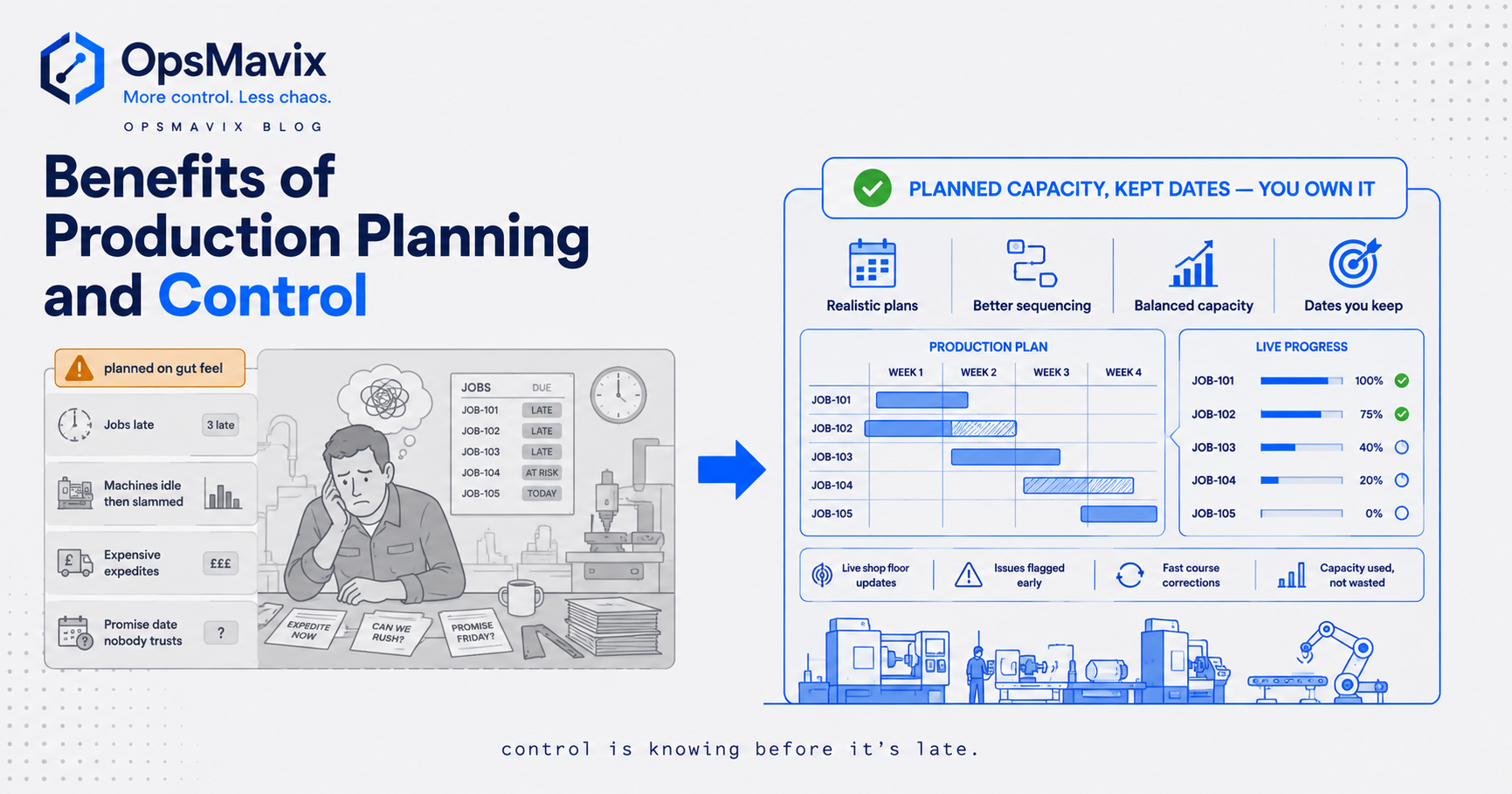
The benefits of production planning and control are clearer priorities, more dependable material and capacity decisions, earlier visibility of delays and a better record of actual production. Those benefits depend on accurate inputs and a routine for responding to exceptions. A schedule alone does not create extra machine hours or guarantee delivery.
Planning decides what should happen, with which materials and resources, and when. Control compares actual progress with that plan and changes it deliberately when conditions change. A factory can have a detailed plan yet weak control if completions, shortages and breakdowns reach the planner too late.
This guide explains the practical benefits, the evidence to measure and how to introduce a limited planning routine before committing to new software. It also compares configuring an existing platform, integrating production records and building a focused system or full ERP.

Production plans become useful when the actual work and exceptions feed back into the schedule. Illustrative photograph, not an OpsMavix client.
Image credit: Nenad Stojković / Shixart1985, CC BY 2.0. Displayed at a reduced size; no additional edits.
Key Takeaways
- Separate material availability from resource capacity when assessing a feasible plan.
- Measure delivery, throughput and work in progress alongside utilisation.
- Record actual output, scrap and interruptions so control has current evidence.
- Make priorities and the authority to change them explicit.
- Compare complete implementation and operating costs without assuming savings.
- Pilot one production flow with acceptance criteria before extending the scope.
In this guide:
- 1. Separate Planning from Production Control
- 2. Improve Delivery Decisions with Feasible Capacity
- 3. Reduce Material Surprises Before Work Starts
- 4. Control Work in Progress and Priorities
- 5. Capture Actual Performance Without False Precision
- 6. Compare Planning Tools Against Real Work
- 7. Calculate Benefits from a Measured Baseline
- 8. Pilot a Planning and Control Routine
- Frequently Asked Questions
- How OpsMavix Can Help
1. Separate Planning from Production Control
Define the planning decisions
Planning translates demand into proposed work: quantities, dates, material requirements and resource needs. It must account for operations, sequence, setup and the timing of supply. A list of orders sorted by due date is a starting priority list, not proof that the work can finish on those dates.
Choose the planning horizon and update frequency around the operation. Some businesses need daily dispatch decisions and a weekly capacity review. Others need longer material visibility because a component takes months to arrive. No single cadence fits every production model.
Define the control loop
Control needs an agreed point for recording started, completed, held, scrapped and reworked quantities. Define who reports a machine interruption and who decides whether to move work elsewhere.
| Stage | Decision | Evidence needed |
|---|---|---|
| Demand review | What work should we prepare? | Accepted orders and a separately identified forecast |
| Material planning | What supply is needed? | Usable stock, commitments and dated receipts |
| Capacity planning | When can we execute? | Routes, calendars, setup and resource availability |
| Dispatch to production | Which job goes next? | Released priorities and readiness checks |
| Control | What must change? | Actual progress, shortages and interruptions |
The loop should reveal the difference between a planned date and a supported customer commitment. Treating every suggested date as a promise can make the system look more certain than the factory actually is.
2. Improve Delivery Decisions with Feasible Capacity
Identify the limiting resource
A feasible schedule considers the resource that restricts completion, whether it is a machine, skill, inspection stage or subcontractor. Loading every workstation fully can increase queues without increasing shipments if the bottleneck cannot process the additional work.
Hypothetical capacity example: a station has 40 scheduled hours. Planned maintenance uses four hours, leaving 36. Three jobs need 12, 14 and 15 hours including setup, or 41 hours altogether. There is a five-hour gap before allowing for further unplanned interruption. The planner needs another date, resource or agreed capacity change.
Do not conceal the gap by deleting setup time. Ask whether a different sequence, alternative route or authorised overtime genuinely resolves it. Check skill and material availability for the alternative too.
Make promises explainable
Keep the original customer due date, current planned completion and actual completion distinguishable. A rescheduled job should not silently replace the original commitment in a performance report.
The useful benefit is earlier, better-informed action: expediting a missing component, agreeing a new date or declining an unsupported rush order. Whether that improves delivery performance must be measured against a consistent baseline.
3. Reduce Material Surprises Before Work Starts
Connect bills of materials to actual readiness
For each released job, confirm the applicable bill of materials, quantities, units and revision. A component in the building may still be unavailable because it is reserved, held, in another location or not yet inspected.
Map how purchasing and stores report receipts. A purchase-order due date does not establish that material has arrived. Late or partial deliveries must affect the plan visibly.
Keep forecasts separate from firm demand
Forecasts help prepare supply but are uncertain. Accepted orders create a different commitment. Decide how an order consumes or replaces forecast demand so the same expected sale is not planned twice.
ERPNext’s stock-entry documentation distinguishes material transfers and manufacturing movements. This illustrates why the transaction type matters: moving components towards production and consuming them are separate events. Verify the behaviour in your own platform and version.
Suggested readiness checks include:
- Correct component identity and unit conversion.
- Eligible stock or confirmed receipt in time.
- Reservations that match released jobs.
- Tools and approved documents available.
- Inspection or quality requirements accounted for.
- Named responsibility for every shortage.
Record why a job is blocked. A single red status without a cause can still leave the team phoning stores, purchasing and production separately to find out what happened.
4. Control Work in Progress and Priorities
Release work at a useful rate
Starting more jobs can increase work in progress without increasing finished output. If every urgent order enters the floor immediately, materials and attention may be spread across many incomplete jobs.
Define release criteria. The job should have an approved priority, suitable resources and a credible material position. Where releasing incomplete kits is an intentional policy, make the shortage and risk visible rather than treating the job as fully ready.
Keep a short change record
A priority change should record its reason, authorisation and effect on other commitments. This does not require a long approval meeting for every adjustment. It requires a way to understand why yesterday’s plan changed.
Hypothetical sequence decision: two jobs share a setup. Grouping them could avoid one changeover, but the second job might displace an earlier customer commitment. Compare the actual setup benefit with the delivery effect before calling the grouped sequence an improvement.
| Control | Practical purpose | Failure to avoid |
|---|---|---|
| Release checklist | Start executable work | Releasing every order regardless of readiness |
| Priority owner | Resolve competing demands | Several people issuing conflicting instructions |
| Hold reason | Explain blocked work | An unexplained status with no action |
| Completion record | Update the next operation | Reporting all work at the end of the week |
| Change history | Explain schedule revisions | Rewriting the plan without retaining the reason |
5. Capture Actual Performance Without False Precision

Material availability must be checked alongside production progress. Illustrative photograph, not an OpsMavix client.
Image credit: FIONASUN, CC0 1.0. Displayed at a reduced size; no additional edits.
Record what the team can maintain
Start with job, operation, completed quantity, rejected quantity, time and exception reason where relevant. Define whether time means elapsed duration, labour time or machine time. Those measures cannot be substituted for one another without explanation.
If an operator runs several machines, summing all machine hours as labour hours can overstate the labour input. If an interruption is not recorded, a slow operation may be blamed on the route rather than unavailable material.
Use balanced measures
Track on-time completion against the agreed commitment, throughput at the constraint, work-in-progress age and recurring shortage reasons. Examine quality and rework alongside output. A higher completion count is not a benefit if it is accompanied by more rejected work.
Explain the reporting boundary. Orders completed in production and orders delivered to the customer measure different events. Do not use whichever date happens to make the result look better.
Reliable production tracking can reduce the delay between work happening and the planner seeing it. Integration still needs exception handling, and data capture still depends on the process being used correctly.
6. Compare Planning Tools Against Real Work
Test the existing platform first
An ERP may already contain material planning, shop-floor records or capacity features that are not configured. Microsoft describes Business Central’s manufacturing and planning functions. Product capability is a reason to demonstrate the workflow, not proof that a particular licence, setup or implementation meets it.
Ask the supplier to show your routing, partial completion, missing material, subcontract stage and urgent priority change. Include an operation that cannot run simultaneously on the same resource.
| Approach | Where it can fit | What to demonstrate |
|---|---|---|
| Improve a spreadsheet routine | Limited scope and manageable updates | Capacity calculation, ownership and revision control |
| Configure current ERP | Needed capability already exists | Your operations and exceptions in the actual release |
| Add an integrated planning tool | Existing records work but scheduling needs support | Reliable inputs, returned dates and failure visibility |
| Focused custom application | A valuable production gap remains | Scope, data capture, support and reconciliation |
| Full ERP programme | Broader finance and operations need coordination | End-to-end process, migration and implementation capacity |
Distinguish material planning from detailed scheduling
A replenishment proposal is not automatically a finite-capacity schedule. Ask whether the tool respects resource calendars and simultaneous use, or whether a planner must resolve overload separately.
Do not dismiss manual adjustments. A planner may need judgement for constraints that are not yet modelled. The important issue is whether the decisions remain visible and supported by current records.
7. Calculate Benefits from a Measured Baseline
Measure the problem before pricing the solution
Record time spent gathering progress, resolving avoidable shortages and reconciling plans. Document actual incidents and their causes. Avoid attributing every late order or quality problem to scheduling software.
Identify which improvement is expected to affect each cost. Faster progress reporting may reduce administration. Better release control might reduce ageing work in progress. Neither automatically creates more sales or reduces payroll.
Work through a transparent example
Hypothetical annual capacity calculation: the team currently spends eight hours a week collecting progress. A pilot reduces that to three, releasing five hours. At £30 an hour for 48 weeks, the valued capacity is five times £30 times 48, or £7,200 a year.
| Hypothetical first-year component | Amount |
|---|---|
| Configuration and training allowance | £5,000 |
| Software and support allowance | £2,000 |
| Total modelled cost | £7,000 |
| Released staff capacity at the stated rate | £7,200 |
These are illustrative allowances, not quotations or a forecast. Released capacity is not necessarily cash. Add migration, hardware, production disruption and remaining administration where applicable. A first-year comparison also needs to consider subsequent support and useful life.
Compare a configured platform, integrated tool and custom approach on the same scope. The cheapest option should still meet the operational acceptance tests.
8. Pilot a Planning and Control Routine
Choose one representative flow
Use a product family that exposes the real constraint without making the pilot unmanageable. Agree opening work in progress, resource calendars, material data and who changes priorities.
During the pilot, test:
- A normal order with complete materials.
- A partial supplier delivery.
- A machine or skill becoming unavailable.
- A partial completion followed by rework.
- An urgent order that displaces other work.
- A subcontract stage that slips.
- A duplicate or failed progress update.
- A planner absence and operational handover.
Set acceptance criteria before judging success
Define the permitted reporting delay, how shortages are assigned and what constitutes a feasible resource load. Reconcile completed quantities and material movements to known jobs. Confirm that operators can maintain the records during normal work.
Review the pilot with production, stores, purchasing and sales. The benefit should be observable in their decisions, not only in a more attractive dashboard. Keep exceptions that the model cannot yet resolve explicit.
Expand after the team can explain and operate the process. Retain exports, configuration records and support responsibilities so the routine does not depend on one person remembering how it works.
Frequently Asked Questions
What are the main benefits of production planning and control?
It can improve priorities, material readiness, capacity decisions and visibility of delays. Results depend on current records and people responding to the exceptions identified.
How does planning differ from control?
Planning proposes what work should happen and when. Control compares actual progress with that plan and adjusts it as resources, supply or demand change.
Does a production plan guarantee on-time delivery?
No. Supply delays, breakdowns, quality problems and unsupported assumptions can still affect delivery. A useful plan exposes those risks early enough to act.
Should every machine be fully utilised?
Not necessarily. Loading non-bottleneck resources can increase queues and work in progress without improving throughput. Evaluate utilisation alongside delivery, quality and the limiting resource.
Is material requirements planning the same as scheduling?
No. Material planning proposes supply against demand, while detailed scheduling also assigns work to resources and time. Verify which constraints the tool actually respects.
Can a spreadsheet support production planning?
Yes, when the scope and update workload are manageable. Test capacity, material visibility, shared use and revision control instead of assuming either that it is always sufficient or always unsuitable.
Do we need a full ERP?
It depends on the wider processes needing coordination. Existing-system configuration or a focused integration may be sufficient; broader finance, purchasing and production requirements may justify a full ERP.
How should we calculate the return?
Use observed time and incidents, a clearly defined change and complete implementation and operating costs. Distinguish released staff capacity from actual cash savings.
Where should a pilot start?
Choose one representative production flow with a known constraint. Agree its baseline, responsibilities, exception tests and acceptance criteria before extending it.
How OpsMavix Can Help
OpsMavix can map your planning decisions, production records and material handoffs, then compare configuration, integration and custom development against the demonstrated gaps.
Our production tracking systems can connect job progress, work in progress and exceptions. Inventory automation can support the material records that make a plan credible. Where wider processes require it, OpsMavix can build a full custom ERP rather than limiting the scope to a dashboard.
Contact OpsMavix with one recently late job, its original plan, actual progress and material position. We can trace the gap and define a pilot with practical acceptance tests.
Keep reading
Getting value from OpsMavix? Add us as a preferred source on Google — you'll see more of our operations content in your AI Overviews, AI Mode and Search.