
ATUM Inventory Alternative: Past the WooCommerce Plugin
ATUM is a solid free stock-management plugin — until you sell on more than WooCommerce. Here's the honest line on when ATUM is the right call, when you've outgrown it, and what a custom inventory system does that a plugin can't.
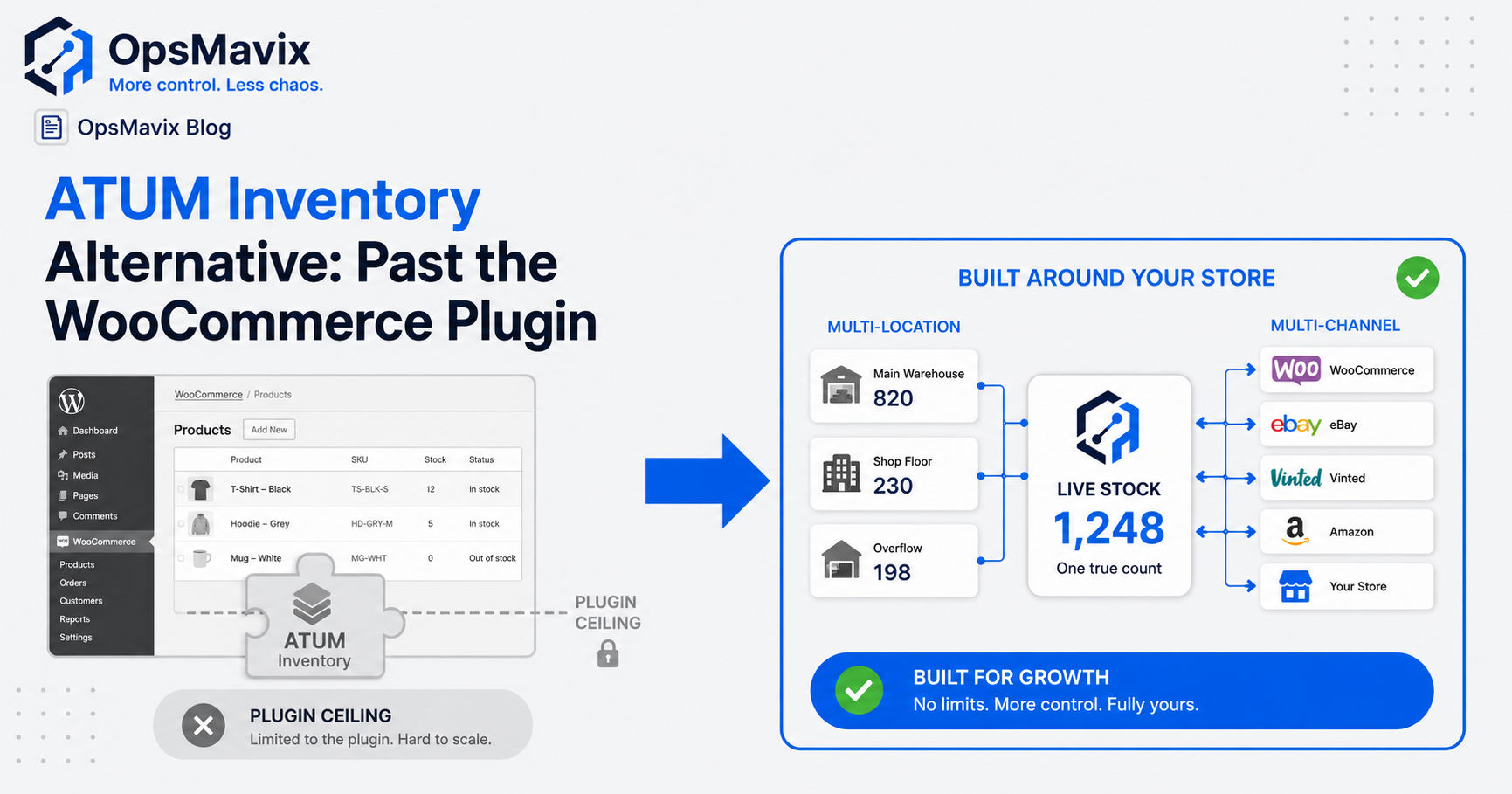
The right ATUM Inventory alternative depends on where your stock actually lives. If everything you sell runs through one WooCommerce store, ATUM is a genuinely good plugin and you probably don’t need anything else. The moment you add Amazon, eBay, a second location, or volume your nightly routine can’t keep up with, the alternative isn’t another plugin — it’s a custom inventory system that follows your stock across every channel, that you own.
Most people searching for an ATUM Inventory alternative haven’t hit a wall with WooCommerce. They’ve hit a wall outside it. The plugin manages your WooCommerce stock fine; the problem is the Amazon order that just sold the same unit, the warehouse count that no longer matches the site, the spreadsheet someone keeps “just to be safe.” This post covers when ATUM is the right tool, when you’ve outgrown the plugin model, and what a built-for-you system changes.
Key Takeaways
- ATUM is a strong, well-supported WooCommerce plugin. Its limit isn’t quality — it’s that it lives inside WordPress, so it sees one store, not your whole operation.
- You’ve outgrown the plugin when stock lives in more places than WooCommerce watches — other marketplaces, a second warehouse, a physical shop.
- A custom system treats every channel and location as movements against one shared figure, so you stop overselling what you don’t have.
- The deeper win is ownership: no per-seat creep, no plugin dependency chain, no number you’ve quietly stopped trusting.
- Don’t switch on principle. Move only when the leak costs more than the migration.
1The ATUM Inventory Alternative Question Is Really a Scope Question
ATUM does what it promises: it gives WooCommerce a proper stock-management layer — purchase orders, suppliers, stock control, reporting — without forcing you onto a separate platform. For a single-store WooCommerce business, that’s often exactly enough, and switching away would be a mistake.
The reason people search for an ATUM Inventory alternative is almost never that the plugin failed at its job. It’s that the job got bigger than WooCommerce. A plugin, by design, lives inside one store’s database. It knows what WooCommerce knows. It does not know what Amazon just sold, what walked out of your physical shop, or what’s sitting in a second unit. The question isn’t “is there a better plugin” — it’s “has my operation outgrown the plugin as a category.”
2Stock Lives in More Places Than One Plugin Can Watch
This is the wall most multichannel sellers actually hit. You sell on WooCommerce, but also on Amazon, eBay, maybe Etsy or TikTok Shop, and you hold stock in more than one place. A plugin watching one store can’t decrement a count for a sale it never saw. So the site figure and the marketplace figure quietly drift apart until you sell something twice.
One multichannel store owner put the consequence bluntly: “We would consistently oversell items we didn’t even have on hand.” That’s not carelessness — it’s structural. When two systems each hold their own copy of “how many do we have,” they will disagree, and the customer finds out at the worst moment. A custom inventory system fixes this at the root: every channel and location posts movements against one shared figure, so a sale on Amazon decrements the same number your WooCommerce checkout and your picker both see. We dig into that overselling trap in detail in how to stop overselling across Shopify, Amazon and eBay.
3You’re Keeping a Spreadsheet Next to the Plugin
Watch for the spreadsheet. When a tool genuinely covers your operation, you don’t run a parallel sheet beside it. The moment you do — to track the Amazon side, to reconcile the warehouse, to handle a case the plugin won’t — you’ve found the edge of what the plugin can do for your real workflow.
The same owner described the cost of that gap directly: “I spend hours every week copy-pasting orders into spreadsheets.” Every manual sync is a tax you pay forever and a fresh place for the number to drift, the same way stock discrepancies creep in when inventory is tracked across disconnected places. A system shaped to your actual flow — receiving, channels, picking, dispatch — leaves nothing to copy-paste, because the movement is captured once, where it happens.
4The Risk You Inherit Is the Dependency Chain
A free plugin’s price looks unbeatable until your operation depends on it. Then the real exposure isn’t a licence fee. It’s that your stock control now rides on a chain you don’t control: WordPress core, WooCommerce, the plugin’s own roadmap, and every other plugin in the stack staying compatible through the next update.
Sellers who’ve been burned by vendor decisions feel this sharply. One described a previous platform simply being “‘broken’ by a banner on the vendor’s website,” which “invalidates two years worth of work.” You’re not exposed to that with a system you own. When the inventory layer is built for you and held by you, there’s no per-seat creep as the team grows, no update that quietly breaks the count, and no roadmap but yours. For a business whose stock figures are the business, that independence outweighs any single feature comparison — which is the same reason the honest question is often whether you need an operations system or a full ERP at all.
5When NOT to Switch (the Honest Bit)
Replacing working software costs real money and time: migration, retraining, the risk of a bad fortnight. So don’t leave ATUM on principle. If everything you sell runs through one WooCommerce store, the count is accurate, and nothing important is being patched by a spreadsheet on the side, keep the plugin. Adding a custom system you don’t yet need is its own kind of leak.
The switch earns its place when the maths tips — when overselling, dead stock, manual reconciliation, and the wobble of a dependency chain cost you more, month after month, than building the right thing once. Our line is plain: choose the ATUM Inventory alternative when staying the same costs more than the fix, not before. Then move once, onto a system that won’t make you do this again the next time you add a channel.
Comparison Table
| ATUM Inventory (WooCommerce plugin) | Custom inventory system (OpsMavix) | |
|---|---|---|
| Best for | Single WooCommerce store | Multichannel / multi-location stock businesses |
| Channels it sees | WooCommerce only | Every channel you sell on (Shopify, Amazon, eBay, shop, more) |
| Locations | Built around one store’s data | Multiple warehouses, shops and 3PL as one shared count |
| Source of truth | The WooCommerce database | One shared figure every channel posts against |
| Spreadsheets on the side | Common, for anything off-WooCommerce | None — captured once at the point it happens |
| Fit to your process | You fit WooCommerce’s shape | Built around your receiving, pick and dispatch |
| Ownership | Depends on WordPress + plugin compatibility chain | You own it outright — no dependency roadmap but yours |
| Cost shape | Low to start; tied to the WordPress stack | Build investment once; no per-seat creep |
FAQ
What is the best ATUM Inventory alternative?
There’s no single best one — it depends on whether your problem is WooCommerce stock or everything around it. If you sell only through one WooCommerce store, another plugin or staying on ATUM is fine. If you’re overselling across marketplaces, juggling spreadsheets, or holding stock in more than one place, the real alternative is a custom inventory system built around your full operation, not just your store.
Why move from a WooCommerce plugin to a custom inventory system?
A plugin lives inside WordPress, so it can only manage what WooCommerce knows. Once your stock also moves through Amazon, eBay, a shop, or a second warehouse, no WooCommerce plugin can see the whole picture. A custom system treats every channel and location as movements against one shared figure — so you sell what you actually have, everywhere — and you own it outright.
Is a custom inventory system more expensive than a free plugin like ATUM?
The plugin is cheaper to start; that’s not in dispute. The honest comparison is total cost. Overselling, cancelled orders, manual reconciliation hours, and a dependency chain that can break on an update all carry a price that adds up month after month. We’d only recommend the move when that ongoing leak outweighs building the right system once.
Can’t I just add more WooCommerce plugins to cover the gaps?
You can, and many people do — a sync plugin here, a marketplace connector there. The trouble is each addition is another moving part in the same compatibility chain, and the count still lives in WooCommerce’s database rather than a neutral source of truth. Past a certain scale, stitching plugins together costs more attention than building one system that owns the count directly.
How do I know I’ve outgrown ATUM and WooCommerce?
The tells are consistent: you keep a spreadsheet alongside the plugin, you oversell stock you don’t have, your stock lives in more places than WooCommerce watches, and your team builds manual steps to cover what the plugin can’t. Those signal the operation has outgrown the plugin model — not that you’re counting badly.
How OpsMavix Can Help
OpsMavix builds custom eCommerce inventory systems that follow your stock across every channel and location — WooCommerce, Shopify, Amazon, eBay, your shop, your warehouses — so every sale posts against one live figure the site, the marketplace and the picker all agree on. No plugin chain to keep compatible, no spreadsheet bolted on the side, and nothing a vendor’s update can break, because you own it.
If you’ve outgrown a WooCommerce plugin but you’re nowhere near needing a six-figure enterprise platform, that middle ground is exactly what we build — and it’s the same case we make for custom inventory systems over off-the-shelf tools generally. Book an Operations Leak Audit and we’ll map where your stock accuracy breaks down today, what it’s costing you, and whether a custom system is genuinely worth the move.