
AS/400 Inventory Management System: Modernise It Without a Rip-and-Replace
An AS/400 inventory management system is often the most reliable thing in the building — and the biggest single-point-of-failure. Here's how to tell when the green screen has become a liability, and how to modernise stock control around it without betting the business on a rip-and-replace ERP.
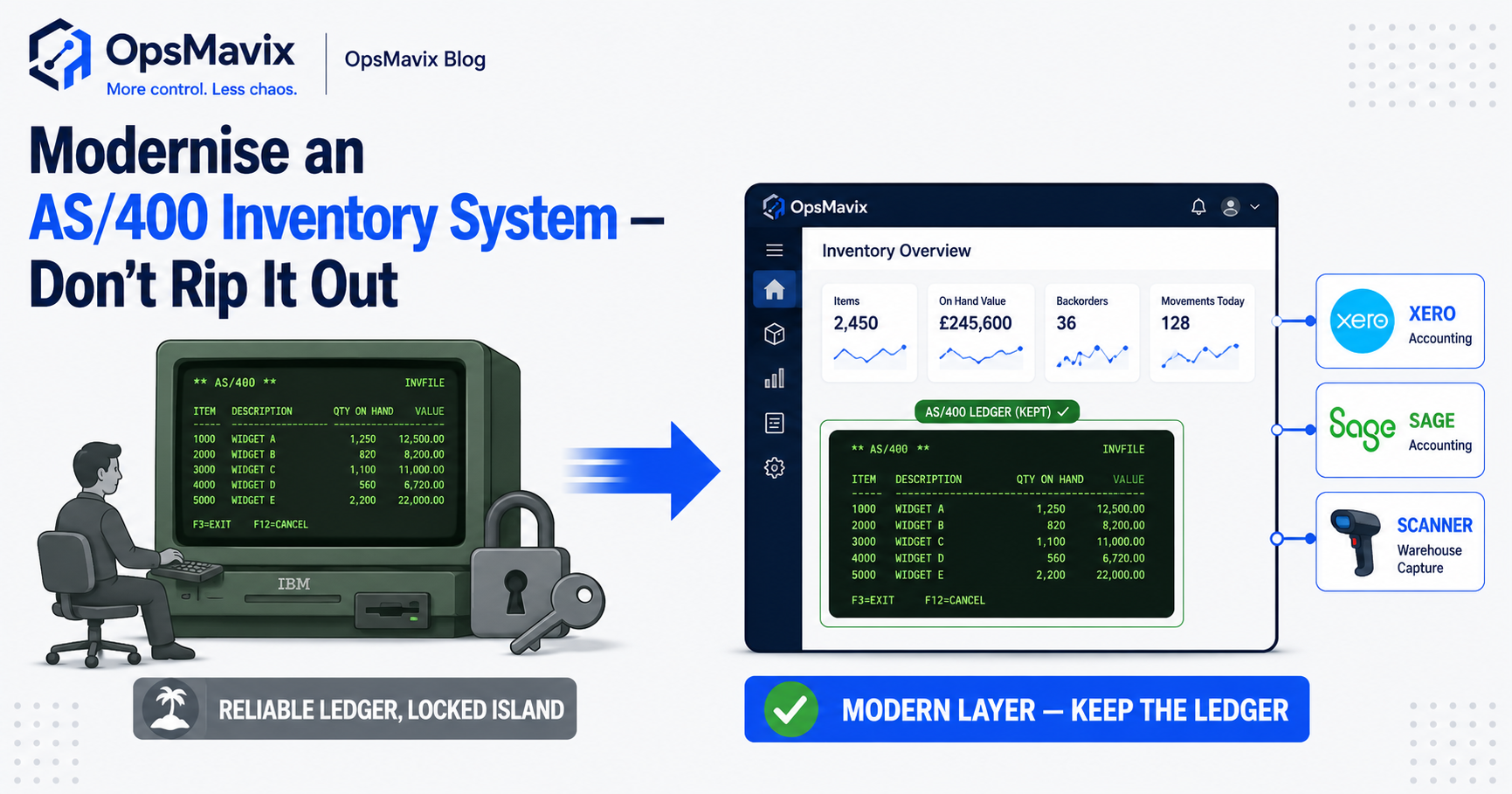
If you run an AS/400 inventory management system, you already know the paradox: it’s often the most reliable thing in the building and the biggest single point of failure at the same time. It keeps accurate stock and has done for twenty years — but only one or two people can use it, it won’t talk to anything modern, and you’ve bolted spreadsheets onto the side to get reports out of it. The fix usually isn’t ripping it out for a six-figure ERP. It’s modernising the layer around it: a web interface the whole team can use, live reporting, and connections to the tools you actually run now — built around the stock data the AS/400 already holds, and owned by you.
This post is about that decision. When a green-screen system has genuinely become a liability rather than an asset, why “rip it out and put in an ERP” is the riskiest option, and what modernising inventory around the iSeries looks like instead. The general build-vs-buy version of this is covered in custom inventory systems; this is the legacy-modernisation layer of it.
Key Takeaways
- An AS/400 isn’t bad software — it’s a closed island. The problem is access, reporting and integration, not accuracy.
- The real risk is key-person dependency: when the one operator who knows the green screen leaves, the knowledge leaves with them.
- “Rip it out for an ERP” is the highest-risk path — migrations of the system your stock runs on are where books get broken.
- A right-sized modern layer — web UI, live reports, connections to Xero/Sage and the warehouse — fixes the access problem without betting the business on a migration.
- Modernise the part that hurts (access, reporting, integration). Keep what works (the reliable stock ledger) until replacing it is genuinely worth it.
What’s Actually Broken Isn’t the AS/400 — It’s the Island It Sits On
Be fair to the iSeries: AS/400 systems are reliable, fast for the people who know them, and have tracked stock accurately for decades. The complaint is almost never “it gets the numbers wrong.” It’s that the system is a closed island. The interface is a green screen only a handful of long-serving staff can navigate, it won’t connect to your accounting tool or your warehouse scanners, and getting a report means exporting and rebuilding it by hand.
So the workarounds appear. Stock lives accurately on the AS/400, then gets re-keyed or exported into spreadsheets so anyone else can see it — and those “spreadsheet counts wind up being off, sometimes wildly so,” as one operator put it. You end up with a reliable ledger nobody outside the core team can reach, and a shadow layer of spreadsheets that drift from it. The accuracy is real; the access is the problem.
1The Real Risk Is Key-Person Dependency
The quiet emergency under most AS/400 inventory setups is people. The green screen is run by one or two staff who learned it years ago, and the operation depends entirely on them being there. When they retire or leave, the institutional knowledge — the codes, the screens, the quirks — walks out with them. You’re not running a stock system; you’re running a person who happens to know a stock system.
That’s the same dread manufacturers describe about “the entire shop is run from my head,” except here the head is one terminal operator and the whole warehouse leans on it. Modernising isn’t about chasing new features. It’s about getting the stock process out of one person’s memory and into a system the whole team can use, so a resignation isn’t a crisis.
2Why “Rip It Out for an ERP” Is the Highest-Risk Option
The instinct when a legacy system frustrates everyone is to replace the lot with a modern ERP. It’s also the most dangerous move you can make, because you’re migrating the system your stock — and often your whole order-to-cash — runs on. Decades of part numbers, history and quirks have to move without error, and the rollouts are brutal: operators describe an ERP switch as “a 4-week ordeal… too time invested to back out,” and the lock-in afterwards as paying “8 times more than Xero” for value that never shows up.
There’s a sharper failure too — building your future on a vendor who can pull the rug. Plenty have watched a replacement platform get sunset “by a banner on the vendor’s website,” which “invalidates two years worth of work.” Swapping a reliable green-screen island for a fragile, rented dependency isn’t modernisation; it’s trading a known limitation for an unknown risk. The honest framing is whether you need an operations system or a full ERP — and for most AS/400-era SMBs, the answer is the middle.
3Modernise the Layer, Not the Ledger
The middle path is to leave the reliable part alone and rebuild the part that hurts. The AS/400 keeps doing what it does well — the accurate stock ledger — while a modern layer sits over or beside it: a web interface anyone on the team can use, live dashboards instead of hand-built exports, and connections to the tools you run now. You modernise access, reporting and integration without touching the data integrity that earned the system its reputation.
Done right, the green screen stops being the thing everyone has to learn. The team works in a clean web view; the stock figure stays single and trustworthy; reports are there, not rebuilt. And because the modern layer is yours, there’s no per-seat creep and no vendor who can switch it off. That single-figure discipline is the same one behind why stock stops matching the system once data lives in disconnected places.
4Connect It to the Tools You Already Run
Half the pain of an AS/400 inventory system is that it sits apart from everything else. Orders get re-keyed out of it into accounting. Warehouse counts get typed back into it by hand. The point of modernising is to close those gaps — stock movements feeding through to Xero, Sage or QuickBooks without re-entry, scanners on the floor updating the same figure the office sees, reorder alerts firing off the real count.
This is exactly the connected-operations problem stock-holding businesses describe when they’re stuck “guessing and manually counting material” because the system can’t reach the floor. A right-sized modern layer turns the isolated ledger into a connected one, so site reality reaches the books on time and the office isn’t retyping the warehouse’s day. The shape of that connected system is our inventory automation system.
5When to Leave the AS/400 Alone (the Honest Bit)
Sometimes the right answer is to do less, not more. If the green screen works, the people who run it aren’t going anywhere soon, and nobody outside that team genuinely needs live access or reporting, then leave it be — adding a modern layer you don’t need is its own kind of leak. A stable AS/400 with no key-person risk and no integration pain is doing its job, and a rebuild for the sake of looking modern is the wrong spend.
The case to modernise earns its place when the maths tips: when the key-person risk is real, when the side-spreadsheets and manual exports cost more month after month than building the layer once, when the team genuinely can’t get at the data they need. Modernise then — and modernise the layer, not the ledger, so you’re never betting the whole operation on a single risky cutover.
Rip-and-Replace ERP vs Modernising Around the AS/400
| Rip-and-Replace ERP | Modern Layer Around the AS/400 | |
|---|---|---|
| What changes | Everything at once — data, process, tool | Access, reporting and integration only |
| Migration risk | High — the system your stock runs on moves | Low — the reliable ledger stays put |
| Key-person risk | Solved, but via a brutal cutover | Solved — team uses a modern web view |
| Cost shape | Six-figure licence + implementation partner | Fixed build (£3k–£25k range), you own it |
| Lock-in | Vendor controls it; sunset risk | You hold it; nothing to switch off |
| Right when | The AS/400 genuinely can’t hold the data | Ledger works; access and integration don’t |
FAQ
Can you modernise an AS400 inventory management system without replacing it?
Yes — that’s usually the lower-risk path. You keep the reliable AS/400 stock ledger and build a modern layer around it: a web interface the whole team can use, live reporting instead of hand-built exports, and connections to your accounting tools and warehouse scanners. You fix the access, reporting and integration problems without migrating the data the business depends on.
Why not just replace the AS/400 with a modern ERP?
You can, but it’s the highest-risk option, because you’re migrating the system your stock and often your order-to-cash run on. Operators describe ERP rollouts as multi-week ordeals you can’t back out of, with costs many times the old setup, and some watch a new platform get sunset by the vendor afterwards. Replacing all at once makes sense only when the AS/400 genuinely can’t hold the data anymore — not just because it looks dated.
What’s the biggest risk of staying on an AS/400?
Key-person dependency. Most green-screen systems are run by one or two long-serving staff, and the operation leans entirely on them. When they retire or leave, the knowledge goes with them. Modernising the layer around the system gets the stock process out of one person’s head and into something the whole team can use, which is the real reason to act.
Will a modern layer connect to Xero, Sage or QuickBooks?
Yes — that’s a core reason to build one. The point of modernising is to close the gaps where data gets re-keyed: stock movements feeding accounting without re-entry, scanners updating the same figure the office sees, reorder alerts firing off the real count. A right-sized system connects to the tools you already run instead of forcing a rip-and-replace.
Is modernising cheaper than a new ERP?
On total cost, usually yes. A modern layer is a fixed build you own, sitting over a ledger that already works. A full ERP adds an implementation partner, per-seat fees, annual modules and migration risk. When the AS/400 still keeps stock accurately and the real problem is access and integration, modernising the layer is the lower-cost, lower-risk move over a few years.
How OpsMavix Can Help
OpsMavix builds right-sized inventory systems for businesses running stock on legacy platforms like the AS/400 — too reliant on the green screen to rip it out, too constrained to leave it isolated. We modernise the layer that hurts: a web interface the whole team can use, live reporting instead of hand-built exports, connections to your accounting tools and warehouse, all built around the stock data you already trust. No risky all-at-once migration, no implementation partner on retainer, and nothing a vendor can switch off, because you own it.
If your AS/400 keeps the stock straight but locks everyone else out, start by seeing where that’s actually costing you. Book an Operations Leak Audit and we’ll map where access, reporting and key-person risk break down today, what it’s costing you, and whether modernising the layer or a bigger change is the genuine fit.