
AI Stock Control: What It Actually Does (and What It Can't Fix)
AI stock control is being sold as the cure for phantom stock and overselling. It isn't — not on its own. Here's where AI genuinely helps (demand forecasting, anomaly flags), where it does nothing (a count that's wrong at source), and the unglamorous fix that has to come first: stock data you can actually trust.
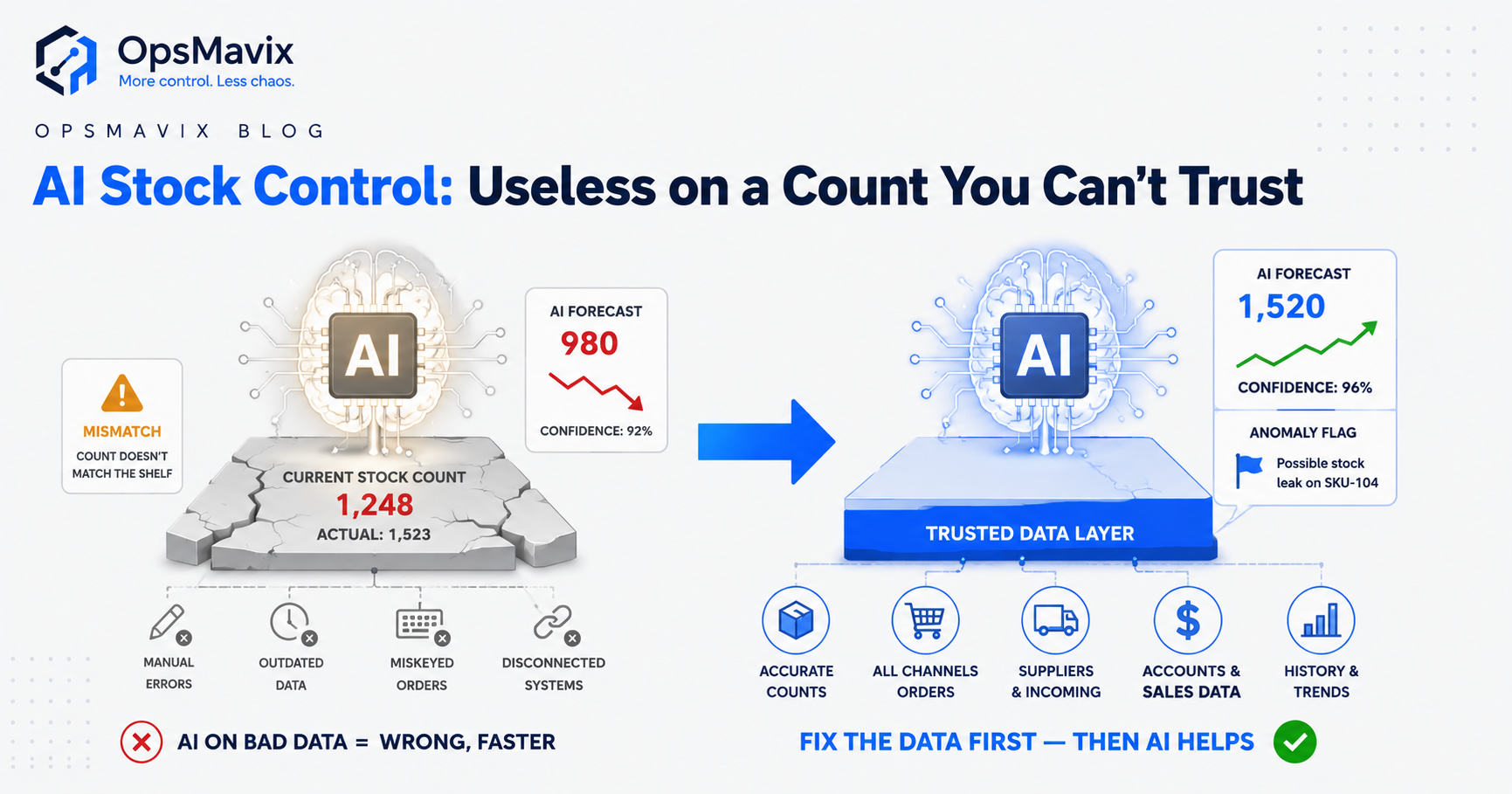
AI stock control works on exactly one condition: the stock data feeding it is true. AI can forecast demand, flag a count that looks wrong, and spot the slow drift toward a stockout before you’d see it by eye — all genuinely useful. What it cannot do is fix a number that’s wrong at source. If your shelf says 40 and the system says 60, no model corrects that gap; it just predicts confidently on top of a lie. So the honest answer to “should I buy AI stock control” is: only after your stock numbers are trustworthy and your systems are connected. AI is downstream of clean data. Get that backwards and you’ve bought a faster way to be wrong.
This post separates where AI genuinely earns its place in stock control from where it’s marketing pasted over an unsolved data problem. If your real issue is that stock never matches the system, AI is not your first purchase — and we’ll be specific about why.
Key Takeaways
- AI in stock control is real for two jobs: demand forecasting and anomaly detection (flagging counts and movements that look wrong). Both are useful.
- AI cannot fix a count that’s wrong at the source. Garbage in, confident garbage out — now with a forecast attached.
- Most “we need AI” stock problems are actually data problems: untrusted numbers, manual counts, and disconnected systems that don’t agree.
- The boring fix has to come first — accurate, connected, real-time stock data. AI is what you add on top once the base is solid, not instead of it.
- Buying AI to paper over phantom stock just makes the wrong number arrive faster and with more authority.
What “AI Stock Control” Actually Means
Strip the marketing and AI stock control covers a narrow, real set of things: predicting how much you’ll sell (demand forecasting), suggesting reorder points and quantities from that prediction, and flagging anomalies — a stock movement, count, or value swing that breaks the pattern. That’s it. That’s the genuine surface area. Everything else sold under the label tends to be ordinary inventory software with “AI” stapled to the homepage.
None of that is fake or useless. Forecasting and anomaly flags are exactly the kind of pattern-work models are good at. The problem isn’t the capability — it’s the order of operations. All of it assumes the numbers going in are accurate. And for most stock-holding businesses, that assumption is precisely the thing that’s broken.
1The Real Problem Is Usually the Data, Not the Intelligence
When a business reaches for AI stock control, the felt problem is almost never “our forecasting model isn’t sophisticated enough.” It’s that the number on the screen doesn’t match the shelf, and nobody trusts either one. One inventory manager we spoke to put the daily reality plainly: they would “consistently oversell items we didn’t even have on hand,” the count scattered across “a million messy spreadsheets for the warehouse,” the number on screen never matching the shelf.
No forecasting model fixes that. The number is wrong before any AI touches it. You can bolt the cleverest demand prediction in the world onto a system that thinks you have 60 of something you have 40 of, and it will cheerfully recommend you don’t reorder — right up until you stock out. The intelligence layer is fine. The data layer underneath it is the leak. AI applied to bad data doesn’t clean the data; it inherits it.
2Garbage In, Confident Garbage Out
The danger isn’t that AI fails loudly on bad data. It’s that it fails quietly and convincingly. A spreadsheet that’s wrong looks wrong — you sense the mess. A model that’s wrong produces a clean chart, a confident reorder suggestion, a tidy forecast. It launders bad numbers into something that looks authoritative, which makes the error harder to catch, not easier.
Operators already live with numbers that drift for no reason. As one described phantom stock: “inventory numbers change for no reason” — an “$80k value difference that cannot be explained.” Feed that into an AI stock control layer and you don’t get an explanation. You get a forecast built on the unexplained swing, presented as fact. The model can’t know the count was wrong; it only knows the data it was given. Confidence is not accuracy, and AI is very good at producing the former without the latter.
3Where AI Genuinely Helps (Once the Data Is Clean)
Be fair to AI — when the base is solid, it earns its place. Two jobs in particular:
Demand forecasting. Once your sales and stock history is accurate, a model can read seasonality, trend, and velocity better than a human eyeballing last year’s numbers, and turn that into sharper reorder points. Less dead stock on slow lines, fewer stockouts on bestsellers. This is real value — on clean history.
Anomaly detection. This is the underrated one. A model trained on your normal movement patterns can flag a count or a stock movement that doesn’t fit — the variance that would otherwise hide until month-end. Used this way, AI isn’t replacing your data; it’s policing it, surfacing the suspect number so a human can check the shelf. That’s AI working with trustworthy data to keep it trustworthy.
The common thread: AI is most useful as a layer that sharpens and watches good data — not as a substitute for having any.
4The Unglamorous Fix That Has to Come First
Before any of the above pays off, the stock number has to be right at source and the same everywhere it appears. That’s not an AI problem; it’s an operations and systems problem, and it’s the one most businesses skip because it’s boring. It means stock movements captured as they happen — receiving, picking, dispatch — instead of reconstructed later from memory and a spreadsheet. It means your sales channels, your stock system, and your accounts agreeing on one figure instead of three.
This is where the actual leak lives. The reason the number lies is usually that it’s entered manually, late, in more than one place, by people doing it between fires — “guessing and manually counting material.” Fix the capture and the connection, and the count stabilises. Then a forecast means something and an anomaly flag has a baseline to flag against. Skip it, and you’ve bought intelligence with nothing intelligent to read. The honest sequence is trustworthy, connected stock data first — AI second.
When AI Helps vs When It’s Hype
| The situation | Is AI the answer? | What actually fixes it |
|---|---|---|
| Stock never matches the shelf | No | Accurate capture at source — movements logged as they happen |
| Numbers differ across channels/accounts | No | Connected systems agreeing on one figure |
| Manual counting, untrusted numbers | No | Real-time stock tracking, not a model on top of bad data |
| Reorder points feel like guesswork (on clean data) | Yes | Demand forecasting from accurate sales history |
| Variance hides until month-end (on clean data) | Yes | Anomaly detection flagging suspect counts early |
| “We bought AI but it still oversells” | No | The data was wrong before AI saw it — fix the base |
FAQ
Does AI stock control fix overselling and phantom stock?
Not on its own. Overselling and phantom stock are caused by the system number not matching the physical shelf — a data-accuracy problem at source. AI forecasts and flags based on the data it’s given; if that data is wrong, the forecast is wrong too. The fix is accurate, real-time stock capture and connected systems first. AI is something you add once the underlying number is trustworthy, not a cure for an untrustworthy one.
Is AI stock control just marketing hype?
Partly. There’s a genuine core — demand forecasting and anomaly detection are real, useful things AI does well. But a lot of software simply labels ordinary inventory features “AI” to sell. The test is simple: ask what it actually predicts or flags, and whether it depends on your stock data being accurate. If the answer dodges the data question, you’re looking at hype pasted over an unsolved problem.
What do I need before AI stock control is worth it?
A stock number that’s right at source and consistent everywhere it appears. That means movements captured as they happen, and your sales channels, stock system, and accounts agreeing on one figure. With that base, AI forecasting and anomaly flags have clean history to work from. Without it, you’re paying for intelligence that reads bad data and reports it back confidently. Get the data trustworthy and connected first.
Can a smaller business benefit from AI in stock control?
Yes — but usually not as the first move. Most small and mid-sized stock businesses don’t have a forecasting problem; they have a trust problem with their numbers. Solve that, and forecasting plus anomaly detection become a worthwhile upgrade rather than an expensive distraction. The sequencing matters more than the size of the business: fix the base, then add the layer that makes good data work harder.
Will AI replace cycle counting?
No — it makes counting smarter, not optional. Anomaly detection can flag which SKUs look suspect so you count those first instead of everything blindly, which is a real efficiency gain. But you still need physical truth to anchor the system, because AI can only flag a count it thinks is wrong; it can’t walk the aisle and verify. Pair it with a sane cycle-count process — AI directs the count, it doesn’t remove it.
How OpsMavix Can Help
OpsMavix builds the layer AI stock control depends on and most businesses are missing: stock data you can actually trust. We start where the leak is — capturing movements as they happen across receiving, picking and dispatch, and connecting your channels, stock system and accounts so one number means the same thing everywhere. That’s the unglamorous base that makes overselling and phantom stock stop, with or without AI. Once that’s solid, forecasting and anomaly flags become a genuine upgrade rather than an expensive layer over a broken count. You own the system outright — no per-seat fees, nothing a vendor can switch off.
If you’re being sold AI as the fix for stock that never matches the shelf, the honest first step is finding out where the number actually breaks. Book an Operations Leak Audit and we’ll map where your stock data goes wrong at source, what the gap is costing you, and whether AI belongs anywhere near it yet.