
The Cost of Purchase Order Approval Delays: An £8M Multi-Site Operation, Priced
£92,000 a year, on the numbers below
A multi-site manufacturer turning over £8M a year runs purchase approvals through email, across five approvers and 40 active suppliers. Priced out, the wait costs roughly £92,000 a year. Every input and every calculation is shown so you can re-run it on your own numbers.
- Vertical
- Multi-site manufacturing
- Revenue
- £8M / yr
- Team
- 5 approvers, 2 buyers
- Suppliers
- 40 active
- Stack
- Email approvals + accounting package + shared spreadsheets
How to read this. This is a worked example of a representative operation — not a named client. Every figure is a transparent calculation you can re-run against your own numbers. No testimonials, no invented results.
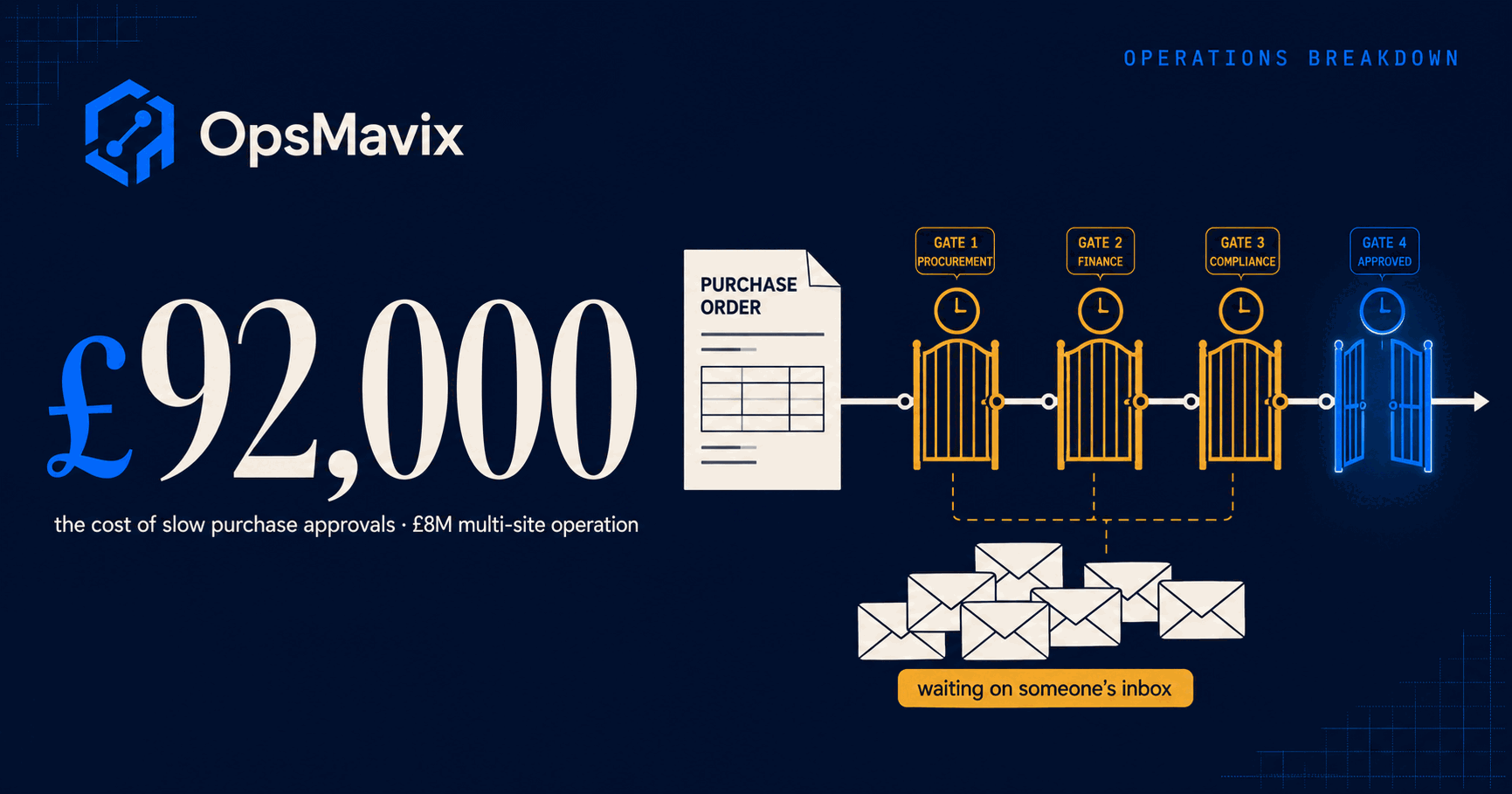
Quick summary: A multi-site manufacturer turning over £8M a year, approving purchase orders by email across five approvers and 40 active suppliers, loses roughly £92,000 a year to the wait itself. It splits three ways — about £42,000 chasing approvals, about £28,000 in expedite and rush fees on orders that left late, and about £22,000 in maverick spend and missed supplier terms.
The setup
Three sites. One central buying function of two people, sitting at the largest site. A production supervisor at each site raises a requisition — sometimes on a form, more often as an email with a photograph of a handwritten note or a line pasted out of a spreadsheet. The buyer turns it into a purchase order in the accounting package, then emails it for approval. Below £2,000 the site manager signs it off. Above that it goes to the operations director. Above £10,000 it goes to the managing director. Capital items need two signatures. Nobody wrote this policy down in one place; it lives in the heads of the five people who apply it.
Nothing here is visibly broken. The orders do get approved. The suppliers do get paid. The sites do get their material, most of the time. The buyers are competent and the approvers are not obstructive — they are just in meetings, on the shop floor, or on a plane. That is exactly why this leak survives for years: there is no incident, no dropped ball anyone can point at, no line on the profit and loss account called “waiting”. There is only a purchasing team that always seems busy, a freight bill that is always a bit higher than budget, and three sites that have quietly learned to order early and hold more stock than they need. The cost is real and it is large. It is simply distributed across other people’s cost codes.
1Chasing approvals — ≈ £42,000
The visible half of this leak is chase time. A requisition goes out for approval on a Tuesday. On Thursday the buyer forwards it again with “any chance of a look at this?”. On Friday she catches the operations director in the corridor. Meanwhile the site supervisor emails her twice asking where it is, because his own reputation is on the line if the line stops. When the approval finally comes back it is a one-word reply on a thread that has forked into three versions, and the buyer has to work out which one is current before she can release the order.
The approvers pay too, and they pay more than anyone counts. An approval email that arrives with no supplier context, no budget position and no history means the approver has to reconstruct the decision from scratch — open the accounting package, check what was paid last time, check whether this site already ordered the same thing last month. Two minutes of clicking becomes fifteen minutes of investigation, five approvers deep, all week. Then the whole thing repeats downstream when the invoice arrives and nobody can find the approval that authorised it, which is the same pathology described in invoice approval delays.
- Two buyers chasing approvals: 2 × 5 hrs/week = 10 hrs/week × 46 working weeks = 460 hours
- Five approvers reconstructing context before signing: 5 × 2 hrs/week = 10 hrs/week × 46 weeks = 460 hours
- Site supervisors re-raising and re-sending stalled requisitions: 2 hrs/week × 46 weeks = 92 hours
- Total ≈ 1,012 hours, call it 1,000 hours a year
- At a loaded cost of £22/hour (ONS median full-time hourly pay of £19.67 plus employer National Insurance and pension) → £22,000
- Plus the cycle-time drag: the published median requisition-to-PO time is 55 hours; this operation runs closer to five working days. The extra three days of lead time on every order gets absorbed as buffer stock, shorter production runs and small schedule slips. Charged conservatively at 0.25% of £8M turnover → £20,000
Leak 1 total: ≈ £42,000 a year.
2Expedite and rush fees on late orders — ≈ £28,000
This is the part that shows up on a real invoice, which is why finance sees it and misattributes it. It gets filed as a freight problem, or a supplier problem, or a planning problem. It is none of those. It is the approval delay arriving three days later, wearing a courier’s uniform.
The mechanism is simple. The requisition was raised with enough lead time. The approval took four days. The order left late. Now the delivery date the site planned around is unachievable at standard freight, so the buyer pays to pull it forward — expedited pallet service instead of standard, or a dedicated van instead of a consolidated run. A handful of times a year it is worse: a line is down, and someone books a same-day dedicated vehicle or an air movement at whatever it costs. Nobody ever traces that £600 back to the two days an email sat unread. Without a purchase order tracking system that timestamps each stage, the causal link is invisible even to the people paying for it.
- Roughly 1,200 purchase orders a year across 40 active suppliers
- About 12% go out late enough that the delivery has to be pulled forward → 144 orders
- Standard inbound freight on those orders averages £320
- Expedited premium at 45% (mid-point of the published 30–60% expedited LTL range) → +£144 per order
- 144 orders × £144 = £20,736
- Plus around 12 genuine emergency movements a year — next-day dedicated vehicle or air — at roughly £600 premium each = £7,200
- £20,736 + £7,200 = £27,936
- Cross-check: 0.35% of £8M turnover = £28,000
Leak 2 total: ≈ £28,000 a year.
3Maverick spend and missed supplier terms — ≈ £22,000
When the approved route is slow, people build an unapproved one. It is not defiance; it is a supervisor with a machine that needs a part today and an approval queue that runs in days. So he buys it on a company card from a trade counter at list price, or rings the supplier direct and asks them to send it, invoice to follow. The order is real, the need is real, and the price is 10–20% above what the central buyer had negotiated for exactly that item. Multiply by three sites and a year.
The second half is quieter. Several suppliers offer settlement discounts — the standard 2% for payment inside 10 days. Capturing that discount requires the whole chain to run on time: PO raised, goods receipted against it, invoice matched and approved, payment released inside the window. When the PO went out four days late, the goods arrive late, the receipt is late, and the invoice lands with an approval window already half gone. The discount lapses. Nobody records a lapsed discount anywhere; it simply never appears. Tightening three-way matching is what makes it visible in the first place.
- Purchasing spend (direct and indirect) at roughly 40% of turnover = £3.2M
- Off-contract, unapproved buying at 2.5% of that spend = £80,000
- Average price premium on off-contract purchases, 15% → £12,000
- Suppliers offering early-settlement terms cover about 25% of spend = £800,000
- Discount missed on 60% of that value because the chain ran late = £480,000 × 2% → £9,600
- £12,000 + £9,600 = £21,600
- Cross-check: 0.275% of £8M turnover = £22,000
Leak 3 total: ≈ £22,000 a year.
The total: ≈ £92,000 a year
£42,000 + £28,000 + £22,000 = £92,000, on an £8M turnover. That is roughly 1.15% of revenue. Assume a net margin of 6–8% — substitute your own, this is an assumption and not a benchmark — and £8M of turnover produces £480,000 to £640,000 of profit, which puts the leak somewhere between a seventh and a fifth of it.
None of it appears as a line on the profit and loss account. There is no cost code called “approval delay”. The £42,000 is buried inside salaries that would be paid anyway. The £28,000 sits in a freight line that gets explained as carrier pricing. The £22,000 is split between a purchasing variance nobody reconciles at item level and a discount that was never taken so was never recorded. Every pound of it is real and every pound of it is invisible in the accounts, which is precisely why it survives for five years in a business where everyone is competent and nothing is on fire.
Where these numbers come from
Every input above is either an internally consistent assumption stated in full, or it is anchored to a published benchmark. Here are the anchors.
- Cycle time — the 55-hour median. Procurify’s 2026 Procurement Benchmark & KPIs report, drawn from anonymised customer data, puts the median requisition-to-PO cycle at 55 hours, with the fastest organisations under 40 hours and manufacturing among the faster sectors. An operation running five working days sits well behind that median, which is what justifies charging the extra lead time in Leak 1.
- What a single PO costs to process. ProcureDesk’s summary of the benchmark data reports CAPS Research figures spanning roughly £40–£560 per purchase order (converted) and APQC figures of roughly £27–£381 (converted). Note the honest caveat: the CAPS survey itself is subscriber-gated, so this is an accessible secondary report of it, and the spread is enormous — from under £30 to over £550 for what is nominally the same transaction. That spread is the point. It is why this breakdown builds the labour cost from hours and a rate rather than importing an average.
- The £22/hour loaded rate. ONS Annual Survey of Hours and Earnings, April 2025 puts median gross hourly pay excluding overtime for UK full-time employees at £19.67. Adding employer National Insurance and pension contributions puts the fully loaded cost at roughly £22 for the buyer and supervisor roles doing most of the chasing. Approvers cost more than that, so this is the conservative end.
- The expedited freight premium. Pinnacle’s expedited freight cost guide puts expedited LTL at a 30–60% premium over standard LTL rates, dedicated solo-driver trucks at 50–100%, and air freight at 300–1,000% over standard ground. Leak 2 uses 45% — the mid-point of the lowest of those bands — for the routine cases, and a flat £600 for the genuine emergencies rather than applying an air-freight multiple.
- Off-contract buying. Art of Procurement, citing The Hackett Group, reports organisations losing as much as 16% of negotiated savings to maverick buying, with top performers hitting 91% on-contract compliance against a peer average of 74%. Leak 3 assumes 2.5% of spend goes off-contract — comfortably inside that peer gap, and modest for a three-site operation where the approved route takes days.
Where a source figure was published in US dollars it has been converted to sterling at approximately 1.33 dollars to the pound and marked “(converted)”. Rounded figures are rounded down, not up.
What closing it looks like
- The chase disappears, not the approval. Approvals still happen and the thresholds still apply — they just happen inside a queue that shows every approver what is waiting, how long it has waited and what it is for, instead of inside five separate inboxes.
- Approvers stop investigating. The request arrives with the supplier, the last price paid, the budget position and the requesting site attached, so signing takes seconds rather than a reconstruction exercise. This is the same principle that speeds up invoice approvals at the other end of the chain.
- Expedite fees stop being routine. They do not go to zero — genuine emergencies exist — but when orders leave on the day they were raised, the standing 12% expedite rate collapses to the handful of real ones.
- Off-contract buying loses its excuse. A supervisor who can get a same-day approval on his phone has no reason to walk into a trade counter, and the negotiated prices actually get used.
- Payback, honestly. A right-sized approvals system for an operation this shape is a Starter Fix or small Growth System build. Against a £92,000 annual leak it typically pays back inside the first year, most often on the chase time alone — but that assumes the approval thresholds are enforced afterwards. A system nobody follows recovers nothing, and any honest assessment says so upfront.
FAQ
Is this a real client?
No. It is a representative worked example built from a composite of common operating patterns, not a named customer, and nothing here should be read as a case study. Every input — hours, rates, order volumes, percentages — is stated in the open precisely so you can substitute your own figures and re-run it. If your numbers produce a smaller total, that is a useful answer too.
What is the cost of purchase order approval delays in a smaller business?
It scales roughly with turnover and with the number of approval hops, not with headcount. A £2M single-site operation with two approvers will see a fraction of the £92,000 — the chase hours fall, and expedite volume falls with order volume. But the ratio holds surprisingly well: around 1% of turnover is a reasonable first estimate anywhere the approval route runs through email and the approvers are also doing another job. Run the calculator below with your own revenue and rate rather than scaling this one.
Isn’t this just an argument for buying procurement software?
Not necessarily. Most of this operation’s £92,000 comes from three things a full procurement suite is oversized for: a request that carries its own context, a queue everybody can see, and a timestamp on each stage. Businesses at this size are usually too messy for spreadsheets and not ready for a full ERP — the fix is an owned operations system sized to the actual approval flow, integrated with the accounting package already in use, rather than a platform whose licence and implementation cost eats the saving it was bought to produce.
Why price the delay rather than fix the process first?
Because a process change nobody has costed is an opinion, and opinions lose to whoever is loudest in the room. Once the wait has a number against it, the argument changes shape: the question stops being “should we tighten approvals” and becomes “is the fix cheaper than £92,000 a year”. That is a decision a managing director can make in one meeting.
Run the same maths on your operation
The defaults reproduce the worked example above exactly — same formulas, nothing hidden. Move them to your own figures and every line recomputes.
- Chasing and re-sending approvals£42,000
- Expedite and rush fees on late orders£28,000
- Maverick spend and missed supplier terms£22,000
Each leak = (hours a year × team size ÷ 5 × hourly cost) + (revenue × that leak's share). Hours scale with the admin team, the rest with turnover. Illustrative, and deliberately simple enough to argue with.
The Approval Delay Worksheet
The same breakdown as a one-page PDF — the figures, the maths, and the assumptions behind them. No email needed.
Download the PDF (free) ↓The full cost model
The full model: every line item, the sensitivity ranges, and the worksheet to run it on your own numbers. We email it to you — one confirm click, unsubscribe anytime.