
The Cost of Overselling Across Channels: A £2M Multi-Channel Seller, Priced
£58,000 a year, on the numbers below
A £2M multi-channel consumer goods seller running Shopify, Amazon and eBay on four people and 4,000 SKUs. Overselling costs it roughly £58,000 a year across cancellations, manual stock syncing and lost ranking. Every input is shown so you can re-run it on your own numbers.
- Vertical
- Multi-channel consumer goods
- Revenue
- £2M/yr
- Team
- 4 people
- SKUs
- 4,000
- Stack
- Shopify + Amazon + eBay
How to read this. This is a worked example of a representative operation — not a named client. Every figure is a transparent calculation you can re-run against your own numbers. No testimonials, no invented results.
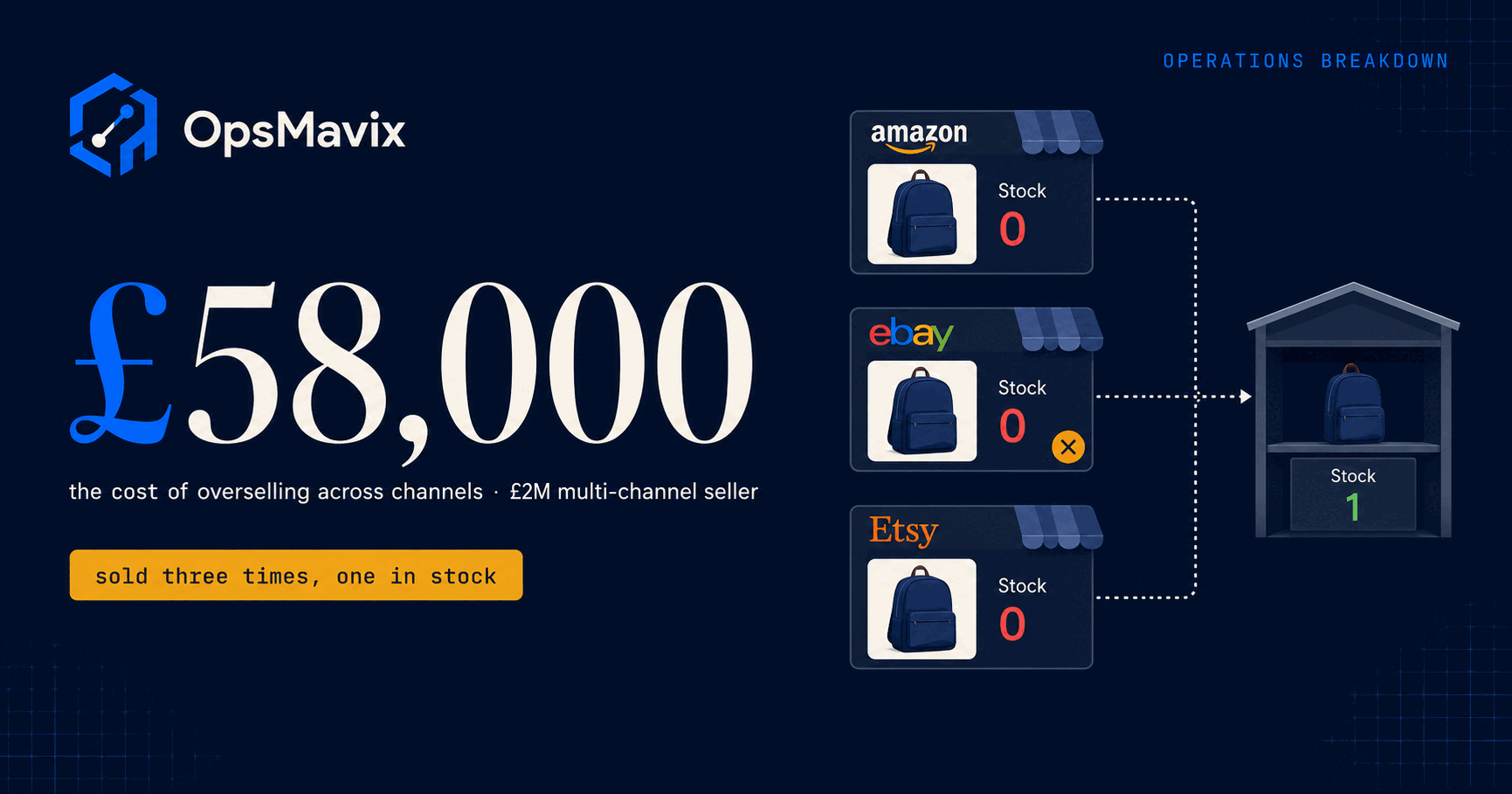
Quick summary: A £2M-a-year multi-channel consumer goods seller — four people, 4,000 SKUs, selling on Shopify, Amazon and eBay — loses roughly £58,000 a year to overselling. That total is made up of £26,000 in oversell cancellations, £17,200 in manual channel syncing, and £14,800 in lost ranking and repeat custom.
The setup
Forty thousand orders a year at an average order value of £50. The split is roughly 45% Shopify (£900,000), 40% Amazon (£800,000) and 15% eBay (£300,000). Four people run the whole thing: a founder who still does buying, one person on customer service, and two on picking, packing and goods-in. Stock lives in one small unit. There is no warehouse management system. The master stock figure lives in a spreadsheet that gets reconciled against the Shopify admin most mornings, and Amazon and eBay quantities are pushed up by hand or by a basic feed that runs on a schedule.
Nothing here is visibly broken. Orders ship. Customers mostly get their parcels. The spreadsheet is well built and the person maintaining it is good at it. That is exactly why the leak survives: every symptom shows up as a normal day’s work — a cancellation email, twenty minutes tidying quantities before the courier collection, a slightly disappointing month on Amazon. None of it has a name, so none of it has a number, so nobody has ever added it up.
1Oversell cancellations — ≈ £26,000
The mechanics are always the same. The last three units of a SKU sell on Shopify at 14:10. The Amazon feed last ran at 13:00 and next runs at 16:00. In that window Amazon sells one of the units that no longer exists. Someone in customer service finds out at 16:40 when the pick list comes back short, emails the customer, cancels the order, processes the refund, and — because this is Amazon — absorbs a pre-fulfilment cancellation against the account. On a busy week it happens six or seven times. On the week after a bank holiday, more.
Each incident is not one action, it is a chain: locate the shortfall, check whether stock is genuinely missing or just mis-synced, contact the customer, decide whether to source a replacement, cancel or refund, adjust the quantity everywhere, and answer the follow-up message. Forty-five minutes is a fair average once the follow-ups are counted.
- Orders a year: 40,000 (£2,000,000 ÷ £50 average order value)
- Oversell rate assumed: 1% of orders → 400 oversold orders a year
- Handling time per incident: 45 minutes (investigate, contact, refund, re-sync, follow up)
- Labour: 400 × 0.75 hrs = 300 hours × £20/hr = £6,000
- Order value reversed: 400 × £50 = £20,000 — 1.00% of turnover
- £6,000 + £20,000 = £26,000
Leak 1: ≈ £26,000 a year.
A note on the £20,000, because this is where most vendor articles quietly cheat. That figure is the full order value that reverses out, not the gross margin on it. We count the whole thing because an oversold multi-channel order is rarely recovered — the customer does not wait, they buy the same item from the next seller, and the acquisition spend that produced the order is spent either way. If you would rather count gross margin only, at a 40% margin leak 1 falls to about £14,000 and the headline total falls to about £46,000. Both numbers are defensible. Pick one and be consistent.
2Manual channel sync — ≈ £17,200
Because nobody trusts the feed, somebody checks it. Every morning one person exports the Shopify inventory, compares it against the spreadsheet, and corrects whatever drifted overnight — returns that were received but not put back, a multipack that decrements the wrong component, an Amazon FBM order that came in after the last push. Then the fast movers get a manual look, because the fast movers are the ones that actually oversell. Goods-in triggers another pass: units land, they get counted, and the quantities are typed into three places.
There is a second, quieter cost sitting underneath the hours. Because the sync cannot be trusted, the operator holds a buffer back. The last two or three units of a fast-moving SKU never go live on Amazon or eBay. That buffer is the price of avoiding the cancellation — and it is paid in orders that the channel would have taken and never got to offer.
- Daily cross-channel reconciliation: 45 min × 5 days × 48 weeks = 180 hours
- Re-keying quantities after goods-in and returns: 30 min × 5 days × 48 weeks = 120 hours
- Weekly sweep of the top 500 SKUs: 2 hrs × 48 weeks = 96 hours
- Month-end variance investigation: 4 hrs × 12 months = 48 hours
- Extra checking through 8 peak weeks: 2 hrs × 8 = 16 hours
- Total: 180 + 120 + 96 + 48 + 16 = 460 hours × £20/hr = £9,200
- Suppressed sales from safety buffers held back from channels: ~160 orders a year (about three a week) × £50 = £8,000 — 0.40% of turnover
- £9,200 + £8,000 = £17,200
Leak 2: ≈ £17,200 a year.
Four hundred and sixty hours is a quarter of a full-time role, spent producing no new value — just keeping three systems from disagreeing with each other. The same pattern shows up in any operation where the stock never matches the system: the reconciliation work grows to fill whatever gap the tooling leaves.
3Lost ranking and repeat custom — ≈ £14,800
This is the leak nobody bills for and everybody feels. Overselling is not just a refund; on marketplaces it is a scored event. Amazon measures a Cancellation Rate over a rolling 7-day window, and eBay treats a seller cancelling because an item is out of stock as a transaction defect. Both scores affect what the channel does with your listings afterwards.
Spread evenly, 400 cancellations a year across 40,000 orders is 1% — comfortably inside Amazon’s threshold. But they are not spread evenly. They cluster in the weeks after a big sales spike, which is precisely when a 7-day window is unforgiving. Two bad weeks a year is all it takes, and the recovery is not instant: the listings that lost visibility do not get it back the day the metric clears.
- Lost repeat custom: £7,000. 400 affected customers a year. Baseline 12-month repeat rate assumed at 35%; assume it halves for this cohort → 70 customers lost × 2 further orders each × £50.
- Amazon visibility: ≈ £4,600. Amazon is 40% of turnover — £800,000/yr, about £15,400 a week. Two bad weeks push the Cancellation Rate past its limit; assume roughly six weeks of suppressed Featured Offer share at a 5% conversion hit → 6 × £15,400 × 5%.
- eBay standing: £3,200. eBay is 15% of turnover — £300,000/yr, about £25,000 a month. One monthly evaluation cycle spent Below Standard means lower search placement and higher final value fees; assume a 12.8% hit to that month’s eBay sales.
- £7,000 + £4,600 + £3,200 = £14,800 — 0.74% of turnover
Leak 3: ≈ £14,800 a year.
The Amazon and eBay lines are the ones people argue with, and they should — they are the least precise numbers here. But they are also the only ones with a hard policy floor underneath them: both platforms publish what happens when the metrics slip, and neither consequence is “nothing”. Halve both estimates if you like; the leak is still five figures.
The total: ≈ £58,000 a year
£26,000 + £17,200 + £14,800 = £58,000. On £2M of turnover that is 2.9% — for a business running at, say, an 8% net margin, it is more than a third of the profit.
Not one pound of it appears as a line on the P&L. There is no “overselling” account code. The £6,000 of incident handling is inside salaries. The £9,200 of reconciliation is inside the same salaries. The £20,000 of reversed orders shows up as revenue that simply never arrived, which is invisible by definition. The £8,000 of buffered stock and the £14,800 of lost ranking are counterfactuals — sales that would have happened. A leak with no line item generates no owner, no review and no fix. That is why operations like this one carry it for five years without noticing.
Where these numbers come from
The £-per-hour and the platform consequences are anchored to real published sources. The behavioural assumptions are ours, and marked as such.
- £20 an hour. ONS Annual Survey of Hours and Earnings 2025 puts median gross hourly pay excluding overtime for full-time employees at £19.67 in April 2025, and median gross annual pay at £39,039 for full-time employees in the same job for at least a year — roughly £20 an hour on a 1,950-hour year. We use £20 flat. It is a conservative figure for a small ops team once employer NI and overheads are added. (ONS, Employee earnings in the UK: 2025)
- Amazon’s thresholds are policy, not opinion. Amazon’s Order Performance programme policy states plainly: “Our policy is that sellers maintain an Order Defect Rate under 1% in order to sell on Amazon” and “Our policy is that sellers maintain a CR that is under 2.5% in order to sell on Amazon. A CR above 2.5% may result in loss or restriction of selling privileges.” The Cancellation Rate is measured over a 7-day period and covers seller-fulfilled orders — which is why clustering matters more than the annual average. (Amazon, Order Performance programme policy)
- An out-of-stock cancellation is a defect on eBay. eBay’s own order cancellation policy lists the reason “The item is out of stock (this will result in a transaction defect and affect your performance and Seller Level).” (eBay, Order cancellation policy)
- What Below Standard actually costs. eBay: “you may be charged higher final value fees, lower your selling limits, your funds from your orders may be placed on hold, eBay may place selling restrictions on your account.” That is the basis for the £3,200 eBay line — a real, published set of consequences rather than a vague “reputation damage”. (eBay, The ABCs of metrics and defects)
- Order failures do dent shopper trust. A Brightpearl survey of 2,000 consumers (results reported by UK region) found 24% had been let down by an online order, and 34% said unreliable delivery had lessened their trust in online shopping. It supports the direction of the repeat-custom assumption; it does not measure lost repeat orders, so we state our own number openly instead. (Brightpearl consumer survey, Feb 2021)
Two figures that circulate widely on this topic we could not verify and therefore did not use: “£20–£120 per overselling incident” (converted) and “unsynced multi-channel sellers oversell about 2% of orders”. Both trace back to vendor blog posts that cite nobody, and at least one of them describes its own numbers as benchmarks rather than measurements. Our 1% oversell rate is a stated assumption, not a borrowed statistic — change it and the model moves with you.
What closing it looks like
Closing this is not a software purchase, it is a change to where the stock number lives. One authoritative stock record, decremented at the moment an order is accepted on any channel, pushed out to all three within seconds rather than hours, with allocation rules that decide who gets the last unit instead of leaving it to whichever feed ran last.
- The 45-minute cancellation chain stops happening 400 times a year, because the second channel never gets the chance to sell the unit.
- The 460 hours of reconciliation stop, because there is nothing to reconcile — there is one number, not three copies of one number.
- The safety buffers come off, and the last two units of every fast mover go live. That is the rare leak that returns revenue rather than just saving cost.
- Amazon’s Cancellation Rate and eBay’s defect rate stop being weather. They become a metric you look at monthly out of habit, not a thing that decides whether a bad fortnight costs you the Featured Offer.
- Honest payback: an owned operations system at this scale sits in the Starter-to-Growth range, £10,000–£25,000. Against £58,000 a year the payback is somewhere between three and six months — but only if the £17,200 of reclaimed hours actually gets redeployed rather than absorbed. If those 460 hours just turn into 460 hours of something else undocumented, you have bought half the return.
Related reading if you are earlier in this: how to prevent overselling covers the mechanics, stop overselling across Shopify, Amazon and eBay covers the channel-specific traps, and backorder management covers what to do with demand you genuinely cannot fill.
FAQ
Is this a real client?
No. It is a representative worked example, built from a common operating profile — £2M, four people, three channels, 4,000 SKUs. Every input is shown so you can re-run it with your own order count, average order value, oversell rate and hourly cost. OpsMavix does not publish client figures or invented case studies.
Our oversell rate is nowhere near 1%. Does this still apply?
The shape does. Halve the rate to 0.5% and leak 1 halves to £13,000, but leak 2 barely moves — the reconciliation hours and the withheld buffers exist because the sync is untrusted, not because oversells are frequent. Plenty of operations have a low oversell rate precisely because they are paying leak 2 in full to keep it there.
Would a marketplace listing tool fix this on its own?
Partly. A listing tool synchronises quantities; it does not decide who gets the last unit, does not handle multipacks and kits that share components, and does not know about the stock that has been received but not put away. Those are the three places the last unit actually goes missing. If your oversells cluster on bundles or on goods-in day, a sync tool alone will not close the gap.
How confident are the leak 3 numbers?
Least confident of the three, and deliberately shown separately for that reason. The £7,000 repeat-custom line rests on a stated assumption about repeat rates. The £4,600 and £3,200 platform lines rest on published policy consequences but estimated impact sizes. Halve all of leak 3 and the total is still around £51,000.
Run the same maths on your operation
The defaults reproduce the worked example above exactly — same formulas, nothing hidden. Move them to your own figures and every line recomputes.
- Cancellations and refunds from oversells£26,000
- Manually syncing stock across channels£17,200
- Lost ranking and repeat custom£14,800
Each leak = (hours a year × team size ÷ 4 × hourly cost) + (revenue × that leak's share). Hours scale with the admin team, the rest with turnover. Illustrative, and deliberately simple enough to argue with.
Overselling Cost Worksheet
The same breakdown as a one-page PDF — the figures, the maths, and the assumptions behind them. No email needed.
Download the PDF (free) ↓The full cost model
The full model: every line item, the sensitivity ranges, and the worksheet to run it on your own numbers. We email it to you — one confirm click, unsubscribe anytime.