
Zoho Inventory Alternative: When the Suite Stops Fitting Your Operation
The best Zoho Inventory alternative depends on why you are leaving. If order caps, per-user pricing or Zoho suite lock-in are the problem, the fix is usually not another SaaS box but one operations system built around your actual workflow.
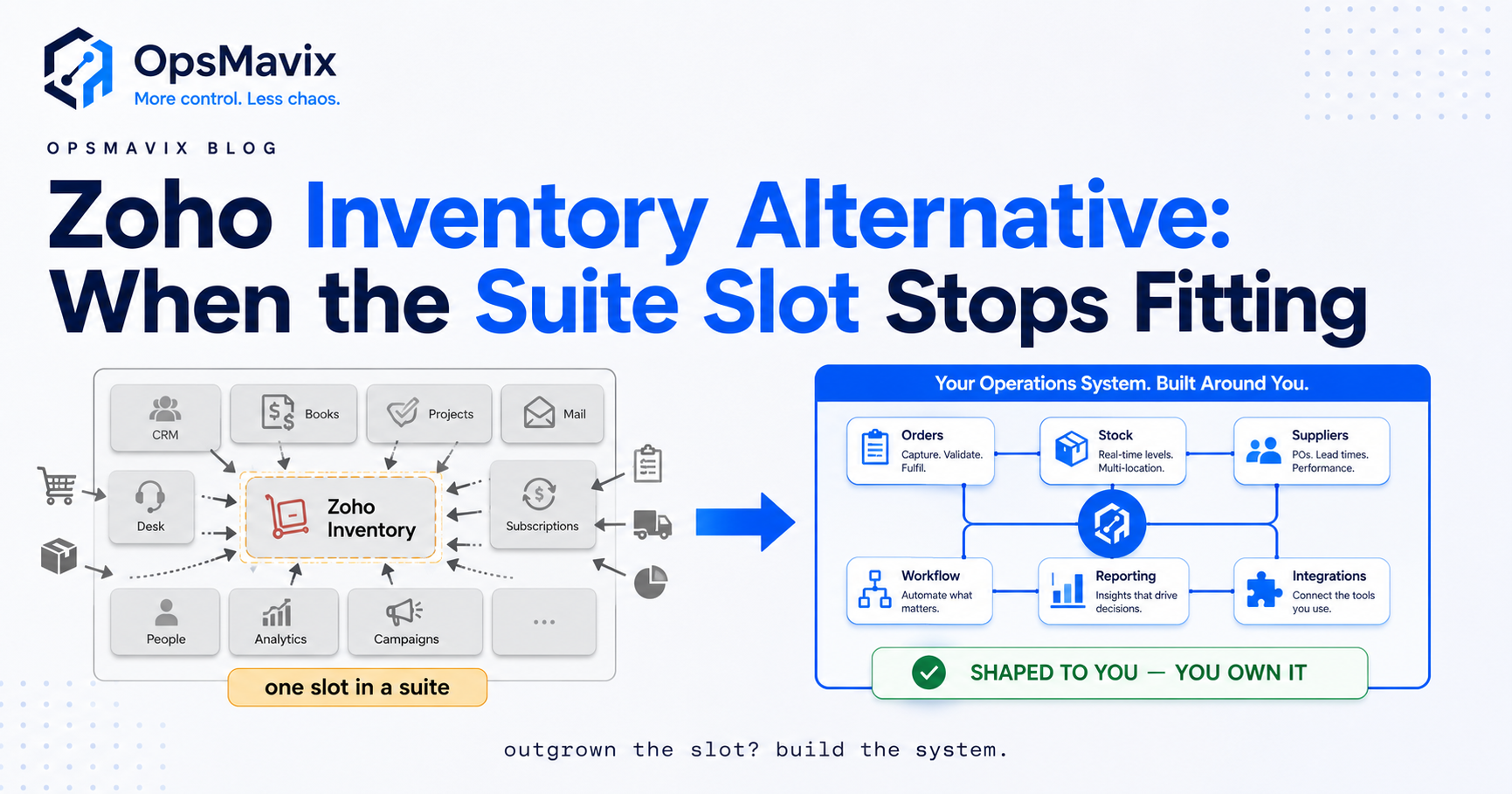
The best Zoho Inventory alternative is whatever ends the specific reason you are looking to leave, and for most growing operations that reason is one of three: monthly order caps that force an upgrade you did not plan for, plans that bundle only a handful of users so extra warehouse staff mean paying for more seats, or the slow realisation that Zoho Inventory only really shines when the rest of your business already lives inside Zoho Books and Zoho CRM.
Zoho Inventory is a genuinely capable SMB inventory tool. It does multi-channel stock sync, multi-location tracking, batch and serial numbers, and purchase order management, and the free tier is one of the more generous starting points on the market. This is not a post about how it is secretly bad. It is a post about the ceiling, where it sits, and what to do when your operation grows past it.
Key Takeaways
- Zoho Inventory is order-capped by design. Each tier allows a fixed number of monthly orders (Free 50, Standard 500, then thousands higher up), so growth itself pushes you up the price ladder.
- The suite is the point. It works best paired with Zoho Books and Zoho CRM; integrating non-Zoho accounting is where teams tell us the friction starts.
- User seats are capped per plan. Pricing is per organisation, but each tier bundles only a few users (roughly one to ten as you climb) and extra logins are a paid add-on, so adding picking staff quietly adds cost even when they touch a small slice of the system.
- It is inventory and orders, not a full WMS. No bin-level directed picking, wave picking or labour tracking out of the box.
- The real alternative is rarely another box. Swapping one capped SaaS tool for another often just resets the same problem 18 months later.
- OpsMavix sits in the middle. One operations system shaped around your workflow, sitting between a spreadsheet and a full ERP, priced to your operation rather than your order count.
Why People Look for a Zoho Inventory Alternative
Almost nobody leaves Zoho Inventory because it fails at the basics. People leave because the shape of the tool stops matching the shape of the business.
The most common trigger is the order cap. Zoho Inventory meters monthly orders per plan, and the jumps are real: the free plan stops at 50 orders a month, Standard at 500, and higher tiers climb into the thousands. That is a clean model for a vendor, but it means a good sales month can quietly push you into a mandatory upgrade. You are not paying for more capability. You are paying for permission to keep trading at the volume you already reached.
The second trigger is the suite gravity. Zoho Inventory is one app inside a 50-plus app ecosystem, and its deepest connections run to Zoho Books and Zoho CRM. If your accounting lives in Xero, QuickBooks or Sage, or your CRM is somewhere else, you feel it. Operations leads describe the same pattern: the inventory side runs fine, but every month-end becomes a reconciliation chore because the numbers have to be nudged across a boundary that Zoho would rather you did not have.
The third trigger is the user seat cap. Zoho Inventory is priced per organisation, but each plan bundles only a limited number of users, and once you pass that count every extra login becomes a paid add-on. Warehouse operations are headcount-heavy at exactly the moment they can least afford it, so when every picker, packer and stock controller beyond the allowance adds to the monthly bill, you start rationing access, which is the opposite of what an operations system should encourage.
What Zoho Inventory Actually Does Well
Being fair to a tool is how you make a good decision, so here is the honest ceiling assessment.
Zoho Inventory handles multi-channel selling cleanly, keeps stock synced across locations, and supports batch and serial tracking that many small manufacturers and distributors genuinely need. Purchase order and vendor management are solid. If you are already committed to the Zoho ecosystem and running Zoho Books, the combined experience is coherent and the pricing at the low end is hard to beat.
For a business doing a few hundred orders a month, selling across two or three channels, and happy to standardise on Zoho, it is a reasonable home. If that describes you, staying put is a perfectly good answer and you should not let anyone sell you off it.
The question is not whether Zoho Inventory works. It is what happens at the edges: when order volume climbs, when your stack is deliberately not all-Zoho, or when your real problem lives in production, purchasing or reporting rather than the stock ledger itself.
The Ceiling: Where Boxed Inventory Tools Stop
Every off-the-shelf inventory app, Zoho included, makes the same trade. It gives you 80 percent of a generic operation for a low price, and it asks you to bend your remaining 20 percent to fit its assumptions. For a lot of businesses the missing 20 percent is where the money leaks.
Zoho Inventory is an order and inventory system, not a warehouse management system. There is no directed bin-level picking, no wave or batch picking logic, no labour tracking. If your leak is in the physical flow of the warehouse rather than the count of stock, the tool cannot reach it.
This is the pattern behind almost every inventory alternative search: the tool does its job, but the operation has grown a set of workarounds around it. A spreadsheet for the reorder logic the tool does not quite get right. A second one for the supplier lead times. A manual export every Friday because the report you need does not exist. The inventory app is fine. The operation is held together by glue.
Alternative or Same Problem Twice?
Here is the contrarian bit. Most Zoho Inventory alternative comparisons hand you another boxed tool, and swapping one capped SaaS product for another usually just resets the clock. You migrate your data, retrain your team, rebuild your integrations, and 18 months later you hit a different tool’s version of the same wall.
Linnworks, Mintsoft, Cin7 and the rest are all worth a look if a better box is genuinely what you need, and we cover several of them honestly elsewhere: our Linnworks alternative breakdown and the Mintsoft competitors guide both apply the same validate-then-ceiling logic. But before you migrate, ask a harder question: is your problem that Zoho Inventory is the wrong box, or that your operation has outgrown boxes entirely?
If three departments each have their own tool and a person whose real job is copying data between them, no fourth box fixes that. That is a systems problem, and it needs a systems answer.
The Middle You Own: How OpsMavix Fits
OpsMavix is not an inventory app and it is not an ERP. It is the practical layer in between, one operations system built around how your business actually runs, covering inventory, orders, purchasing, production and reporting in one place instead of five.
The difference from Zoho is structural. There is no monthly order cap, because you are not renting throughput. There is no per-seat add-on every time you give a picker a login, because the system is yours. And there is no suite gravity pulling you toward one vendor’s accounting, because it connects to the tools you already chose, Xero, Sage, QuickBooks, your existing CRM, rather than fighting them.
Consider the before and after. Before: an inventory tool at one order tier, a separate accounting package, a bolt-on for reporting, and roughly a day a week of someone’s time spent moving numbers between them and chasing the discrepancies that movement creates. After: one system where an order updates stock, triggers the purchase requirement, and feeds the month-end report without anyone re-keying anything. The tool cost might look similar on paper. The recovered day a week is where the real return sits.
Build vs Buy vs Own Your System
Here is the honest take, because you deserve one rather than a pitch.
If you are small, all-Zoho, and under a few hundred orders a month, buy Zoho Inventory and move on. It is good and it is cheap, and building anything would be overkill.
If your operation is genuinely standard and you just need a better-shaped box, buy the right box. Sometimes the answer really is Linnworks or Mintsoft, and we will tell you so.
But if you are the messy middle, too complex for a spreadsheet, too specific for an off-the-shelf tool, and tired of paying a cap on your own growth, then owning one operations system built around your workflow is usually the cheaper answer over any three-year horizon, not the expensive one. The cost of the glue, the re-keying, the reconciliation and the order-tier upgrades adds up faster than most teams expect.
The right move is not the tool with the best feature list. It is the one that ends the specific leak you are living with. Start by finding out where that leak actually is.
Keep reading
Getting value from OpsMavix? Add us as a preferred source on Google — you'll see more of our operations content in your AI Overviews, AI Mode and Search.