
Supply Chain Planning Systems and Software: As Good as Your Data
Supply chain planning software promises to forecast demand, plan replenishment and balance stock, but it is only ever as good as the data you feed it. This guide explains what planning software actually does, the garbage-in trap that sinks most rollouts, and how a right-sized owned system beats a heavyweight suite for businesses that have outgrown spreadsheets and disconnected tools.
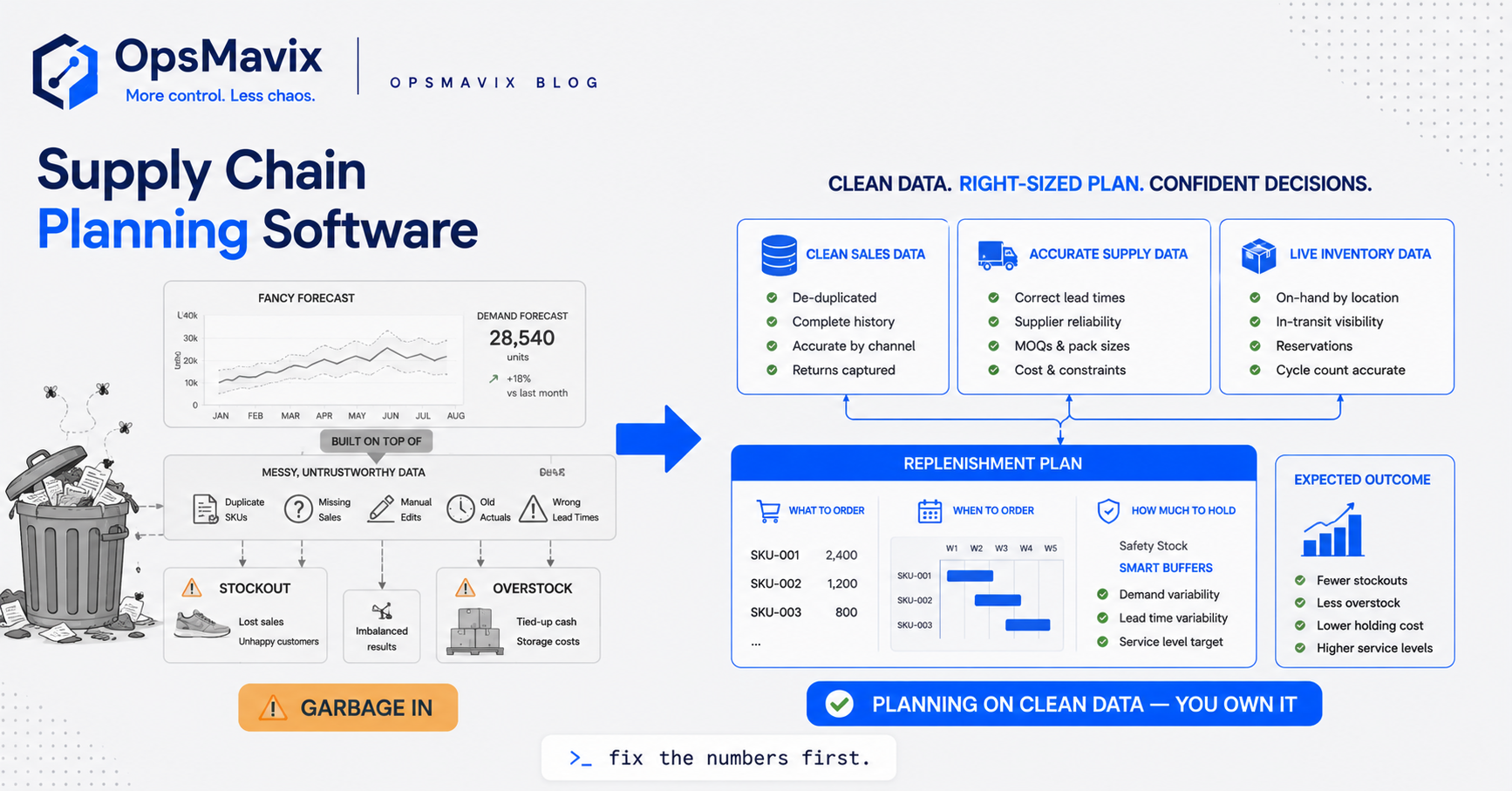
Supply chain planning software is the set of tools a business uses to decide what to buy, make and hold before demand arrives. It forecasts what you will sell, works out what to reorder and when, and tries to keep stock high enough to serve customers without tying up cash in slow movers. In plainer terms, it is the software that answers “how much of everything do we need, and when”, so you stop guessing and stop firefighting.
Here is the pain that sends most owners searching for it. You are either short of the thing everyone wants or drowning in the thing nobody does. The buyer over-orders to feel safe, then writes off dead stock at quarter end. Sales promise delivery dates against numbers that were wrong the moment they were typed. Every planning decision leans on a spreadsheet that is always a day behind reality. The instinct is to buy a clever forecasting engine and let it sort the mess out. The uncomfortable truth is that a forecasting engine fed bad numbers just produces confident, well-formatted wrong answers faster.
Quick summary: Poor stock planning costs UK retailers around £15 billion a year, driven in large part by businesses still leaning on prior-year sales to predict current demand (EcommerceNews UK). The lesson is not “buy a smarter forecasting tool”. It is that planning software only pays off when the data underneath it is clean and connected. Fix the numbers first, and a modest planning setup beats an expensive one running on rubbish.
Contents
- What supply chain planning software actually does
- The blind spot: garbage in, garbage out
- The four planning jobs, and which ones you actually need
- Cheap tool vs full planning suite vs right-sized owned system
- Integrations and why ownership matters
- A Worked Example: a £4m homeware distributor
- FAQ
- How OpsMavix Can Help
- Sources
What supply chain planning software actually does
Planning software sits upstream of the day-to-day. Your inventory and order systems record what is happening now: stock in, stock out, orders placed, orders shipped. Planning software looks forward and answers the “how much and when” questions before events force your hand.
Strip away the jargon and it does four things. It forecasts demand, projecting future sales from history, seasonality and known events. It plans replenishment, turning that forecast into purchase and production quantities with the right timing. It balances supply and demand across the business, the meeting-room exercise vendors call sales and operations planning, or S&OP. And it sets the buffers, the safety stock and reorder points that absorb the fact that no forecast is ever exactly right.
The important thing to understand is that planning software does not create information. It amplifies whatever you already have. Feed it accurate stock figures, real sales history and honest lead times, and it turns them into decisions you can trust. Feed it stock counts that disagree with the shelf and lead times someone guessed at two years ago, and it turns those into decisions you cannot. This is why the same forecasting tool transforms one business and disappoints another. The tool is rarely the variable that matters most.
The blind spot: garbage in, garbage out
Every planning project has a moment of truth, and it is not the demo. It is the week you connect the software to your real data and discover how much of it is wrong.
Forecast accuracy is the number everyone fixates on, and it is genuinely hard to move. Across industries, average demand-forecast accuracy sits far lower than most owners assume, and even well-run operations rarely push past the high eighties. Chasing another few points of accuracy with a cleverer algorithm is the wrong fight for most growing businesses, because the accuracy ceiling is usually set by the inputs, not the maths. If your sales history is polluted by stockouts (you did not sell it because you did not have it, not because nobody wanted it), your forecast learns the wrong lesson. If returns, samples and internal transfers are mixed into sales, the baseline is off. If your lead times are optimistic fiction, your reorder timing is wrong no matter how good the forecast.
This is the honest limit of planning software, and the part vendors skate over. A forecast is a multiplier on data quality. Good data times a decent forecast beats great forecasting software times bad data, every time. The businesses that get burned are the ones that buy a heavyweight planning suite, point it at a messy spreadsheet estate, and expect the software to fix problems that live in the data.
It gets harder in a volatile environment, and the last few years have been exactly that. UK research from Ivalua found that 47% of UK businesses saw supply chain disruption rise over the previous year, based on a survey of 300 UK supply chain and procurement decision-makers (Ivalua). When lead times and demand swing that much, clean current data matters more, not less, because a plan built on last year’s assumptions ages badly.
So the first question is never “which planning tool is best”. It is “are the numbers we would feed it actually trustworthy”. If stock accuracy is shaky, that gets fixed first, often with an inventory automation system that gives you one live stock figure everyone reads from. Get that right and even a modest planning layer performs. Skip it and the most expensive suite on the market will still guess.
The four planning jobs, and which ones you actually need
“Supply chain planning” is an umbrella over four distinct jobs. Naming them separately makes it far easier to see which you genuinely need and which you would pay for but never switch on.
- Demand forecasting. Predicting future sales per product, channel and location. Genuinely valuable when you carry lots of SKUs with real seasonality or promotions. Often overkill for a stable range the team already knows in their sleep.
- Replenishment and supply planning. Turning the forecast into what to order or make, in what quantity, by when, from which supplier. For most product businesses this is the job that actually saves money, because it is where over-ordering and stockouts are decided.
- Sales and operations planning (S&OP). The regular cadence where sales, operations and finance agree one plan instead of three. Powerful in bigger, multi-department businesses. In a four-person office it can be a monthly conversation, not a software module.
- Safety stock and buffer setting. Calculating how much cushion each item needs given its demand variability and supplier reliability. Unglamorous, and quietly one of the highest-leverage jobs, because it is where “never run out” and “don’t drown in cash” are balanced.
Two things are worth noticing. First, these jobs depend on each other: replenishment is only as good as the forecast, and safety stock is meaningless without honest lead times. Second, most growing businesses feel real pain in only two of them, usually replenishment and safety stock, the practical “what do I order and how much buffer” questions. The forecasting and S&OP layers matter more as complexity grows. Buying all four when you needed two is the classic way to overspend on planning software. If your pain is more about scheduling what gets made than what gets bought, our guide to production planning software covers that neighbouring problem.
Cheap tool vs full planning suite vs right-sized owned system
There are three honest ways to buy supply chain planning capability, and each genuinely fits a different business. A cheap or built-in tool is quick and low-risk but shallow. A full planning suite is powerful but broad, expensive and slow to adopt. A right-sized owned system targets the two planning jobs that actually leak and grows from there.
| Factor | Cheap / built-in planning tool | Full planning suite | Right-sized owned system |
|---|---|---|---|
| Best for | Small ranges, simple demand | Large, multi-site, high-SKU complexity | “outgrowing spreadsheets and disconnected tools” |
| Planning jobs covered | Basic reorder points | All four, whether needed or not | Only the jobs that leak, usually replenishment and buffers |
| Data quality demands | Hides them until you outgrow it | Exposes them fast, at high cost | Fixed as part of the build, on your real numbers |
| Fit to your process | Generic, you adapt | Template-driven, you adapt | Built around how you actually plan |
| Setup time | Fast, shallow | Months to over a year | Weeks, focused on the bottleneck |
| Cost model | Cheap subscription | Per-user, per-module, forever | One-off build, you own it |
| Time to value | Immediate but limited | Long, value after full adoption | Fast, value at the first fixed workflow |
| Ownership | You rent it | You rent the whole platform | You own the system outright |
| Main risk | Outgrown quickly | Over-scoped, low adoption, garbage-in | Scoped too narrow if complexity is truly broad |
Be fair to the cheap tool. If you carry a small, stable range and just need sensible reorder points, the planning features baked into your existing inventory or accounting software may be all you ever need, and there is no shame in that. The trouble starts when the range grows, seasonality bites, and the built-in logic cannot keep up, so the team quietly reverts to a spreadsheet alongside it.
Be fair to the suite too. If you run several sites, thousands of SKUs, heavy promotional planning and a dedicated planning team, the breadth of a full suite earns its keep, and the S&OP discipline it enforces is worth real money. The point is not that suites are bad. It is that they are built for a level of complexity most growing businesses have not reached, and they punish messy data harder than anything else on this list.
Integrations and why ownership matters
Planning software is uniquely dependent on other systems, because it does not generate its own inputs. It has to read live stock, real sales history and current lead times from wherever those actually live. That makes integration the difference between a plan you trust and a plan built on a stale export someone pasted in last Tuesday.
A cheap tool tends to be an island: you re-key figures into it, and every re-key is a fresh chance for the numbers to drift from reality. A full suite has the opposite instinct, wanting to swallow inventory, orders and often accounting too, so it controls the data end to end, which is why the projects run long and disrupt tools your team already trusts. A right-sized owned system takes the middle line: it reads live from the systems you keep, so the plan always reflects today’s stock and today’s orders, without forcing a rip-and-replace of everything around it. An order flow built on a wholesale order management system, for instance, can feed real demand signals into planning without a second data-entry step.
Ownership is the quieter issue, and usually the more expensive one over time. Rent a planning suite and you pay per user, per module, forever, while the vendor decides which features live and die. Own the system and you pay once, control the logic, and change it when your business changes rather than when a roadmap forces your hand. With planning specifically, ownership matters more than usual, because your forecasting rules and safety-stock logic are genuinely your competitive know-how. Baking that into software you own keeps it yours.
A Worked Example: a £4m homeware distributor
The numbers below are illustrative, built to show the shape of the decision rather than any real client.
Picture a homeware distributor turning over around £4m a year. Roughly 1,200 active SKUs, three people in the office, one warehouse, stock bought from a mix of UK and overseas suppliers with lead times from one to twelve weeks. Demand is seasonal, spiking hard before Christmas and again in spring.
The pain. Buying runs off a spreadsheet built on last year’s sales, so the buyer over-orders the safe lines and gets caught short on the ones that suddenly move. Overseas orders are placed on gut feel about lead time, so containers land late or early. Dead stock builds up in one corner of the warehouse while best-sellers hit zero mid-season. Nobody can say with confidence what to order next month without a day of spreadsheet wrangling, and the answer is wrong often enough that the team stopped fully trusting it.
The oversold option. A full planning suite is quoted, with a demand-forecasting engine, an S&OP module and a supply-planning layer. The price is a per-user monthly licence plus a five-figure implementation across two or three quarters. The catch surfaces in week one of the trial: the suite is only as good as the sales history it ingests, and that history is polluted by past stockouts and mixed-in returns. Most of the “implementation” turns out to be data cleanup the business would have to do regardless, and the S&OP module is aimed at a planning team this business does not have.
The right-sized option. First, the foundation: one live, accurate stock figure the whole office reads from, with sales history cleaned so stockout periods and returns no longer poison the baseline. Then two planning jobs, and only two. Replenishment logic that turns real sales velocity and each supplier’s actual lead time into a clear reorder quantity and date, overseas and UK handled differently. And safety-stock levels calculated per line from how variable its demand really is, so the buffers sit where the risk is, not spread evenly. No forecasting engine straining for another two points of accuracy, no S&OP module, no per-seat rent. Built in weeks on the business’s real numbers, owned outright.
The outcome that matters. The buyer orders from a live picture instead of last year’s ghost, so the safe lines stop piling up and the fast movers stop hitting zero. Containers land closer to when they are needed, because lead times in the system match reality. The day of spreadsheet wrangling shrinks to a glance, and the numbers are trusted again. That is the difference between buying a clever forecast and fixing the data the forecast has to stand on.
FAQ
What is supply chain planning software?
It is software that decides what to buy, make and hold before demand arrives. It forecasts future sales, turns that into replenishment quantities and timing, balances supply against demand across the business, and sets the safety-stock buffers that absorb forecast error. It sits upstream of your inventory and order systems, using their data to answer “how much of everything do we need, and when”.
Will planning software fix my forecasting if my data is messy?
No, and this is the most important thing to understand before you buy. Planning software amplifies your data rather than repairing it. Feed it stock counts that disagree with the shelf, sales history polluted by past stockouts, or guessed lead times, and it produces confident but wrong plans. Clean, connected data underneath a modest planning tool beats messy data underneath an expensive suite every time. Fix stock accuracy first, then plan on top of it.
Do I need demand forecasting, or just better reordering?
For most growing businesses, better replenishment and safety stock matter more than sophisticated forecasting. Full demand-forecasting engines earn their keep when you carry many SKUs with strong seasonality or heavy promotions. If your range is fairly stable and the team already knows the patterns, the higher-value fix is usually turning what you know into reliable reorder quantities and buffers, not chasing marginal forecast accuracy.
Is an owned planning system cheaper than a full suite?
Over a three-year horizon it usually is, because you pay a one-off build cost and own the result instead of per-user, per-module licences that never stop. It is not always cheaper on day one, and if your complexity is genuinely broad, across many sites and a dedicated planning team, a suite can be better value. The real saving is scope: you build the two planning jobs that actually leak rather than renting all four.
How do I know if planning software is even worth it for us?
Follow the money and the wasted time. If you regularly write off dead stock while best-sellers hit zero, if buying takes a day of spreadsheet wrangling and is still often wrong, or if promised delivery dates lean on numbers nobody trusts, planning is leaking real cash. If your range is small and stable and reorders are simple, the planning features already inside your inventory software may be plenty. The trigger is pain and cost, not company size.
How OpsMavix Can Help
OpsMavix builds right-sized, owned planning systems for growing UK businesses that are outgrowing spreadsheets but not looking for a full planning suite. We are not an ERP vendor and we do not sell generic custom code. We sell the outcome: clean, connected data feeding replenishment and safety-stock logic you can actually trust, built around how you already plan and owned outright with no per-seat rent. Crucially, we fix the data foundation before we build anything clever on top, because a forecast is only as good as the numbers underneath it. If a full suite genuinely is your fit, we will tell you, the same honest way our guide to supply chain management software solutions does. We start by finding exactly where your planning leaks, then build only what fixes it. When you are ready to see the leaks in yours: Book a Free Operations Leak Audit.
Sources
- EcommerceNews UK — “Poor stock planning costs UK retailers GBP £15 billion a year”, reporting that poor stock planning costs UK retailers roughly £15 billion annually, driven partly by reliance on prior-year sales to predict current demand: https://ecommercenews.uk/story/poor-stock-planning-costs-uk-retailers-gbp-15-billion-a-year
- Ivalua — “UK businesses in the middle of a chain reaction”, finding 47% of UK businesses saw supply chain disruption increase over the previous year, based on a survey of 300 UK supply chain and procurement decision-makers: https://www.ivalua.com/press-releases/uk-businesses-in-the-middle-of-a-chain-reaction-with-nearly-half-experiencing-a-surge-in-supply-chain-disruption/