
The Sortly Alternative When Photo Inventory Isn't Enough
The best Sortly alternative is rarely another photo-inventory app. It is one operations system that connects stock with the orders, purchasing, production and reporting Sortly was never built to hold. Sortly is a genuinely good visual catalogue. This is the honest guide to when you have outgrown it.
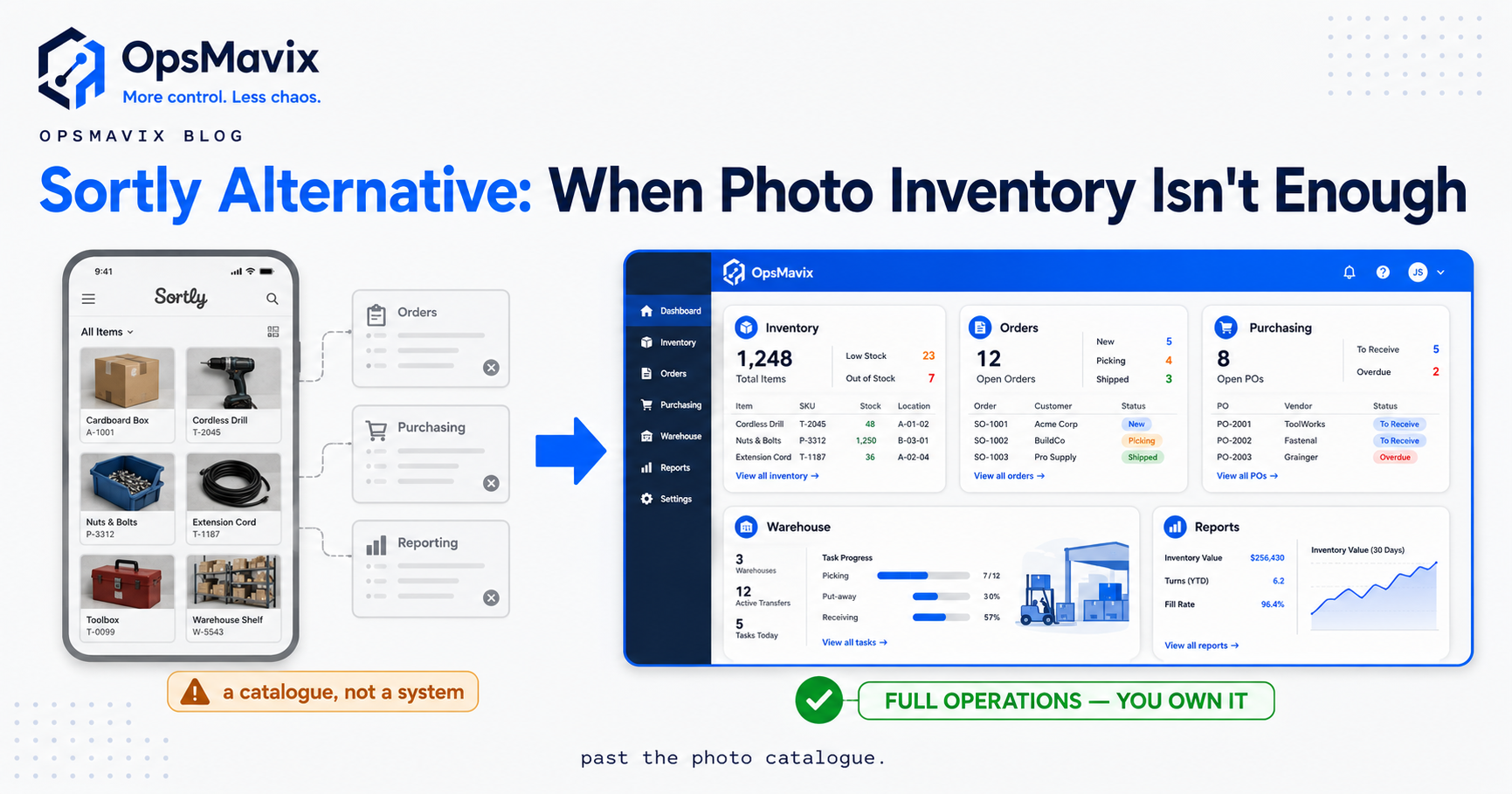
The best Sortly alternative is usually not another photo-inventory app. It is one owned operations system shaped to how your business actually runs, so stock stops being a tidy picture-book that lives apart from your orders, purchasing and reporting. Sortly is a genuinely good product: a visual, app-first way to catalogue stock and assets with photos, QR and barcode labels, and nested folders. If your problem is knowing what you own and where it sits, it earns its place. If your problem is that orders, reorders and production live somewhere else entirely, a photo catalogue solves the wrong layer.
That distinction is the whole post. Most people searching for a Sortly alternative are not unhappy with how Sortly photographs a shelf. They are bending their operation to fit an app that stops at the edge of the stockroom, or paying for scanning tiers when the real leak is in the paperwork around the stock. Before you shortlist another tool, tell those two problems apart.
Key Takeaways
- Sortly is a real visual inventory app, US-built (San Francisco), app-first, with photos, QR and barcode labels, custom fields and nested folders for tracking stock and assets.
- It catalogues; it does not operate. Orders, purchasing, supplier chasing, production and joined-up reporting sit outside what a photo-inventory tool is designed to do.
- Pricing is tiered and USD-based, with a free plan and paid tiers that climb as you add entries, users and scanning — success on the app costs more, not less.
- The right question is layer, not vendor: do you need a better picture of your stock, or one system that connects stock to everything that moves it?
- Sortly is US-first, so UK operators should weigh support hours, courier and marketplace fit, and VAT handling before committing.
- The middle ground exists: outgrowing spreadsheets and disconnected tools, and not solved by a prettier stock list.
What Sortly Actually Is
Sortly is a visual inventory and asset-tracking app made by Sortly Inc., based in San Francisco. Its core idea is sound: instead of a grey spreadsheet of SKUs, you get a catalogue built around photographs. You snap a picture of an item, add custom fields (serial number, location, value, expiry), print a QR or barcode label, and organise everything into nested folders that mirror your shelves, rooms or vans. Scan a label with a phone and the item’s record opens instantly.
That is a real, well-defined job done well. For a business whose pain is genuinely “we do not have a reliable picture of what we own and where it is” — a workshop, a field-service team with kit in vans, a studio tracking equipment, a small warehouse doing periodic counts — Sortly is a sensible, low-friction choice. It gets people off a shared spreadsheet and onto something visual, mobile and quick to search, with low-stock alerts and simple activity history on top.
Give it the credit it is due: for visual cataloguing and asset tracking, it is one of the tidier tools in the category. That is the validate part. Now the ceiling.
Where Sortly Hits Its Ceiling
A photo-inventory app is scoped to the shelf — a strength for cataloguing, a hard limit everywhere your operation actually leaks. The pains that push people to search for a Sortly alternative almost always sit outside the catalogue:
- Sales orders arriving by email, phone and marketplace, re-keyed by hand into whatever holds stock.
- Purchasing and reorder decisions run on a separate spreadsheet that never sees live commitments.
- Production or assembly — turning components into finished goods — tracked on a whiteboard the office cannot see.
- Reporting that means exporting the app and stitching it to sales and purchase data in a fourth spreadsheet every week.
Sortly counts and pictures your stock, and on its higher tiers it can build and export a basic purchase order. What it does not do is hold a supplier price list, manage a bill of materials, take a customer or sales order, run production, or tell you margin after real costs. It connects to a few other tools, but a connector is not one system — it is another sync to distrust and another place a number can quietly drift. The moment stock has to do something — get ordered, built, sold, reported on — you are back in the spreadsheets Sortly was supposed to save you from. That is not a Sortly failing. It is what a catalogue is, by design.
The Pricing Reality
Sortly runs a tiered subscription priced in US dollars: a free plan for very small use, then paid tiers commonly listed around £39, £118 and £236 per month (converted), cheaper on annual billing — check the current figures directly, as they are quoted in dollars and change. The mechanics matter more than any number: the free plan caps entries and users hard, and moving up buys more entries, more seats, more custom fields and the barcode and QR scanning that make the app worth using at scale.
So the curve runs the wrong way for a growing operation. The better you do — more stock lines, more people who need to see them, more scanning — the more you pay, for a tool that still stops at the catalogue. You pay more each year to picture your stock, while the actual leak (orders re-keyed, reorders guessed, margin rebuilt by hand) never appears on the invoice, because Sortly was never covering it.
When Sortly Is Genuinely the Right Choice
Be honest with yourself, because sometimes buying Sortly is exactly correct. Choose it when:
- Your real pain is visibility of assets or stock — knowing what you own, where it is, and its condition — not the paperwork around it.
- You want a fast, mobile, photo-first catalogue your team will actually keep updated, with QR or barcode labels.
- Your orders, purchasing and production are already handled elsewhere and working, and only the stock picture is weak or stuck in a spreadsheet.
If that describes you, a focused visual inventory app beats a broader system, and OpsMavix would tell you so. Selling you a bigger build for a problem Sortly already solves helps nobody. The catch is that most people typing “sortly alternative” do not match that list. Their catalogue is fine. Everything it is supposed to feed is broken.
The Right-Sized Middle: One Operations System
If your real leak is disconnection — stock in one app, orders in an inbox, purchasing in a spreadsheet, production on a whiteboard, reporting rebuilt every Monday — the fix is not a better picture of the shelf. It is one operations system that holds stock and the things that move it, so a number entered once is the number everyone sees.
This is the ground OpsMavix works: outgrowing spreadsheets and disconnected tools, and not solved by a prettier stock list. Instead of a catalogue plus a stack of side-tools, you run one right-sized system shaped to how your business already operates. An order lands once and stock reacts to it live. Purchasing sees real commitments, not last week’s guess. A build consumes components and creates finished goods against the same shared figure. Margin is a report that was already true, not a Friday export. The catalogue barely changes — because the leak was never in the catalogue.
For the wider view, see a fully automated inventory system for what “captured once” looks like end to end, multi-location inventory management if your stock is spread across sites, rooms or vans, and custom inventory systems for how a system gets shaped to your process instead of the other way round.
The Honest Build-vs-Buy Take
Here is the plain version. Buying Sortly is the right move when your problem is genuinely the picture of your stock or assets and the rest of your operation is already handled. It is a good product doing a real job; do not talk yourself out of it to sound sophisticated. Buying a full ERP is right only if you are large enough that everything genuinely needs to live in one heavy, standardised platform and you have the team to run it — most growing UK operators are nowhere near that and would drown in the implementation.
Owning a right-sized operations system is the move when your pain is disconnection rather than cataloguing — when you want stock, orders, purchasing, production and reporting to be one thing you own, shaped to your process, and you would rather pay for the outcome (the leak closed) than pay a rising subscription to photograph a shelf while the real cost hides in the spreadsheets around it. It is not a heavier Sortly, and not an ERP with the price crossed out — it is the middle layer you actually hold.
Start by naming the leak, not the vendor. If the honest sentence is “we cannot see what we own,” go and look hard at Sortly. If it is “the stock is visible but nothing joins up,” a better catalogue will not fix it, and no integration will make a stack of tools feel like one system. Work out which sentence is true for you, and the right choice stops being a shortlist and becomes obvious.
Keep reading
Getting value from OpsMavix? Add us as a preferred source on Google — you'll see more of our operations content in your AI Overviews, AI Mode and Search.