
The Practical Datapel Alternative for UK Operations Teams
The best Datapel alternative depends on whether you need a warehouse management system bolted onto your accounts, or a single operations system that fits how your business actually runs. Datapel is a strong AU-built WMS with deep Xero and MYOB ties. But if your leak is in orders, purchasing and reporting rather than bin-level warehouse control, a right-sized operations system usually fits better.
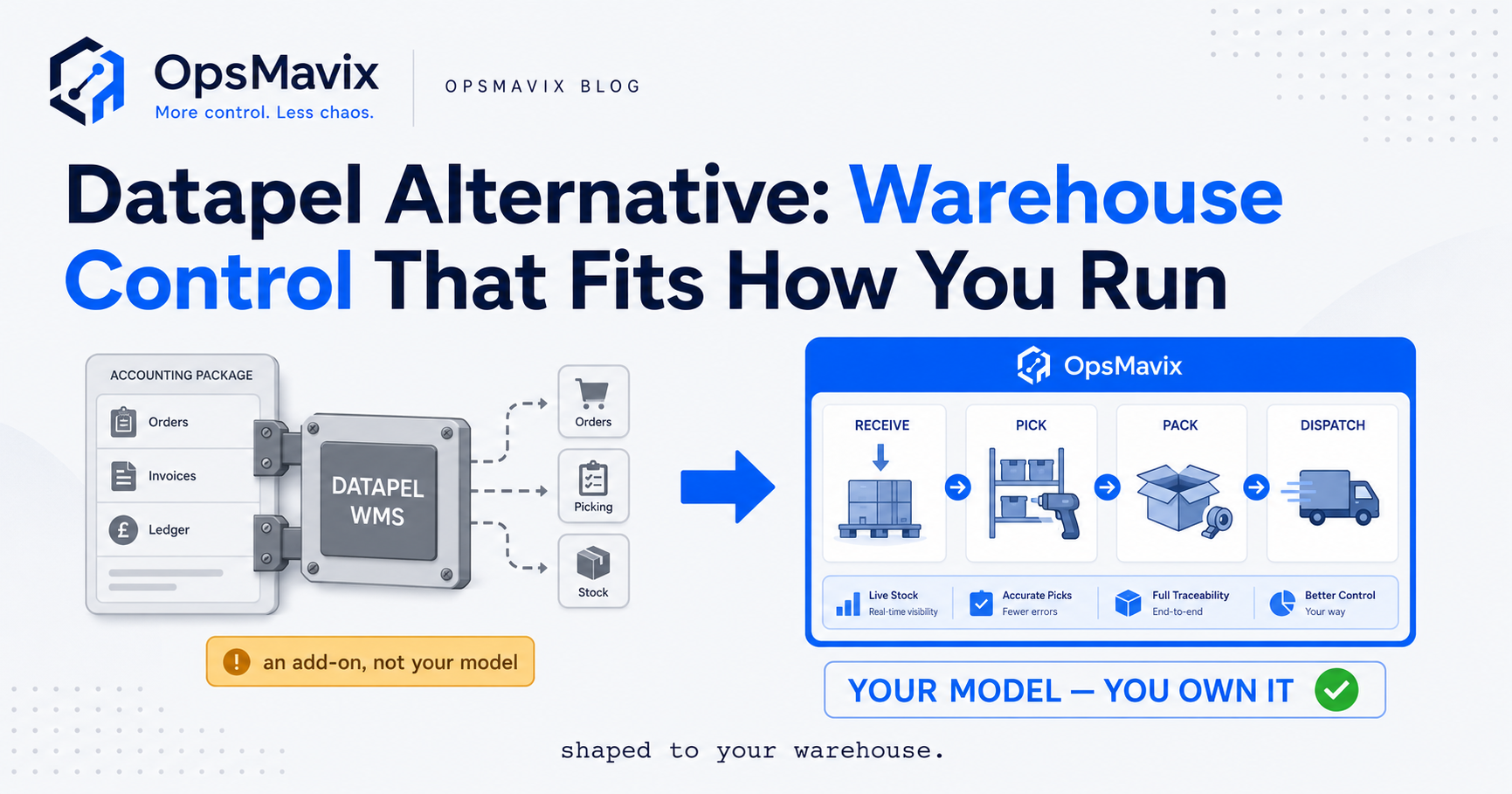
The best Datapel alternative for a UK operations team is usually not another warehouse management system. It is a single operations system that connects your stock, orders, purchasing and reporting in one place. Datapel is a capable, Australian-built WMS with deep links into Xero, MYOB and QuickBooks. If your problem is genuinely bin-level warehouse control, it earns its place. If your problem is that orders, stock counts and supplier chases all live in separate spreadsheets, a WMS solves the wrong layer.
That distinction matters more than any feature list. Most businesses searching for a Datapel alternative are not unhappy with warehouse scanning. They are unhappy that nothing joins up, and they assumed a WMS would fix it. This post is about telling those two problems apart before you buy anything.
Key Takeaways
- Datapel is a genuine WMS, cloud-based, built in Australia, with strong batch, serial, bin and expiry tracking bolted onto Xero, MYOB and QuickBooks.
- A WMS solves warehouse execution, not the wider operational mess of orders, purchasing, production and reporting sitting in disconnected tools.
- Per-user pricing scales awkwardly for growing teams; costs climb as you add the people who actually need visibility.
- The right question is layer, not vendor: do you need bin-level control, or one joined-up operations system?
- Datapel is AU-first; UK operators should weigh support hours, local eCommerce and courier fit before committing.
- The middle ground exists: outgrowing spreadsheets and disconnected tools, and not purely a warehouse problem.
What Datapel Actually Is
Datapel Cloud.WMS is a warehouse management system. It sits on top of an accounting package, usually Xero or MYOB, and adds the warehouse-floor capabilities those accounting tools lack: bin and location management, barcode scanning for put-away and picking, batch and serial number tracking, expiry-date control, multi-warehouse stock, and quality-control workflows for compliance-heavy stock.
That is a real, well-defined job. If you run a warehouse where the pain is genuinely operational at floor level (pickers walking the wrong routes, stock in the wrong bin, no traceability on a recalled batch) Datapel does that job properly. It reads accounts, tax codes and contacts from Xero and writes back sales, purchases and work orders, so your finance figures stay in step with what physically moved.
Give it credit where it is due: for a stock-heavy business that already lives in Xero or MYOB and needs proper warehouse discipline, it is a sensible, focused choice. That is the validate part. Now the ceiling.
Where Datapel Hits Its Ceiling
A WMS is scoped to the warehouse. That scoping is a strength on the floor and a limit everywhere else. The leaks that push UK businesses to search for a Datapel alternative usually sit outside the warehouse walls:
- Orders re-keyed by hand from email, marketplace and phone into whatever system holds stock.
- Purchasing run on a separate spreadsheet, so reorder decisions never see live commitments.
- Production or assembly tracked on a whiteboard the office cannot see.
- Reporting that means exporting three tools into a fourth spreadsheet every Monday.
Datapel can integrate with some of these, but integration is not the same as one system. Every connector is another thing to maintain, another sync to distrust, another place a number can drift. The way most operators describe it, once you strip out the sales talk, is blunt: the WMS is flawless in the warehouse and useless the moment a customer changes an order. That is not a Datapel failing. It is what a warehouse-scoped tool is, by design.
There is also the pricing shape. Datapel runs on a per-user model, with figures commonly cited from around £62 per user per month (converted from Australian dollars). Per-user pricing quietly penalises the thing you want most: visibility. The moment you want the purchasing clerk, the production lead and the account manager all seeing live stock, you are paying per head for the privilege. Growing teams feel that curve. Put it in blunt terms: get six people who genuinely need the numbers onto that model and you are carrying a recurring bill that only grows as your team does, on a tool that still only covers the warehouse layer. The visibility you are paying extra for is the visibility you should not have to ration in the first place.
The UK Angle Datapel Cannot Fully Close
Datapel is Australian-built and AU-first. That is not a criticism of the software; it is a fit question. Support hours, default courier and marketplace integrations, tax handling and the everyday assumptions of the product are shaped by its home market.
A UK wholesaler running next-day courier SLAs, UK marketplace channels and UK VAT edge cases is not the product’s centre of gravity. It can be made to work, but “made to work” is exactly the kind of quiet, ongoing tax that operations leaks are made of. For a UK-first business, a UK-first system removes a class of friction you would otherwise carry forever.
When A WMS Is Genuinely The Right Answer
Be honest with yourself here, because sometimes Datapel or a WMS like it is correct. Choose a WMS when:
- Your pain is genuinely on the warehouse floor: picking accuracy, bin discipline, put-away speed.
- You handle serial, batch or expiry-controlled stock and need audit-grade traceability.
- Your orders, purchasing and reporting are already fine and only the warehouse layer is weak.
If those describe you, a focused WMS beats a broader system, and OpsMavix would tell you so. Selling you the wrong layer helps nobody.
The trouble is that most businesses matching the search “datapel alternative” do not match that list. Their warehouse is fine. Their joins are broken.
The Right-Sized Middle: One Operations System
If your real leak is disconnection (orders, stock, purchasing, production and reporting each living in their own tool) then the fix is not a better warehouse layer. It is one operations system that holds all of it, so a number entered once is the number everyone sees.
This is the ground OpsMavix works: outgrowing spreadsheets and disconnected tools, and not purely a warehouse problem. Instead of bolting a WMS onto accounts and stitching the rest together, you run one system shaped to how your business already operates. Orders land once. Stock updates once. Purchasing sees live commitments. Reporting is a view, not a Monday-morning export ritual.
Picture a UK wholesaler before and after. Before: an order arrives by email, gets typed into the stock tool, a second person checks a purchasing spreadsheet to see if it can be fulfilled, and someone exports to Excel on Friday to work out margin. After: the order is captured once, stock and purchasing react to it live, and margin is a report that was already true. The warehouse barely changed. The leak was never in the warehouse.
For a fuller view of the landscape, see Mintsoft competitors for how the WMS-style options stack up, a fully automated inventory system for what “captured once” looks like end to end, and warehouse slotting software if your pain really is on the floor.
Build, Buy, Or Own Your System
Here is the honest take. Buying a WMS like Datapel is the right move if your problem is warehouse execution and you already live in Xero or MYOB. It is a real product doing a real job, and you should not talk yourself out of it to sound clever.
Buying a full ERP is the right move if you are large enough that everything genuinely needs to sit in one heavy, standardised platform and you have the team to run it. Most growing UK operators are not there and will drown in the implementation.
Owning a right-sized operations system is the move when your pain is disconnection rather than the warehouse, when you want the system shaped to your process instead of reshaping your process to the system, and when you would rather pay for the outcome (the leak closed) than per user for visibility you already needed. It is not a cheaper clone of a WMS and it is not an ERP with the price crossed out. It is the middle layer you actually own.
Start by naming the leak, not the vendor. If the honest answer is “the warehouse floor,” go and look hard at Datapel. If the honest answer is “nothing joins up,” a warehouse system will not fix it, and no integration will make it feel like one. Work out which sentence is true for you, and the right choice stops being a shortlist and becomes obvious.
Keep reading
Getting value from OpsMavix? Add us as a preferred source on Google — you'll see more of our operations content in your AI Overviews, AI Mode and Search.